Emergency Generator Testing: NFPA 110 Guide
When it comes to emergency generators, reliability is non-negotiable. NFPA 110 sets the standards to ensure these systems are always ready. Here’s what you need to know:
- Testing Requirements: Weekly visual checks, monthly load tests, annual load bank and fuel quality tests, and a 36-month system test for Level 1 systems.
- Key Risks: Battery failure and wet stacking are common issues. Regular tests help identify and prevent these problems.
- Documentation: Detailed logs are essential. Record specific data like voltage, load, and transfer times to meet compliance.
-
System Levels:
- Level 1: Critical for life safety (e.g., hospitals). Requires stricter testing.
- Level 2: For less critical loads (e.g., industrial processes).
Sticking to NFPA 110’s schedules ensures your system performs during outages. Missed tests or incomplete records can lead to compliance issues, even if the generator works fine. Let’s break it down further.
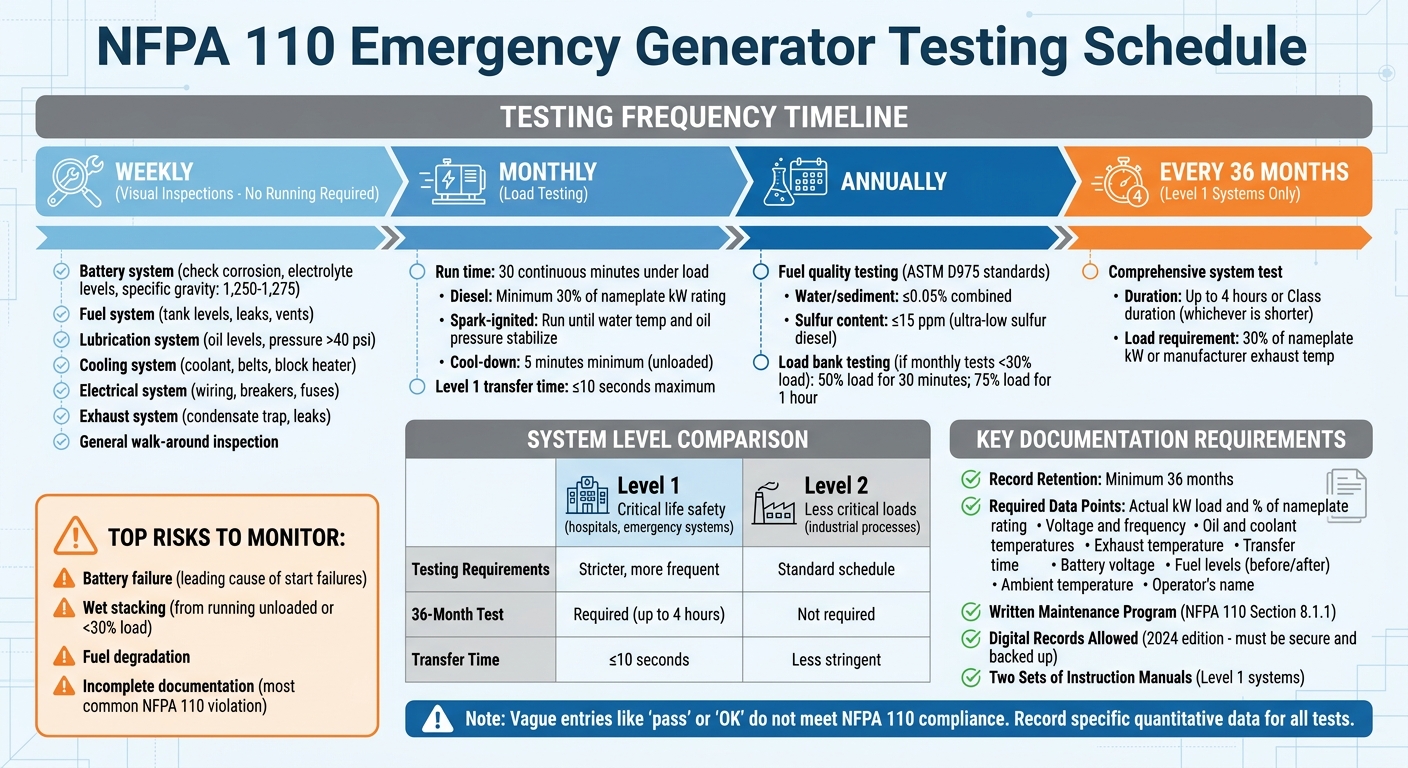
NFPA 110 Emergency Generator Testing Schedule and Requirements
NFPA 110 Emergency Power System Testing Explained
sbb-itb-501186b
Weekly Visual Inspections
Weekly inspections are your first line of defense against generator failure. The good news? These checks don’t require running the generator. According to NFPA 110 Section A.8.4.1:
"Weekly inspection does not require running of the EPS. Running unloaded generators as part of this weekly inspection can result in long-term problems such as wet stacking."
The purpose here is simple: catch potential issues early, before they snowball into bigger problems. Since starting battery failures are the leading cause of emergency generators failing to start, these inspections are vital for ensuring reliable power when you need it most. They also set the stage for more in-depth monthly and annual testing.
Inspection Checklist Items
A proper weekly inspection involves checking several critical systems:
- Battery system: Look for corrosion on terminals, confirm electrolyte levels are adequate, and measure specific gravity (ideally between 1,250 and 1,275). If a battery is defective, replace it immediately, as required by NFPA 110 Section 8.3.6.
- Fuel system: Use a measuring stick to verify tank levels, check for leaks in piping and hoses, and make sure tank vents and overflow piping are clear.
- Lubrication system: Confirm oil levels are correct and that operating pressure stays above 40 psi.
- Cooling system: Check coolant levels, inspect belts and hoses for wear, and ensure the block heater is keeping the engine compartment warm and dry.
- Electrical system: Inspect wiring and connections, check circuit breakers and fuses, and verify transfer switch indicators.
- Exhaust system: Examine the condensate trap and look for any signs of leakage.
- Generator: Walk around the unit to spot debris, loose fittings, or unusual vibrations.
Having the right tools on hand makes the process smoother. Keep a kit ready with essentials like a hydrometer, fuel measuring stick, water-indicating paste, voltmeter, and flashlight.
Once the visual inspection is complete, the recorded data will serve as a baseline for more detailed monthly load tests.
Recording Inspection Results
After completing the checklist, document everything carefully. Accurate records aren’t just good practice - they’re a compliance requirement. NFPA 110 Section 8.5.3 specifies that inspection records must include the date, the name of the person performing the inspection, details of any unsatisfactory conditions, and the corrective actions taken (including any parts replaced).
NFPA 110 also emphasizes the need for quantitative data. Avoid vague entries like "pass" or "OK." Instead, record specific readings, such as voltage levels, fuel quantities in gallons, or pressure measurements. The 2024 edition of NFPA 110 allows digital records, provided they’re secure, backed up, and readily accessible to inspectors. Be sure to keep logs for at least 36 months.
It’s wise to ensure at least two people at your facility know where these logs are stored. If a problem is identified and fixed, document the follow-up testing to confirm the repair was successful. This end-to-end tracking - from spotting the issue to resolving it and verifying the fix - is a critical part of compliance and will be closely reviewed during inspections.
Monthly Load Testing
Monthly load tests ensure your generator is ready to respond instantly during a power outage. Unlike weekly visual checks, these tests simulate real outage conditions, requiring the generator to operate under actual electrical load. This process confirms both its mechanical reliability and electrical performance. Here's a breakdown of the procedures and requirements for conducting these tests effectively.
How to Perform Monthly Load Tests
Start the test by using the test switch on your Automatic Transfer Switch (ATS) instead of the generator’s control panel. This approach mimics a real power outage and tests the entire signal chain - from detecting a power loss to transferring the load. If your system includes multiple transfer switches, alternate which switch initiates the test each month to ensure all start circuits are functioning properly.
For diesel generators, it's critical to run them at a minimum of 30% of their nameplate kW rating. If your building's electrical load doesn't meet this threshold, you can use supplemental load banks or ensure the generator reaches the manufacturer-recommended exhaust gas temperature. This helps prevent wet stacking - a condition where unburned fuel and carbon accumulate in the exhaust system. On the other hand, spark-ignited generators (natural gas or propane) don’t have the 30% load requirement. They just need to run for 30 minutes or until their water temperature and oil pressure stabilize.
During the test, record key performance metrics like kW output, percentage of nameplate load, voltage, frequency, and exhaust temperature. Compliance with NFPA 110 requires specific quantitative data - not vague notes like "passed" - to ensure proper documentation.
Run Time and Cool-Down Requirements
After the loaded phase, follow specific timing guidelines to complete the test safely. The generator must run under load for 30 continuous minutes, excluding warm-up or cool-down periods. Once the loaded phase is complete, allow the generator to idle without load for at least 5 minutes before shutting it down. This cool-down period prevents engine damage.
| Requirement | Specification |
|---|---|
| Minimum Run Time (Under Load) | 30 continuous minutes |
| Diesel Load Minimum | 30% of nameplate kW (or recommended exhaust gas temperature) |
| Cool-down Duration | 5 minutes minimum (unloaded) |
| Transfer Time (Level 1) | 10 seconds maximum |
Only trained professionals who understand electrical safety and arc flash hazards should perform these tests. Because live electrical equipment is involved, wearing proper personal protective equipment (PPE) is non-negotiable. Additionally, avoid disconnecting the facility's main breaker to initiate the test unless absolutely necessary, as this could complicate restoring normal power.
Annual and 3-Year Testing
According to NFPA 110, annual fuel quality checks and supplemental load bank tests are essential to identify issues that may go unnoticed during monthly tests. Additionally, every three years, Level 1 systems must undergo a comprehensive test lasting up to four hours. This ensures the system can handle critical loads during prolonged outages. Together, these yearly and triennial tests verify both fuel integrity and the system's ability to operate under extended outage conditions.
Annual Fuel and Load Bank Testing
Diesel fuel doesn't last forever - it degrades over time. A tragic example occurred during Hurricane Irma when contaminated fuel led to a generator failure, resulting in 12 fatalities. To prevent such disasters, NFPA 110 Section 8.3.7 mandates annual fuel quality testing in line with ASTM D975 standards. Fuel samples should be taken from 3–6 inches above the tank bottom to detect water, sediment, and microbial growth. Properly maintained diesel fuel should have no more than 0.05% combined water and sediment, and ultra-low sulfur diesel must adhere to a 15 ppm maximum sulfur content.
"Special attention should be paid to sampling the bottom of the storage tank to verify that the stored fuel is as clean and dry as practicable and that water, sediment, or microbial growth on the tank bottom is minimized." - NFPA 110, Appendix A8.3.7
If a diesel generator fails to reach 30% of its rated kW during monthly tests, annual load bank testing becomes necessary to avoid wet stacking. The 2025 NFPA 110 update specifies a procedure: run the generator at 50% load for 30 minutes, then increase to 75% load for one hour. This process helps burn off unburned fuel and carbon buildup caused by light loading. To ensure safety, supplemental load banks must automatically disconnect if normal power fails during the test, allowing building loads to take priority. These tests confirm the reliability of the entire emergency power system, from the fuel supply to transfer switches, during extended outages.
In addition to these yearly evaluations, NFPA 110 also requires a more rigorous system-wide test every three years.
3-Year System Load Test
Every 36 months, Level 1 systems must complete a comprehensive system test lasting up to four hours or the system's assigned Class duration, whichever is shorter. Unlike monthly tests that focus on the generator's startup, this test evaluates the entire emergency power system's ability to sustain operations during an extended outage. During the test, diesel generators must either maintain at least 30% of their nameplate kW or meet the manufacturer's recommended exhaust gas temperature.
To optimize time and resources, the 3-year test can be combined with monthly and annual tests. For instance, if paired with the annual load bank test, the system can operate at 30% load for three hours, followed by 75% load for the final hour. The test begins by activating the test function of at least one transfer switch, then engaging all remaining ATSs to verify the signal chain without causing a full facility power outage.
| Test Type | Frequency | Duration | Load Requirement (Diesel) |
|---|---|---|---|
| Fuel Quality Test | Annually | N/A | ASTM D975 standards |
| Annual Load Bank | Annually (if needed) | 1.5 continuous hours | 50% kW (30 min), then 75% kW (1 hour) |
| 3-Year System Test | Every 36 months | Class duration (max 4 hours) | 30% of nameplate kW or manufacturer exhaust temp |
Documentation and Record Keeping
Accurate documentation is a cornerstone of NFPA 110 compliance, especially when it comes to proving proper testing. Interestingly, many NFPA 110 violations aren't caused by equipment issues but by gaps in documentation. As noted by Uptime Compliance:
"Most NFPA 110 citations do not stem from equipment failure. They stem from documentation deficiencies - missing test months, incomplete log fields, no written maintenance program, and no deficiency tracking".
Required Documentation Details
After conducting regular tests, detailed documentation is essential to confirm the system's integrity. According to NFPA 110 Section 8.1.1, facilities must maintain a written maintenance program - not just a testing schedule. This program should clearly outline key details such as responsible personnel, testing frequency, acceptance criteria, and record retention policies. Monthly test logs, for instance, must capture specifics like:
- Actual kW load
- Percentage of nameplate rating
- Voltage and frequency
- Oil and coolant temperatures
- Exhaust temperature
- Transfer time
- Battery voltage
- Fuel levels (before and after testing)
- Ambient temperature
- Operator's name
Simply marking "pass" or "fail" isn't enough. These logs serve as proof of compliance for weekly, monthly, annual, and three-year tests.
One example highlights the risks of incomplete documentation. In 2026, a regional medical center faced compliance issues during a Joint Commission survey. Despite their 2MW generator functioning flawlessly - starting reliably and transferring power within 10 seconds each month - their 36 months of records only showed dates, test durations, and "pass" status. Missing quantitative load data, voltage readings, and operator names led to non-compliance. As a result, the facility had to overhaul its testing logs, retrain staff, and implement a Plan of Correction.
Proper logs should also include maintenance details such as dates, technician names, tasks performed, parts replaced, and follow-up tests. Fuel deliveries should be documented with ASTM D975 quality results. For Level 1 systems, facilities must maintain two complete sets of instruction manuals - one stored near the equipment and another in a secure, separate location. Additionally, any deficiencies must be logged with a description, corrective action taken, and resolution date.
Meeting NFPA 110 Compliance Standards
Inspectors from Authorities Having Jurisdiction typically request at least 36 months of records during their evaluations. Starting with the 2024 edition of NFPA 110, digital record-keeping is allowed, provided the system is secure, accessible, and backed up. Whether you use physical binders or software, records must remain on-site and readily available for review. Ensure at least two staff members know where these records are stored.
To maintain consistency, standardize your forms to capture all required data points. If your facility has multiple automatic transfer switches, rotate which one initiates the monthly test to verify each switch's functionality. Additionally, keep a secure on-site copy of instruction manuals, tools, and spare parts. Conduct quarterly internal audits of logs to identify and address documentation gaps before an official inspection. It's worth noting that even if a generator runs perfectly during monthly tests, failing to document operating parameters still constitutes non-compliance. By maintaining thorough records, you're not just meeting NFPA 110 standards - you're also safeguarding the reliability of your entire system.
Conclusion
Testing Schedule Overview
NFPA 110 outlines a structured testing framework, ranging from weekly visual checks to in-depth system evaluations. Weekly inspections focus on basics like fluid levels and battery voltage, without running the engine. Monthly tests, however, require running the generator under load for 30 minutes at either 30% of its nameplate kW rating or at the manufacturer-recommended exhaust gas temperature. When monthly tests fall short of the 30% threshold, annual load bank testing is necessary to prevent issues like wet stacking. For Level 1 systems, a 4-hour continuous load test is required every three years to confirm the system's ability to handle extended outages.
Adhering to these schedules is critical. Curtis Power Solutions emphasizes:
"Random inspection and testing are not a basis for maintaining the dependability of an EPSS. The continued reliability of the EPSS is dependent on an established program of routine maintenance and operational testing".
In healthcare settings, Type 10 systems must restore power within 10 seconds. This performance should be verified and documented during every monthly test. Consistent testing not only ensures compliance but also extends the life of your equipment and guarantees readiness when emergencies strike.
Equipment Quality and Compliance
Following the testing schedule is just one part of maintaining system reliability - using high-quality, compliant components is equally important. Key elements like engine block heaters (set to 100–120°F), dependable battery chargers, and properly calibrated ATS sensors are essential for reliable cold-start performance. Since battery failure is the leading cause of generator start issues, investing in durable batteries and regularly checking electrolyte levels is critical.
If you're planning to upgrade or replace emergency power components, sourcing dependable electrical equipment is a must. Electrical Trader provides a variety of power generation tools, breakers, transformers, and distribution equipment - offering both new and used options. Whether you're replacing outdated transfer switches, upgrading batteries, or acquiring spare parts for Level 1 systems, having access to reliable components helps meet NFPA 110 standards while ensuring long-term system performance.
Ultimately, NFPA 110 compliance is about more than just passing inspections. It’s about ensuring your emergency power system is ready to perform when it’s needed most. By sticking to rigorous testing schedules and using dependable equipment, you can ensure both compliance and uninterrupted operation during critical moments.
FAQs
What makes a generator system Level 1 vs. Level 2?
According to NFPA 110 standards, Level 1 generator systems are built for environments where power outages could pose life-threatening risks. Think of places like hospitals, where even a brief power loss can have serious consequences. These systems are engineered to restore power quickly - often within just 10 seconds.
In contrast, Level 2 systems are designed for less critical applications. They handle loads where a delay in power restoration isn't as urgent. As a result, these systems have longer transfer times and less demanding performance criteria.
The main distinction between the two lies in how quickly power needs to be restored and the importance of the application they support.
What should I do if my monthly test can’t reach 30% load?
If your monthly generator test doesn't achieve at least 30% load, the NFPA 110 suggests conducting a load bank test. This process evaluates the generator's performance under load conditions by testing it at a minimum of 30% of its rated capacity. Scheduling a load bank test helps ensure compliance and verifies that the generator operates reliably when regular testing falls short of the required load level.
What records do inspectors expect to see for NFPA 110 compliance?
Inspectors usually check for thorough documentation related to testing and maintenance. This includes records of weekly inspections, monthly load or conductance tests, and annual load testing. These documents are essential to show compliance with NFPA 110 standards and to confirm the reliability of emergency power systems.