

Why Energy Meters Fail: Key Causes
Energy meters fail for several reasons, leading to billing errors, revenue losses, and operational challenges. Here's a quick breakdown of the main causes:
- Environmental Stress: Extreme temperatures, high humidity, and electromagnetic interference can disrupt meter accuracy and functionality.
- Manufacturing Issues: Low-quality components, aging parts, and assembly errors often result in long-term or immediate failures.
- Power Supply Problems: Voltage fluctuations, surges, and outages can damage internal components and disrupt readings.
- Installation Errors: Incorrect wiring, loose connections, and poor setup lead to faulty readings and operational issues.
- Software Glitches: Firmware bugs, outdated communication protocols, and calibration problems compromise performance.
- Physical Damage and Tampering: Mechanical stress, overheating, and illegal alterations can render meters unsafe and inaccurate.
Understanding these issues helps ensure better reliability, accurate billing, and compliance with new regulations requiring timely repairs. Proper installation, maintenance, and sourcing quality components are key to reducing failures.
Meter Socket Failure Causes and Troubleshooting Tips
sbb-itb-501186b
Environmental Factors That Cause Meter Failures
EMI Impact on Energy Meter Sensors: Deviation Comparison
Weather and environmental conditions play a big role in energy meter malfunctions. Factors like temperature, humidity, and electromagnetic interference can impact accuracy, leading to billing errors and even device failure.
Extreme Temperatures
Temperature fluctuations directly affect how accurately energy meters perform. According to research by Qing Xu, standard electricity meters exhibit a linear relationship between temperature and accuracy, with an absolute temperature coefficient of about 0.0013. In simpler terms, as the temperature changes, so does the meter's measurement precision.
Meters are typically calibrated in controlled environments at 68°F ± 3.6°F (20°C ± 2°C). However, real-world conditions often involve far greater temperature swings. For instance, large-scale verification facilities can experience temperature differences of up to 18°F (10°C), which can push meters beyond their optimal operating range if they lack compensation mechanisms. As Qing Xu emphasized:
The adaptability of the standard electricity meter to the temperature becomes the key factor that affects the verification results.
To combat these challenges, advanced meters equipped with constant temperature control systems can maintain accuracy within ±0.9°F (±0.5°C) and limit measurement errors to below 0.02%, even in temperatures ranging from 50°F to 95°F (10°C to 35°C). For field testing, portable meters with built-in thermometers can help correct temperature-induced inaccuracies. But temperature isn’t the only environmental factor to consider - moisture can also wreak havoc on meter performance.
High Humidity and Moisture
Humidity and moisture pose serious risks to energy meters. While the exact failure mechanisms caused by humidity weren’t detailed in the research, it’s well-documented that water exposure can lead to corrosion, short circuits, and other hardware issues. These problems not only degrade the device but also compromise its accuracy and reliability.
Electromagnetic Interference and Vibrations
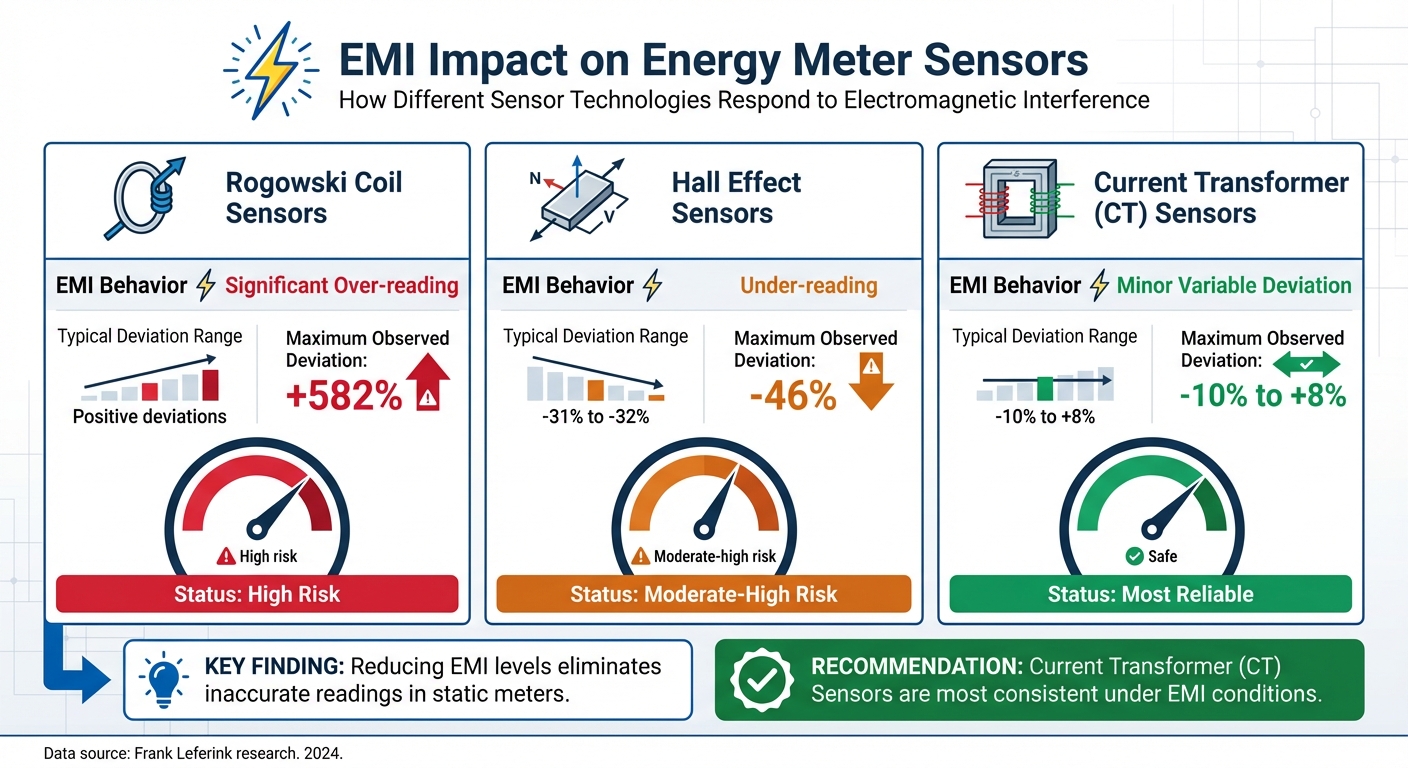
Modern electrical equipment generates electromagnetic interference (EMI), which can severely disrupt static electronic meters. Research led by Frank Leferink revealed that static meters subjected to conducted EMI experienced significant deviations, ranging from -46% to +582%. For example, Rogowski coil sensors were prone to over-read under EMI, with one test showing a staggering +582% deviation. Conversely, Hall effect sensors often under-read, with typical deviations around -31% to -32%, and in some cases as low as -46%. Current transformer (CT) sensors performed more consistently, showing smaller deviations between -10% and +8%.
The researchers noted:
Electromagnetic interference has been observed between active infeed converters as used in photo-voltaic systems and static meters. Reducing the interference levels eliminated inaccurate reading in static meters.
| Sensor Type | Typical EMI Impact | Maximum Observed Deviation |
|---|---|---|
| Rogowski Coil | Significant over-reading | +582% |
| Hall Effect Sensor | Under-reading | -46% |
| Current Transformer (CT) | Minor variable deviation | -10% to +8% |
Fast-switching loads, such as those from solar inverters, can worsen interference. Implementing filters or reducing EMI levels can help restore accurate meter readings.
Manufacturing Defects and Hardware Failures
Manufacturing issues can also play a major role in reducing the reliability of energy meters. Defects in production and the use of low-quality components may not surface immediately but can cause meters to fail after months or even years of use. This creates challenges for both utility providers and consumers.
Component Aging and Wear
Digital meters typically have a lifespan of around 8 years before their calibration begins to drift, leading to potential inaccuracies. In contrast, traditional mechanical Ferraris meters can remain reliable for up to 16 years due to differences in how their components age over time.
For smart meters, certain components like clock chips and batteries are particularly prone to failure after several years in service. As noted by Chen, Zhiru in the Journal of Physics Conference Series:
In the process of widespread use of smart electric energy meters, the quality problems of clock chips, batteries and other components have also been exposed.
When these components fail, issues like frozen displays, flickering screens, or errors in remote readings may occur. Mechanical meters, on the other hand, often experience wear in their rotating mechanisms, which can lead to halted counting or inaccurate readings over time.
Assembly and Production Errors
Beyond wear and tear, errors during assembly can immediately impact meter functionality. Common issues include faulty solder joints, loose pulse connections, and bridged timing circuits, all of which can lead to communication failures or timing inaccuracies. Problems like loose or broken sampling wires, damaged voltage-divider resistors, or fractured optocouplers during installation can render a meter completely unresponsive, even when it has power.
Production-related issues like high temperatures or mechanical impacts can also loosen internal components or shift parts in relays, preventing the meter from executing commands like tripping or closing circuits. Additionally, improperly secured terminal screws or incorrectly clipped pulse lines can disrupt the daily timing pulses required for accurate billing. These flaws often result in error codes such as "ERR-04" (low battery power) or "ERR-08" (clock fault) shortly after installation.
Such assembly and production errors highlight the critical need for stringent quality control measures during the manufacturing process. Without these safeguards, both utilities and end-users are left to deal with unreliable meters and frequent failures.
Power Supply Instability and Its Effects
Unstable electrical conditions can wreak havoc on energy meters, causing stress that leads to increased internal losses, higher temperatures, and ultimately, a shorter lifespan for the device. Researchers Subin Koshy, M. S. Ballai, and H. M. Suryawanshi have explained:
Increase in temperature occurs due to these losses incurred due to such disturbances [undervoltage and overvoltage]. By obtaining the temperature, the Arrhenius equation can be used to calculate the life expectancy of the equipment.
The IEEE highlights the growing importance of power quality, noting that it matters to electricity consumers across all usage levels. Ignoring these issues can result in costly equipment failures and downtime, making it essential to understand how various power instabilities affect meter performance. Voltage irregularities and outages, in particular, present significant challenges.
Voltage Fluctuations and Surges
Voltage fluctuations, including transients, swells, and sags, can severely impact energy meters:
- Voltage transients are brief spikes - lasting less than 1/60th of a second - that can irreparably damage circuit boards and processors inside meters.
- Voltage swells, where voltage exceeds 110% of normal levels, often lead to equipment shutdowns, hardware failures, and data loss in microprocessor-based meters.
- Voltage sags (or dips), which are drops between 10% and 90% lasting milliseconds to 60 seconds, can cause meters to reset unexpectedly, lose data, or malfunction entirely.
Another concern is harmonic distortion, which arises from non-linear loads. This creates "dirty" electricity that overheats internal wiring and components over time, drastically reducing a meter's lifespan. The accuracy of energy measurements under these conditions depends heavily on the meter's design. As noted in research published by Springer, the errors in energy measurements depend on the design and the algorithms used in electricity meters. For instance, inductive meters typically measure only the fundamental harmonic, while digital meters account for all distortions, leading to varying results under unstable power conditions.
| Power Quality Issue | Duration/Threshold | Impact on Energy Meters |
|---|---|---|
| Voltage Sag/Dip | 10%–90% decrease; up to 60s | Microprocessor malfunctions, unexpected resets, and display issues |
| Voltage Swell | 110% or higher | Equipment shutdowns, hardware failures, and data loss in microprocessors |
| Transients (Spikes) | 1/60th of a second or less | Permanent destruction of circuit boards and internal processors |
| Harmonic Distortion | Steady-state | Overheating of components and wiring; long-term reduction in lifespan |
These voltage-related issues are just one piece of the puzzle. Power outages and interruptions bring their own set of complications.
Outages and Power Interruptions
Frequent or prolonged power outages can drain the internal battery of smart meters, leading to clock synchronization errors and the need for battery replacement or recalibration. Additionally, the repeated mechanical stress from power restoration cycles can damage internal relays, preventing the meter from properly engaging or disconnecting the power supply.
Sudden power losses also pose risks to the meter's software and hardware. Corrupted software operations and stressed components like voltage-divider resistors or optocouplers are common outcomes. After significant power interruptions, utilities are advised to conduct a "trip/close" test to confirm that internal relays remain functional and undamaged.
Installation and Wiring Problems
Even the most advanced meters can fail if they're not installed correctly. Faulty installation can lead to reading errors, flickering displays, and billing inaccuracies, creating significant headaches for both homeowners and energy suppliers. While most smart meters - around 92% - function as intended, the remaining 8% of failures are often tied to installation errors. To address this, new regulations for 2026 require energy suppliers to repair faulty meters within 90 days of being notified.
Incorrect Wiring of CT/PT Sensors
For homes with high connection capacities, current transformers (CTs) are essential. However, incorrect wiring of these sensors can result in signal errors and inaccurate readings. The first step in avoiding these issues is identifying the type of electrical service, such as a 120V single-phase or a 480V three-phase delta system. For example, a 120V line typically requires two CTs, while a three-phase service needs more.
Proper CT ratio and burden management are also critical. Take a 100:5 ratio as an example - secondary wiring must maintain impedance within acceptable limits to ensure accurate measurements. Miswiring often shows up as "unusual counting behavior", like sudden spikes in electricity use or unexpectedly high bills. In some cases, even when the main fuse is off or all devices are disconnected, improper wiring or defects can cause the meter to keep recording consumption.
Loose Connections and Poor Setup
Loose electrical connections are another common problem, leading to intermittent failures and unreliable readings. Regular inspections following NFPA 70-2023 and manufacturer guidelines can help catch these issues early. Warning signs include flickering lights or frequent circuit breaker trips.
Homeowners can perform a simple "no-load" test to check for installation issues: turn off the main fuse or disconnect all devices in the house. If the meter continues to register usage, there’s likely a wiring fault or technical defect.
To avoid these problems, it's crucial to hire a licensed electrician. They can ensure all connections comply with local building codes and utility requirements, reducing the risk of electrical shocks and costly mistakes. Replacing an outdoor electrical meter box typically takes four to eight hours, with electricians charging $50 to $100 per hour. Improper installations can also prevent meters from operating in "smart mode", which stops them from sending automatic readings to energy suppliers.
Software and Display Malfunctions
Software glitches and display issues can turn an otherwise functional meter into an unreliable device. These problems often show up as blank screens, flickering displays, or frozen readings that don't change even when energy is being used. Software errors can also prevent meters from transmitting automatic readings to energy suppliers, adding another layer of inconvenience.
Firmware Glitches and Error Codes
Firmware issues can cause a host of operational problems, including error codes like "ERR-04" (indicating low internal battery power) and "ERR-08" (signaling a clock fault that requires recalibration). Communication breakdowns often happen when protocols or baud rates aren't properly aligned between the meter and the management system. Another common issue arises during software updates - if an error occurs while downloading security keys or updates remotely, the meter might lock itself for 24 hours before allowing another attempt. In cases where the display freezes or shows error codes, a simple power cycle might fix temporary software lockouts.
Smart meters relying on outdated 2G/3G communication networks face potential lockouts by 2033 unless they are upgraded. To avoid these problems, it’s essential to keep firmware updated and ensure communication protocols are correctly set for all connected devices. Additionally, calibration errors can further compromise the accuracy of readings.
Loss of Calibration
Calibration problems can make meters less accurate, leading to disputes over billing. Digital meters generally maintain calibration for around 8 years, but their accuracy can deteriorate over time. Factors like extreme temperatures, high humidity, and exposure to strong magnetic fields can speed up this decline. Internal component failures - such as broken voltage-divider resistors, damaged optocouplers, or poorly soldered circuit boards - can also reduce measurement accuracy. Another issue is clock drift; external clock chips that lose precision can disrupt daily timing pulses, resulting in errors in time-of-use billing.
To identify calibration problems, compare current readings with historical seasonal data or past bills. Sudden, unexplained changes often point to calibration loss, which means the meter is no longer fit for legal billing purposes.
Software malfunctions and calibration issues, much like environmental or installation challenges, can severely impact the reliability of meters and the accuracy of billing. Addressing these problems requires careful troubleshooting and attention to all potential failure points.
Tampering and Physical Damage
External interference and mechanical wear can turn an energy meter into a safety risk and lead to inaccurate billing. Beyond earlier challenges like wiring issues or environmental factors, tampering and physical stress introduce additional dangers that undermine meter performance. Unlike software or environmental issues, these problems often stem from deliberate tampering or severe mechanical strain, which compromise both the meter's structure and its ability to measure accurately.
Intrusion and External Alterations
Tampering with energy meters is illegal and highly dangerous, yet it continues to be a widespread issue. In Great Britain alone, energy theft and meter tampering cost consumers over $1.7 billion annually. Common tampering methods include bypassing the meter by attaching wires with clips or wraps to divert electricity, disconnecting the neutral line so the meter reads zero voltage while the load continues to operate, and physically altering the meter by breaking seals, opening the base, or removing the device altogether.
Modern smart meters are designed to combat such interference. They use dual current sensing to measure current in both the Live and Neutral wires. If a discrepancy is detected, the meter either triggers an alarm or bases billing on the higher of the two readings. As Bobflux, an Electrical Engineering Expert, explains:
Most smart meters measure current in both wires and if there is a difference they will usually bill power calculated from the higher of the two currents, and/or raise an alarm if they have a network connection.
Signs of tampering can include damaged casings, smoke, sparks, burning odors, or exposed wiring. Legal consequences for tampering are severe, including up to five years in prison and fines for unmetered electricity usage. Beyond billing inaccuracies, tampering introduces serious safety risks.
While tampering is intentional, physical stress on meters can also lead to significant problems.
Overheating and Physical Stress
Meters can suffer long-term damage from overheating or physical impacts, making them unreliable. Strong impacts or high temperatures can loosen internal components and cause thermal degradation, leading to issues like failed relay engagement or other operational failures. Oliver Watts, an inspection and testing expert, notes:
Control circuit faults are primarily caused by high temperatures or strong mechanical impacts, leading to loosened structural components and shifted moving parts, resulting in failed relay engagement or release.
Physical stress can damage critical internal components, such as fractured voltage-divider resistors, broken optocouplers, or loose sampling wires, all of which affect the meter's ability to process energy data accurately. Excessive heat or electrical stress may burn out components or weaken solder joints, leaving the meter completely unresponsive even when powered. Additionally, external damage - like cracked casings or displays with missing digits - can make manual readings unreliable. These failures not only disrupt billing but also pose significant safety hazards.
Conclusion
Energy meter failures can arise from several causes, including environmental stress, manufacturing flaws, aging components, unstable power supply, improper installation, software bugs, and physical damage.
Addressing these issues starts with understanding how they occur. For instance, ensuring meters are installed by licensed electricians and following strict maintenance schedules can prevent many problems. Digital meters typically need recalibration every 8 years, and error codes like "Fault" or "Battery" often indicate malfunctions that require attention.
Take steps to protect meters from direct sunlight, moisture, and extreme temperatures. Distributing electrical loads evenly and keeping firmware updated can help prevent overheating, component degradation, and connectivity disruptions.
Another critical factor is sourcing quality components. Purchasing from trusted suppliers, such as Electrical Trader, ensures meters are built to handle operational stress, reducing the risk of failures and billing errors. If a defect does occur, the metering point operator usually provides verified replacements - self-replacement is not advised.
FAQs
How can I tell if my meter is inaccurate or just my usage changed?
To figure out if your meter is off or if your energy usage has shifted, start by taking manual readings regularly and comparing them over time. Pay attention to any signs of damage, display errors, or external factors that might suggest the meter isn't working properly. Additionally, check if the readings match up with your typical energy consumption patterns. These steps can help pinpoint whether the problem stems from the meter itself or changes in how you're using energy.
What power quality issues damage meters the fastest?
Power quality problems, such as voltage sags, surges, and transients, are the leading causes of rapid damage to energy meters. These fluctuations put significant stress on the meter's internal components, which can eventually result in malfunctions or complete failure.
When should a digital meter be recalibrated or replaced?
If a digital meter starts showing error messages like "Fault" or "Error", becomes unresponsive, or exhibits problems such as sudden spikes in energy usage or a malfunctioning display, it’s a clear sign that something’s wrong. These issues suggest potential underlying faults, and the meter should be recalibrated or replaced without delay.