Common Problems with Medium Voltage Switchgear and Solutions
Medium voltage switchgear, operating between 1.1 kV and 36 kV, is critical for controlling and isolating electrical systems in power distribution networks. Despite its importance, it often faces recurring issues like mechanical failures, overheating, and insulation problems, which can lead to downtime, safety risks, and costly repairs. Here’s a quick rundown of the key challenges and solutions:
- Mechanical Failures: Caused by wear and tear, overheating, or poor maintenance. Regular inspections, lubrication, and thermal monitoring can help prevent breakdowns.
- Overheating: Results from loose connections, overloaded circuits, or poor ventilation. Infrared thermography and continuous thermal monitoring are effective for early detection.
- Insulation Failures: Triggered by partial discharge, moisture, or poor installation. On-line PD monitoring and insulation resistance testing are essential for identifying issues early.
- Environmental and Human Factors: Moisture, dust, and operational errors exacerbate failures. Sealing systems, dehumidification, and staff training are key preventive measures.
Mechanical Failures in Switchgear
What Causes Mechanical Failures
Mechanical failures are the most common issues in medium voltage switchgear, often resulting from natural wear and tear due to prolonged stress. Breaker contacts can become damaged from overheating or handling excessive current loads, while transmission mechanisms may break down after repeated cycling over time.
Environmental conditions can make things worse. For example, moisture can corrode metal parts, leading to sticking or misalignment in mechanisms. Dust buildup is another culprit, contributing to about 19% of bus failures. On top of that, poor design or manufacturing flaws can create weak spots that fail earlier than expected. Maintenance issues, such as skipping cleaning routines, neglecting lubrication, or leaving connections loose, can also lead to thermal stress. In fact, under poor maintenance conditions, mechanical failure rates can climb from 30% to 38%. These factors highlight the importance of targeted maintenance to avoid costly breakdowns.
How to Fix Mechanical Failures
Preventing and fixing mechanical failures starts with a solid maintenance plan. Schedule quarterly inspections to check all moving parts and connections. Tighten loose connections, clean compartments to eliminate dust and moisture, and lubricate components like transmission parts, springs, and latches to minimize friction and reduce the risk of corrosion.
Thermal monitoring can be a game changer - use it to spot hotspots caused by worn contacts before they turn into bigger problems. Environmental controls, such as heaters, proper ventilation, and moisture barriers, can help protect switchgear from humidity and dust. If you're dealing with outdated circuit breakers, consider upgrading to modern designs that demand less upkeep. Finally, keep detailed performance records to identify patterns and anticipate potential failures before they happen.
sbb-itb-501186b
Operation Maintenace of MV SWGR
Overheating and Thermal Hotspots
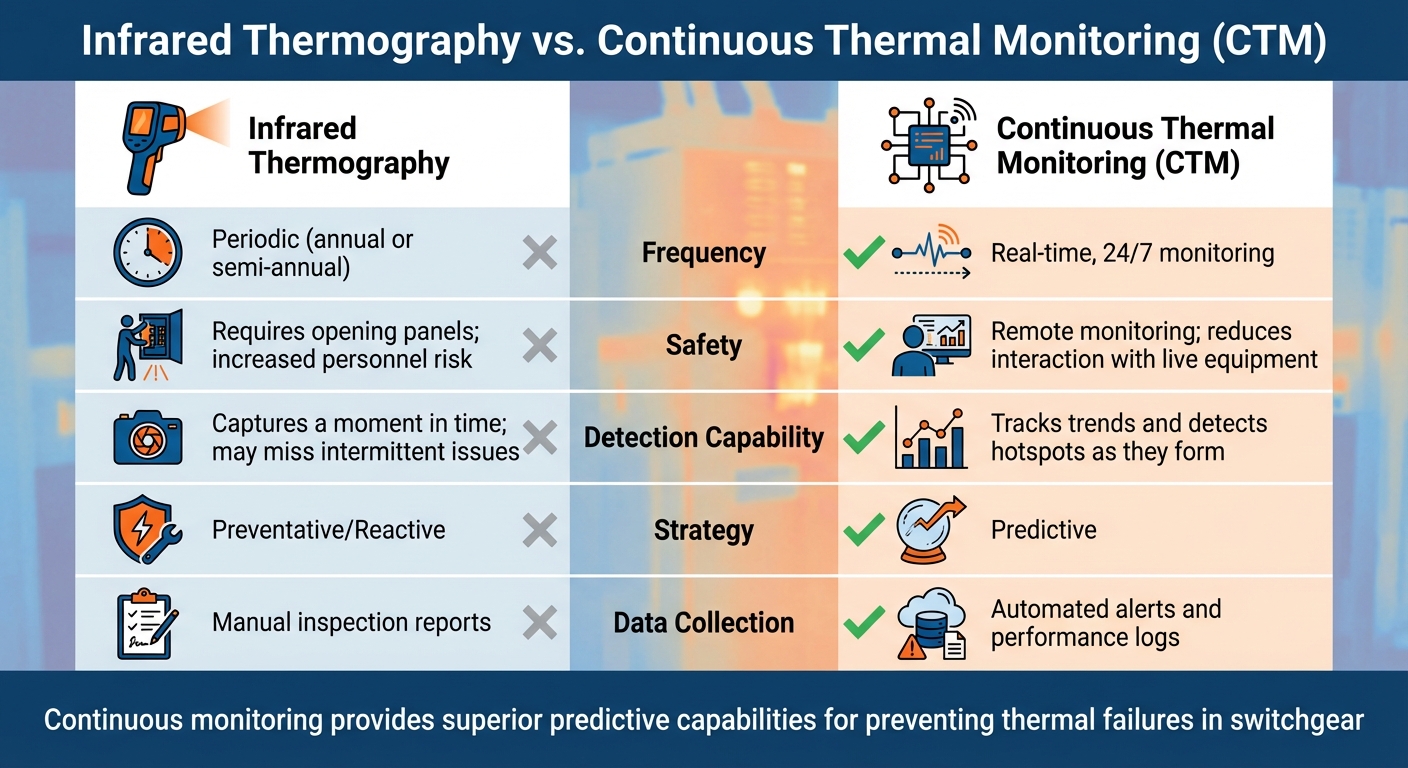
Infrared Thermography vs Continuous Thermal Monitoring for Switchgear
What Causes Overheating
Thermal issues in medium voltage switchgear often stem from a mix of mechanical, electrical, and environmental factors. Among the most critical are loose or faulty connections, which can significantly increase resistance and generate concentrated heat. As electrical engineer Yasser explains:
"The faulty connections in switchgear cause an increase of resistance which leads to an increase in heat. That continuous increase in heat will cause thermal failure of the connection resulting in a fault".
Overloaded circuits are another common issue. When switchgear operates beyond its rated capacity, excess heat builds up, damaging components and cutting the equipment’s lifespan short. Similarly, contact degradation - caused by corrosion, dirt, or regular wear - raises resistance and contributes to overheating over time.
Another factor is thermal cycling, the repeated expansion and contraction of materials due to heating and cooling. Over time, this loosens mechanical connections, creating a cycle where loose connections generate more heat, causing further expansion and loosening.
Environmental factors also play a role. High ambient temperatures, poor ventilation, and dust buildup can accelerate thermal problems. Additionally, aging or damaged insulation can lead to excess current loads, further contributing to overheating. Together, these interconnected factors highlight the importance of proactive thermal monitoring to prevent costly failures.
How to Fix Thermal Issues
Solving thermal problems requires a mix of advanced monitoring tools and regular maintenance. Infrared thermography is a popular method for identifying surface hotspots and partial discharge activity. While effective, this approach only provides periodic snapshots of thermal conditions. In contrast, Continuous Thermal Monitoring (CTM) systems offer a more thorough solution by tracking temperature changes in real-time.
| Feature | Infrared Thermography | Continuous Thermal Monitoring (CTM) |
|---|---|---|
| Frequency | Periodic (e.g., annual or semi-annual) | Real-time, 24/7 monitoring |
| Safety | Requires opening panels; increased personnel risk | Remote monitoring; reduces interaction with live equipment |
| Detection Capability | Captures a moment in time; may miss intermittent issues | Tracks trends and detects hotspots as they form |
| Strategy | Preventative/Reactive | Predictive |
| Data Collection | Manual inspection reports | Automated alerts and performance logs |
In addition to monitoring, hands-on maintenance is crucial. Regularly retorquing connections can prevent resistance-related overheating. Installing automated load shedding systems helps ensure components stay within their rated capacity during peak usage. Adequate ventilation and, when necessary, active cooling systems are also key to dissipating heat effectively.
Partial Discharge and Insulation Failures
What Causes Insulation Failures
Insulation degradation is a major concern for switchgear, often leading to failures that compromise system reliability. One of the key culprits is partial discharge (PD) - a localized electrical discharge within insulation that doesn’t completely bridge the electrodes. PD is a leading indicator of insulation issues in medium voltage systems and is responsible for about 26% of reported switchgear faults.
PD typically arises when the electric field strength at a specific point exceeds the insulating material’s breakdown threshold. This can occur in areas like voids or cavities within solid or liquid insulation, delaminated insulation layers, or improperly installed cable joints and terminations. On-site cable terminations, where workmanship may vary, are particularly vulnerable.
Environmental factors, such as contaminants, significantly accelerate insulation degradation. Electrical engineer Yasser highlights this issue:
"Whenever it's exposed to high humidity conditions switchgear will absorb moisture, and hydrophobic insulation surfaces will be attacked by voltage stresses which were designed to inhibit moisture absorption".
Poor connections further exacerbate the problem by increasing resistance, creating heat, and damaging nearby insulation. Alarmingly, a large number of insulation failures occur within the first 1–3 years of service, often due to manufacturing defects or improper installation.
Next, we’ll look at methods for detecting and addressing these insulation challenges early.
How to Fix Partial Discharge and Insulation Problems
Catching insulation issues early is essential. On-line PD monitoring is a non-intrusive method that tracks voltage, load, and environmental conditions in real time, without disrupting service. Similar to thermal monitoring for hotspots, this approach enables condition-based maintenance, which can delay costly replacements for equipment that’s still in good shape.
Other effective diagnostic tools include infrared inspections to detect surface PD activity and overheating from poor connections. Pair these with insulation resistance testing (commonly done with a Megger) and power factor testing. Generally, power factor values below 1% indicate healthy insulation, while anything above 1% signals the need for immediate attention.
Maintaining the integrity of hydrophobic insulation surfaces is also crucial. Keep them clean and dry to prevent moisture absorption, which can lead to short circuits and corrosion. Use enclosures and proper ventilation to shield equipment from moisture, dust, and corrosive gases.
When replacing damaged parts or upgrading systems, prioritize high-quality components. Platforms like Electrical Trader (https://electricaltrader.com) offer a range of new and used medium voltage switchgear parts from trusted suppliers. Pay special attention to installation quality, particularly for cable joints and terminations, as these are common weak points that can undermine even top-tier equipment.
Environmental and Operational Faults
Environmental Factors
Medium voltage switchgear operates in environments that can be harsh and unpredictable. Moisture, dust, and temperature fluctuations are constant threats that can undermine even the most robust systems. For instance, moisture exposure is a known cause of bus failures, while accumulated dust poses its own set of risks.
High humidity is particularly damaging. It stresses hydrophobic insulation surfaces, leading to moisture absorption, which can result in short circuits and corrosion of metal components over time. Dust buildup on busbars and other internal parts not only creates pathways for insulation breakdown but also adds wear and tear to mechanical components. Extreme temperatures - whether from external heat or internal overheating - further degrade insulation materials and shorten the lifespan of critical parts.
Ian Naylor, Principal Consultant at Threepwood Consulting, highlights the critical role of environmental protection:
"The objective of sealing is to ensure the equipment operates in a warm, dry and dust-free environment".
By maintaining such conditions, the risk of partial discharge and catastrophic failures is significantly reduced. However, environmental factors are only part of the equation - human errors also play a major role in switchgear reliability.
Operational Errors
Human mistakes remain a major cause of switchgear failures. Improper operation, such as mishandling during breaker racking or ignoring warning signs like abnormal sounds, can quickly lead to equipment failure. Poor maintenance practices further compound these risks.
For example, loose control wires or improperly bolted connections in protective circuits can overheat and lose integrity over time, potentially leading to catastrophic outcomes. Misconfigured relays or using equipment that is not rated for the application can cause premature failures, sometimes within just five years. The financial toll of unplanned outages in industrial facilities can range from $50,000 to $500,000 per incident. Clearly, addressing these challenges requires focused solutions.
How to Fix Environmental and Operational Faults
Building on earlier preventive maintenance strategies, specific measures can directly address environmental and operational issues. Start by improving environmental sealing. Use cable sealing systems with proper IP and NEMA ratings to block water, dust, and pests. For outdoor assemblies, weatherproof caulking can seal roof and wall seams, while operational cubicle heaters prevent internal condensation.
Dehumidification, adequate ventilation, and controlled enclosures are essential for maintaining dry, clean conditions. Regular cleaning schedules can stop dust accumulation before it becomes a problem. Continuous thermal monitoring and annual infrared inspections are also critical - these inspections alone are estimated to prevent 70% of potential switchgear failures.
On the operational side, prioritize remote operation whenever possible. Ian Naylor emphasizes this approach:
"Remote operation naturally is number one in the hierarchy of control measures".
Remote operation reduces human interaction with live equipment, cutting the risk of exposure to arc flash hazards, which can reach temperatures as high as 35,000°F. Additionally, invest in staff training programs that cover safe operating procedures, emergency responses, and strict lockout/tagout (LOTO) protocols. When upgrading systems or sourcing replacement parts, platforms like Electrical Trader (https://electricaltrader.com) provide medium voltage switchgear components that meet modern standards and environmental requirements.
Conclusion
Failures in medium voltage switchgear often follow consistent patterns, and most of these issues can be avoided with the right approach to maintenance and monitoring.
To tackle these challenges, focus on three key practices: conduct regular inspections - using tools like thermal imaging and partial discharge monitoring to identify early signs of trouble; maintain a controlled environment - ensuring proper sealing, cleanliness, and dehumidification; and invest in high-quality components, such as modern circuit breakers, advanced insulation materials, and reliable monitoring sensors.
These steps form the backbone of an effective maintenance strategy. As electrical engineer Yasser explains:
"Detecting failures in equipment and trying to avoid it is mandatory to ensure continuity of service, protect your assets and reduce downtime".
For retrofitting outdated systems or sourcing replacement parts, platforms like Electrical Trader provide access to dependable components. Whether you're upgrading circuit breakers, adding continuous thermal monitoring sensors, or replacing worn-out parts, having a trustworthy supplier is crucial for supporting your maintenance efforts.
Ultimately, proactive maintenance is far more cost-effective than waiting for failures to occur. By addressing common issues like mechanical wear, thermal stress, insulation breakdown, and environmental risks before they escalate, you safeguard your power distribution infrastructure. These strategies not only prevent costly downtime but also ensure consistent and reliable grid performance.
FAQs
How often should medium voltage switchgear be inspected?
Medium voltage switchgear requires regular inspections to ensure safe and efficient operation. How often you should inspect depends on the equipment type and its operating conditions. For components that are critical or have shown issues in the past, more frequent checks are recommended. Always stick to the manufacturer’s guidelines, and if you notice reliability concerns, it’s wise to adjust the inspection schedule accordingly.
When is continuous thermal monitoring worth it over infrared scans?
Continuous thermal monitoring is perfect for scenarios where catching temperature changes in real time is a must. It allows for early identification of potential problems, cutting down on maintenance expenses and avoiding costly downtime. This is especially important in applications where detecting failures early can make all the difference. While infrared scans can be helpful, they only offer periodic snapshots, meaning they might miss issues that arise between inspections.
What are the earliest signs of partial discharge in switchgear?
Localized noise, faint hissing, or crackling sounds are some of the early signs of partial discharge in switchgear. You might also notice slight discoloration or surface erosion. These signs point to electrical activity within the insulation, which demands immediate attention to avoid more serious damage.