

Failure Modes in Transformers: FMEA Insights
Power transformer failures can cause major disruptions, financial losses, and safety risks. A study of 612 transformers (2021–2023) showed a 17.97% failure rate, with overloading (29.09%) and external short circuits (16.37%) as the top causes. To minimize risks, Failure Mode and Effects Analysis (FMEA) is a structured approach used to identify, assess, and prioritize potential failures. The method calculates a Risk Priority Number (RPN) based on severity, occurrence likelihood, and detection difficulty, helping utilities focus on preventive maintenance.
Key Points:
- Common Failures: Electrical (insulation breakdown, partial discharges), mechanical (winding stress, vibration damage), and thermal (overheating, moisture issues).
- FMEA Process: Breaks down transformer components (e.g., windings, bushings) to analyze failure modes, root causes, and impacts.
- Maintenance Strategies: Include condition-based monitoring (like dissolved gas analysis), oil quality testing, and real-time temperature sensors.
- RPN Impact: High RPN scores for critical components (e.g., windings) guide maintenance priorities, reducing downtime and costs.
This proactive approach shifts maintenance from reactive fixes to strategic prevention, improving reliability and safety in power systems.
Condition-Based Monitoring for Transformers | Prevent Failures & Improve Grid Reliability
sbb-itb-501186b
Common Failure Modes in Power Transformers
Power transformers can fail due to electrical breakdown, mechanical damage, or thermal degradation. A study involving 612 transformer units revealed an average failure rate of 17.97%, with overloading (29.09%) and external short circuits (16.37%) being the primary culprits. Other contributing factors include loose couplings, moisture, and thermal stress. Below, we explore the electrical, mechanical, and thermal issues that lead to these failures.
Electrical Failures
Electrical failures primarily target the insulation system. Dielectric breakdowns occur when insulation materials degrade due to moisture, oil contamination, or aging, leading to internal short circuits that can severely damage the transformer. Transient overvoltages, caused by events like lightning strikes or switching operations, can exceed the insulation's design limits and result in immediate failure.
Another major issue is partial discharges, which are small electrical sparks within the insulation. Over time, these discharges erode the insulation material, eventually causing a complete breakdown. Faulty protection systems also contribute to electrical failures. From 2002 to 2009, the Egyptian Electricity Transmission Company (EETC) analyzed 1,922 transformers (33 kV to 500 kV) and found that firefighting systems caused the most false trips in most voltage categories. However, for the 220 kV class, busbar protection was the primary issue.
Mechanical Failures
Mechanical failures occur when the physical stresses on a transformer exceed the limits of its components, particularly the windings and core. Common failure modes include hoop buckling, conductor telescoping, and conductor tipping. These issues are often triggered by the massive electromagnetic forces generated during external short circuits.
"A mechanical failure can be caused by hoop buckling, conductor telescoping, or conductor tipping. These mechanical failures happen when you do not maintain your generators and can be easily prevented with regular maintenance." - MES (Maintenance Engineering Services)
Vibration wear from loose couplings and thermal expansion/contraction cycles from overloading can also weaken the transformer's structural integrity over time. Additionally, physical impacts, such as falling trees or storm debris, can cause immediate and severe damage.
Thermal Failures
Thermal degradation is particularly harmful to the oil-paper insulation system. High temperatures speed up the chemical breakdown of cellulose insulation, a process worsened by the presence of moisture. Overloading is a significant contributor to excessive heat generation, making it one of the leading causes of thermal failure.
Thermal runaway is a critical condition where partial discharges combine with moisture migration within the insulation, leading to rapid deterioration. Techniques like hot-spot temperature monitoring, dissolved gas analysis (DGA), and advanced spectroscopy can help identify thermal issues early. Increasingly, utilities are using fiber optic temperature sensors to monitor internal temperatures in real time. Preventing accelerated thermal aging involves managing moisture levels with effective breathing systems and monitoring dielectric dissipation factors.
How FMEA Works for Transformers
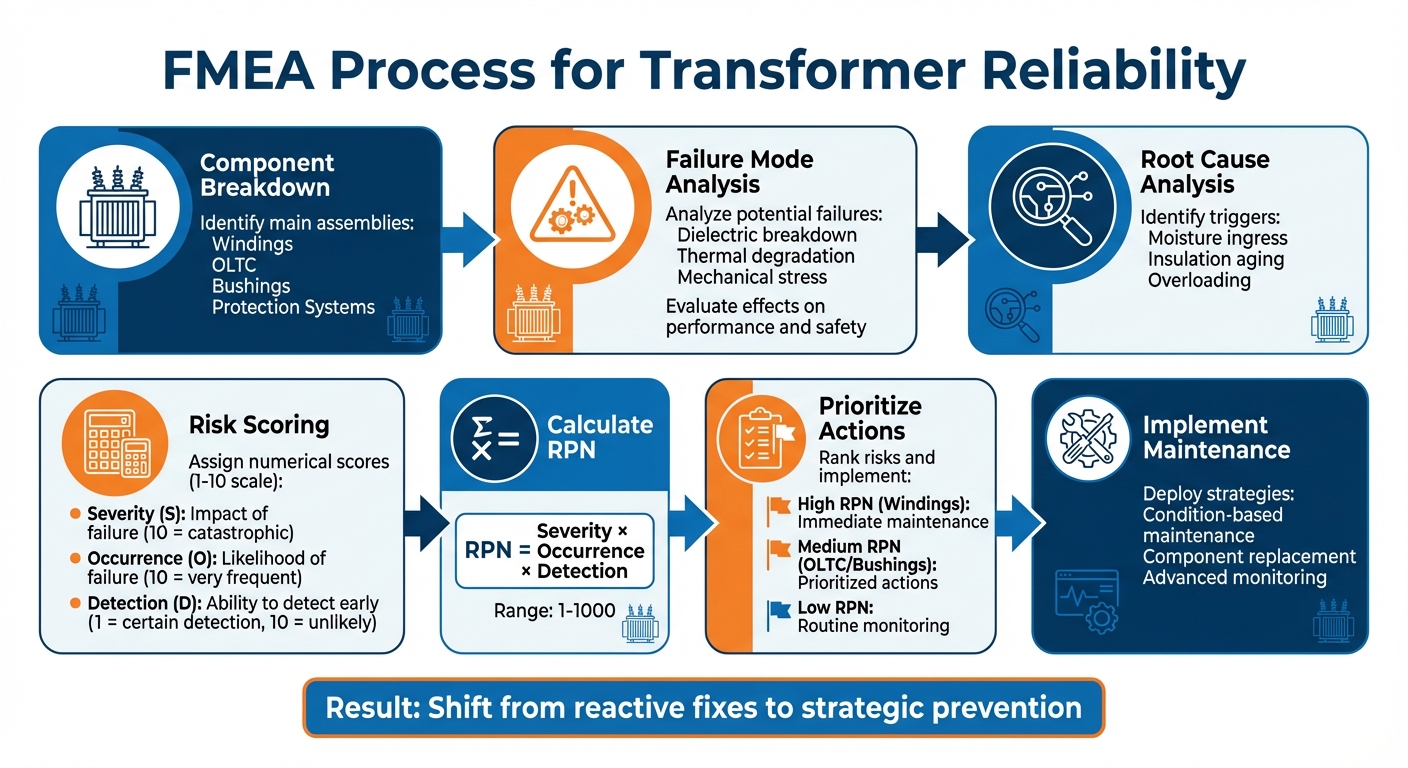
FMEA Process for Power Transformer Risk Assessment
FMEA Process Steps
To apply Failure Modes and Effects Analysis (FMEA) to transformers, the first step is breaking down the transformer into its main assemblies: windings, on-load tap changers (OLTC), bushings, and protection systems. Each of these components is analyzed for potential failure modes - such as dielectric breakdown, thermal degradation, or mechanical stress - and their effects on performance and safety are evaluated. Engineers then conduct a root cause analysis to identify triggers like moisture ingress, insulation aging, or overloading.
Once the causes are identified, numerical scores are assigned for Severity (S), Occurrence (O), and Detection (D). These scores are used to calculate the Risk Priority Number (RPN), which helps utilities rank risks and prioritize maintenance actions. For example, high-priority actions may include condition-based maintenance (CBM) or replacing aging transformer units. These assessments are carried out by cross-functional teams, who also consider factors like replacement costs, lead times, safety implications, and environmental risks. This structured approach ensures maintenance strategies are targeted and effective.
"FMEA effectively identifies and assesses failure modes in power transformers, enhancing system reliability."
– Mohsen Akbari, K.N. Toosi University of Technology
Risk Evaluation Metrics
The RPN is calculated by multiplying three scores, each rated on a scale from 1 to 10. Here's how the scores work:
- Severity measures the impact of failure (10 indicates a hazardous or catastrophic outcome).
- Occurrence reflects how often the failure is likely to happen (10 means very frequent).
- Detection evaluates how likely it is to catch the failure early (1 means almost certain detection, while 10 means it's unlikely to be detected).
Transformers with ratings of 500 KVA or more often generate high RPN values due to their costly replacements and extended lead times - typically 12 weeks or more. For example, high RPN values for windings usually demand immediate maintenance, while elevated scores for OLTCs or bushings might prompt prioritized but less urgent actions. Advanced tools like the Analytic Hierarchy Process (AHP) are increasingly used to weigh these risks, often giving higher importance to severity in critical systems. This precise, metric-driven approach lays the groundwork for deeper analyses.
Fault Tree Analysis
Fault Tree Analysis (FTA) builds on FMEA by mapping how combinations of failures can lead to critical outcomes. While FMEA focuses on individual components and their failure modes, FTA takes a top-down approach, starting with a major failure - like a transformer fire or explosion - and tracing backward to uncover its root causes.
Through FTA, engineers identify "minimal cut sets", which are the smallest groups of primary failures that could result in a complete system outage. Using Boolean logic with AND/OR gates, this method provides a visual representation of how different failures interact. For instance, in oil-immersed transformers, FTA can reveal the pathways that might lead to catastrophic events.
Utilities often use FTA alongside FMEA, especially for high-severity failure modes. Insights from FTA guide the selection of CBM tools, such as dissolved gas analysis (DGA) for detecting thermal faults or ultrasound technology for identifying mechanical issues. Together, these methods provide a comprehensive view of risks and help utilities implement more targeted maintenance solutions.
FMEA Case Studies in Transformer Reliability
160 MVA Transformer Analysis
Applying Failure Mode and Effects Analysis (FMEA) to transformers has consistently revealed patterns that help utilities avoid expensive downtime. Over six years, a study of 1,196 transformer failures highlighted windings as the most vulnerable component. These findings align with earlier research on common failure causes and stress factors.
When engineers conducted FMEA on utility-scale transformers, winding failures were consistently identified as having the highest likelihood and criticality ratings. Short circuit failures, however, stood out as the most severe, prompting factory inspections and on-site evaluations to assess mechanical stress. The analysis focused on three main components - windings, On-Load Tap Changers (OLTC), and bushings - with Risk Priority Numbers (RPN) ranging from 1 to 120. Building on these findings, subsequent case studies have shown that monitoring oil quality can significantly reduce risks.
Oil Quality Testing and RPN Reduction
Monitoring oil quality plays a key role in reducing RPNs in transformer maintenance programs. Testing for factors like acidity, sludge, moisture, and flash point improves the Detectability (D) score in RPN calculations. Advanced diagnostic tools, such as Dissolved Gas Analysis (DGA) and Oil Quality Index Factor (OQIF), help identify early signs of failure. By incorporating these metrics into FMEA, maintenance strategies can be refined to lower overall risk.
The benefits are clear. Between 2010 and 2015, a failure analysis in one city sub-division revealed that oil contamination caused 20 transformer failures. Routine oil maintenance, such as filtration or replacement, prevents cellulose insulation degradation, which in turn lowers the Occurrence (O) score. Modern FMEA methods now include Operation and Maintenance Cost Rankings (OMCR) in RPN calculations, helping to prevent costly disasters.
For instance, a transformer failure at ArcelorMittal's steel mill in July 2025 led to losses exceeding $40 million. Similarly, an insulation failure at the Indian Point Unit 3 nuclear plant caused the release of about 3,000 gallons of dielectric fluid into the environment.
"Hydrogen gas is the first and most reliable indicator of insulation breakdown, providing operators with a crucial early signal to act before failures occur."
– André Marais, Executive Vice President of Sales and Marketing, H2scan Corporation
Continuous monitoring of hydrogen and moisture offers real-time insights, shifting maintenance from reactive to predictive. This approach is especially critical now, as global supply chain delays have pushed transformer replacement lead times to over 15 months.
How to Improve Transformer Reliability
Monitoring and Maintenance Approaches
Improving transformer reliability starts with effective monitoring and maintenance strategies, building on insights from Failure Mode and Effects Analysis (FMEA). One key approach is Reliability Centered Maintenance (RCM), which shifts from fixed-interval maintenance to condition-based schedules. This allows utilities to perform maintenance based on the actual condition of equipment, leading to better asset availability and reduced costs. FMEA plays a crucial role in RCM by identifying priority components - like windings, On-Load Tap Changers (OLTC), and bushings - that require focused attention.
Another tool, Risk Priority Numbers (RPN), helps maintenance teams allocate resources more effectively. For example, detailed RPN assessments can pinpoint areas like protection systems that need targeted improvements.
Controlling moisture ingress is also critical. Maintenance strategies should include robust breathing systems and regular monitoring of insulation to maintain the transformer's integrity. Advanced tools, such as fiber-optic sensors and variable frequency measurements, provide real-time data, enabling a proactive rather than reactive approach to maintenance.
These methods not only improve reliability but also align operations with global standards, ensuring high-quality performance and durability.
Industry Standards and Best Practices
Adhering to industry standards complements proactive maintenance efforts and further enhances transformer reliability. For instance, IEEE C57.125-2015 outlines standardized methods for failure investigations and data collection:
"This document is intended to encourage the establishment of routine and uniform data collection procedures, consistency of nomenclature and compatibility with similar efforts by other organizations." - IEEE C57.125-2015
Standards like IEC 60812 and MIL-STD-1629A provide detailed frameworks for conducting FMEA, enabling systematic identification of critical failure modes and prioritization of corrective actions. Additional guidelines, such as CIGRE Brochure 761 for condition assessment and ISO 18095 for diagnostics, help maintain the health of key systems like insulation and cooling.
A reliability study conducted between 2021 and 2023 on 612 transformer units in the Ifako-Ijaiye community in Nigeria revealed a 17.97% failure rate. Overloading accounted for 29.09% of failures, while external short circuits contributed 16.37%. These findings highlight the importance of adhering to standards to improve load management and operational practices. Insights from FMEA have directly shaped these standards, influencing both procurement and maintenance practices.
Sourcing Quality Transformers
The reliability of transformers begins with their technical specifications, which define manufacturing requirements, testing protocols, and compliance with industry standards. Manufacturing defects remain a major cause of premature failures. For example, a study in Punjab identified 22 specific failure events caused by such defects. In India, the failure rate of distribution transformers ranges from 12–17%, compared to just 2–3% in developed countries, emphasizing the need for stringent procurement standards.
To ensure quality during procurement, buyers should request factory test data reports and verify nameplate ratings against established standards. Using high-grade solid insulation with a Degree of Polymerization (DP) of 1,200–1,400 can prevent premature degradation. Additionally, switching to resin-impregnated bushings reduces the risk of catastrophic failures.
Platforms like Electrical Trader provide access to both new and used transformers from reputable manufacturers. Their categorized listings and resource center make it easier for buyers to find equipment that meets specifications such as those detailed in CIGRE Technical Brochure 528.
"Technical specifications play a crucial role in defining various aspects, including industry standards, characteristics, manufacturing requirements, and testing protocols. These specifications significantly influence transformer reliability and performance." - CIGRE
Following standards like IEEE C57.125 for failure investigation and documentation helps identify probable causes and refine future procurement practices. Collaboration between users and manufacturers during design and failure analysis phases promotes consistent data collection and leads to better reliability outcomes.
Conclusion
Failure Mode and Effects Analysis (FMEA) serves as a structured method to pinpoint transformer failure modes and evaluate their potential impact. By categorizing failures and focusing on critical components, FMEA ensures attention is directed where it matters most. The Risk Priority Number (RPN) - calculated by multiplying Severity, Occurrence, and Detection rankings - helps prioritize key areas like windings, tap changers, and bushings . This approach not only improves reliability but also leads to notable cost reductions.
Proactively addressing issues during the design phase can be up to 29 times less expensive than fixing them during operations. Efficient manufacturers often report a cost of poor quality at around 1% of revenue, compared to nearly 5% for those lacking strong quality processes.
"A systematic process for identifying potential design and process failures before they occur, with the intent to eliminate them or minimise the risk associated with them." – IMCA
When integrated into a Reliability Centered Maintenance (RCM) framework, FMEA shifts maintenance strategies from rigid schedules to condition-based approaches. This transition enhances asset uptime while reducing costs. Modern advancements continue to refine failure predictions and improve maintenance prioritization.
FAQs
How does FMEA help improve transformer reliability and prevent failures?
FMEA, or Failure Modes and Effects Analysis, is a methodical process designed to uncover potential failure points in transformers, evaluate their impact, and rank them based on three key factors: severity, likelihood, and detectability. By diving deep into these aspects, engineers can pinpoint vulnerabilities and take proactive steps to address the root causes of potential issues.
This approach does more than just prevent unexpected breakdowns. It helps extend the operational life of transformers, ensuring they perform reliably and efficiently within power distribution systems. By tackling problems early - before they grow into major challenges - FMEA becomes an essential tool for maintaining smooth operations and reducing the risk of costly interruptions.
What are the common causes of thermal failures in transformers?
Transformers often face thermal failures due to poor cooling performance, such as inadequate oil flow or forced-air circulation, which hinders proper heat dissipation. Additional culprits include excessive circulating currents that generate heat within components, overheated windings or bushing leads, and elevated ambient temperatures or nearby heat sources that intensify thermal stress. On top of that, overloading can push the core and windings to dangerously high temperatures, increasing the risk of damage.
Preventing these problems requires consistent maintenance and monitoring. Keeping an eye on cooling systems, load levels, and operating conditions ensures the transformer stays within safe temperature ranges. Regular check-ups can go a long way in avoiding costly failures.
Why is it important to monitor transformer oil quality during maintenance?
Monitoring the quality of transformer oil is crucial because this oil serves two key purposes: it insulates the transformer’s internal components and helps dissipate heat generated during operation. However, over time, factors like electrical stress, moisture, and thermal aging can degrade its performance. This deterioration can lead to insulation failure, overheating, or even a complete transformer breakdown.
Regular testing of the oil’s properties - such as moisture content, dissolved gases, acidity, and interfacial tension - is essential for spotting potential problems early. Early detection gives maintenance teams the chance to address issues through measures like oil filtration or replacement. These proactive steps help avoid expensive failures, extend the transformer’s life, and ensure it operates reliably. Since transformers are significant investments, consistent oil monitoring not only reduces downtime but also improves safety and cuts maintenance costs.