

High Voltage Safety: Brand Comparison for PPE
Choosing the right PPE for high-voltage work is critical for safety and compliance. This article reviews five leading brands to help you make informed decisions based on protection, durability, and cost:
- Salisbury by Honeywell: Premium rubber insulating gloves for high-voltage tasks (up to 26,500V AC). Known for durability and dual-color safety features. Price: ~$244.
- Magid: Affordable Class 0 gloves for lower-voltage systems (up to 1,000V AC). Flexible and comfortable for light industrial use.
- 3M: Arc flash clothing with reflective materials for improved visibility. Focused on thermal protection and compliance with NFPA 70E standards.
- Radians: Budget-friendly arc-rated clothing starting at $55, combining flame resistance with high visibility.
- PIP and Portwest Kits: All-in-one arc flash kits covering multiple hazard categories, with lightweight designs reducing fatigue. Prices range from $629 to $2,936, based on protection level.
Quick Comparison:
| Brand | Key Product | Voltage Rating | Price Range | Key Features |
|---|---|---|---|---|
| Salisbury by Honeywell | Class 3 Rubber Gloves | 26,500V AC | ~$244 | Dual-color safety, ASTM D120 compliance |
| Magid | Class 0 Rubber Gloves | 1,000V AC | Affordable | Lightweight, flexible, ASTM D120-09 |
| 3M | Arc Flash Clothing | N/A | Varies | Reflective materials, NFPA 70E compliant |
| Radians | Arc Flash Clothing | N/A | $55+ | High-visibility, lightweight materials |
| PIP & Portwest | Arc Flash Kits | 4–100 cal/cm² | $629–$2,936 | Pre-assembled kits, lightweight hoods |
Each brand offers specific strengths, from premium durability to cost-effective solutions. Matching PPE to your facility's incident energy levels ensures safety and cost-efficiency.
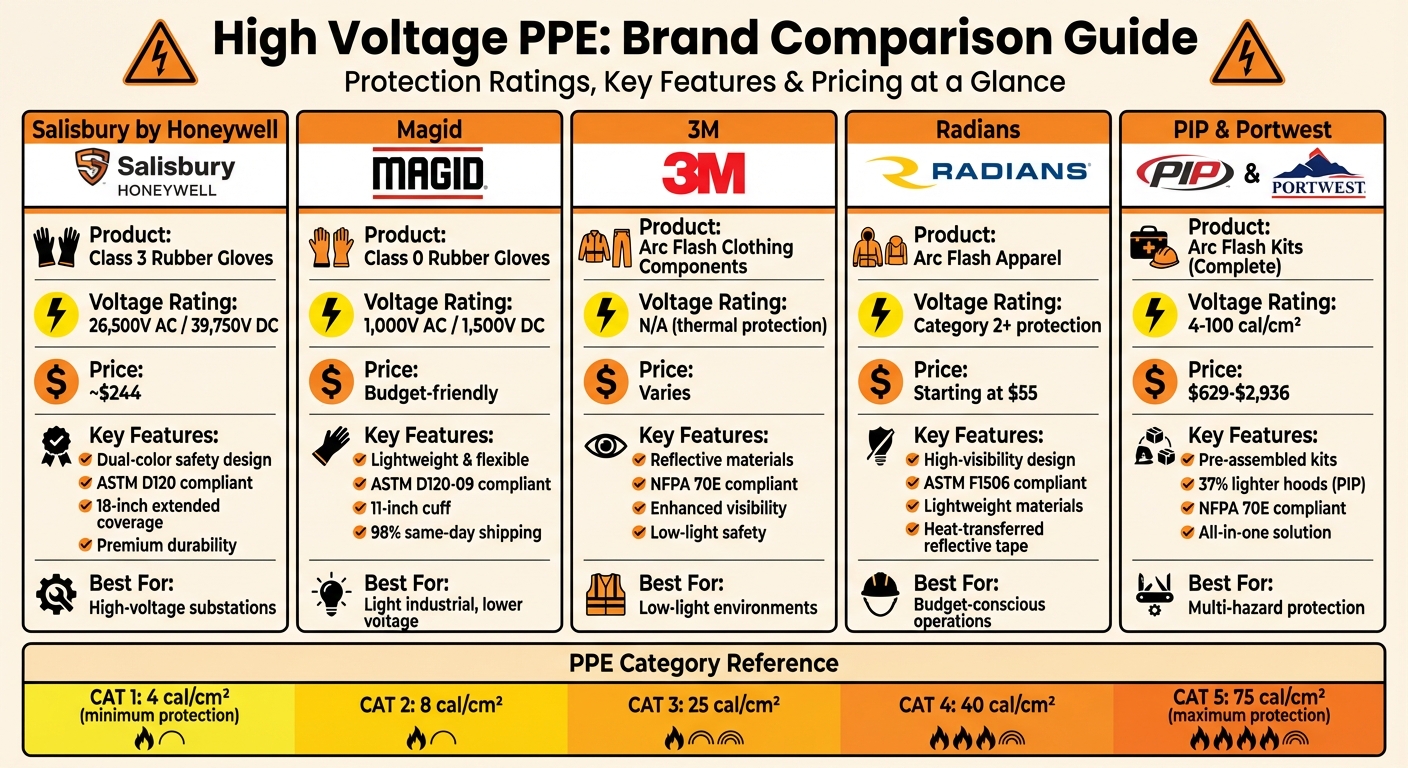
High Voltage PPE Brand Comparison: Protection Ratings, Features, and Pricing
Ask the Expert: Why is arc flash PPE so important? | Eaton
sbb-itb-501186b
1. Salisbury by Honeywell Rubber Insulating Gloves
Salisbury by Honeywell is a well-known name in electrical PPE, offering top-tier protection with its Electriflex™ line of rubber insulating gloves. These gloves are specifically crafted for high-voltage tasks, combining safety with enhanced flexibility for easier use.
Voltage/Protection Ratings
The Electriflex Class 3 gloves are built for serious electrical work, rated for a maximum AC use voltage of 26,500V and a maximum DC use voltage of 39,750V. At 18 inches long, they provide extended forearm coverage, which is crucial when working around live equipment in environments like substations. A standout feature is the dual-color design - typically a black outer layer over a red inner layer. This design acts as a safety alert: if the outer layer is damaged, the contrasting inner color shows through, signaling that the gloves need to be replaced.
Compliance Standards
These gloves meet ASTM D120 standards, the key benchmark for rubber insulating gloves in the U.S., and also comply with the international IEC EN60903 standard. This dual compliance makes them suitable for both domestic and international use.
Durability and Comfort
The Electriflex gloves are engineered to reduce hand fatigue during extended use, offering greater flexibility without sacrificing protection. This makes them particularly useful for long workdays in demanding environments.
As PaulEngr, a Plasma Level Member on the Arc Flash Forum, put it: "Salisbury is sort of the 'Fluke' of electrical PPE...you might find better quality but if you assume price = quality, you'll get the best".
This reputation for reliability makes Salisbury a go-to choice for professionals working in high-stakes, high-voltage settings.
Cost-Effectiveness
A pair of Electriflex Class 3 (18-inch) gloves costs around $244.00. While there are cheaper options on the market, Salisbury's reputation and proven durability make them a worthwhile investment. Regular cleaning and periodic voltage testing at certified glove labs can extend their lifespan, further justifying the upfront cost.
Salisbury sets a high bar for quality and performance, providing a solid foundation as we move on to evaluate Magid's approach to electrical safety gloves.
2. Magid Insulating Electrical Gloves
Magid's Class 0 rubber insulating gloves (M011B series) are designed for commercial and light industrial electrical work. With a maximum use rating of 1,000V AC and 1,500V DC, these gloves are ideal for tasks involving lower voltage systems in such environments.
Voltage/Protection Ratings
These gloves feature an 11-inch cuff, providing extra protection for the wrist and forearm. While their voltage rating is on the lower side, they undergo rigorous proof testing - 5,000V AC and 20,000V DC - to ensure a wide safety margin. This makes them a reliable choice for contractors and linemen working on distribution systems.
Compliance Standards
Magid's Class 0 gloves meet key safety standards, including ASTM D120-09, OSHA, and NFPA 70E. A 2026 report from Expert Consumers highlighted Magid's ability to balance protection, comfort, and compliance with workplace safety regulations. Additionally, the company’s impressive 98% same-day shipping rate ensures quick access to replacement PPE when needed, a critical factor in time-sensitive situations.
Durability and Comfort
Made from natural rubber latex, these gloves are designed for flexibility and ease of movement, reducing hand fatigue during intricate tasks. Their contoured shape enhances comfort without compromising durability. As with all rubber insulating gloves, they should be paired with leather protectors to avoid mechanical damage. A minimum 1/2-inch gap between the glove cuff and leather protector is recommended to prevent creating a conductive path if the leather becomes wet.
Cost-Effectiveness
Although specific pricing details aren't provided, Magid's Class 0 gloves earned a spot at #5 on the "10 Best Electrician Gloves 2026" list in the U.S.. Their lower voltage rating makes them an economical choice for electricians handling systems under 1,000V. Like higher-rated gloves, they require lab testing every six months, ensuring they meet safety standards while remaining a cost-effective option for lower-voltage applications. These gloves offer a practical alternative to higher-rated models, delivering dependable performance for specific tasks.
3. 3M Arc Flash Protective Clothing
After reviewing insulating gloves, let's shift focus to arc flash protective clothing, specifically those incorporating advanced visibility features. While 3M doesn’t produce complete arc flash suits, they manufacture reflective components designed to enhance visibility and improve safety in high-risk, low-light environments. These reflective elements are integrated into arc-rated apparel, making them particularly useful for workers operating near heavy machinery.
Voltage/Protection Ratings
Arc flash clothing is rated based on its ability to withstand thermal energy, measured in ATPV/EBT values (cal/cm²). These ratings reflect the amount of incident energy the fabric can absorb before causing a second-degree burn. For context, ATPV represents the energy level at which there’s a 50% chance of a second-degree burn occurring.
Standards like NFPA 70E and CSA Z462 classify arc flash protection into four PPE categories. These categories range from Category 1, with a minimum arc rating of 4 cal/cm², to Category 4, which requires a minimum of 40 cal/cm². For example, Category 3 mandates arc-rated jackets, pants, and flash hoods rated at 25 cal/cm², while Category 4 requires full arc-rated suits, hoods, and gloves rated at 40 cal/cm² or higher.
Compliance Standards
NFPA 70E specifies that all arc-rated PPE must meet or exceed the incident energy levels of the work environment. Additionally, arc-rated clothing must align with ASTM standards to ensure safety and effectiveness.
It’s critical for workers to wear non-melting undergarments, like those made from 100% cotton, beneath their arc-rated clothing. Synthetic materials are dangerous in these scenarios since they can melt onto the skin during an arc flash. A small air gap between the garment and skin is also recommended as it provides an extra layer of thermal protection.
Durability and Comfort
The durability of arc flash clothing largely depends on the type of fabric used. Materials with inherent flame-resistant (FR) fibers, such as modacrylic or aramid, offer built-in protection that doesn’t wash out or degrade over time. In contrast, chemically treated fabrics lose their effectiveness more quickly. Best practices suggest replacing arc flash PPE every five years, though heavily used garments may need earlier replacement.
Modern designs aim to improve comfort by incorporating features like ventilation and moisture-wicking fabrics to combat heat stress. Lightweight materials are also becoming more common, reducing the physical strain on workers. Regular inspections for damage such as rips or tears are essential since these flaws can compromise safety during an arc flash event. Importantly, repairs should never be done with standard sewing kits, as non-FR threads can reduce the garment’s protective capabilities.
These advancements in durability and comfort directly impact the long-term value and performance of arc flash PPE.
Cost-Effectiveness
Proper care is essential to extend the life of arc flash clothing. Washing garments in warm water with mild detergents on a delicate cycle helps maintain their protective properties. Harsh treatments or chemicals should be avoided as they can degrade the fabric’s effectiveness. The addition of 3M’s reflective materials enhances visibility in low-light settings, which can reduce workplace accidents and, by extension, lower injury-related costs.
4. Radians Arc Flash Apparel
Radians combines arc-rated and flame-resistant protection with high visibility, offering a range of safety apparel at competitive prices. Their product line includes shirts, coveralls, jackets, pants, and specialized rainwear, often crafted with materials like Glengard for flame resistance. These garments are specifically designed to guard against arc flash hazards while maintaining high visibility standards. Below, we explore their voltage ratings, compliance with safety standards, durability, and pricing.
Voltage/Protection Ratings
Radians provides garments with various protection levels, including lightweight 5.7-ounce fabrics designed for Category 2 protection. For head protection, the Radians DPG22 Helmet is rated as Type II Class E and can withstand up to 20,000 volts from high-voltage electrical conductors. By integrating ANSI 107 high-visibility standards into their arc-rated clothing, Radians eliminates the need for separate vests, which can add bulk or create compliance issues. Be sure to verify that Radians' ATPV ratings match your facility's calculated incident energy levels.
Compliance Standards
Radians apparel meets rigorous safety standards, including ASTM F1506 for arc-rated textiles and ANSI 107 for high visibility. Their arc-rated rainwear is also compliant with ASTM F903, ensuring resistance to liquid penetration. Additionally, they offer CSA-certified high-visibility jackets, shirts, and vests in both flame-resistant and self-extinguishing versions.
Durability and Comfort
Radians tackles heat stress with thoughtful design features. For instance, the Neese by Radians DH Air series incorporates vented backs to improve airflow and is priced at approximately $124.99. The use of 100% Max-Dri™ wicking polyester mesh helps keep workers cooler by pulling moisture away from the body during long shifts. Instead of traditional sewn-on reflective stripes, Radians uses heat-transferred, stretchable reflective tape, which enhances mobility and reduces bulk. Their garments also feature an X-back design for full 360° visibility.
Cost-Effectiveness
Radians stands out for its affordability, offering arc-rated hi-vis shirts starting at just $55. Here's a quick comparison of FR hi-vis shirt pricing:
| Brand | Estimated Price (FR Hi-Vis Shirt) | Key Material/Feature |
|---|---|---|
| Radians | $55 | Glengard / Budget-friendly |
| Carhartt | $100 | Brand recognition / Mid-range |
| Dragonwear | $150 | Premium modacrylic blends |
| Neese by Radians | $124.99 | 5.7-oz DH Air / Vented Back |
Radians prioritizes cost-effectiveness by offering low minimum order requirements and competitive pricing for both standard and custom gear. Their MyViz Custom Apparel Design program allows for a quick 7-day turnaround on custom-imprinted protective gear, all while maintaining compliance with essential safety standards.
5. PIP and Portwest Arc Flash Kits
If you're looking for a complete solution to arc flash protection, PIP and Portwest offer pre-assembled kits that combine essential safety components like hoods, suits, gloves, and face shields. These kits are tailored to meet various hazard categories, providing a convenient and reliable option for workers. While both brands meet the same core safety standards, PIP has incorporated specific technologies to address common issues with traditional arc flash gear, such as discomfort and weight.
Voltage/Protection Ratings
Arc flash kits are categorized based on their protection levels, measured in cal/cm². PIP's ultralight hoods, for example, are rated at 40 cal/cm², making them suitable for PPE Category 4 scenarios. This rating ensures protection against severe arc flash events at that energy level.
| PPE Category | Minimum Arc Rating | Typical Kit Components |
|---|---|---|
| CAT 1 | 4 cal/cm² | AR shirt and pants/coveralls |
| CAT 2 | 8 cal/cm² | AR shirt and pants, face shield, balaclava |
| CAT 3 | 25 cal/cm² | Arc flash suit and hood |
| CAT 4 | 40 cal/cm² | Arc flash suit and hood (e.g., PIP Ultralight) |
| CAT 5 | 75 cal/cm² | Heavy-duty arc flash suit and hood |
Compliance Standards
Both PIP and Portwest kits are designed to meet NFPA 70E and OSHA regulations under 29 CFR 1910 Subpart S and 1926 Subpart K. These standards require garments to pass rigorous tests like ASTM F1506, which includes:
- ASTM D6413: Ensures materials self-extinguish within 2 seconds.
- ASTM F1959: Measures arc thermal performance.
Additional ASTM standards ensure the reliability of individual components. For example, face shields must comply with ASTM F2178/F2178M, gloves with ASTM F2675/F2675M and ASTM D120, and rain gear with ASTM F1891. PIP enhances its kits with Hybrid Fabric Technology and DuPont™ shells, offering durability while maintaining compliance.
"The National Fire Protection Association (NFPA) 70E is a comprehensive standard that establishes best electrical safety practices standards on how to protect industrial workers from electric ARC flash and ARC blast exposure." - Andy Ortman, Marketing Channel Manager, PIP
This adherence to standards ensures that every part of the kit works together to keep workers safe.
Durability and Comfort
PIP's ultralight 40 cal/cm² arc hood reduces neck and shoulder weight by 37% compared to traditional designs. This lighter design helps combat heat stress - a known risk factor for heat-related illnesses identified by OSHA. The DuPont™ shell construction enhances durability, offering resistance to wear and industrial washing.
Comfort features include ventilated units with removable power packs and "lift front" hoods, which allow workers to breathe fresh air without removing the entire hood. Additionally, the fogless, highly transparent face shields improve visibility and color contrast, making it easier to distinguish between wires, even in low-light environments. These improvements not only enhance safety but also reduce worker fatigue, leading to long-term cost savings.
Cost-Effectiveness
The cost of arc flash kits varies based on protection levels:
- 40 cal kits: $1,357.97 to $1,473.97, depending on size and glove options.
- 12 cal kits: $629 to $730.
- 100 cal suits: $2,486.97 to $2,936.97.
To avoid unnecessary expenses, assess the incident energy levels at your facility and select the appropriate protection category. Regular maintenance is also key - inspect rubber gloves daily for leaks, ensure leather protectors are intact, and wash arc-rated clothing weekly using warm water and mild detergent. Avoid bleach, fabric softeners, and ironing, as these can compromise flame-resistant properties.
Advantages and Disadvantages
Let’s break down the key strengths and weaknesses of each brand based on their performance in protective gear. Each brand has its own standout features, which can help guide your decision. Salisbury by Honeywell is a leader in rubber insulating gloves, offering extensive voltage class coverage, though their products come at a premium price. Magid, on the other hand, provides budget-friendly glove options. 3M stands out for its focus on material innovation and long-term durability, particularly with its use of inherently flame-resistant fibers. Meanwhile, Radians strikes a balance with mid-range protection that meets compliance standards.
These differences go beyond cost; they directly influence how long the gear lasts and its overall safety performance. For facilities seeking a complete PPE setup, PIP and Portwest kits offer an affordable, all-in-one solution, though they may lack customization options.
The quality of materials plays a major role in determining the overall cost of ownership. For instance, PPE made with inherently flame-resistant fibers can last 1–2 weeks under regular use, while budget-friendly options using chemically treated fabrics may only last 1–2 days. This means that higher-end gear can last up to 16 times longer, justifying the higher upfront cost by reducing how often it needs to be replaced.
"You get what you pay for isn't just a saying – it's a reality, especially when it comes to PPE. Investing in higher-quality protective gear isn't about luxury; it's about ensuring safety, compliance, and long-term cost savings." – HexArmor
Another critical factor is ensuring that PPE ratings align with your facility's specific incident energy levels. This helps avoid the pitfalls of overspending on unnecessary protection or, worse, under-protecting your team. Overall, choosing the right gear for your specific energy needs is essential to balancing safety and cost.
Conclusion
Choosing the right PPE requires aligning workplace needs with the strengths of specific brands. Salisbury by Honeywell stands out for its premium rubber insulating gloves, offering wide voltage class coverage - perfect for high-risk environments where dependability is critical. Magid, on the other hand, delivers affordable Class 0 gloves tailored for lower-voltage tasks, balancing safety standards with budget considerations. For enhanced visibility, 3M's reflective components in arc-rated apparel are a smart choice, especially in dimly lit settings. Radians provides arc flash clothing starting at $55, combining flame resistance with high visibility at a competitive price. For all-in-one solutions, PIP and Portwest kits come pre-assembled for multiple hazards, with PIP's lightweight designs reducing worker fatigue by 37%.
The key takeaway is ensuring PPE matches your facility's calculated incident energy levels. As Thomas Northcott, Senior Power Engineer at Jacobs Technology, Inc., explains:
"The arc flash PPE is only effective for equipment that has incident energy levels that are lower than the ATPV rating of the PPE. This is a fundamental understanding that all electrical workers should have".
For certified and compliant PPE tailored to your specific energy levels, visit Electrical Trader (https://electricaltrader.com). This approach not only prioritizes safety but also ensures cost-efficiency in high-voltage operations.
FAQs
How do I match PPE arc ratings to my site’s incident energy?
To ensure your PPE aligns with your site’s incident energy levels, select gear with an arc rating that matches or exceeds the identified energy level for your work environment. Start by conducting an arc flash hazard analysis. This involves evaluating factors such as system voltage, fault current, and exposure duration. Once you’ve determined the incident energy, choose PPE that meets or surpasses this level to stay compliant with NFPA 70E and IEEE 1584 standards.
When should I choose Class 0 vs Class 3 rubber insulating gloves?
Class 0 rubber insulating gloves are designed for low-voltage tasks, providing protection up to 1,000 volts. For jobs involving higher voltages, Class 3 gloves are the better choice, offering insulation for up to 17,000 volts. Select gloves based on the voltage level you’re working with: Class 0 for lower-voltage applications and Class 3 when dealing with high-voltage environments that demand stronger protection and adherence to safety standards.
What maintenance and retesting schedule should PPE follow?
Voltage-rated gloves and other insulating personal protective equipment (PPE) need to be regularly maintained and retested every six months. Additionally, any new gloves must undergo testing within 12 months of their manufacture date before they can be used for the first time. These routine tests are crucial for ensuring both safety and compliance with industry standards.