




Arc Flash PPE Categories: NFPA 70E Guide
Arc flash incidents are among the most dangerous hazards in electrical work, with over 2,000 workers hospitalized annually due to severe burns and injuries. Proper Personal Protective Equipment (PPE) is crucial to ensure safety when working near energized systems. NFPA 70E outlines four PPE categories, each tailored to specific levels of risk based on incident energy (measured in cal/cm²).
Here’s what you need to know:
- PPE Categories 1–4 correspond to energy levels from 4 cal/cm² to 40 cal/cm².
- The higher the category, the more protective gear required (e.g., arc-rated suits, gloves, and tools).
- NFPA 70E mandates risk assessments to determine the right PPE for each task.
- Two methods exist to select PPE: Incident Energy Analysis or PPE Category Method - only one can be used per task.
Key takeaway: PPE is the last line of defense. Always prioritize de-energizing equipment when possible, and ensure PPE is properly inspected, maintained, and stored to retain its protective properties.
Arc Flash Hazards and PPE Fundamentals
What Is an Arc Flash?
An arc flash is a sudden, intense release of thermal energy caused by an electrical fault. These incidents often happen when workers interact with live electrical equipment - like operating circuit breakers, maintaining panelboards, or working on switchgear.
The danger comes from the intense heat generated. Even though arc flashes last less than a second, the extreme temperatures can instantly vaporize water in human tissues, leading to severe burns, electrical shock, or even death. The arc flash boundary marks the distance where incident energy falls to 1.2 cal/cm² - enough to cause a second-degree burn.
Recognizing these risks highlights the importance of using proper personal protective equipment (PPE).
Why PPE Matters for Electrical Safety
When de-energizing equipment or using engineering controls isn't possible, arc-rated PPE serves as the last line of defense against life-threatening injuries. According to NFPA 70E Section 130.7, workers exposed to electrical hazards must wear PPE designed to protect the specific body parts at risk and suited to the task at hand.
Proper protection requires full coverage, including arc-rated clothing, head and face shields, and insulated gloves. The PPE must be rated to handle the potential incident energy of the task to ensure effective protection.
Arc Rating and Incident Energy Explained
Incident energy refers to the thermal energy released during an arc flash at a specific distance - usually 18 inches from the source - measured in calories per square centimeter (cal/cm²). Arc ratings, determined by ATPV (Arc Thermal Performance Value) and Ebt (Energy Breakopen Threshold), indicate how much energy a material can withstand before a second-degree burn occurs. The arc rating always reflects the lower of these two values.
If the incident energy is less than 1.2 cal/cm² at an 18-inch distance, arc-rated clothing typically isn't required. However, non-melting natural fibers like cotton are still recommended. Synthetic fabrics such as polyester, nylon, or spandex should never be worn under arc-rated gear, as they can melt into the skin during an arc flash.
Understanding these ratings is key to choosing the right PPE for the job.
NFPA 70E and PPE Categories Explained
How NFPA 70E Addresses Electrical Safety
NFPA 70E establishes safety standards for electrical work by requiring documented arc flash risk assessments and safe work practices to address hazards like shock, arc flash, and arc blast. For medium-voltage systems, this often means ensuring equipment is de-energized whenever possible. If working on energized equipment is unavoidable, PPE must meet the calculated risk level. These guidelines help workers select the right protective gear based on the specific risks involved.
When working on live equipment, NFPA 70E Section 130.7 mandates the use of arc-rated protective clothing and gear designed to shield the entire body. This requirement is critical, as over 2,000 individuals are admitted to burn centers annually with severe arc flash injuries.
Two Methods for Determining PPE Requirements
NFPA 70E provides two distinct methods for determining the appropriate PPE for electrical tasks: the Incident Energy Analysis Method and the PPE Category Method. Both approaches are rooted in understanding incident energy and arc ratings, which were previously discussed.
- Incident Energy Analysis Method: This method calculates the potential thermal energy (measured in cal/cm²) at a standard working distance. It uses system-specific parameters like fault current and clearing time to determine the required level of protection.
- PPE Category Method: This approach assigns a minimum PPE rating based on predefined tables linked to equipment type and the task being performed. However, the tables are only valid if the equipment parameters match the limits specified in NFPA 70E.
Christopher Coache, NFPA Senior Electrical Engineer, highlights a key point:
"Either, but not both methods shall be permitted to be used on the same piece of equipment."
This means that PPE categories define the minimum required protection level for specific tasks but do not equate to an incident energy calculation. If the PPE Category Method is chosen and the equipment parameters exceed the table limits, the Incident Energy Analysis Method must be used instead. This ensures the selected PPE is appropriate for the actual risk level.
EC&M Tech Talk - How to Use the PPE Category Method
sbb-itb-501186b
The 4 Arc Flash PPE Categories
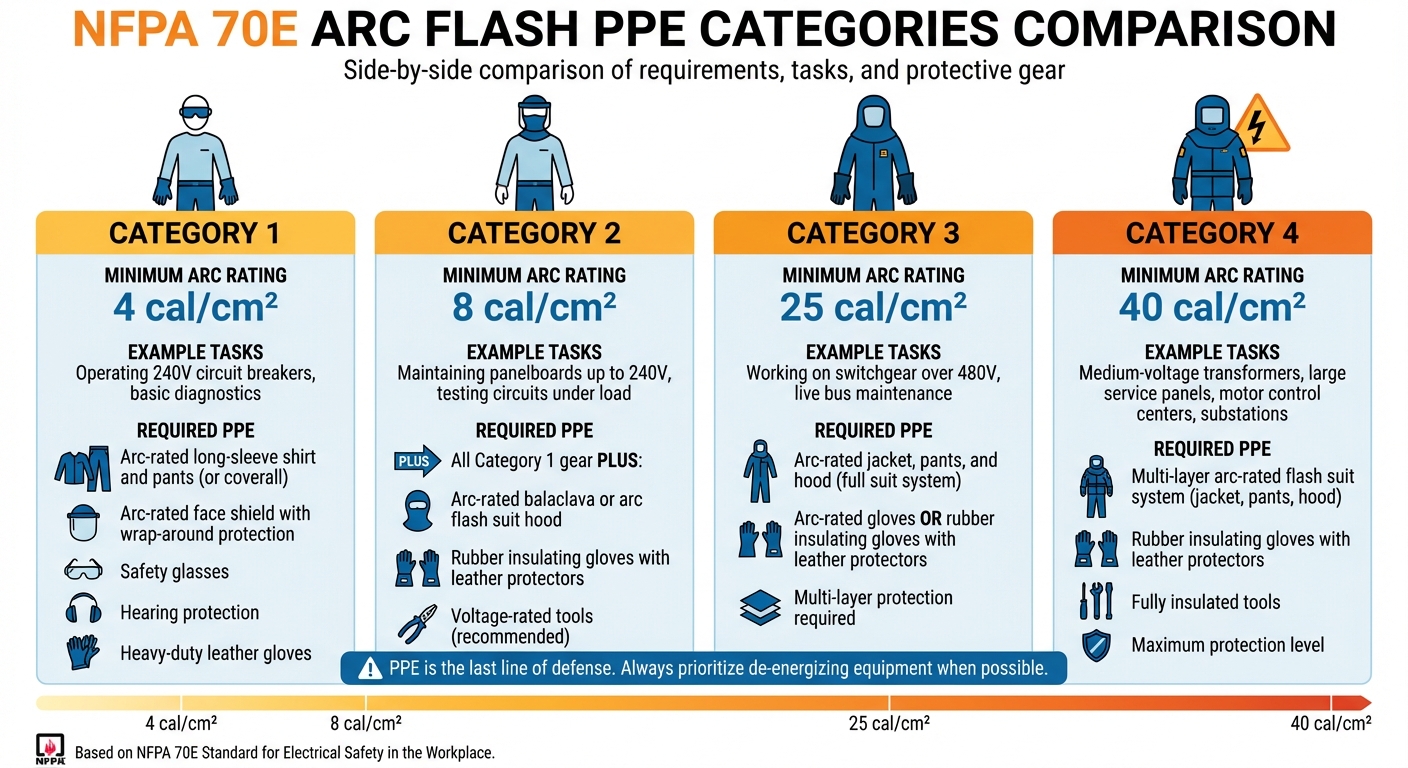
NFPA 70E Arc Flash PPE Categories 1-4 Requirements Guide
The NFPA 70E outlines four distinct PPE categories, each designed to protect against specific levels of incident energy exposure, ranging from 4 cal/cm² to 40 cal/cm². These categories establish minimum arc ratings and required protective gear, ensuring workers have the right equipment for the job. Here’s a closer look at each category and its requirements.
PPE Category 1: Minimum 4 cal/cm²
Category 1 is designed for tasks involving lower levels of incident energy, such as operating 240V circuit breakers under normal conditions or performing basic diagnostics. The minimum arc rating is 4 cal/cm², and the required gear includes:
- Arc-rated long-sleeve shirt and pants (or a single-layer coverall)
- Arc-rated face shield with wrap-around protection
- Safety glasses
- Hearing protection
- Heavy-duty leather gloves
This category provides essential protection for routine, low-risk electrical work.
PPE Category 2: Minimum 8 cal/cm²
Category 2 steps up the protection level to 8 cal/cm², making it suitable for tasks like maintaining panelboards up to 240V or testing circuits under load. In addition to Category 1 gear, workers must also use:
- An arc-rated balaclava or arc flash suit hood
- Rubber insulating gloves with leather protectors
- Voltage-rated tools (recommended for added safety)
This additional equipment ensures better face and hand protection in scenarios with moderate energy exposure.
PPE Category 3: Minimum 25 cal/cm²
For higher-risk tasks, such as working on switchgear over 480V or live bus maintenance, Category 3 requires a full arc flash suit system rated for at least 25 cal/cm². The required gear includes:
- Arc-rated jacket, pants, and hood
- Either arc-rated gloves or rubber insulating gloves with leather protectors
At this level, single-layer protection is no longer sufficient, and the multi-layer system provides enhanced safety for dealing with significant energy hazards.
PPE Category 4: Minimum 40 cal/cm²
Category 4 offers maximum protection for extreme-energy environments, such as working on medium-voltage transformers, large service panels, motor control centers, and substations. The minimum arc rating is 40 cal/cm², and the required gear includes:
- A multi-layer arc-rated flash suit system (jacket, pants, and hood)
- Rubber insulating gloves with leather protectors
- Fully insulated tools
As Rich Gojdics from Enespro PPE explains:
"PPE has long been considered the last line of defense for workers, and often draw the line between a 'near miss' and a life changing injury or fatality."
This category ensures workers are equipped to handle the most hazardous electrical tasks safely and effectively.
Selecting and Maintaining PPE
How to Choose the Right PPE Category
When it comes to selecting personal protective equipment (PPE) under NFPA 70E, you have two options - but you should stick to just one method per piece of equipment. The Incident Energy Analysis Method involves calculating the actual thermal energy (measured in cal/cm²) at your working distance. Once you have that number, you choose PPE that can handle that level of energy or higher. On the other hand, the PPE Category Method uses NFPA 70E Table 130.7(C)(a) or (b). This method assigns a PPE category - ranging from 1 to 4 - based on the type of equipment and the task you're performing. However, the system's fault current and clearing time must align with the limits outlined in the table for this method to apply. Both approaches rely on the arc flash risk assessment you’ve already conducted, ensuring a smooth integration into your safety protocols.
Before starting any work, always determine the Arc Flash Boundary - this is the distance where the incident energy level falls to 1.2 cal/cm². While PPE is a crucial safety measure, it should be your last line of defense. Follow the Hierarchy of Risk Control, prioritizing de-energization of equipment whenever possible, before resorting to PPE. After selecting the correct PPE, proper inspection and maintenance are key to ensuring it continues to provide the protection you need.
PPE Inspection, Maintenance, and Storage
PPE must be inspected before every use. Look for tears, holes, or worn areas, and replace any damaged items immediately - there’s no room for compromise here. For rubber insulating gloves, electrical testing is required at least every six months once they’re in use. If the gloves are new and unused, they can be stored for up to 12 months before their first test. To protect these gloves from mechanical damage, always wear leather protectors over them.
Storage conditions are just as important as inspections. Keep arc-rated clothing and equipment in clean, dry environments, away from direct sunlight, as exposure can degrade the materials over time. If flame-resistant (FR) clothing becomes contaminated with grease, oil, solvents, or other flammable substances, it must be cleaned thoroughly or replaced right away. Contamination significantly reduces the protective effectiveness of the material. Additionally, repairing damaged FR clothing requires special techniques. For instance, using standard nylon thread is not allowed because it compromises the garment's arc rating. Always follow the manufacturer’s care instructions to maintain the equipment’s protective properties throughout its lifespan. With the right PPE, maintained properly, you’re setting the stage for safer work conditions.
Training and Compliance Requirements
Training is a cornerstone of PPE effectiveness. According to NFPA 70E Article 130.7(D), workers must be trained not only in how to use their PPE but also in understanding its limitations. The stakes are high - each year, more than 2,000 people are admitted to burn centers with severe arc-flash injuries, and human error or failure accounts for 75% to 85% of electrical incidents. Proper training directly addresses these risks.
R.W. Hurst, Editor at Electricity Today, emphasizes the importance of education:
"Electrical workers must be properly trained to safely use and apply appropriate personal protective equipment for the possible electrical hazard they may face".
Employers are responsible for conducting and documenting formal arc flash risk assessments before selecting PPE. The individuals performing these assessments must have the proper training and access to the latest version of NFPA 70E. Beyond that, regular inspection schedules, detailed records of PPE testing and replacements, and clear guidance on interpreting arc flash labels are all essential. This documentation isn’t just about compliance - it’s a vital part of building a safety-first workplace culture.
Conclusion
Arc flash hazards pose a serious risk to electrical workers, with over 2,000 individuals hospitalized each year due to severe injuries. To address these dangers, NFPA 70E and OSHA regulations emphasize the importance of proper personal protective equipment (PPE) to safeguard lives. While OSHA outlines the "must-dos", NFPA 70E offers the practical guidance to meet these requirements, particularly for OSHA standards like 29 CFR 1910 Subpart S and 1926 Subpart K. As RedaSafe aptly states, "OSHA provides the 'shall' while NFPA provides the 'how'".
When selecting PPE, there are two main approaches: the Incident Energy Analysis or the PPE Category Method. Both rely on documented arc flash risk assessments, but it’s essential to stick to one method for the same equipment - especially in medium-voltage systems where the high incident energy often demands Category 3 or 4 protection. It’s crucial to remember that PPE is a last resort. The hierarchy of risk controls prioritizes eliminating hazards, such as de-energizing equipment, whenever feasible. Additionally, once chosen, PPE must be properly maintained to ensure it remains effective.
Compliance doesn’t stop at selecting the right PPE. It requires ongoing responsibilities like pre-use inspections, proper storage, and routine testing to ensure the equipment performs as intended throughout its lifespan. With NFPA 70B now elevated from a recommended practice to a mandatory standard, maintaining documented upkeep is no longer optional - it’s essential for protecting workers.
Training is another cornerstone of safety. Workers must fully understand how to use PPE correctly and recognize its limitations. Without adequate training and current knowledge of NFPA 70E, the risks increase significantly. Christopher Coache, Senior Electrical Engineer at NFPA, cautions that "The employer and the person assigned to do the risk assessments are putting employees at risk of injury" if training and assessments fall short.
A strong safety culture, built on detailed risk assessments, diligent PPE inspections, and continuous training, ensures that every worker has the tools and knowledge to return home safely.
FAQs
What determines the correct arc flash PPE category for a specific task?
When selecting the right arc flash PPE, the starting point is understanding the incident energy exposure linked to the task at hand. This energy level is determined through an arc flash risk assessment, which evaluates several critical factors: system voltage, available fault current, protective device clearing time, working distance, and how long the task will take.
The aim is straightforward - choose PPE with an arc rating (measured in cal/cm²) that equals or surpasses the potential energy exposure. This ensures workers are properly shielded while performing their duties. Always refer to the NFPA 70E guidelines and your company's safety procedures to make the right choice for PPE.
What’s the difference between the Incident Energy Analysis Method and the PPE Category Method for arc flash protection?
The Incident Energy Analysis Method and the PPE Category Method are two different ways to determine the appropriate arc flash protective gear for workers.
The Incident Energy Analysis Method relies on detailed engineering calculations to estimate the energy (measured in cal/cm²) that could be released during an arc flash at a specific distance. Using this method, the chosen protective gear must have an Arc Thermal Protection Value (ATPV) that meets or exceeds the calculated energy. This approach is best suited for precise risk evaluations or situations where the standard PPE Category tables don’t apply.
On the other hand, the PPE Category Method offers a simpler, table-based approach. It assigns equipment to one of four categories based on typical exposure levels, with each category linked to a minimum arc rating. For example, Category 1 corresponds to a rating of 4 cal/cm², while Category 2 requires at least 8 cal/cm². This method is practical for common scenarios where quick decisions are needed.
According to NFPA 70E, only one method can be used per piece of equipment, so labels will display either an incident energy value or a PPE category. Both methods are designed to ensure workers are adequately protected, and Electrical Trader provides a wide selection of arc-rated clothing and gear to meet these safety standards.
How should arc flash PPE be maintained to ensure it stays effective?
To ensure arc flash PPE remains effective, it’s crucial to inspect, clean, and store it properly on a regular basis. Before each use, examine items like clothing, helmets, gloves, face shields, and footwear for tears, holes, discoloration, melted fibers, or any other signs of damage. If you spot any issues, remove the item from service immediately. Depending on the situation, it can either be repaired according to the manufacturer’s guidelines or replaced entirely. Additionally, inspections should always follow incidents involving potential arc flash exposure, as hidden damage could compromise the equipment's protective abilities.
When cleaning PPE, stick to mild detergent and lukewarm water. Avoid using harsh chemicals, high-temperature washes, or solvents, as these can weaken flame-resistant (FR) or arc-rated (AR) coatings. After washing, make sure the PPE is completely dry before storing it. Store it in a cool, dry place, away from direct sunlight, ozone exposure, or extreme temperatures. Use racks or hangers for storage to avoid compressing the materials, and keep PPE separate from non-rated garments to maintain its integrity.
Maintaining a documented maintenance program is equally important. Keep records of all inspections, cleanings, repairs, and the issue dates of each item. Most PPE has a typical service life of 5–7 years, and even if it appears undamaged, it should be retired after this period to ensure safety. Electrical Trader provides NFPA 70E-compliant PPE and replacement parts, making it easier to uphold safety standards and keep your equipment current.





