




Common PPE Mistakes During Electrical Maintenance
Electrical maintenance is dangerous, and personal protective equipment (PPE) is your last line of defense against severe injuries like burns or shocks. But using the wrong PPE - or using it incorrectly - can leave you exposed to life-threatening hazards. Here’s what you need to know to stay safe:
- Non-arc-rated PPE won’t protect against arc flash events. Always check for an arc rating (cal/cm²).
- Wrong glove class or missing leather protectors can lead to electrical shock or glove damage.
- Skipping face and eye protection leaves you vulnerable to debris and thermal energy.
- Expired or damaged PPE is unreliable. Inspect gloves, clothing, and gear before every use.
- Poor fit or incomplete coverage exposes skin to arc flash heat and electrical contact.
To avoid these mistakes, inspect your PPE regularly, ensure it matches hazard assessments, and use a pre-task checklist. Remember, PPE is only effective if it’s properly rated, maintained, and worn correctly.
The Voltage Rated Glove Mistakes Putting Workers at Risk
sbb-itb-501186b
5 Common PPE Mistakes in Electrical Maintenance
Avoid these frequent missteps to prioritize safety during electrical maintenance.
1. Using Non-Arc-Rated PPE
One of the biggest errors is assuming all flame-resistant (FR) clothing offers protection against arc flash hazards. Here's the truth: not all FR fabrics are designed for arc flash situations. Arc-rated PPE is tested and verified by its Arc Thermal Performance Value (ATPV) or Breakopen Threshold Energy (EBT), measured in cal/cm². Without these ratings, materials like untreated cotton can ignite, and synthetics such as polyester or nylon might melt onto the skin during an arc event.
The ATPV represents the incident energy needed to create a 50% chance of a second-degree burn, while EBT refers to the point at which fabric forms a hole of 16 mm² or a 25 mm-long tear. Outdated risk assessments can leave workers with PPE that no longer aligns with current system fault currents or protective device settings.
"All arc rated clothing is flame resistant; but not all flame resistant clothing is arc rated." - Leaf Electrical Safety
Always double-check that your PPE has a specific arc rating that matches or exceeds the incident energy listed on the arc flash label.
2. Wrong Glove Class or Missing Leather Protectors
Using gloves with a voltage rating below the system voltage is a direct safety hazard. Rubber insulating gloves come in different classes, from Class 00 (for 500V AC) to Class 4 (for 36,000V AC). Selecting the wrong class can lead to electrical failure and shock. Equally important are leather protectors, which shield rubber gloves from punctures, cuts, and heat from arc flashes. While rubber gloves provide shock protection, they are vulnerable to physical damage, making leather protectors essential for maintaining their integrity.
| Glove Class | Maximum AC Use Voltage | Maximum DC Use Voltage |
|---|---|---|
| Class 00 | 500V | 750V |
| Class 0 | 1,000V | 1,500V |
| Class 1 | 7,500V | 11,250V |
| Class 2 | 17,000V | 25,500V |
| Class 3 | 26,500V | 39,750V |
| Class 4 | 36,000V | 54,000V |
Perform daily air tests by rolling the cuff to check for leaks, and inspect leather protectors for holes, tears, or contamination.
3. Skipping Face and Eye Protection
Relying solely on a face shield is another common oversight. While face shields protect against larger projectiles and thermal energy, they don’t cover the sides or bottom of the face. Pairing them with safety glasses ensures full eye protection from smaller debris and provides an additional layer of safety if the shield shifts during work.
Proper maintenance of face and eye protection is just as important as choosing the right gear.
4. Using Expired or Damaged PPE
Expired or damaged PPE can’t provide reliable protection. Gloves should pass dielectric tests and inflation checks before each use.
"OSHA considers 'first issue' of rubber insulating gloves to be the date they are issued for use after the manufacturer's seal has been broken." - Patrick J. Kapust, Acting Director of OSHA's Directorate of Enforcement Programs
Regular inspections are key. Look for signs of wear, such as "ozone checking" (tiny cracks in the rubber), and immediately remove compromised gloves from service. Similarly, dirt, oil, or grease on arc-rated clothing can weaken its flame-resistant properties, reducing its effectiveness.
5. Poor Fit or Incomplete Coverage
PPE that doesn’t fit properly can leave dangerous gaps. Open collars, rolled-up sleeves, or gaps between garments expose skin to arc flash heat and electrical contact. For example, shirts should be tucked into pants, and sleeves should meet gloves without leaving wrists exposed. Oversized PPE can snag on equipment, while undersized gear may tear or restrict movement, compromising safety. Ensuring proper fit is just as important as selecting the right type of PPE, as it provides an extra layer of defense during electrical maintenance tasks.
How to Avoid PPE Mistakes
Preventing PPE errors starts with routine inspections, effective training, and using a pre-task PPE checklist. Ensuring PPE aligns with hazard assessments - like we discussed earlier - requires consistent attention to detail to maintain its effectiveness.
Perform Regular PPE Inspections
Routine checks help spot potential risks early. Before any electrical maintenance task, employers must conduct hazard assessments to determine the PPE required based on the specific voltage levels and environmental conditions. These evaluations should also identify physical risks, such as sharp edges or moving parts.
"Inspect and test certain PPE such as insulating (rubber) gloves and sleeves (29 CFR 1910.137) to ensure that they are not damaged or defective, and will provide the needed protection." - Occupational Safety and Health Administration (OSHA)
When inspecting PPE, look closely for damage or wear. For insulating rubber gloves and sleeves, check for punctures, cuts, or signs of chemical exposure, and confirm that testing dates align with OSHA’s 29 CFR 1910.137 requirements. Flame-resistant clothing should be inspected for holes, fraying, or contaminants like oil or grease, which can compromise its arc rating. Examine face shields and safety glasses for cracks or scratches that might obstruct vision. Hard hats need to be checked for cracks, dents, or issues with their suspension systems. Always follow the manufacturer’s care guidelines to ensure PPE remains effective.
Provide Training on PPE Use
Training helps workers understand the importance of PPE and avoid skipping it because it feels inconvenient - a common issue highlighted in the Annual Fluke Safety Survey. Ongoing training reinforces that PPE serves as a crucial last line of defense in hazardous environments.
Workers should be trained on OSHA and NFPA 70E guidelines, including how to select, use, and time their PPE correctly. Training should also explain the Hierarchy of Controls, emphasizing that PPE is only used after other safety measures, like elimination and engineering controls, have been implemented. Sessions should teach workers how to conduct hazard assessments, recognize PPE limitations, and inspect their equipment for wear and tear before each use. Adding PPE training to regular safety meetings ensures workers stay informed about the latest standards.
With solid inspection and training protocols in place, a pre-task checklist can help ensure no detail is missed.
Use a PPE Checklist Before Each Task
A standardized checklist is a simple yet effective way to make sure every safety measure is accounted for. Employers should review PPE requirements during mandatory job briefings before starting work. The checklist should confirm that all clothing and face protection meet NFPA 70E arc-rating requirements for the specific hazard level. Verify that insulating rubber gloves are paired with leather protectors, and inspect hard hats, safety glasses, and flame-resistant clothing for any signs of damage or contamination. Include items like line hoses, rubber blankets, and hotsticks (IPE) in the checklist, as these are critical for complete protection. Lastly, ensure workers understand the limitations of their PPE and know how to properly dispose of damaged equipment.
PPE Selection Guide for Electrical Maintenance
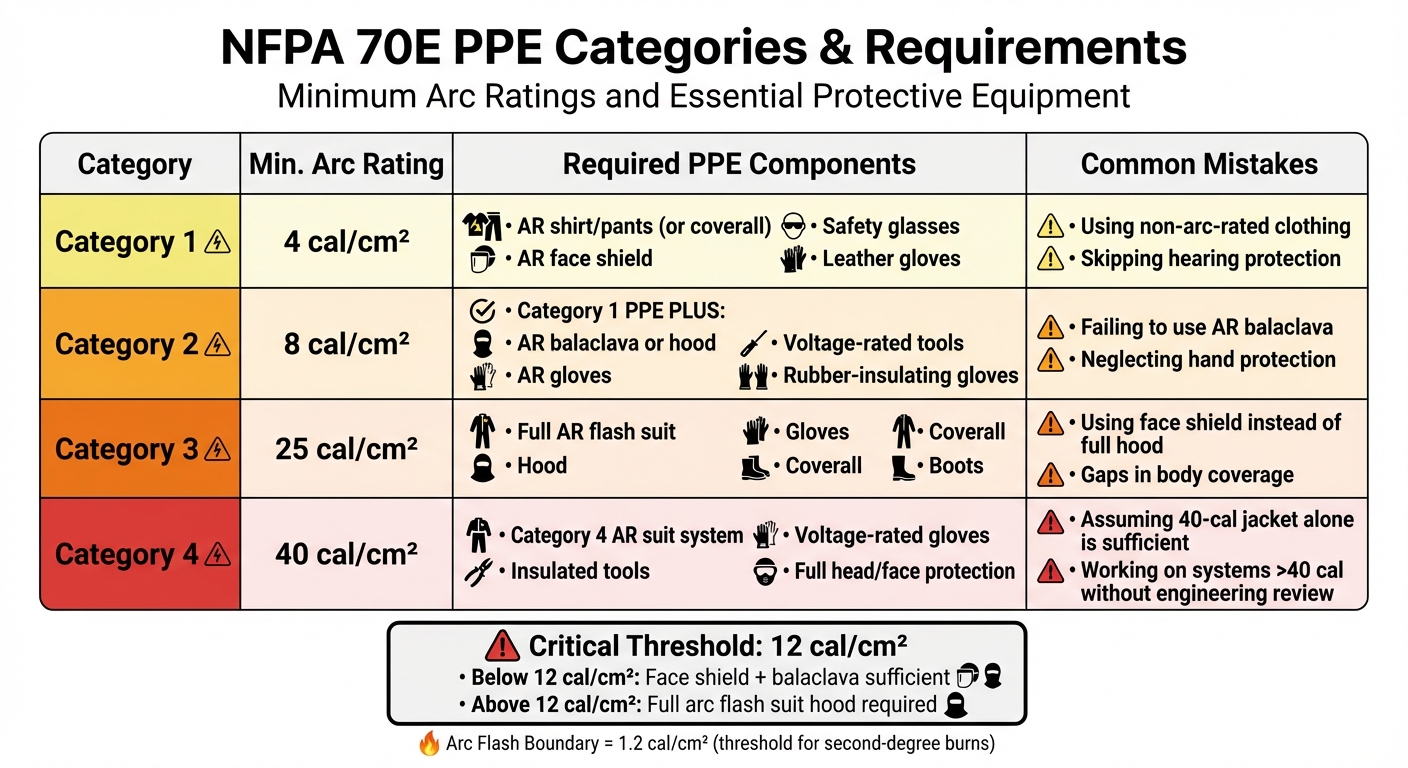
NFPA 70E PPE Categories: Arc Ratings and Required Equipment for Electrical Safety
Choosing the right PPE is just as important as inspecting and training for its use. To ensure workers are protected during an arc flash, you need to understand the thermal energy they might encounter. NFPA 70E provides two methods to guide this process: the Incident Energy Analysis Method, which calculates the exact energy in cal/cm², and the PPE Category Method, which relies on standardized tables based on equipment and tasks. Stick to one method per piece of equipment to avoid confusion or potential safety gaps.
It's important to note that incident energy, not voltage, determines the thermal risk during an arc flash. While higher voltages often result in more energy, the voltage itself is not the hazard. As Frank Baker, Associate Editor at Electricity Today T&D Magazine, explains:
"Category numbers are not the hazard. Incident energy is".
This underscores the need for every PPE component to meet the required energy threshold. For example, a jacket rated for 40 cal/cm² won't provide full protection if your gloves, face shield, or underlayers are rated for less. Every single piece of the arc-rated PPE system - from shirts to hoods - must meet or exceed the energy level indicated on the equipment's arc flash label.
NFPA 70E PPE Categories and Requirements
The table below outlines the NFPA 70E PPE categories, their minimum arc ratings, and the essential gear for each level. It also highlights common mistakes workers make when selecting or using PPE. Keep in mind that Category 1 begins at 4 cal/cm², while Category 4 requires a minimum of 40 cal/cm². The arc flash boundary - where incident energy drops to 1.2 cal/cm² - is critical because it marks the threshold for second-degree burns. Anyone working within this boundary must wear full arc-rated PPE.
| Category | Min. Arc Rating | Required PPE Components | Frequent PPE Errors |
|---|---|---|---|
| 1 | 4 cal/cm² | AR shirt/pants (or coverall), AR face shield, safety glasses, leather gloves | Using non-arc-rated clothing; skipping hearing protection |
| 2 | 8 cal/cm² | Category 1 PPE + AR balaclava or hood, AR gloves, voltage-rated tools, rubber-insulating gloves | Failing to use an AR balaclava; neglecting hand protection |
| 3 | 25 cal/cm² | Full AR flash suit (hood, gloves, coverall, boots) | Using a face shield instead of a full hood; gaps in body coverage |
| 4 | 40 cal/cm² | Category 4 AR suit system, insulated tools, voltage-rated gloves, full head/face protection | Assuming a 40-cal jacket alone is sufficient; working on systems >40 cal without engineering review |
One key threshold to remember is 12 cal/cm². Below this level, a face shield paired with a balaclava is sufficient. However, for anything above, a full arc flash suit hood becomes necessary. For example, tasks like racking a circuit breaker in 480V switchgear with fault currents above 25 kA often require Category 4 PPE. Following these guidelines helps prevent errors like using non-arc-rated gear or leaving parts of the body exposed. Always verify the arc flash label and adjust PPE selections if the system changes.
Conclusion
Recent data on workplace fatalities serve as a stark reminder: choosing the wrong personal protective equipment (PPE) can have deadly consequences. Many of these incidents could have been avoided with the right PPE, thorough inspections, and consistent training.
It's crucial to remember that PPE is your last line of defense, only to be used after de-energizing equipment through proper lockout/tagout procedures. As Tom Pitts, Director of Safety and Environment at Schneider Electric, points out:
"PPE is the least effective risk control method and should only be used as a last resort".
When de-energizing equipment isn't an option, every piece of PPE must be up to standard - properly rated, inspected, and fitted. It's also important to understand that incident energy, not just voltage, dictates the type of PPE you need. This aligns with established best practices for matching PPE to the specific hazards present.
Before starting any task, make it a habit to inspect and test all PPE components. This includes performing glove inflation tests, checking test dates, and immediately replacing any damaged items.
Using PPE effectively requires more than just wearing it. Following detailed checklists and prioritizing regular training can help identify and correct errors before they lead to harm. As Pitts succinctly puts it:
"It is not enough for a maintenance employee or their supervisor to plead ignorance for not providing or wearing personal protective equipment after an electrical incident".
Your safety hinges on these precautions - every single time. Take the extra steps, because they could save your life.
FAQs
How do I find the right arc rating for my PPE?
To choose the right arc rating for your PPE, it’s essential to ensure the rating matches or exceeds the hazard level of your electrical tasks. This hazard level is identified through an arc flash risk assessment. The arc rating reflects how well the PPE can handle the thermal energy generated by an arc flash, providing the necessary protection. Always align the PPE’s arc rating with the specific danger level in your work environment to maintain safety.
Do I need leather protectors over rubber insulating gloves?
Wearing leather protectors over rubber insulating gloves is highly recommended. The leather layer adds durability and helps protect the rubber gloves from cuts, abrasions, and punctures. This extra layer ensures the rubber gloves maintain their insulating properties, which is crucial during electrical maintenance.
When should rubber insulating gloves be replaced or retested?
Rubber insulating gloves need to be replaced or retested every 6 months when actively used. If they are stored and unused, testing is required after 12 months. This timeline follows industry standards to maintain safety and compliance.





