




Top Brands for High-Voltage Safety Gear
Working with high-voltage equipment is dangerous. Without proper safety gear, you risk burns, shocks, or worse. Each year, the U.S. sees 30,000 arc flash incidents, leading to 7,000 burn injuries, 2,000 hospitalizations, and 400 deaths. Reliable protective equipment isn’t just a legal requirement - it’s about saving lives.
Here’s a quick look at trusted brands for high-voltage safety gear:
- Salisbury by Honeywell: Known for durable rubber insulating gloves and arc flash kits. Their SALCOR® synthetic rubber resists ozone and UV damage.
- Novax: Specializes in ergonomic rubber insulating gloves tested beyond their voltage ratings.
- Klein Tools: Offers insulated hand tools and leather protectors for mechanical safety.
- Honeywell: Provides a wide range of safety gear, including flame-resistant clothing and voltage detectors.
- Ansell: Focuses on high-dexterity insulating gloves, including options for cold or wet conditions.
Key Tip: Always match gloves to your system’s voltage and double-check testing dates to ensure compliance and safety.
For a more detailed breakdown, keep reading.
What Arc Flash PPE Looks Like
sbb-itb-501186b
Leading Brands for High-Voltage Safety Gear
Selecting the right high-voltage safety gear isn't just about compliance - it's about ensuring reliable protection when it counts. Below are some of the top brands trusted for their proven safety standards and performance in high-voltage environments.
Salisbury by Honeywell
Founded in 1855, Salisbury has long been a go-to name in electrical safety equipment. The company offers a comprehensive range of products, including rubber insulating gloves, sleeves, blankets, and patented line hoses.
A standout feature is their SALCOR® synthetic rubber, designed to withstand harsh conditions. Unlike natural rubber (Type I), which deteriorates in polluted environments, SALCOR remains durable in cold temperatures and resists ozone and UV damage. This Type II rubber extends the lifespan of gloves and sleeves, making it ideal for outdoor utility work where ozone exposure is common.
Salisbury products meet ASTM D120 and IEC 60903 standards. Their gloves feature a bi-color design - typically a black outer layer with a yellow or red inner layer - that highlights cuts or tears when stretched, allowing workers to spot damage easily. Voltage classes range from Class 00 (500V AC) to Class 4 (36,000V AC), with each item clearly marked for its voltage rating and last dielectric test date to comply with OSHA 1910.137. They also offer arc flash protection kits rated from 8 cal/cm² to 100 cal/cm².
Novax
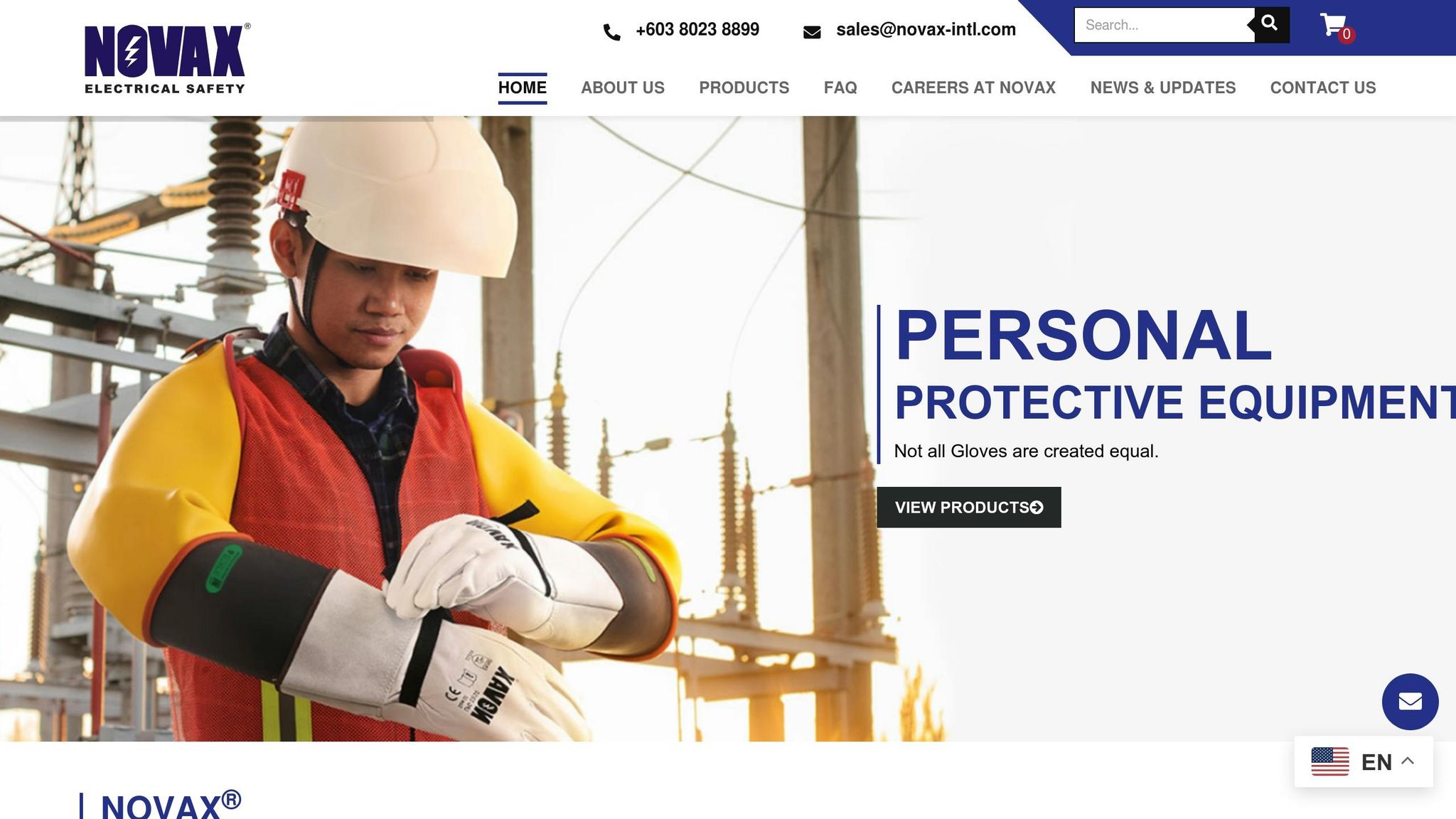
Novax specializes in high-voltage rubber insulating gloves, offering options across all voltage classes from Class 00 to Class 4. Their gloves are designed with ergonomic features like pre-formed fingers and contoured gauntlets, reducing hand fatigue during extended use.
Like Salisbury, Novax gloves use a bi-color design for quick damage detection during daily inspections. Each glove undergoes rigorous dielectric proof-testing at voltages higher than its rating - for instance, Class 4 gloves rated for 36,000V AC are tested at 40,000V AC to ensure safety. The gloves meet ASTM D120, IEC 60903, and EN 60903 standards. Their focus on high-quality rubber ensures flexibility and insulation even in extreme temperatures, making them a reliable choice for utility and industrial workers.
Klein Tools
Klein Tools is well-known for its lineman gloves and insulated hand tools, which combine durability with a focus on grip and safety. Their insulated tools are rated for up to 1,000 volts and comply with ASTM F1505 standards.
Their lineman gloves, made from leather with reinforced palms and fingers, are designed to work as leather protectors for Class 0 or Class 00 rubber insulating gloves. These protectors shield the rubber gloves from cuts and punctures without compromising flexibility. Additionally, Klein's insulated tools feature two-layer insulation, with a bright orange inner layer that becomes visible if the outer layer is damaged, offering an instant safety warning. The ergonomic design of their tools helps reduce hand strain, making them a favorite among electricians working long hours.
Honeywell
Honeywell offers a wide range of electrical safety equipment, including voltage detectors, flame-resistant (FR) clothing, and arc flash protection gear like hoods and helmets. This diverse product selection allows safety managers to source multiple types of PPE from a single manufacturer.
Their voltage detectors are essential for verifying de-energized equipment, forming a critical part of lockout/tagout procedures. Honeywell’s FR clothing and arc flash suits are designed to meet OSHA and NFPA 70E standards, with clear energy-level ratings. Their arc flash face shields and hoods integrate with hard hats and offer protection ranging from 8 cal/cm² to 100 cal/cm². Additionally, Honeywell produces insulating blankets and mats for added protection when working on energized equipment or in confined spaces.
Ansell
Ansell is a leader in high-dexterity work gloves and electrical insulating gloves. Their focus is on balancing protection with tactile sensitivity, making it easier for workers to handle small components without removing their gloves.
Ansell's insulating gloves are built for durability, with reinforced designs to withstand frequent use. They offer both natural rubber (Type I) and synthetic rubber (Type II) options, allowing safety managers to choose based on environmental factors like ozone exposure. Their gloves cover all voltage classes, from Class 00 to Class 4, and are marked for easy identification. Proper fit is a priority, as poorly fitted gloves can reduce dexterity and lead to premature removal. Ansell also offers options for cold-weather flexibility and enhanced grip for wet or oily conditions.
These brands represent the gold standard in high-voltage safety gear, setting the stage for further comparison in the following section.
Brand Comparison
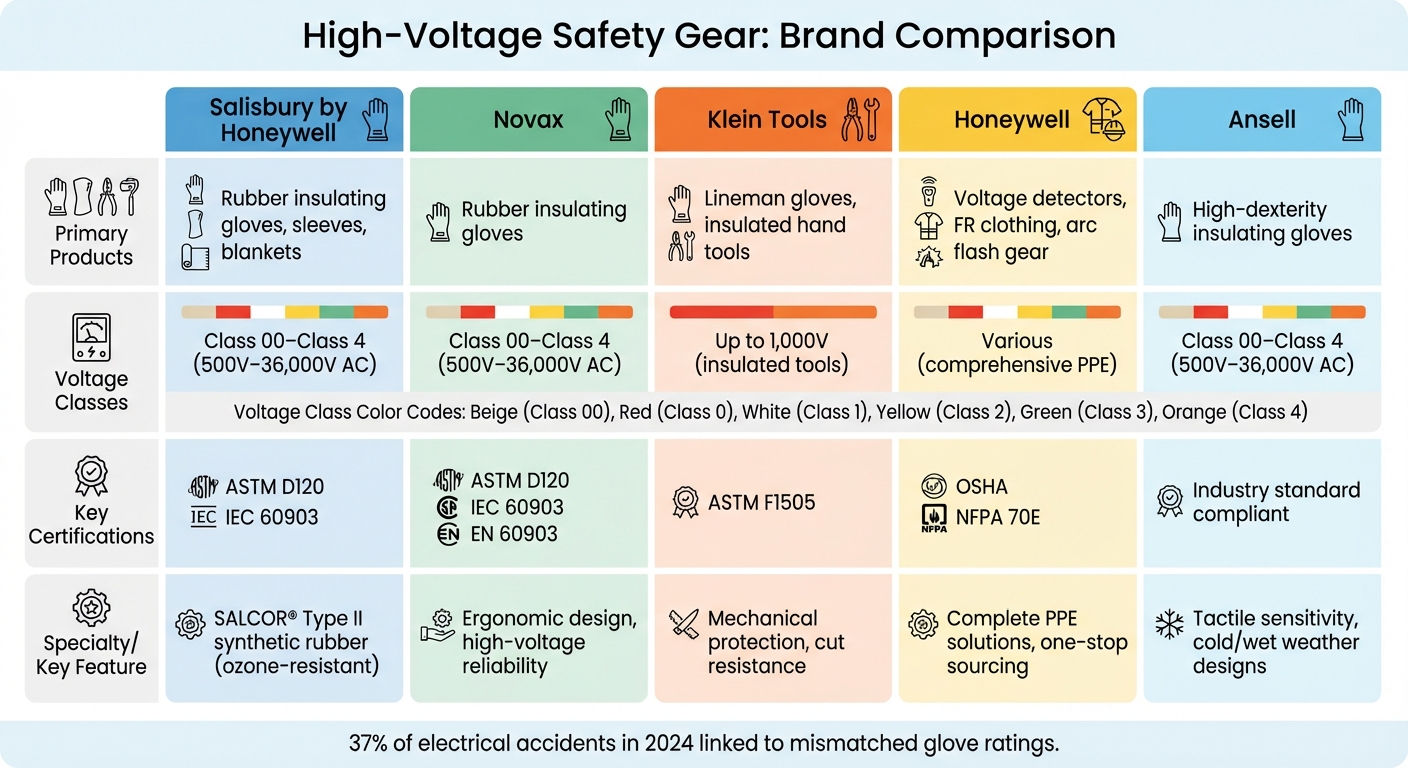
High-Voltage Safety Gear Brand Comparison Chart
Brands cater to diverse high-voltage safety needs, offering solutions designed for specific applications.
Salisbury by Honeywell and Novax are leaders in rubber insulating gloves, covering voltage protection from Class 00 (500V) to Class 4 (36,000V). Both brands hold dual certifications and meet the rigorous ASTM D120 and IEC 60903 standards. Salisbury is often regarded as the benchmark for high-voltage rubber equipment, while Ansell dominates in production, manufacturing over 10 million safety gloves annually. Additionally, Salisbury and Novax provide ozone-resistant Type II synthetic rubber options, enhancing durability.
Klein Tools takes a different approach, focusing on mechanical protection rather than primary electrical insulation. Their lineman gloves and insulated hand tools prioritize features like cut resistance, abrasion protection, and dexterity, making them ideal for handling smaller components.
Honeywell and Ansell offer more expansive product ranges. Honeywell provides a comprehensive lineup that includes voltage detectors, flame-resistant clothing, and arc flash protection gear, enabling safety managers to source complete PPE kits from a single supplier. Ansell, on the other hand, emphasizes tactile sensitivity with both Type I and Type II rubber gloves across all voltage classes. They also offer specialized designs for extreme conditions, such as cold weather (below –13°F) and wet environments.
Investing in complete systems rather than individual items delivers better value. With 37% of electrical accidents in 2024 linked to mismatched glove ratings and the average cost of an electrical incident ranging from $150,000 to $750,000 due to downtime and legal expenses, using certified, durable gear from trusted brands can significantly reduce risks and costs while improving worker safety. The table below highlights the key differences among these brands.
Brand Comparison Table
| Brand | Primary Products | Voltage Classes | Key Certifications | Specialty |
|---|---|---|---|---|
| Salisbury by Honeywell | Rubber insulating gloves | Class 00–Class 4 (500V–36,000V AC) | ASTM D120, IEC 60903 | Ozone-resistant Type II synthetic rubber |
| Novax | Rubber insulating gloves | Class 00–Class 4 (500V–36,000V AC) | ASTM D120, IEC 60903 | Optimized for high-voltage reliability |
| Klein Tools | Lineman gloves, insulated hand tools | – | – | Focus on mechanical protection and durability |
| Honeywell | Voltage detectors, flame-resistant clothing, arc flash gear | – | – | Comprehensive PPE solutions for safety management |
| Ansell | High-dexterity insulating gloves | Class 00–Class 4 (500V–36,000V AC) | – | Tactile sensitivity with cold-weather and wet-weather designs |
Voltage Classifications and Safety Standards
Choosing the right high-voltage gloves starts with understanding their classifications and safety standards. These gloves are divided into classes ranging from Class 00 to Class 4, with each class designed for specific voltage levels. For instance, Class 00 gloves can handle up to 500 V AC, making them ideal for tasks like appliance repair or working on low-voltage panels. On the other hand, Class 4 gloves are built for heavy-duty applications, such as extra-high-voltage systems, and can protect against voltages as high as 36,000 V AC.
To simplify selection, each class is color-coded: beige for Class 00, red for Class 0, white for Class 1, yellow for Class 2, green for Class 3, and orange for Class 4. These colors act as a quick reference, ensuring workers can easily identify the correct glove for their task.
When it comes to standards, insulating gloves must comply with ASTM D120 (the U.S. standard recognized by OSHA) and IEC 60903 (the international standard). Many top manufacturers now produce gloves that meet both standards, offering dual certification for added reliability. For example, Class 2 gloves, rated for 17,000 V AC, are tested at 20,000 V AC to include a safety margin. This is crucial since contact with as little as 50 V can be fatal. These rigorous standards ensure that high-quality gloves go above and beyond basic safety requirements.
OSHA also plays a key role here. Under OSHA 29 CFR 1910.137, workers must use insulating gloves that match the voltage level of their tasks. Additionally, these gloves must undergo dielectric testing every six months to maintain their reliability.
Another important distinction lies in the glove material. Gloves are classified as either Type I (made from natural rubber) or Type II (made from synthetic materials like EPDM). Type I gloves are not resistant to ozone, making them less suitable for areas like motor rooms or high-voltage switchgear environments, where ozone exposure is common. In contrast, Type II gloves are designed to resist ozone damage, preventing the fine cracks that can compromise natural rubber gloves.
"Electrical insulating gloves serve as the primary defense against deadly shocks, but the reality is that many companies still overlook proper class selection, testing intervals, and storage practices." - Workwear Solutions
Before using insulating gloves, always roll the cuff to trap air and squeeze to check for leaks. Even the smallest pinhole can jeopardize their effectiveness. By understanding these classifications and standards, you can make informed choices about high-voltage safety gear and ensure maximum protection.
How to Choose High-Voltage Safety Gear
When it comes to high-voltage safety gear, getting the right fit and materials is just as important as following established safety standards. Start by ensuring the gear's voltage class matches your system's maximum voltage. For instance, if you're working on a 10,000V system, you'll need Class 2 gloves rated for 17,000V AC. Class 1 gloves, which only cover up to 7,500V AC, won't provide adequate protection. In environments with higher risks or humidity, consider applying a safety margin of 3–5× to account for additional factors. These voltage-based choices form the foundation for effective protective measures.
The Two-Glove System
Always use the two-glove system for high-voltage work. Rubber insulating gloves act as the first line of defense, providing a dielectric barrier against electrical shocks. However, they must be paired with leather protector gloves, which shield the rubber from damage caused by cuts, punctures, or abrasions. As David Smith from ProtGuide points out:
"Rubber insulating gloves stop electrical current, but a single puncture eliminates all dielectric protection. Leather protectors are not optional - they are the mechanical shield that keeps the rubber intact".
Monica, Director at CHEAMY PPE, adds:
"Selecting the wrong class of gloves can be deadlier than wearing none - misuse may lead to arc flashes or fatal shocks".
Fit and Material Matter
Proper fit and material selection are critical for safety and comfort. Measure the circumference of your hand at its midpoint (typically between 8–12 inches) to find the right size. Gloves that are too tight can cause fatigue, while oversized gloves may reduce dexterity and increase the likelihood of accidents. Standard glove lengths - 11, 14, and 16 inches - should be chosen based on voltage levels and potential forearm exposure.
For environments with ozone exposure, opt for Type II synthetic rubber gloves, as they are more resistant to cracking and degradation.
Inspection and Maintenance
Before each shift, perform an air test to check for leaks. OSHA mandates dielectric testing every six months, so always confirm the glove's re-test date. Using gloves with expired testing dates violates compliance standards and puts workers at risk. Inspect gloves for any signs of damage, such as "ozone cutting" (fine cracks), chemical swelling, or embedded debris.
The importance of proper selection and maintenance can't be overstated. According to the National Electrical Safety Foundation, 37% of electrical accidents in 2024 were caused by mismatched glove ratings. This statistic underscores how critical it is to choose the right gear and keep it in top condition - it’s not just about compliance; it’s about saving lives.
Conclusion
Choosing the right high-voltage safety gear is a decision that directly impacts lives. With around 30,000 arc flash incidents reported annually in the U.S. - leading to 2,000 hospitalizations and 400 fatalities - having the proper equipment is non-negotiable. Brands like Salisbury by Honeywell, Novax, and Klein Tools have earned trust by meeting rigorous safety standards like OSHA 29 CFR 1910.137, NFPA 70E, and ASTM D120. These certifications aren’t just bureaucratic - they’re lifesaving.
Each of these brands brings something different to the table. Salisbury stands out for its rubber insulating gloves, covering all voltage classes. Novax focuses on ergonomic designs for high-voltage reliability, while Klein Tools delivers tough, insulated tools and lineman gloves for mechanical protection. When selecting gear, it’s crucial to match the voltage class to your system’s maximum voltage, check re-test dates on rubber gloves, and always adhere to the two-glove system.
Investing in reliable safety gear isn’t just about compliance - it’s about survival. With arc flash temperatures soaring to 35,000°F and even minor flaws like a pinhole compromising protection, attention to detail is paramount. As Mick Chan, a professional in the safety supplies field, aptly notes:
Electrical hazards don't give second chances.
Whether you’re equipping a utility team or protecting yourself on the job, these trusted brands offer the reliability you need to ensure every workday ends safely. For electrical professionals, this guide provides a dependable resource for making the right choice.
FAQs
Which voltage class of gloves do I need for my job?
When selecting gloves, ensure they are rated for the highest voltage you'll be working with. Here are the common classes and their voltage limits:
- Class 00: Protects up to 500 volts
- Class 0: Protects up to 1,000 volts
- Class 1: Protects up to 7,500 volts
- Class 2: Protects up to 17,500 volts
- Class 3: Protects up to 26,000 volts
- Class 4: Protects up to 36,000 volts
Always choose gloves that meet or exceed the voltage level of your specific task.
How can I tell if my rubber insulating gloves are still safe to use?
To keep your rubber insulating gloves in top condition, start with a visual inspection. Look closely for any cuts, abrasions, or punctures that could compromise their safety. Additionally, follow OSHA and ASTM guidelines by performing dielectric and inflation tests every six months. These routine checks are essential for ensuring the gloves maintain their protective properties.
What else do I need besides gloves for high-voltage work?
In addition to gloves, you’ll need arc flash protective clothing, as well as proper head and face protection, hearing protection, and footwear designed for electrical safety. These items play a key role in ensuring full protection when working with high-voltage equipment, significantly reducing the chances of electrical injuries.





