IEC and DOE Testing Procedures for Transformers
Transformers are critical for power distribution, and testing ensures they meet performance and efficiency standards. Two primary frameworks guide these tests:
- IEC 60076: A global standard covering design, safety, and performance for transformers up to 765 kV.
- DOE Standards: U.S.-specific regulations focusing on energy efficiency for distribution transformers.
Key Differences:
- IEC 60076 emphasizes design and safety, with broader tolerances (e.g., ±15% for losses).
- DOE Standards prioritize energy efficiency, with stricter loss tolerances (+10%, -0% for no-load losses).
Both standards include routine, type, and special tests, but their approaches differ in focus and technical requirements. IEC is globally adopted, while DOE ensures U.S. market compliance. Understanding these frameworks is crucial for ensuring transformer reliability, efficiency, and compatibility.
Introduction to power transformer testing
sbb-itb-501186b
IEC 60076 Testing Procedures
Building on the overview of IEC and DOE standards, this section dives into the testing procedures outlined in IEC 60076.
The IEC 60076 framework categorizes testing into three main types: routine tests, type tests, and special tests. Each category plays a distinct role in assessing transformer performance, from basic quality assurance to testing under extreme conditions, ensuring compliance with global standards.
Routine Tests
Routine tests are performed on every transformer unit produced. These tests act as a critical quality checkpoint, identifying any manufacturing defects before the transformer is deployed. They cover key areas such as winding resistance, voltage ratio, vector group, insulation strength, and dielectric performance.
- Winding resistance measurement: This detects problems in conductors and joints, even when the resistance variation is as small as a few milliohms.
- Insulation resistance measurement: This test evaluates the resistance between windings and ground, ensuring the dielectric system is robust enough to prevent failures and extend the transformer's life.
- Tank leakage test: For oil-immersed transformers, this involves a 24-hour pressure test to confirm tank integrity, reducing the risk of insulation breakdown and fire hazards.
- Dielectric tests: These include applied and induced voltage tests to verify the transformer's ability to handle its rated AC voltage while maintaining inter-turn insulation.
IEC 60076-1 allows a tolerance of ±15% for both no-load and load losses, balancing manufacturing flexibility with strict quality expectations.
Type Tests and Special Tests
In addition to routine tests, type and special tests provide deeper insights into a transformer's durability and suitability for specific applications.
-
Type tests: These are conducted on a representative unit of a particular design to validate the overall design's compliance with international standards. Key tests include:
- Temperature rise tests: For oil-immersed transformers, the maximum allowable winding temperature rise is 65 K, and the top oil temperature rise is capped at 60 K.
- Lightning impulse tests: For 400 kV-rated transformers, this involves withstanding impulse voltages of 1,425 kV.
- Short-circuit impedance tests and sound level measurements are also part of this category.
-
Special tests: These are tailored to address specific operating conditions or customer needs. Examples include:
- Dissolved gas analysis (DGA): Identifies early signs of internal faults.
- Electromagnetic compatibility (EMC) testing: Ensures the transformer operates without causing or suffering from electromagnetic interference.
- Magnetic balance tests: Confirms symmetrical flux distribution within the transformer.
As Energeks puts it:
"Compliance is not a formality on paper. It is a shield that protects your investment during commissioning, operation, and potential dispute resolution".
For installations in specialized settings, like data centers or photovoltaic farms, specifying these special tests in the contract can help avoid disputes and ensure optimal performance. These detailed IEC tests pave the way for a comparison with DOE procedures in the next section.
DOE Testing Procedures

Transformers sold in the U.S. must comply with DOE testing requirements as outlined in 10 CFR Part 431, Subpart K, Appendix A. These regulations cover three main types of transformers: low-voltage dry-type, liquid-immersed, and medium-voltage dry-type distribution transformers. Any transformer manufactured on or after January 1, 2016, and sold within the U.S. or its territories must meet these standards [[7]](https://ecfr.gov/current/title-10/chapter-II/subchapter-D/part-431/subpart-K/subject-group-ECFR90521622529c7b7/appendix-Appendix A to Subpart K of Part 431).
The primary focus of DOE testing is on energy efficiency. Manufacturers are required to demonstrate that their transformers meet or exceed specified efficiency levels under realistic operating conditions.
Efficiency Verification Tests
DOE efficiency testing evaluates two key types of power loss: no-load losses (core losses) and load losses (conductor losses).
- No-load loss testing measures the power consumed by the transformer's magnetic core when rated voltage and frequency are applied, but no load is connected.
- Load loss testing assesses the resistive losses in the windings under specific load conditions [[7]](https://ecfr.gov/current/title-10/chapter-II/subchapter-D/part-431/subpart-K/subject-group-ECFR90521622529c7b7/appendix-Appendix A to Subpart K of Part 431).
Unlike traditional full-load testing, DOE uses per-unit load (PUL) levels to better reflect real-world usage. For instance, efficiency for low-voltage dry-type transformers is determined at 35% of the nameplate-rated load, while medium-voltage dry-type units are tested at 50% load. This method aligns with how transformers typically operate in commercial and industrial environments, where full-capacity operation is rare.
Efficiency standards have tightened over time. Low-voltage dry-type transformers have been regulated since 2007, with liquid-immersed and medium-voltage units following in 2010. For example:
- A 100 kVA single-phase low-voltage dry-type transformer must now achieve at least 98.6% efficiency.
- A 1,000 kVA three-phase unit must meet an efficiency of 99.28%.
This testing framework ensures that transformers meet modern energy performance expectations, setting the stage for more detailed protocols outlined by IEEE.
Related IEEE Standards for Testing
DOE testing requirements are closely linked to IEEE C57.12.00 and IEEE C57.12.01 standards. These IEEE guidelines provide the technical details for conducting the loss measurements required by DOE regulations. They outline everything from test setups and instrumentation accuracy to calculation methods, ensuring consistency in transformer testing across the U.S. market. Manufacturers often rely on both DOE and IEEE standards to certify compliance, creating a streamlined and unified approach to testing.
IEC vs. DOE Testing Standards
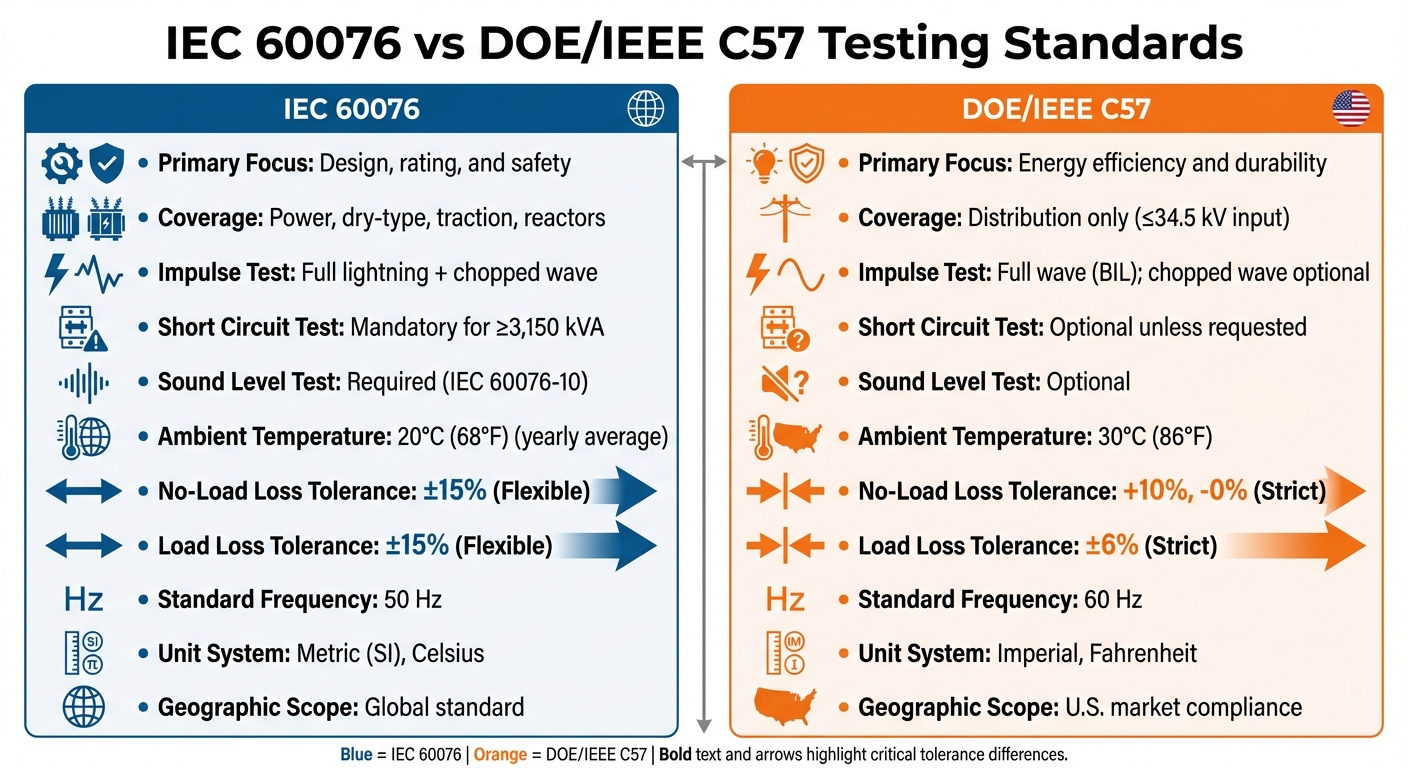
IEC 60076 vs DOE Testing Standards Comparison for Transformers
The IEC 60076 standard oversees transformer design, performance, and safety on a global scale, while DOE standards focus specifically on energy efficiency for U.S. distribution transformers. These DOE requirements are enforced under federal law through 10 CFR Part 431, Subpart K.
The two standards differ in both purpose and technical approach. IEC prioritizes design accuracy and global compatibility, using metric measurements and a 20°C ambient temperature baseline. On the other hand, DOE/IEEE standards are tailored to U.S. grids, employing imperial units and a 30°C baseline, with a focus on conservative design margins. This divergence can lead to compatibility challenges, such as BIL (Basic Insulation Level) mismatches in impulse tests for IEC-tested transformers used in the U.S..
When it comes to loss tolerances, the differences become even more pronounced. IEC 60076-1 allows a ±15% tolerance for no-load losses, whereas IEEE C57 standards (aligned with DOE requirements) impose a stricter range of +10% and -0%. For load losses, IEC maintains the same ±15% tolerance, but IEEE enforces a tighter ±6% range. These stricter tolerances reflect the DOE's emphasis on measurable energy efficiency over design flexibility.
Testing Requirements Comparison Table
| Feature | IEC 60076 | DOE / IEEE C57 |
|---|---|---|
| Primary Focus | Design, rating, and safety | Energy efficiency and durability |
| Transformer Coverage | Power, dry-type, traction, reactors | Distribution only (≤34.5 kV input) |
| Impulse Test | Full lightning + chopped wave | Full wave (BIL); chopped wave optional |
| Short Circuit Test | Mandatory for ≥3,150 kVA | Optional unless requested |
| Sound Level Test | Required (IEC 60076-10) | Optional |
| Ambient Temperature | 20°C (yearly average) | 30°C |
| No-Load Loss Tolerance | ±15% | +10%, -0% |
| Load Loss Tolerance | ±15% | ±6% |
| Standard Frequency | 50 Hz | 60 Hz |
| Unit System | Metric (SI), Celsius | Imperial, Fahrenheit |
The testing requirements highlight additional contrasts. For instance, tests that are mandatory under IEC standards may be optional under DOE/IEEE frameworks. A good example is sound level testing, which is required by IEC 60076-10 but typically optional in North America unless specifically requested. Similarly, short-circuit withstand tests are mandatory for IEC transformers rated at 3,150 kVA or higher but are only performed under IEEE standards if requested.
These differences mean that while IEC-compliant transformers may excel in certain performance areas, they might not meet DOE energy efficiency benchmarks. This distinction has important implications for compliance and labeling, which will be explored further in later sections.
Compliance, Certification, and Labeling
Certification and Required Documentation
Transformers entering the U.S. market must meet DOE efficiency standards outlined in 10 CFR part 431, subpart K. These guidelines incorporate IEC 60076-5:2006 to define testing procedures while prioritizing energy efficiency.
Manufacturers need to provide documentation proving their transformers meet the minimum efficiency standards for their specific equipment class (1–11), kVA rating, and Basic Impulse Insulation Level (BIL). This documentation typically includes details on testing methods, efficiency calculations, and impact assessments. Additionally, third-party certifications such as UL/cUL and CSA listings are often essential, especially for pad-mounted and substation transformers.
Starting May 7, 2025, manufacturers must submit both initial and annual DOE certification reports for basic transformer models. Before pursuing certification, it’s important to confirm whether the transformer falls into one of the 13 exempt categories, such as autotransformers, welding transformers, or units with tap ranges of 20% or more.
Thorough and accurate certification documentation is essential for ensuring compliance and sets the foundation for proper transformer labeling.
Labeling Requirements
Once certification is complete, proper labeling plays a critical role in demonstrating compliance. Transformer nameplates must clearly display the rated load and efficiency levels, which are calculated at specific load points. For low-voltage dry-type transformers, efficiency is measured at 35% of the nameplate-rated load. For medium-voltage dry-type and liquid-immersed transformers, efficiency is calculated at 50% of the nameplate-rated load. These efficiency levels must meet the standards effective July 8, 2024, and comply with even stricter requirements through April 23, 2029.
Meeting higher efficiency standards can lead to increased transformer weight, ranging from 2% to 25%, depending on the type and capacity. This may require adjustments to installation procedures and mounting supports to accommodate the added weight.
Conclusion
Grasping the nuances of both IEC 60076 and DOE procedures is essential for ensuring transformers operate effectively and safely within the U.S. market. The stakes are no small matter - failing an impulse test can lead to hefty financial setbacks, such as $75,000 in redesign costs and a 12-week project delay, as seen in a South American industrial project.
Beyond compliance, these rigorous testing protocols offer manufacturers a solid foundation for success. IEC 60076 serves as a global benchmark for transformer standards, facilitating reliable international trade. On the other hand, DOE standards enforce strict efficiency benchmarks - ranging from 97.89% for 15 kVA units to 99.47% for 2,500 kVA medium-voltage transformers - helping to minimize operational costs over the equipment's lifespan. These efficiency measures not only save money but also improve performance under real-world conditions.
For instance, consider a 50 MVA transformer deployed in a desert grid project. Initially, the unit failed its temperature rise test at 55°C (131°F). After redesigning the cooling system with larger radiators and fans, the retest proved the transformer could handle the extreme environment.
U.S. standards also incorporate conservative safety margins, such as a 30°C (86°F) base ambient temperature compared to IEC's 20°C (68°F). Paired with DOE efficiency verification, these measures ensure transformers are both durable and economical to operate. Whether purchasing through platforms like Electrical Trader or working directly with manufacturers, adhering to these standards helps avoid costly mistakes and ensures long-term reliability.
FAQs
Do IEC-tested transformers automatically meet DOE rules?
Transformers tested under IEC standards do not automatically comply with DOE regulations. Meeting DOE standards involves additional testing and certification processes that go beyond what IEC standards cover. Each regulatory framework has its own specific requirements focused on performance and energy efficiency.
Which tests are most likely to fail when importing to the U.S.?
When importing transformers into the U.S., the tests most prone to failure often relate to compliance with standards like IEC 60076. This standard outlines specific loss limits and efficiency benchmarks that may not align with U.S. Department of Energy (DOE) efficiency standards or regional testing protocols. These differences can cause problems during the evaluation process. To prevent such failures, it's crucial to ensure the transformers meet U.S. requirements beforehand.
What paperwork is needed for DOE certification and labeling?
The necessary paperwork involves providing documentation that demonstrates adherence to energy efficiency standards. This usually includes details like test procedures and performance data outlined in the Department of Energy (DOE) regulations. Make sure all submissions are up to date with the latest standards to fulfill certification and labeling requirements.