Energy-Efficient Transformers vs. Standard Models
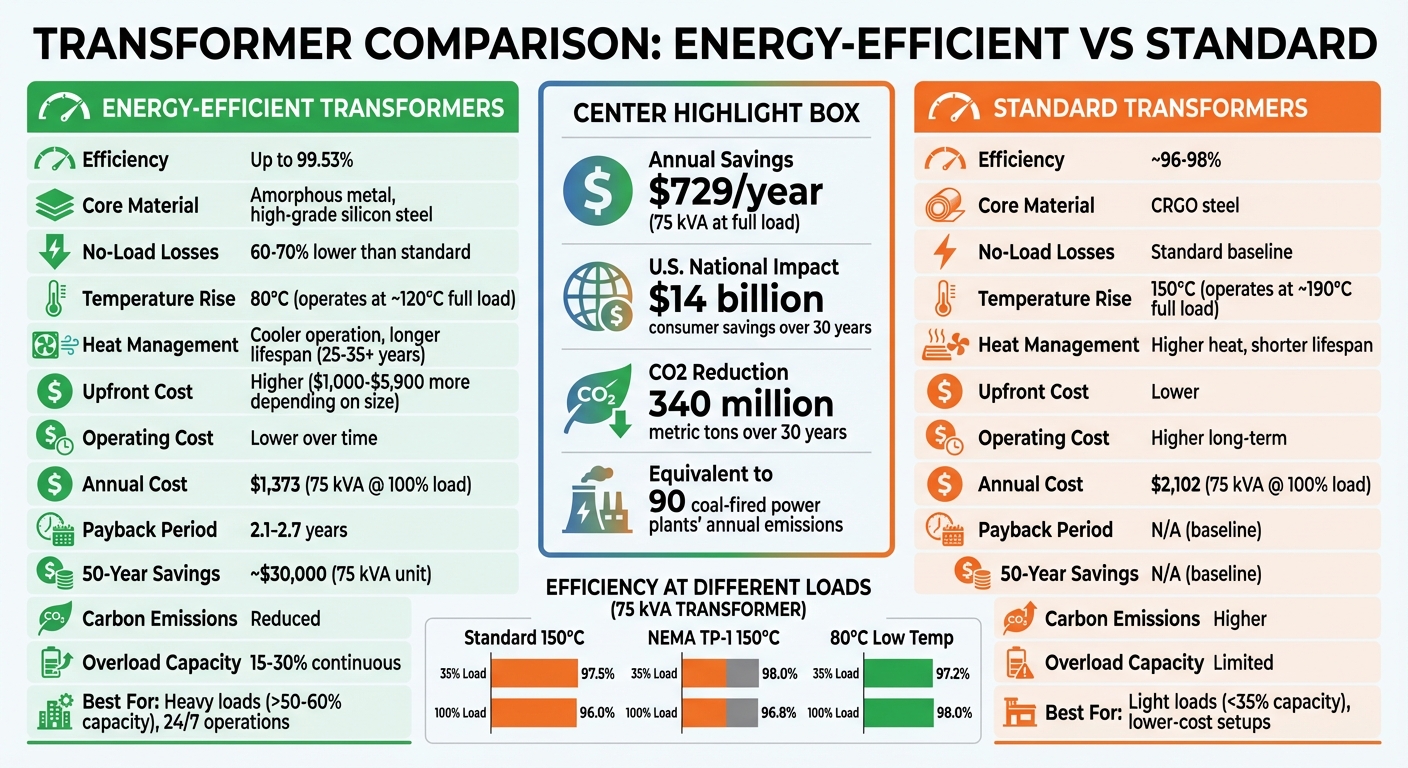
Energy-efficient transformers are designed to reduce energy losses compared to standard models, offering long-term savings despite higher upfront costs. They use advanced materials like high-grade silicon steel and amorphous metal cores, which improve efficiency and lower heat production. Standard transformers, while reliable, consume more energy due to older construction methods.
Key differences include:
- Efficiency: Energy-efficient models achieve up to 99.53% efficiency, while standard ones are slightly less efficient.
- Materials: Advanced cores and windings in energy-efficient units reduce losses significantly.
- Heat Management: Energy-efficient transformers operate cooler, extending their lifespan and reducing cooling costs.
- Cost: Higher initial price but lower operating costs over decades.
- Environmental Impact: Energy-efficient models contribute to lower carbon emissions.
Quick Comparison
| Feature | Energy-Efficient Transformers | Standard Transformers |
|---|---|---|
| Efficiency | Up to 99.53% | ~96%–98% |
| Core Material | Amorphous metal, silicon steel | CRGO steel |
| Heat Management | Cooler operation, longer lifespan | Higher heat, shorter lifespan |
| Upfront Cost | Higher | Lower |
| Operating Cost | Lower over time | Higher |
| Carbon Emissions | Reduced | Higher |
Energy-efficient transformers are ideal for high-load applications and long-term savings, while standard models suit lighter, lower-cost setups. Choose based on your operational needs and budget priorities.
Energy-Efficient vs Standard Transformers: Efficiency, Cost & Performance Comparison
How To Choose The Right Transformer For Your System? - Electrical Engineering Essentials
sbb-itb-501186b
Design and Operating Differences
Energy-efficient transformers stand apart from standard ones due to their advanced materials, improved construction, and better thermal management. These transformers use cores made from amorphous metal alloys or high-grade silicon steel, while standard models rely on traditional cold-rolled grain-oriented (CRGO) steel. These design upgrades not only cut energy losses but also lower long-term operating costs.
Core Materials and Construction
Amorphous metal ribbons, typically 25 microns thick, reduce the magnetic path and limit eddy currents. This results in a significant performance boost: amorphous core transformers reduce no-load losses by 60% to 70% compared to CRGO transformers, with some newer designs cutting core losses by as much as 80%. These transformers also feature high-conductivity copper or aluminum windings with optimized cross-sections to minimize proximity and skin effects. Additionally, their step-lapped and precision-machined core joints ensure even magnetic flux distribution. Despite their enhanced performance, these cores are 10% to 15% lighter than those in standard models.
The improved efficiency of the core is further complemented by advanced thermal design, which sets energy-efficient transformers apart from conventional ones.
Temperature Rise and Heat Management
Temperature rise ratings indicate how well transformers manage heat at full load. Dry-type transformers are typically rated at 80°C, 115°C, or 150°C, measured as the average temperature rise above a 40°C ambient temperature. Energy-efficient models with an 80°C rise operate at approximately 120°C under full load, while standard 150°C rise units reach around 190°C. This 70°C difference has a direct impact on the transformer's lifespan. As noted by the Copper Development Association:
Increased temperature is the major cause of reduced transformer life.
An 80°C rise transformer with Class 220°C insulation has a significant thermal reserve, allowing it to handle continuous overloads of 15% to 30% without damaging the insulation or shortening its lifespan. These cooler-running transformers also reduce the heat load in electrical rooms, cutting ventilation and air conditioning costs by 13%–21%.
Load Efficiency and Energy Losses
Transformers experience two types of energy losses: no-load (core) losses and load losses. No-load losses, determined by the core material, occur continuously whenever the transformer is energized, while load losses increase with the square of the current and rise sharply under heavier loads. According to the EPA, transformer losses in the U.S. total 60 to 80 billion kWh annually, costing end-users $3 to $4 billion. Energy-efficient transformers are designed to minimize both types of losses. For example, a typical 75 kVA commercial transformer incurs about 400W in no-load losses, costing $350 annually at $0.10/kWh just to stay energized. Philip J.A. Ling, Vice President of Technology at Powersmiths Corp., explains:
Core losses are roughly constant from no-load to full-load... They represent a continuous cost, 24/7, for the 25- to 40-year life of the transformer.
The choice of transformer depends on your load profile. Models compliant with NEMA TP-1 or DOE 2016 standards are ideal for light loads (under 35%–40%), while 80°C low-temperature rise models are better suited for heavy loads (over 50%).
Performance and Cost Comparison
Efficiency at Different Load Levels
The way transformers handle efficiency depends heavily on their load levels. Standard 150°C rise transformers tend to hit their peak efficiency - about 98% - when operating at 35% load. On the other hand, energy-efficient 80°C rise transformers shine at higher loads, reaching their top efficiency of roughly 98% when fully loaded.
This creates a tipping point: energy-efficient models outperform standard ones when the load surpasses 50% to 60% of their rated capacity. Below that threshold, standard transformers may hold a slight edge in efficiency. Here’s a comparison for a typical 75 kVA transformer:
| Transformer Type (75 kVA) | Efficiency at 35% Load | Efficiency at 100% Load | Annual Operating Cost (@ 100% Load, $0.08/kWh) |
|---|---|---|---|
| Standard 150°C Rise | ~97.5% | ~96.0% | $2,102 |
| NEMA TP-1 150°C Rise | 98.0% | ~96.8% | $1,682 |
| 80°C Low Temp Rise | ~97.2% | ~98.0% | $1,373 |
Mark Fairhead, Product Manager at Eaton/Cutler-Hammer, offers practical advice for choosing the right transformer:
When a transformer is going to be lightly loaded, a NEMA TP-1 compliant or 115°C low temperature rise model is likely the best option.
For facilities that run heavy equipment around the clock, the numbers speak for themselves. Using an 80°C rise transformer at the same 75 kVA rating can save $729 annually compared to a standard unit. These savings highlight how efficiency impacts long-term costs.
Initial Investment vs. Operating Savings
While energy-efficient transformers deliver lower operating costs, their initial price can be higher. For instance, a 1,500 kVA transformer with an 80°C rise and copper windings costs about $5,900 more than a standard 150°C rise model with aluminum windings. For smaller setups, a 75 kVA energy-efficient unit might cost between $1,000 and $3,000 more than its standard counterpart.
The payback period depends on electricity rates and usage patterns. At $0.09/kWh, the $5,900 premium for a 1,500 kVA transformer pays off in just 2.1 years. Even at a lower rate of $0.07/kWh, the break-even point is only 2.7 years. Philip J.A. Ling, Vice President of Technology at Powersmiths Corp., emphasizes the importance of considering long-term savings:
The lifetime cost of the operating losses far exceeds the purchase cost.
Over a 50-year lifespan, a single 75 kVA energy-efficient transformer can save around $30,000 in electricity costs.
Looking at the bigger picture, the U.S. Department of Energy estimates that updated 2024 efficiency standards will save U.S. consumers $14 billion on energy bills over the next 30 years. Additionally, choosing transformers that exceed DOE conservation standards can cut distribution losses by 11% to 29%. For example, a 75 kVA commercial transformer with 400W in no-load losses could rack up $14,000 in core loss costs over 40 years at $0.10/kWh - often surpassing the initial purchase price of the transformer itself.
Long-Term Benefits of Energy-Efficient Transformers
Longer Lifespan and Lower Maintenance
Energy-efficient transformers are designed to run at significantly lower temperatures compared to standard models. This cooler operation reduces insulation stress, which is a major factor in determining a transformer's lifespan. With these improvements, energy-efficient transformers can last 25 to 35 years or more.
Using high-conductivity copper windings and advanced amorphous cores, these transformers minimize internal resistance and vibration, which helps prevent mechanical failures. As copper.org explains:
Efficient transformers run cooler, and thus more reliably, because of decreased stress on insulation materials.
Modern energy-efficient transformers often include IoT sensors for real-time monitoring, allowing for predictive maintenance. This feature is especially critical for facilities like hospitals and data centers, where unexpected outages can be extremely costly. Additionally, high-efficiency dry-type transformers are fire-resistant and require far less upkeep than traditional oil-filled units, further lowering long-term operating expenses.
In addition to their durability and reduced maintenance needs, these transformers also bring notable environmental benefits.
Environmental and Grid Impact
The extended lifespan and reduced energy waste of these transformers significantly lessen environmental strain. According to the U.S. Department of Energy, the 2024 efficiency standards are projected to cut carbon dioxide emissions by 340 million metric tons over 30 years - comparable to the annual emissions of 90 coal-fired power plants. Highlighting the broader implications, U.S. Secretary of Energy Jennifer M. Granholm stated:
Efficient distribution transformers enhance the resilience of our nation's energy grid and make it possible to deliver affordable electrical power to consumers in every corner of America.
To put it in perspective, upgrading a single three-phase 75 kVA transformer to NEMA Premium efficiency can save 1.19 metric tons of CO2 annually. That's equivalent to planting 28 trees or saving 121 gallons of gasoline. With 70% of the 50 million distribution transformers in the U.S. having been in service for 25 years or more, the opportunity for emissions reductions through widespread upgrades is immense.
Choosing the Right Transformer
Key Takeaways
When selecting a transformer, it’s essential to think beyond the initial price tag. Focusing on full life-cycle costs can reveal long-term savings that justify a higher upfront expense - sometimes 30% to 100% more. These investments often pay for themselves in just one to four years while providing the added benefit of a 15% to 30% overload capacity.
For systems running above 60% capacity, models with an 80°C or 115°C rise are typically more efficient, offering lower losses and quicker payback periods. On the other hand, if your application averages below 35% capacity - like single-shift operations in commercial buildings - standard transformers may be a better fit. These units have smaller cores, resulting in reduced no-load losses.
It’s also important to consider the broader system impacts. High-efficiency transformers often have lower impedance, which can dramatically increase available fault current. For instance, some 1,000 kVA configurations might see fault current jump from 21,000 A to 80,000 A. This could necessitate upgrades to downstream circuit breakers, adding to overall project costs. Always verify both load and no-load loss figures specific to your operational needs.
If your facility includes nonlinear loads - like computers, LEDs, or variable frequency drives - standard transformers may fall short. These environments can cause transformer losses to double or even triple. In such cases, harmonic mitigating or K-rated transformers are better suited to handle the distorted current waveforms while maintaining efficiency. As the Copper Development Association wisely points out:
First cost is not the last cost of any transformer. Complete life-cycle costs must be carefully examined.
These considerations are crucial for finding a transformer that aligns with your operational and financial goals.
How Electrical Trader Supports Your Transformer Needs
To help you make the best choice, Electrical Trader offers a vast selection of new and used transformers. Whether your priority is a high-efficiency copper-wound unit for a demanding industrial application or a cost-effective standard model for lighter use, their marketplace has you covered. The inventory includes dry-type transformers, three-phase units, and substation equipment across various voltage ratings. With the ability to compare specifications, efficiency ratings, and pricing from multiple suppliers in one place, Electrical Trader simplifies the process of finding the perfect transformer for your specific load requirements and budget.
FAQs
How can I tell if my transformer is running above 50% load?
To determine if your transformer is exceeding 50% load, keep an eye on its load consistently. You can do this with a load monitoring system or simpler tools like load gauges. For instance, a 10 kVA transformer running above 5 kVA is operating beyond 50% load. Regular checks help maintain safe and efficient performance levels for your transformer.
What’s the typical payback time for an energy-efficient transformer?
The payback period for an energy-efficient transformer usually falls between 3 to 7 years. This timeframe can vary based on several factors, including the amount of energy saved, the specific load conditions, and the initial investment cost. Over the long run, these transformers can lead to notable cost savings by cutting down on energy use and reducing operating expenses.
Will a high-efficiency transformer increase fault current?
High-efficiency transformers are designed to reduce energy losses and improve overall performance, but they don't inherently increase fault current. The level of fault current is influenced more by the transformer's impedance than its efficiency. While a higher impedance can help lower short-circuit fault currents, this is a result of specific design choices rather than the efficiency rating itself. In short, energy-efficient transformers aim to minimize wasted energy and typically don't impact fault current levels unless their impedance characteristics are intentionally modified.
Related Blog Posts
- Emerging Trends in Transformer Cooling Systems
- Checklist for Choosing Smart Grid-Ready Transformers
- Dry-Type Transformers: Fire Safety Features
- Amorphous Core vs Silicon Steel: Key Differences