Amorphous Core vs Silicon Steel: Key Differences
Transformers rely on their core materials to manage energy transfer efficiently. The two main options - amorphous cores and silicon steel - offer distinct advantages and trade-offs. Here's what you need to know:
- Amorphous cores reduce energy losses by 70–80%, thanks to their non-crystalline structure and high resistivity. They're ideal for low-load, continuous operation but are fragile and cost 2–3 times more than silicon steel.
- Silicon steel cores are durable, cost-effective, and handle high magnetic loads well. However, they have higher energy losses and are less efficient in low-load scenarios.
Quick Comparison
| Feature | Amorphous Core | Silicon Steel |
|---|---|---|
| Energy Efficiency | ~99.5% (low losses) | ~96–97% |
| No-Load Losses | 70–80% lower | Higher |
| Durability | Fragile, needs care | Tough, easy to handle |
| Cost | 2–3x higher upfront | Lower upfront cost |
| Applications | Low-load, continuous use | High-load, industrial use |
Choosing the right material depends on your needs: Amorphous cores save energy long-term but cost more upfront, while silicon steel is a robust, budget-friendly option for heavy-duty use.
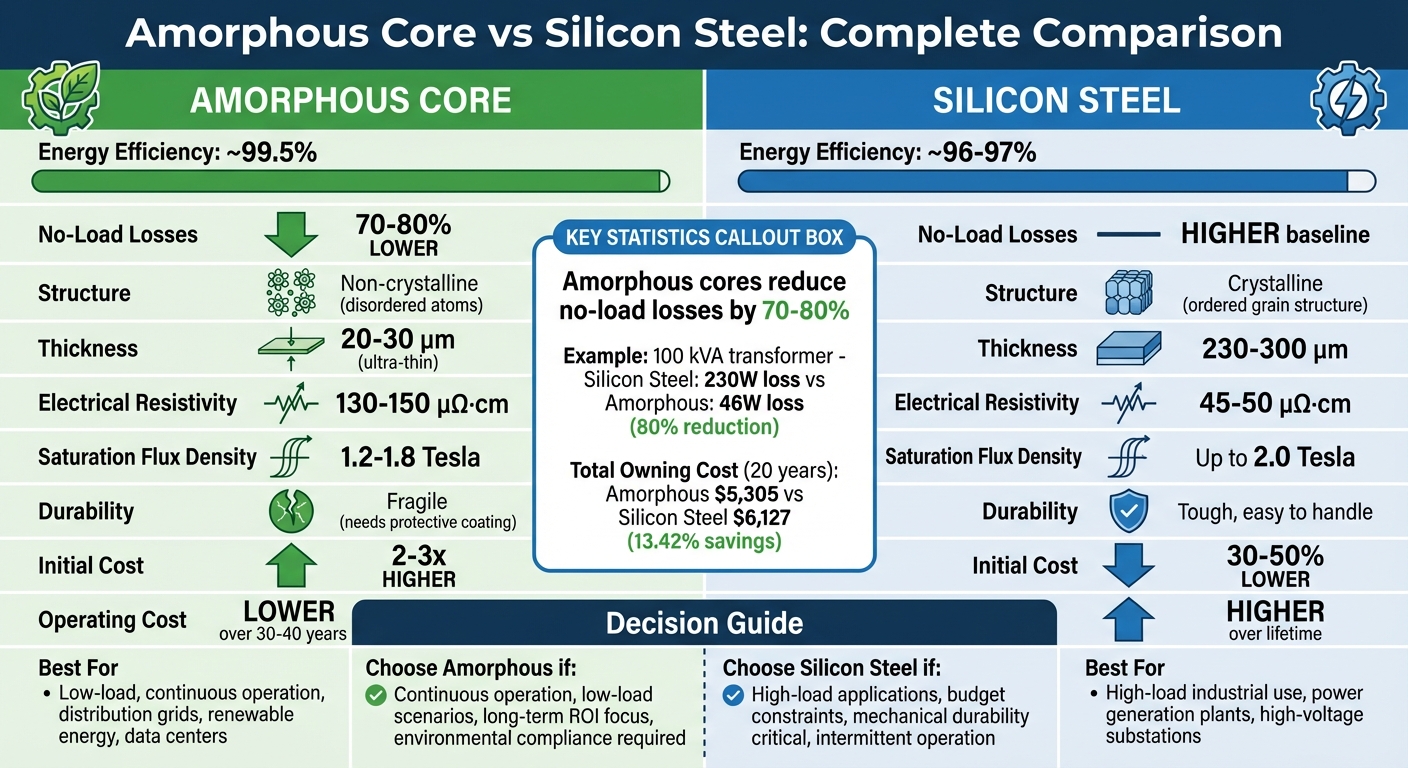
Amorphous Core vs Silicon Steel Transformer Comparison Chart
How to choose transformer core materials?
sbb-itb-501186b
Material Structure and Composition
When comparing the efficiency of transformer cores, the differences between amorphous cores and silicon steel begin at the atomic level. Their distinct structures influence how they handle magnetic fields and energy losses, leading to varying performance outcomes.
Amorphous Core: Non-Crystalline Structure
Amorphous metal uses a unique process called planar flow casting, where molten alloy is cooled at an astonishing rate of about 1,000,000°C per second. This rapid cooling locks the atoms into a disordered arrangement, much like the structure of window glass, but made of metal. This lack of a long-range atomic pattern eliminates grain boundaries, which significantly reduces resistance to the movement of magnetic domains.
The electrical resistivity of amorphous alloys is around 130–150 μΩ·cm - approximately three times higher than that of silicon steel. Additionally, the ultra-thin ribbons, measuring just 25–30 microns (0.001–0.0012 inches) thick, naturally suppress the formation of eddy currents.
"The amorphous structure eliminates grain boundary resistance to magnetic domain movement, reducing hysteresis loss to 1/4 that of silicon steel." - Lushan
However, this disordered structure comes with certain challenges. Amorphous ribbons are about five times harder than silicon steel and are mechanically brittle, making them prone to damage. To address this, protective epoxy coatings are applied, and careful handling is essential during assembly. In contrast, silicon steel follows a more traditional approach in its structure.
Silicon Steel: Crystalline Grain Structure
Silicon steel takes a different route by utilizing a crystalline structure. Through cold rolling and annealing, its grains are aligned to optimize the flow of magnetic flux. Laminations of silicon steel typically measure 0.23–0.3 mm (0.009–0.012 inches) in thickness and have an electrical resistivity of 45–50 μΩ·cm. While its lower resistivity makes it more susceptible to eddy currents than amorphous metal, the thicker laminations help mitigate these effects in most practical applications.
"The crystalline grain structure of the silicon steel allows the magnetic flux flow in one direction thus improving the efficiency of the transformer core." - Daelim Transformer
Silicon steel's ordered structure offers mechanical durability and ease of manufacturing. It can handle physical stress without breaking and retains stable magnetic properties over decades of use. However, the grain boundaries that provide mechanical strength also hinder magnetic domain movement, leading to higher hysteresis losses compared to amorphous cores. While its structure favors robustness, it ultimately impacts transformer efficiency when compared to the amorphous alternative.
Energy Efficiency and Core Losses
The structural makeup of transformer cores plays a key role in energy savings. Core losses - also called iron losses or no-load losses - occur continuously, 24/7, as long as a transformer is energized, even if it isn’t carrying a load. For distribution transformers, which often operate at partial load or idle for most of their lifespan, these constant losses account for a significant portion of wasted energy.
No-Load Loss Comparison
The reduction in core losses with amorphous metals is tied to their non-crystalline structure and ultra-thin ribbon design. Tests across multiple manufacturers and transformer sizes confirm the energy-saving potential of these cores.
In June 2017, researchers at the TEK TRANSFORMER factory in Turkey compared 630 kVA, 34.5/0.4 kV distribution transformers. Their findings showed that an amorphous core prototype cut no-load power losses by 63% compared to an M5-type silicon steel transformer. Hitachi Industrial Equipment Systems reported even greater results: a 100 kVA silicon steel transformer experienced 230W of no-load losses, while its amorphous counterpart produced just 46W - an 80% reduction.
| Manufacturer | Transformer Rating | Silicon Steel Loss (W) | Amorphous Loss (W) | % Reduction |
|---|---|---|---|---|
| Hitachi | 100 kVA | 230 | 46 | 80% |
| ABB Group | 1,000 kVA | 1,150 | 290 | 75% |
| Ferranti-Packard | 25 kVA | 85 | 18 | 79% |
These impressive reductions are largely due to minimized hysteresis and eddy current losses.
Hysteresis and Eddy Current Losses
Core losses are primarily made up of hysteresis losses and eddy current losses.
- Hysteresis losses occur during the magnetization and demagnetization cycles caused by alternating current. Amorphous metals, with their disordered atomic structure, allow magnetic domains to move freely without being hindered by grain boundaries. This significantly reduces the energy required for each cycle.
- Eddy current losses are caused by circulating currents induced by alternating magnetic flux. The high electrical resistivity (130–150 μΩ·cm) and ultra-thin ribbons (20–30 microns) in amorphous cores greatly limit these currents, especially when compared to silicon steel, which has a resistivity of 45–50 μΩ·cm and laminations 0.23–0.3 mm thick.
"The high resistance and thin foils lead to low losses by eddy currents when subjected to alternating magnetic fields." - Wikipedia
By reducing these losses, amorphous cores not only improve efficiency but also decrease heat generation, which is another advantage.
Efficiency Numbers
Amorphous core transformers achieve efficiencies ranging from 98.5% to 99%, compared to 96%–97% for silicon steel transformers. This difference translates into significant energy savings over a transformer's typical 25–30 year lifespan. For example, in a test at 1.2T and 50 Hz, amorphous core material demonstrated a 57.46% improvement in nominal loss compared to 3% SiFe material.
Even small percentage improvements in efficiency can lead to substantial energy and cost savings over time. Additionally, the lower operating temperatures resulting from reduced core losses help extend the lifespan of the equipment and enhance reliability. These efficiency metrics highlight the potential of amorphous cores in advancing transformer design.
Magnetic Properties and Performance
Magnetic properties play a key role in shaping transformer performance. Factors like coercivity, permeability, flux density, and electrical resistivity determine how a transformer core reacts to alternating magnetic fields.
Coercivity and Permeability
Amorphous alloys stand out for their extremely low coercivity, which minimizes hysteresis losses during each AC cycle. They also have high magnetic permeability at elevated frequencies, unlike silicon steel, which is designed for optimal performance at standard 50/60 Hz.
Pourleroi explains, "High permeability means the core can be magnetized and demagnetized more easily with minimal energy loss, which improves overall performance and leads to less wasted energy". Lushan further notes, "Amorphous structure eliminates grain boundary resistance to magnetic domain movement, reducing hysteresis loss to 1/4 that of silicon steel".
These characteristics pave the way for differences in flux capacity and how each material handles varying frequencies.
Flux Density and Frequency Response
Silicon steel boasts a higher saturation flux density, reaching up to 2.0 Tesla compared to the 1.2–1.8 Tesla range of amorphous cores. This higher flux capacity allows silicon steel transformers to handle larger magnetic loads within a compact core, making them ideal for large-scale power distribution.
However, when it comes to higher frequencies, amorphous cores outperform. At 350 Hz and above, they maintain better efficiency, while silicon steel experiences increased losses. Daelim Transformer highlights, "The high electrical resistivity of the amorphous metal helps reduce eddy current losses and this improves overall efficiency at specifically high frequency applications".
Electrical Resistivity
Electrical resistivity is another critical factor. Amorphous cores have approximately three times the resistivity of silicon steel. Combined with their thinner construction, this high resistivity limits circulating eddy currents within the core, further enhancing efficiency.
| Property | Amorphous Core | Silicon Steel |
|---|---|---|
| Coercivity | Very Low | Moderate |
| Permeability | Excellent (high freq) | High (50/60 Hz) |
| Saturation Flux Density | 1.2–1.8 Tesla | Up to 2.0 Tesla |
| Electrical Resistivity | 130–150 μΩ-cm | 45–50 μΩ-cm |
| Typical Thickness | 20–30 μm | 230–300 μm |
Together, these properties influence how transformers are sized and how efficiently they operate in various industrial settings.
Cost, Durability, and Practical Factors
Initial Cost vs Operating Cost
Amorphous core transformers come with a higher upfront cost - typically 16%–30% more than their silicon steel counterparts. For instance, a 2011 study by First Philec showed a 50 kVA silicon steel transformer priced at $2,077, while the amorphous version was $2,415. This price gap stems from the complex manufacturing process and the limited availability of amorphous materials [3,4].
But when it comes to operating costs, the story shifts. Thanks to their ability to cut no-load losses by 70%–80%, amorphous cores waste significantly less energy when energized but not actively carrying a load. Over a standard 20-year lifespan, this efficiency leads to a lower Total Owning Cost (TOC). For example, the TOC for an amorphous transformer is $5,305, compared to $6,127 for a silicon steel unit - a 13.42% savings in the long run.
"Consider both initial and operating costs over the transformer's lifespan."
For transformers in continuous, grid-connected operation, the energy savings often justify the higher initial investment. However, in applications where transformers are used intermittently or for shorter durations, the lower upfront cost of silicon steel might be the more practical choice. These factors highlight the importance of balancing upfront expenses with operational efficiency, especially for continuous-use scenarios where durability and energy performance are critical.
Mechanical Strength and Durability
Cost aside, mechanical durability plays a big role in determining a transformer's performance and overall lifecycle. Silicon steel stands out for its toughness, easily withstanding transportation, installation stress, and environmental vibrations [4,5]. On the other hand, amorphous cores are far more fragile. Their ribbon material is about 10 times thinner than silicon steel sheets - 20–30 μm compared to 230–300 μm [3,5,6].
This fragility necessitates extra protective measures. As Pourleroi explains:
"Amorphous materials tend to be more brittle than silicon steel, which makes them susceptible to stress and potential fractures. As a result, additional design considerations, such as protective casings or epoxy coatings, are often necessary".
Manufacturing challenges further illustrate this brittleness. Only 70%–80% of amorphous ribbons survive the production process without fracturing. The material's delicate nature also limits design flexibility, requiring specialized equipment and protective reinforcements during manufacturing and installation [3,4]. While amorphous alloys are about five times harder than silicon steel, this hardness doesn't translate to better impact resistance, leaving them vulnerable to mechanical shocks and bending stress.
Choosing the Right Core Material
Picking the best core material for a transformer comes down to balancing operational needs, budget constraints, and compliance with regulations. The trade-off between the upfront cost and fragility of amorphous cores versus their long-term energy efficiency plays a significant role in the decision-making process.
When to Use Amorphous Core Transformers
Amorphous cores are excellent for reducing no-load losses, making them ideal for systems that operate under low-load conditions for extended periods. They’re commonly used in utility distribution grids, renewable energy setups like solar and wind farms, and data centers. These cores also shine in smart city projects and micro-grid installations, where idle periods are frequent, and cutting core losses significantly boosts efficiency.
In fact, their efficiency is so notable that U.S. regulators recognize their benefits. For example, a standard 500 kVA amorphous transformer can save about 1,500 kWh annually compared to one made of silicon steel. When scaled across thousands of units, these savings add up quickly. However, for applications with consistently high loads, silicon steel cores might be a better fit.
When to Use Silicon Steel Transformers
Silicon steel is the go-to choice for applications that demand high magnetic loads and robust performance. It’s particularly suited for heavy-duty operations, such as power generation plants, high-voltage substations, and industrial facilities running at or near full capacity. Its higher saturation flux density - up to 2.0 Tesla compared to 1.56 Tesla for amorphous metal - ensures reliable performance without the need for oversized cores.
Cost is another factor where silicon steel stands out. With an initial cost that’s 30–50% lower than amorphous cores, it’s a practical option for budget-conscious projects, especially those with intermittent operation where the immediate savings outweigh long-term energy benefits. Additionally, silicon steel’s durability makes it easier to transport, install, and maintain in demanding environments.
Environmental Regulations and Energy Incentives
Stricter environmental regulations are pushing the industry toward amorphous cores. For instance, the EU Ecodesign Directive mandates high-efficiency transformers that often rely on amorphous cores to meet stringent loss limits. However, for projects with tighter budgets, it’s important to check whether local regulations still permit silicon steel transformers for specific applications.
"The IEA predicts that by 2030, amorphous alloys will dominate 60% of the global distribution transformer market, cutting CO₂ by 500 million tons annually."
Total Owning Cost (TOC) models further highlight the long-term benefits of amorphous cores. Over a 30–40 year lifespan, high-efficiency transformers could save the European Union around 18.5 TWh annually, translating to $1 billion in reduced operating costs. In countries like China and India, widespread adoption of amorphous technology could save 25–30 TWh of electricity each year while slashing CO₂ emissions by 20–30 million tons.
Conclusion
Choosing the right transformer comes down to balancing load requirements and cost considerations. Transformers with amorphous cores are excellent for reducing no-load losses, making them well-suited for distribution grids, renewable energy setups, and other applications where they operate continuously. On the other hand, silicon steel cores offer greater mechanical strength, higher saturation capacity, and can cost up to 50% less upfront compared to amorphous options.
The concept of Total Owning Cost plays a crucial role in this decision. While amorphous core transformers have higher initial costs, their lower operating expenses over a lifespan of 30–40 years can make them more economical in the long run. Silicon steel cores, however, are often preferred in scenarios with tight budgets, high-load industrial needs, or where mechanical durability is a priority. Ultimately, the choice depends on the specific demands of the operation.
As Pourleroi observed, "Amorphous core transformers represent a more modern, eco‑friendly solution, while silicon steel core transformers provide a reliable, budget‑friendly option." Regulatory trends also factor into this decision. Policies like the EU Ecodesign Directive and U.S. DOE classifications lean toward efficiency, favoring amorphous technology. The IEA even predicts that amorphous materials could account for 60% of the global distribution transformer market by 2030. Still, silicon steel remains a dependable choice for powering generation plants and high-voltage substations, where design flexibility and mechanical robustness take precedence over efficiency.
FAQs
How do I calculate payback time for an amorphous core transformer?
To figure out the payback time, you'll need to compare the extra upfront cost of an amorphous core transformer to the yearly energy savings it provides. These transformers can reduce core losses by up to 63% compared to silicon steel cores. The calculation is straightforward: divide the additional cost by the yearly savings.
For instance, if the transformer costs an extra $10,000 and the annual savings amount to $4,000, the payback period would be 2.5 years.
Which transformer type runs cooler and lasts longer in service?
Amorphous core transformers operate at cooler temperatures and have a longer lifespan because their core losses are much lower. The reduced no-load (core) losses lead to less heat generation, improving both their efficiency and durability over time.
Do amorphous core transformers need special handling or installation?
Yes, these materials need to be handled and installed with care due to their fragile nature. Mishandling can result in damage, which might lower their efficiency or cause them to fail entirely. To maintain their performance, it's crucial to adhere to the correct procedures during transportation and installation.