

Emerging Trends in Transformer Cooling Systems
Transformers are critical to power grids, but managing heat is a constant challenge. Overheating accounts for 32% of transformer failures, often due to thermal stress and insulation degradation. Advanced cooling systems and materials are addressing these issues, ensuring reliability and longer lifespans. Here's what you need to know:
- Cooling Methods: Systems like ONAN (natural convection) are simple and cost-effective but limited in heat dissipation. Forced cooling methods (e.g., ONAF, OFAF) actively circulate oil and air, improving efficiency for larger transformers.
- Alternative Fluids: Ester-based fluids, both natural and synthetic, are safer (fire points over 300°C) and more eco-friendly than traditional mineral oil. They also help extend insulation lifespan by absorbing moisture.
- Nanotechnology: Fluids enhanced with nanoparticles improve thermal conductivity and dielectric strength, reducing hotspot temperatures and extending transformer life by decades.
- IoT and Smart Cooling: IoT sensors enable predictive maintenance and real-time temperature control, optimizing performance and preventing failures. Technologies like Fiber Bragg Grating (FBG) sensors and digital twins enhance monitoring accuracy.
- Energy Efficiency: Innovations like low-energy fans and pumps reduce cooling costs and comply with stricter U.S. energy standards set for 2029.
These advancements are reshaping transformer performance, ensuring they meet the demands of aging grids, renewable energy, and electric vehicle infrastructure.
How Do Large Power Transformers Stay Cool? - Electrical Engineering Essentials
New Cooling Methods and Materials
Transformer Cooling Fluid Comparison: Mineral Oil vs Natural Ester vs Synthetic Ester
The world of transformer cooling is evolving quickly as manufacturers and utilities strive to improve performance while addressing environmental concerns. For decades, mineral oil has been the go-to choice, but new alternatives are emerging that prioritize safety and environmental care without sacrificing efficiency.
Natural and Forced Cooling Systems
Transformer cooling systems generally fall into two categories: natural and forced. Natural systems, like ONAN (Oil Natural Air Natural), rely on convection. Here, oil circulates naturally within the transformer, and air flows around the radiators without the help of pumps or fans. This method is simple and cost-effective, making it ideal for smaller transformers. However, its ability to dissipate heat is limited, which can be a drawback for larger or more demanding applications.
On the other hand, forced cooling systems - such as ONAF (Oil Natural Air Forced), OFAF (Oil Forced Air Forced), and ODAF (Oil Directed Air Forced) - use fans or pumps to actively circulate oil and air. These systems are critical for larger transformers, where managing hotspot temperatures is essential to prevent overheating. While these setups are more effective at heat removal, they come with higher installation and operational costs.
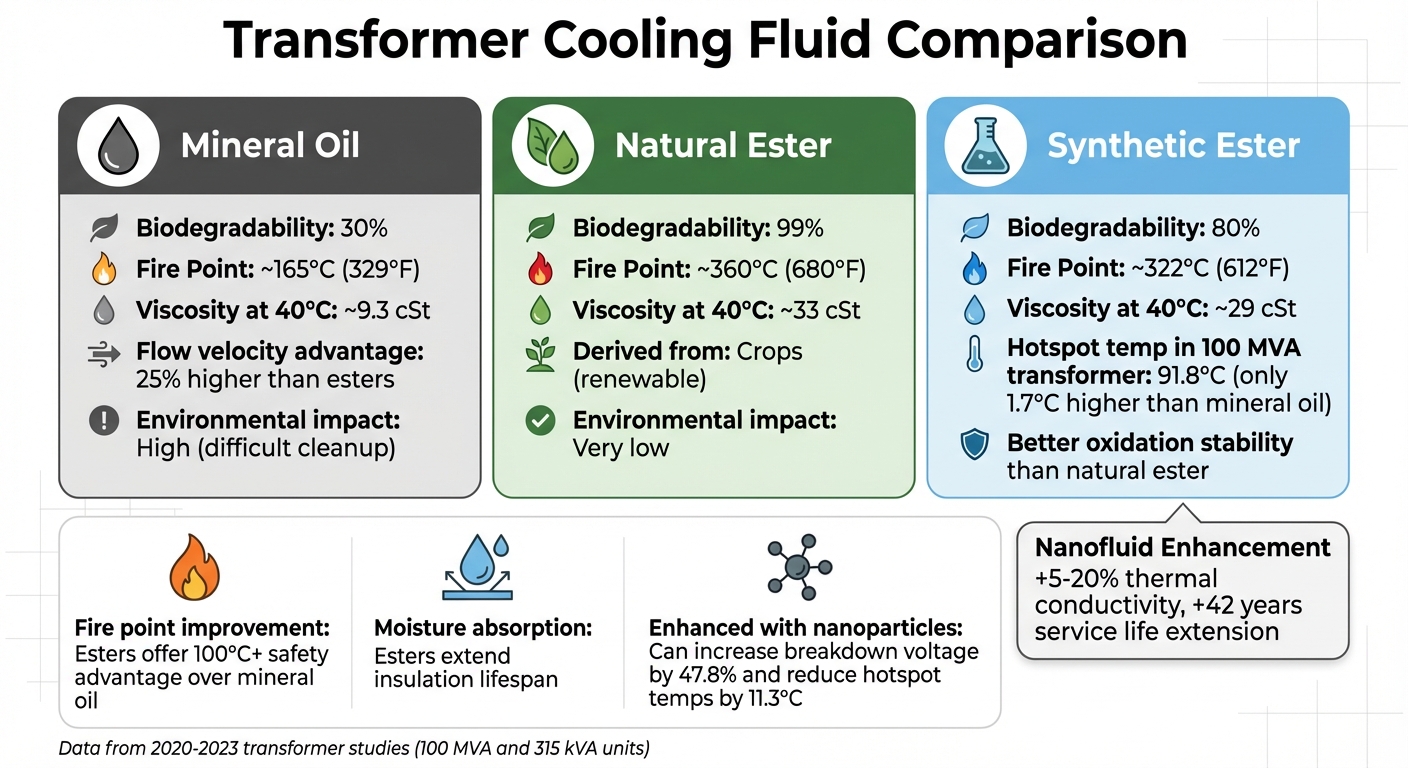
The difference in efficiency between these approaches is notable. In a June 2021 study involving a 315 kVA distribution transformer (13.2 kV/0.4 kV), researchers observed that mineral oil achieved a 25% higher flow velocity through cooling ducts compared to biodegradable esters. This was largely due to differences in viscosity. For context, transformer winding temperature should rise no more than 65°C (149°F) above ambient, with hotspot temperatures staying below 80°C (176°F) at rated load.
In addition to these cooling methods, advancements in alternative fluids are pushing the boundaries of transformer performance.
Ester-Based Fluids and Hybrid Cooling Innovations
Ester-based fluids are becoming popular as replacements for traditional mineral oil. These fluids come in two varieties: natural esters, derived from crops, and synthetic esters. Both types have fire points exceeding 300°C (572°F) - a significant improvement of over 100°C (180°F) compared to mineral oil. This makes them a safer choice, particularly for urban substations.
From an environmental standpoint, esters are a game-changer. Natural esters are 99% biodegradable, a stark contrast to mineral oil, which is only 30% biodegradable. This reduces cleanup costs and minimizes environmental damage in the event of a spill. Additionally, esters absorb more moisture than mineral oil, keeping internal paper insulation drier and extending the transformer's lifespan.
Research supports their effectiveness. In November 2020, a study conducted at Universidad de Cantabria tested a 100 MVA high-power transformer (170/36 kV) using both mineral oil and ester fluids under ONAN cooling. The results showed that synthetic ester produced a hotspot temperature of 91.8°C (197.2°F), just 1.7°C (3.1°F) higher than mineral oil's 90.1°C (194.2°F). This suggests that ester-based fluids can effectively replace mineral oils in high-power transformers operating near rated capacity.
Even more cutting-edge are hybrid systems that combine ester fluids with nanoparticles. These nanodielectric fluids incorporate particles like titanium dioxide, aluminum oxide, or graphene to enhance both thermal conductivity and dielectric strength. For example, optimized nanofluids can increase breakdown voltage by up to 47.8% (reaching 88.7 kV) and improve thermal conductivity by 5–20%. In a recent November 2023 study, adding multi-walled carbon nanotubes at just 0.05 g/L concentration reduced hotspot temperature by 11.3°C (20.3°F), potentially extending the transformer's service life by an impressive 42 years.
| Fluid Type | Biodegradability | Fire Point | Viscosity at 40°C (104°F) |
|---|---|---|---|
| Mineral Oil | 30% | ~165°C (329°F) | ~9.3 cSt |
| Natural Ester | 99% | ~360°C (680°F) | ~33 cSt |
| Synthetic Ester | 80% | ~322°C (612°F) | ~29 cSt |
Smart Cooling Systems with IoT Technology
As cooling materials and systems continue to evolve, smart technologies are stepping in to revolutionize thermal management. Thanks to IoT, maintenance has shifted from reactive to predictive, reducing costs and extending the lifespan of transformers.
Predictive Maintenance with IoT Sensors
IoT sensors are transforming predictive maintenance (PdM) by optimizing the timing of component replacements. This approach ensures parts are used longer while avoiding unexpected failures, which often come with high labor costs and downtime. By the end of 2023, there were approximately 16.1 billion connected IoT devices worldwide, a number projected to surge to 39.9 billion by 2033.
The precision of these sensors is impressive. Take PT100 thermal resistors, for example - they boast a measurement error of just ±0.1°C, a dramatic improvement over standard K-type thermocouples, which have an error margin of ±1.5°C. Such accuracy is vital, as even small temperature changes can significantly impact transformer longevity. According to the 8-degree law, an 8°C (14.4°F) rise in operating temperature can cut the service life of mineral oil–impregnated paper insulation in half.
In high-voltage environments where electromagnetic interference can disrupt traditional sensors, Fiber Bragg Grating (FBG) sensors stand out. They provide localized, interference-free temperature readings within transformer windings. Field tests conducted at 220 kV substations reveal that Bluetooth 5.0 achieves a 98.2% packet delivery ratio at 15 meters, all while consuming less power than Wi-Fi.
This level of precise monitoring sets the stage for real-time cooling adjustments that adapt dynamically to operating conditions.
Real-Time Temperature Control
Continuous monitoring does more than just catch problems early - it also fine-tunes cooling performance in real time. One key metric is the hotspot temperature (HST), which determines the thermal stress a transformer endures. As noted in MDPI Energies, "The temperature at the hotspot ultimately dictates the thermal capacity of the transformer, making it a primary consideration in cooling system design".
Digital twin technology enhances this process by creating a virtual model of the transformer, allowing engineers to simulate operating conditions safely. Meanwhile, deep learning models like CNNs and RNNs analyze sensor data to uncover subtle thermal patterns.
Real-time data also opens the door to dynamic load rating. This capability lets utilities safely push transformers beyond their standard capacity during cooler weather or peak demand, without accelerating insulation wear. For those operating on tight budgets, platforms like Arduino and ESP32 microcontrollers offer a cost-effective way to develop monitoring systems without requiring heavy investments.
sbb-itb-501186b
Energy Efficiency and Environmental Compliance
With real-time monitoring becoming the norm, the efficiency of cooling systems themselves is taking center stage. Transformers are now grappling with growing grid demands and stricter efficiency requirements. In April 2024, the U.S. Department of Energy (DOE) finalized new Energy Conservation Standards for Distribution Transformers, which manufacturers must comply with by April 23, 2029. These updated standards build on earlier advancements in cooling materials and IoT technologies, making energy efficiency a key focus in transformer innovation. This regulatory momentum aligns with the latest developments in cooling hardware and smart control systems.
Low-Energy Fans and Pumps
Traditional cooling fans, which often run continuously, not only waste energy but also reduce equipment lifespan. In November 2022, researchers at Virginia Tech unveiled a forced air-cooling system for 15-kW planar transformers that slashed power consumption by a factor of four - down to just 6.8 W - compared to standard 120×120 mm fans. Their innovative design used converging air ducts and epoxy resin cast windings to reduce heat transfer barriers. This approach achieved a threefold reduction in cooling system volume and lowered peak winding temperatures by 8%.
Smart controls, powered by IoT sensors, add another layer of efficiency by activating fans and pumps only when hotspot temperatures exceed pre-set thresholds. For instance, Oil-Directed Air-Forced (ODAF) systems channel cooled oil directly to transformer windings through internal ducts, ensuring critical components receive proper cooling while avoiding energy waste from oil bypassing unnecessary areas. Together, these advancements are driving the shift toward smarter, more efficient cooling solutions.
U.S. Regulations Driving Cooling Technology
Federal regulations are steering manufacturers toward more energy-efficient cooling designs. The DOE Energy Policy and Conservation Act requires periodic updates to ensure standards remain both technologically achievable and economically viable. According to the DOE, "DOE has determined that the amended standards for these products would result in significant conservation of energy and are technologically feasible and economically justified". This creates a unified national framework, as states cannot set separate standards unless they obtain an exemption, further pushing the industry toward high-efficiency solutions.
Sandra Sorte and her colleagues at the University of Aveiro highlight that mineral oil "presents significant limitations, including low fire resistance, non-biodegradability... These drawbacks are increasingly problematic as electricity demand rises and stricter environmental standards are imposed".
In response, synthetic esters have emerged as a promising alternative, offering approximately 80% biodegradability and better oxidation stability than natural esters. Additionally, nanofluids - insulating fluids enhanced with nanoparticles - can boost thermal conductivity by 5% to 20%. This improvement enables transformers to dissipate heat more effectively without needing extra cooling hardware.
Cooling Solutions for Specialized Applications
As transformers are pushed to handle higher voltages and operate in tougher environments, their cooling systems must rise to the challenge. High-voltage transmission units and newer solid-state designs each bring unique thermal demands that go beyond what standard cooling methods can handle.
High-Voltage Transformer Cooling Requirements
High-voltage transformers often face a critical issue: localized "hotspots" where temperatures can soar well above safe limits. This problem is even worse when nonlinear loads, such as those from renewable energy sources or electric vehicle (EV) charging, introduce harmonic distortion. These distortions can raise hotspot temperatures by as much as 18.7°C. Such elevated temperatures drastically shorten the lifespan of insulation, making precise thermal management a necessity.
To address this, modern high-voltage systems employ oil-directed (OD) cooling. This method uses internal ducts and oil washers to guide coolant through the windings in a zigzag pattern, ensuring the oil reaches critical components instead of simply flowing along the tank walls. A study conducted in November 2025 by State Grid Anhui Electric Power Co. demonstrated the effectiveness of this approach. Using a 50 MVA SSZ11-50000/110 transformer equipped with optical-fiber sensors embedded in the winding discs, researchers found that their multiscale coupling model could predict hotspot temperatures with a deviation of only 3.1 K. Additionally, the oil washers created localized temperature differences of up to 5.3 K.
Ester-based fluids are gaining traction as a replacement for traditional mineral oil in high-voltage transformers, particularly at renewable energy sites. While these fluids have higher viscosity, they offer improved fire safety and environmental compliance, making them a better fit for demanding applications.
Although high-voltage systems rely on specialized cooling techniques like oil-directed methods, the rise of solid-state transformer designs introduces an entirely new set of cooling challenges.
Solid-State Transformer Cooling
Solid-state transformers (SSTs) operate at higher frequencies than traditional transformers, which leads to increased heat loss per unit volume. As Minh Ngo from Virginia Tech explains:
"Due to increased loss per unit volume in power transformers when operating at higher frequency, the increase in cooling system size can outweigh high-frequency transformer (HFT) size reduction benefits".
This means SSTs require advanced cooling solutions that are both compact and highly efficient - especially for applications like EV charging stations and data centers.
In November 2022, researchers at Virginia Tech showcased a forced air-cooling system for 15-kW, 500-kHz planar Litz-wire transformers. This system achieved a power density of 635 W/in³ with a peak height of just 1.7 inches (43 mm). It reduced peak winding temperatures by 8% and cut cooling power consumption significantly - down to just 6.8 W compared to standard 120×120 mm (4.7×4.7 in) fans. Its low-profile design fits neatly into 1U rack spaces while still delivering excellent thermal performance.
Additionally, SSTs are increasingly adopting hybrid liquid/air cooling systems that integrate directly with power electronics. These systems are essential for managing the complex electrical flows required in fast EV charging and high-density data centers, where traditional oil-immersed transformers fall short of meeting the demands.
Conclusion and Where to Find Advanced Transformers
Main Trends in Transformer Cooling
The latest trends in transformer cooling focus on three key areas: sustainability, compact design, and smarter technology. These shifts address the challenges of managing heat and meeting the growing demands of modern grids. Innovations like alternative cooling fluids and nanotechnology are pushing the boundaries of efficiency. Hybrid cooling systems, for example, can shrink transformer sizes by as much as 50% while reclaiming up to 90% of heat losses.
Advanced tools like CFD modeling and AI-driven monitoring are also changing the game. They allow for precise control of hotspot temperatures, which can extend the lifespan of transformers. These advancements are especially critical as stricter U.S. regulations and the push for grids to support electric vehicle charging and renewable energy integration come into play. Together, these technologies are reshaping transformer performance and providing buyers with the tools to make informed decisions when selecting equipment.
Finding Transformers with Advanced Cooling on Electrical Trader
With these advancements in mind, choosing the right transformer is more important than ever. Electrical Trader offers a wide range of new and used transformers equipped with cutting-edge cooling technologies. Look for models labeled with terms like ODAF or ODAN, which indicate systems that direct coolant into the windings for better performance.
Transformers featuring ester-based fluids or thermally upgraded insulation are also worth considering. These features not only meet modern environmental standards but also enhance fire safety. If space is a concern, dry-type or hybrid models with compact designs and efficient cooling systems might be the best fit. Electrical Trader's organized listings make it easy to compare specifications, including features like CFD-optimized radiators and compatibility with advanced monitoring tools for tracking hotspots in real time.
FAQs
What advantages do ester-based fluids offer compared to traditional mineral oil in transformer cooling?
Ester-based fluids offer a range of benefits over traditional mineral oil when it comes to transformer cooling. For starters, they are biodegradable and non-toxic, which means they pose a much lower risk to soil and water if a leak or spill occurs. This makes them a cleaner, more environmentally conscious option. On top of that, esters boast a higher flash point, which significantly reduces fire hazards, adding an extra layer of safety.
What’s more, ester fluids are derived from renewable resources, aligning perfectly with today’s push for responsible and sustainable resource use. These qualities make ester-based fluids a smart choice for those looking to enhance both safety and environmental responsibility in transformer cooling systems.
How does nanotechnology improve transformer cooling systems?
Nanotechnology is making waves in transformer cooling systems through the use of nanofluids - coolants infused with tiny nanoparticles like boron nitride or zirconium dioxide (ZrO₂). These nanoparticles boost the thermal conductivity of standard cooling fluids, allowing heat to dissipate more effectively. The result? Hotspot temperatures drop by 5–10 °F, which can play a big role in extending the lifespan and improving the reliability of transformers.
But that's not all. Nanofluids also improve the dielectric properties of transformer oils, enhancing the system's overall performance. By fine-tuning the characteristics of these nanoparticles, engineers are tackling issues like stability and long-term efficiency. This makes nanofluids a forward-thinking solution for the evolving needs of modern electrical grids.
How does IoT improve the efficiency and reliability of transformer cooling systems?
IoT is revolutionizing transformer cooling systems by introducing real-time monitoring and data-driven decision-making. With wireless sensors in place, it’s possible to continuously track temperatures, spot hotspots, and detect unusual thermal patterns - all without any physical contact. This means maintenance becomes more precise, downtime decreases, and overheating issues are minimized.
Beyond just temperature tracking, IoT combines data from multiple sources like thermal performance, vibration levels, and dissolved gas analysis. This creates a complete picture of the transformer's health. Using predictive maintenance powered by this data, potential cooling issues can be identified and resolved early, which not only extends the transformer's lifespan but also ensures it operates reliably.
On top of that, IoT-driven tools such as digital twins and machine learning algorithms take cooling optimization to the next level. These systems adapt dynamically to real-time conditions, making cooling processes more efficient and stable. The result? Enhanced energy efficiency, reduced risk of failure, and improved overall performance.