How Transformers Improve Industrial Efficiency
Transformers are essential for powering industrial operations, but inefficiencies can lead to high energy costs and frequent power failures. Upgrading to high-efficiency transformers can save billions of dollars annually, reduce downtime, and lower carbon emissions. Here’s a quick breakdown:
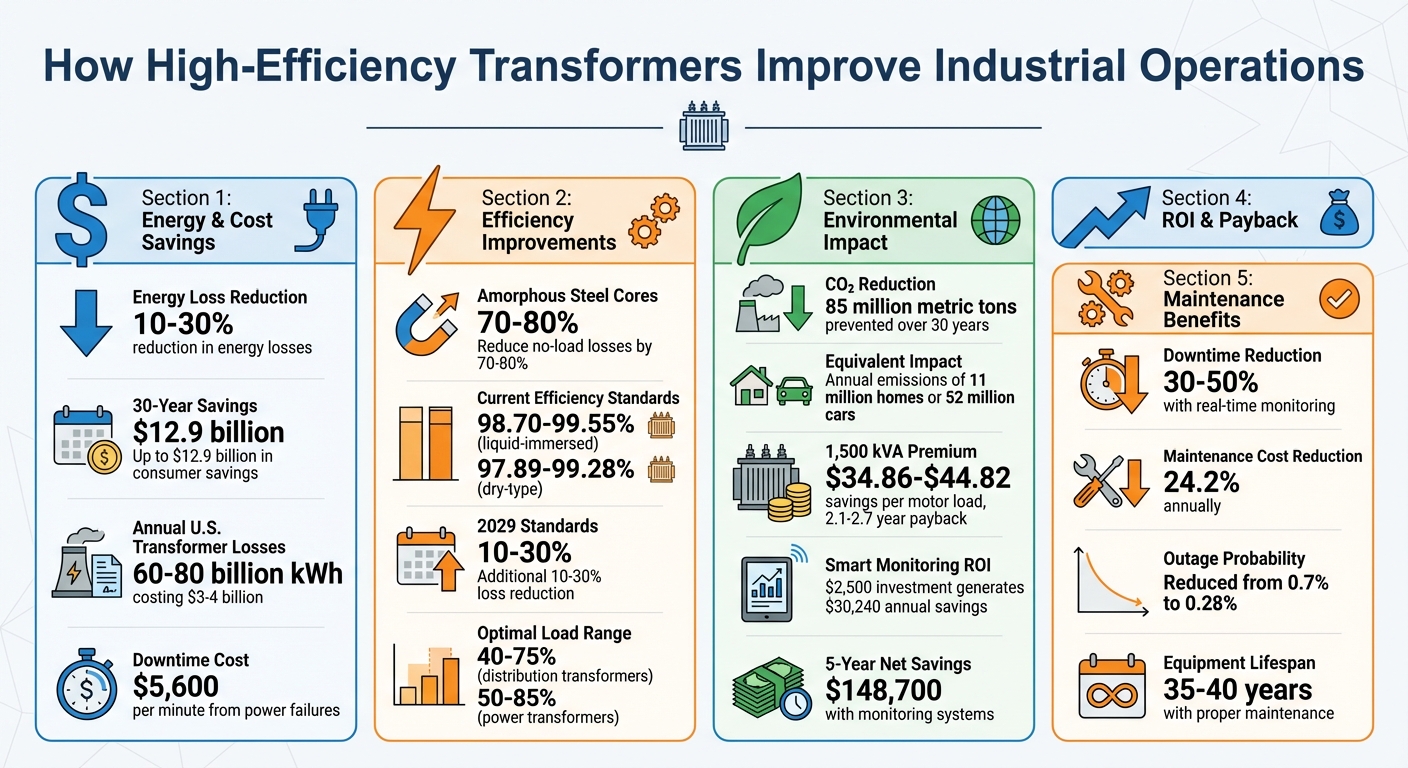
- Energy Savings: High-efficiency transformers cut energy losses by 10–30%, saving up to $12.9 billion over 30 years.
- Cost of Downtime: Power failures linked to transformers cost industries $5,600 per minute. Efficient transformers reduce these risks.
- Materials and Design: Using advanced materials like amorphous steel cores reduces energy loss by up to 80%.
- Smart Monitoring: Real-time monitoring prevents overheating, manages load levels, and extends equipment life.
- Environmental Impact: Upgrades can prevent 85 million metric tons of CO₂ emissions over 30 years.
Investing in modern transformers not only reduces operating costs but also supports long-term reliability and sustainability. The total cost of ownership (TCO) is key - efficient transformers pay for themselves through energy savings and reduced maintenance.
High-Efficiency Transformers: Energy Savings, Cost Benefits, and Environmental Impact
Features of High-Efficiency Transformers
Efficiency Ratings and Standards
The U.S. Department of Energy (DOE) has implemented mandatory efficiency standards under 10 CFR 431, which have been in effect since January 1, 2016. More recently, in April 2024, the DOE finalized updated standards that will take effect on April 23, 2029. These updates are projected to cut energy losses by an additional 10% to 30%. Current requirements demand efficiency levels of 98.70–99.55% for three-phase liquid-immersed transformers and 97.89–99.28% for dry-type units. The upcoming standards aim to further reduce losses by up to 20% for liquid-immersed transformers and up to 30% for low-voltage dry-type units.
Efficiency tests are conducted under simulated real-world conditions, with low-voltage dry-type transformers tested at 35% load and medium-voltage units at 50% load. These rigorous benchmarks push manufacturers to adopt advanced designs that significantly minimize energy losses.
Materials and Design That Reduce Energy Loss
Adhering to DOE standards involves more than meeting regulatory requirements - it demands innovative design strategies, particularly in the choice of core materials and winding techniques. The core material plays a pivotal role in transformer efficiency. While traditional transformers use grain-oriented electrical steel (GOES), high-efficiency transformers often feature amorphous steel cores. These cores, with their disordered atomic structure, dramatically reduce magnetic hysteresis losses during each magnetization cycle. Manufactured as ultra-thin ribbons, approximately 25 microns thick, amorphous steel cores can cut no-load losses by 70% to 80% compared to conventional silicon steel.
"Almost all transformers produced under the new standard would feature amorphous steel cores, which are significantly more energy efficient than those made of traditional, grain-oriented electrical steel."
- U.S. Department of Energy
Amorphous steel also limits eddy currents due to its high resistivity, achieving efficiency levels of 98.5–99%, compared to 96–97% with GOES. By 2029, the DOE estimates that approximately 25% of the market will transition to amorphous steel, while the remaining 75% will continue using high-grade GOES.
The choice of winding materials and temperature rise ratings also plays a crucial role in improving efficiency. Copper windings, while more expensive than aluminum, offer superior conductivity. Additionally, transformers designed with lower temperature rise ratings - such as 176°F (80°C) or 239°F (115°C) instead of the standard 302°F (150°C) - incorporate extra conductor material. This design reduces resistance and minimizes load losses, especially when transformers operate above 35% of their capacity. By addressing both core losses and the load-dependent nature of coil losses, these designs ensure optimal performance.
sbb-itb-501186b
Transformer Efficiency EXPLAINED: When is it at its Maximum?
How to Improve Transformer Efficiency in Industrial Operations
Advances in materials and design are only part of the solution when it comes to optimizing transformer performance. Operational practices play an equally important role in ensuring transformers run efficiently in industrial settings.
Managing Transformer Load Levels
Transformer losses stem from two sources: constant no-load losses and load-dependent I² losses. Operating at 90% capacity generates significantly more heat than running at 50% capacity due to the square of the current (I²), which causes winding losses to escalate quickly when overloaded.
Many transformers in industrial operations don't run at their most efficient load levels. For example, distribution transformers (≤2.5 MVA) are most efficient at 40%–75% load, while larger power transformers perform best at 50%–85% of their rated capacity. Operating outside these ranges can lead to wasted energy - excessive core losses when underloaded or higher winding losses when overloaded.
Phase balancing is another critical factor. Uneven current across phases causes one winding to overheat, while the others remain cooler, leading to thermal stress and reduced efficiency. Regularly monitoring and redistributing loads across all three phases can prevent this issue. Additionally, staggering motor starts or using sequential load control can help minimize inrush currents that unnecessarily spike load losses.
Choosing the right transformer size from the start can also prevent inefficiencies. Oversized transformers incur high no-load losses, while undersized ones experience excessive copper losses and overheating. When purchasing, focus on efficiency ratings at 35–50% load, as transformers rarely operate at full capacity in industrial applications.
Effective load management not only enhances energy efficiency but also ensures stable voltage and better power quality.
Maintaining Voltage Regulation and Power Quality
Voltage regulation, which refers to the change in output voltage from no-load to full-load, has a direct impact on transformer efficiency. Poor power quality forces transformers to work harder.
"Ideally, there should be no change in the transformer's output voltage from no-load to full-load."
- Mark Lamendola, Expert in Maintenance Management
One way to improve power quality is by installing capacitor banks for power factor correction. This reduces winding current by up to 20%, significantly cutting copper losses. The effect is even more pronounced at lower power factors - operating at 0.75 results in 77.8% more copper losses compared to operating at 1.0.
Harmonics from nonlinear loads, such as variable frequency drives (VFDs) and computers, can double or triple transformer losses. For example, a 75 kVA transformer with 2% losses at 35% loading may see losses jump to 4%–6% when serving equipment with high harmonic distortion. Using K-rated transformers or active harmonic filters can help mitigate these effects and protect transformer efficiency.
Routine maintenance also plays a key role in supporting power quality. Activities like oil filtration restore cooling and dielectric strength, while cleaning bushings prevents surface leakage and corona losses. Thermal imaging can identify overheating connections or tank walls, signaling internal issues before they escalate.
Real-time monitoring systems complement these efforts by ensuring voltage regulation and power quality are consistently maintained.
Using Smart Monitoring Systems
Real-time monitoring transforms reactive repairs into predictive maintenance. Sensors that track power quality, voltage fluctuations, load imbalances, and temperature provide continuous insights into transformer health. These systems can reduce equipment downtime by 30%–50%, which is significant given that industrial downtime costs approximately $5,600 per minute.
The upfront cost of an IIoT monitoring device and integration is around $2,500. However, Hammond Power Solutions' 5-year cost model shows this investment can generate $30,240 in annual savings, leading to net savings of $148,700 over five years. Additionally, online monitoring can cut annual maintenance expenses by 24.2% and lower the probability of major outages from 0.7% to 0.28%.
Key metrics like Total Harmonic Distortion (THD), K-factor ratings, and voltage unbalance should be monitored for hidden electrical stress. For instance, a 3% voltage unbalance can raise winding temperatures by 15°F to 20°F (15°C to 20°C), accelerating insulation wear. Installing Class A power quality meters on critical transformers provides waveform-level data, uncovering issues like eddy current losses caused by individual harmonics.
Modern IIoT-enabled transformers support standard communication protocols like Modbus, TCP/IP, and Ethernet IP, making it easier to integrate them into existing automation systems. Alerts for parameters like THD or inrush currents allow for immediate action, preventing damage to insulation. Time-stamped data logging also creates detailed maintenance records, helping identify trends and troubleshoot performance issues.
Cost Savings and Environmental Benefits
Calculating Energy Savings
Transformers operate continuously for decades - typically 25 to 40 years. Even small improvements in efficiency can lead to major cost savings over that time. According to the U.S. Department of Energy, high-efficiency transformers could save consumers up to $12.9 billion over a 30-year span.
Take this example: upgrading a 150 kVA transformer from TP‑1 standards to DOE 2016 compliance saves about 6,964 kWh annually. At $0.15 per kWh, that’s approximately $1,045 in yearly savings. On a larger scale, a 1,500 kVA premium-efficiency transformer could save between $34.86 and $44.82 per 25 hp motor load annually, depending on local electricity costs.
The Environmental Protection Agency (EPA) estimates that transformer losses across the U.S. account for 60 to 80 billion kWh annually, costing end-users between $3 billion and $4 billion. For context, a standard 75 kVA transformer with 400 W of no-load losses could rack up $14,000 in electricity costs over 40 years at $0.10 per kWh. This highlights the importance of Total Cost of Ownership (TCO), as operating losses can make up as much as 96% of a transformer's total life cycle cost.
"Buying based on life cycle cost would save literally hundreds of thousands of dollars in operating losses over the installed life for transformers in a typical facility."
- Philip J.A. Ling, P.E., Vice President of Technology, Powersmiths Corp.
Efficient transformers also produce less heat, which reduces the load on HVAC systems in industrial facilities. When calculating return on investment (ROI), operators should consider not only energy savings but also reductions in peak demand (kW) and kVA charges. Facilities with high nonlinear loads - like those using computers or variable frequency drives - can benefit further by adding harmonic filters to minimize related losses.
These savings don’t just reduce costs - they also contribute to meaningful environmental improvements.
Reducing Carbon Emissions
By wasting less energy as heat, high-efficiency transformers play a key role in cutting carbon emissions. The DOE’s 2024 standards are projected to reduce carbon dioxide emissions by nearly 85 million metric tons over 30 years - equivalent to the combined annual emissions of 11 million homes.
Consider the impact of upgrading a single three-phase 75 kVA transformer: it can save approximately 1.19 metric tons of CO₂ annually, which is like planting 28 trees or saving 121 gallons of gasoline. Previous DOE standards have already helped avoid 265 million metric tons of CO₂ emissions, comparable to the annual emissions of 52 million cars.
These reductions not only help facilities meet sustainability goals and comply with environmental regulations but may also open doors to participating in emissions trading programs by selling unused carbon credits.
"Improvements in energy efficiency of electrical equipment reduce the greenhouse gas (GHG) emissions and contribute to the protection of the environment."
More efficient transformers can also reduce distribution losses by 11% to 29%. For high-loss units, the environmental cost of transformer losses can amount to about 35% of the transformer's purchase price.
The combination of reduced emissions and operational savings makes these upgrades a win-win for both businesses and the planet.
Return on Investment for Industrial Operations
High-efficiency transformers not only cut energy expenses but also offer financial returns through reduced maintenance costs and extended equipment lifespan. To maximize ROI, it’s critical to evaluate the Total Cost of Ownership (TCO) - especially since the purchase price typically accounts for just 4% of lifetime costs.
For instance, upgrading a 150 kVA transformer from TP‑1 to DOE 2016 standards, which costs about $5,500, could pay for itself in roughly 5.2 years, thanks to annual savings of $1,045. Similarly, a premium-efficiency 1,500 kVA transformer with a $5,900 price premium could achieve a payback period of 2.1 to 2.7 years, depending on electricity rates ($0.07 to $0.09 per kWh).
| Transformer Size | Upgrade Type | Annual Energy Savings | Annual Dollar Savings (Est.) | Payback Period |
|---|---|---|---|---|
| 150 kVA | TP‑1 to DOE 2016 | 6,964 kWh | $1,045 (at $0.15/kWh) | ~5.2 years |
| 1,500 kVA | Standard to Premium | 498 kWh (per 25 hp motor load) | $34.86–$44.82 (per motor) | 2.1–2.7 years |
To optimize ROI, industrial operators should conduct energy audits to identify older, inefficient transformers (pre‑TP‑1 or pre‑DOE 2016). Special attention should be given to measuring total harmonic distortion (THD), as high harmonic content from nonlinear loads can lower efficiency and may require additional filtering. Utility rebates and government incentives can also help shorten the payback period.
Maintenance and Purchasing Guidelines
Transformer Maintenance Practices
Keeping transformers in top shape involves a few essential practices. Start by clearing dust and debris from cooling vents and ducts regularly. Blocked airflow can cause hot spots, which degrade insulation over time. For dry-type transformers, use a vacuum instead of compressed air to clean - this prevents contaminants from being pushed deeper into the windings.
Infrared thermography, combined with infrared windows, is a safe and effective way to spot loose connections or overloaded components without shutting down the transformer. To put it in perspective, a single 1-milliohm resistance in a 75 kVA transformer can produce 43.3 watts of heat.
Electrical connections should be tested and re-torqued regularly, following the manufacturer’s specifications and using calibrated tools. For aluminum cable connections, applying anti-oxidizing compounds ensures a stable, low-resistance bond. Liquid-filled transformers benefit from routine Dissolved Gas Analysis (DGA) and moisture testing to monitor insulation health and detect internal arcing. For dry-type units, Transformer Turns Ratio (TTR) tests and dielectric absorption tests are key to evaluating insulation condition.
"Heat accumulation will degrade the transformer's essential insulation system while also contributing to premature failure or end of life." - Frank Basciano, Global Product Manager, ABB Inc.
Well-maintained transformers can last 35 to 40 years, but neglect can cut that lifespan in half. The stakes are high - unplanned outages from transformer failure can cost manufacturing facilities anywhere from $500,000 to $5 million per hour. To avoid this, ensure a 6-inch clearance around the unit for proper ventilation.
Beyond extending the equipment’s life, good maintenance practices save energy, which is crucial for improving industrial efficiency. Plus, a well-maintained transformer simplifies the process of selecting replacements, ensuring smooth operations in the long term.
Where to Buy Quality Transformers
Choosing the right transformer is just as important as maintaining it. Start by assessing your load profile, including your current power needs and anticipated growth over the next five years. Keep in mind that transformers are rated in apparent power (VA), but loads are measured in active power (W). A helpful rule: usable power is about 85% of apparent power, so for a 1 MW load, you’d need a transformer rated around 1.17 MVA.
If your facility uses non-linear loads - such as variable frequency drives, LED lighting, or computers - invest in K-rated transformers (K-4, K-13, or K-20). These are designed to handle harmonic-induced heat without damaging the insulation. Make sure your equipment complies with IEEE C57 standards for design and performance, as well as NEC Article 450 for installation and grounding.
For sourcing, Electrical Trader is a reliable marketplace offering a variety of new and used transformers tailored for industrial applications. Their inventory includes three-phase transformers, substation transformers, and specialized units for specific voltage needs. Whether you’re replacing a failed unit or upgrading your facility, working with trusted distributors ensures you get equipment that meets efficiency standards while staying within budget.
Avoid focusing solely on the purchase price. Instead, evaluate the Total Cost of Ownership (TCO) by factoring in energy losses over the transformer’s 20-year lifespan. This decision can significantly impact operational costs. High-efficiency transformers often pay for themselves within 10 years when replacing older models. If your average daily load is 40% or less, opt for a NEMA TP-1 compliant transformer. For loads consistently above 50%, an 80°C low temperature rise model is a more cost-effective choice.
Conclusion
Optimizing transformer efficiency isn’t just about cutting costs - it’s about achieving long-term operational improvements. Over their 25–30 year lifespan, high-efficiency transformers deliver measurable financial and performance benefits. According to the U.S. Department of Energy, adopting higher efficiency standards could save consumers up to $12.9 billion over 30 years and prevent approximately 265 million metric tons of CO₂ emissions - the equivalent of removing 52 million cars from the road each year.
"Considering the life expectancy of a transformer and the fact that the transformer will be on 24 hours a day, 7 days a week for the next 25-30 years, even small energy efficiency improvements will pay dividends for decades." - Hammond Power Solutions
Beyond cost savings, high-efficiency transformers bring operational advantages. They generate less internal heat, reducing cooling demands and protecting insulation. These units also enhance power quality by minimizing harmonics and electrical noise, which helps safeguard sensitive automated systems. When integrated with AI-driven monitoring systems capable of detecting wear with up to 91.55% accuracy, they enable predictive maintenance strategies that can cut unplanned downtime by 30% to 50%.
For businesses committed to sustainability, these transformers align with Environmental, Social, and Governance (ESG) goals while meeting stricter regulations like the DOE 2016 standards. Older, inefficient models come with hidden environmental costs - losses that can equal 35% of the transformer’s purchase price when factoring in greenhouse gas emission credits. Upgrading to modern designs eliminates these losses and supports long-term sustainability efforts.
When evaluating transformer investments, it’s crucial to consider the Total Cost of Ownership (TCO) rather than just the upfront price. For reliable options that meet today’s efficiency standards, Electrical Trader offers a wide selection of new and used transformers tailored to industrial needs. Choosing the right transformer ensures decades of efficient, cost-effective, and environmentally responsible performance.
FAQs
How do I choose the right transformer size for my facility?
To choose the right transformer size, focus on your facility's load demand, voltage needs, and safety margins. The transformer’s kVA rating should align with your load, ensuring it can comfortably handle peak demands without risking overload. Use trusted sizing formulas that factor in load, power factor, and a safety margin - typically around 25% - to maintain efficiency, avoid energy waste, and prevent overheating issues.
When should I use a K-rated transformer?
When powering nonlinear loads that generate harmonic currents, it's essential to use a K-rated transformer. These transformers are specifically built to manage harmonic distortion effectively. They prevent overheating and ensure the transformer operates reliably while staying within safe temperature limits, even in challenging conditions.
What data should I monitor to prevent transformer failures?
To keep transformers running smoothly and avoid failures, it's essential to keep an eye on several critical factors. These include moisture levels, the condition of insulation, mechanical integrity, partial discharges, temperature (both surface and ambient), voltage quality, and electrical stresses like harmonics and transient over-voltages. By regularly checking these parameters, you can catch potential problems early and ensure the transformer continues to perform efficiently.