Top 7 Tools for Medium Voltage Cable Installation
Installing medium voltage (MV) cables is a precise process that requires the right tools to ensure safety, reliability, and longevity. Mistakes, like a small nick in insulation, can lead to failures or even industrial fires. This guide highlights the seven key tool categories that professionals rely on to handle cables operating between 600V and 69kV effectively.
Key Tools for MV Cable Installation:
- Cable Jacket and Insulation Strippers: Precision tools like the Ripley US15 PRO prevent damage when removing outer layers.
- Chamfer and End Preparation Tools: Tools such as the Intercable 17240 ensure clean, beveled edges for proper alignment.
- Screen and Semi-Conductive Layer Removal Tools: Critical for bonded and peelable screens, with options like Ripley US02-7000.
- Cable Cutting and Slitting Tools: Tools like the Cembre B-TC950 deliver clean cuts, avoiding jagged edges that can compromise safety.
- Measurement and Alignment Tools: Devices like Alroc LH2 ensure precise insulation removal and alignment.
- Crimping and Termination Tools: Hydraulic and battery-powered tools, including the Cembre HT131-C, secure reliable connections.
- Handling and Support Equipment: Pay-off racks, guide wheels, and dynamometers protect cables during installation.
Why These Tools Matter:
- Precision: Prevents damage to cable layers and ensures proper electrical performance.
- Safety: Reduces risks of accidents and long-term failures.
- Compliance: Meets standards like NEC Article 315 and ensures warranties remain intact.
Using manufacturer-approved tools is essential for avoiding costly errors and ensuring installations last their intended 30+ years. Proper tools not only save time but also improve the quality and safety of MV cable systems.
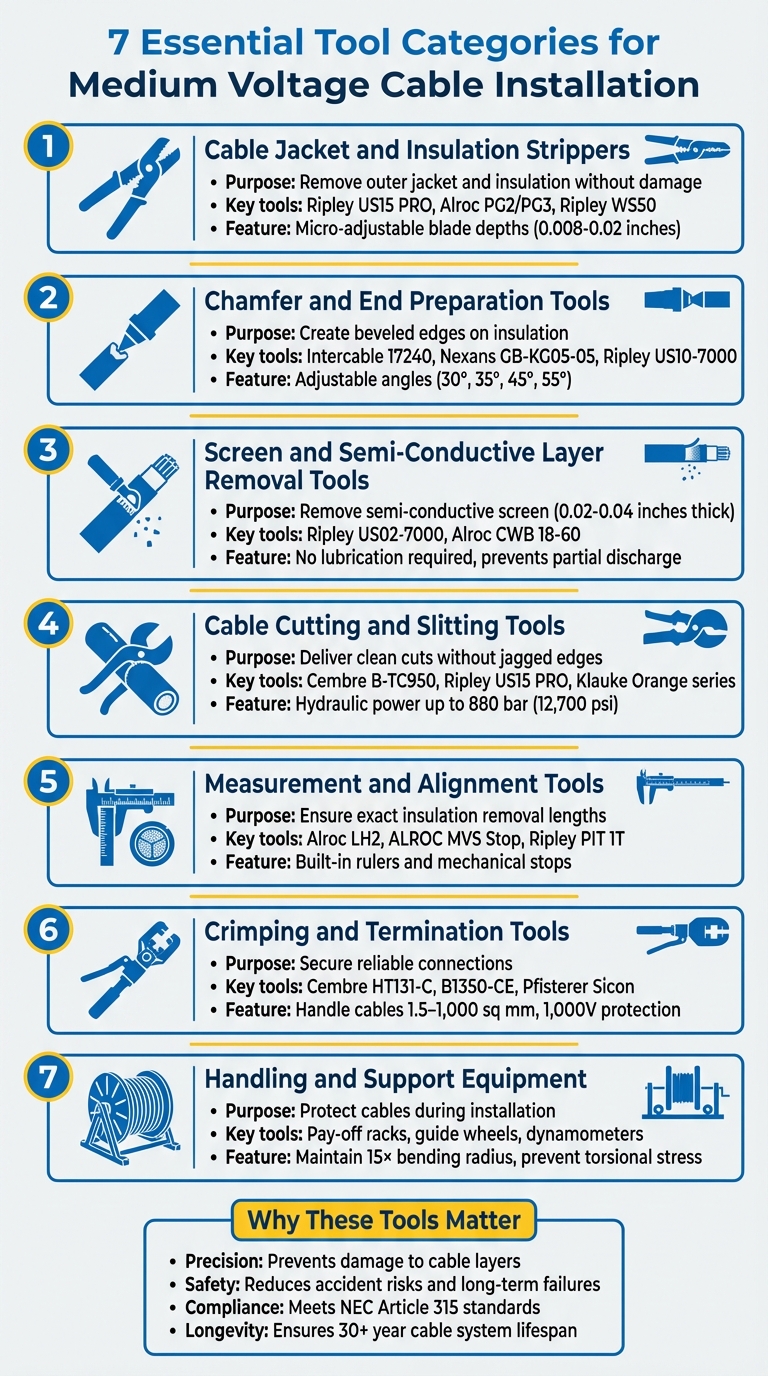
7 Essential Tool Categories for Medium Voltage Cable Installation
Preparing Medium Voltage Cable - Step 1
sbb-itb-501186b
1. Cable Jacket and Insulation Strippers
The first step in installing medium voltage cables is removing the outer jacket and insulation without damaging the layers beneath. This process demands precision tools. As Intercable explains:
"Every millimetre is critical in the medium voltage cable preparation process where primary insulation diameters must be carefully measured to prevent possible future cable failures."
Getting this step right is essential, as it lays the groundwork for all the subsequent tasks, each requiring its own specialized tools.
Precision and Safety in Cable Preparation
Modern stripping tools have largely replaced traditional knives, offering improved accuracy and safety. For instance, the Ripley US15 PRO features micro-adjustable blade depths, enabling slit, ring, and spiral cuts on cables with diameters between 0.39 inches and 2.36 inches. This design ensures that the conductor or insulation remains undamaged. By setting the blade depth just 0.008 to 0.02 inches less than the jacket's wall thickness, you can safeguard the cable's underlying layers.
For cables with bonded semi-conductive layers, the Ripley US02 is a go-to tool. It delivers smooth finishes without requiring lubrication. HV Jointer Steffan Evans even used this tool to strip 20/22 kV cables for a Siemens NXAIR Vacuum Circuit Breaker, achieving clean and uniform results.
Matching Tools to Medium Voltage Cable Specifications
Compatibility with cable diameters is crucial. The Alroc PG2 and PG3 tools are designed for cables ranging from 0.83 to 1.38 inches and 1.02 to 2.05 inches, respectively. For larger conductors - up to 1,000 kcmil - the Ripley WS50 is specifically designed to handle materials like XLPE, PE, and EPR. Since insulation types like XLPE and EPR differ in hardness, always confirm that your tool is suited to your cable's specific material requirements.
Durability and Maintenance for Long-Term Use
High-quality strippers feature replaceable hardened steel blades to maintain precision over time. The Ripley US01-7000 offers adjustable settings for both mid-span and end stripping on various cable types, including URD, PE, PVC, XLPE, and EPR. This versatility enhances safety for jointers and ensures consistent results. After stripping, a 30-degree chamfer is often required for installations between 15 kV and 35 kV to maintain proper electrical stress control.
2. Cable Insulation Chamfer and End Preparation Tools
After carefully stripping the cable jacket, the next step is chamfering the primary insulation. This involves creating a beveled edge on the insulation to prevent damage to terminations and connectors during assembly. Chamfering is crucial for ensuring proper alignment and avoiding tears in accessories, making it a precision task that requires the right tools for the job.
Compatibility with Medium Voltage Cable Specifications
Chamfering tools must align with the specific diameter and voltage rating of your cables. For instance:
- The Intercable 17240 works with insulation diameters ranging from 0.59 to 2.36 inches and supports voltage ratings between 11–66 kV. It also offers selectable chamfer angles of 45° or 55°.
- For tighter spaces, the Nexans GB-KG05-05 provides a standard 35° chamfer angle and accommodates diameters from 0.47 to 2.36 inches (12–60 mm).
- The Ripley US10-7000 is designed for 15–35 kV cables, featuring a factory-set 30° chamfer angle and adjustable cutting depth from 0.075 to 0.150 inches (1.905–3.81 mm).
These tools are tailored to meet specific requirements, ensuring precision and ease of use.
Precision and Safety in Cable Preparation and Installation
Modern chamfering tools are designed to improve both accuracy and safety, eliminating the hazards associated with using unguarded knives. As Ripley Cable Tools puts it:
"Improve reliability and safety at the same time; take the knife out of your hand and put the Ripley tools in your hand".
Secure clamping systems, such as screw spindles or thermoplastic V-jaw designs, hold cables firmly during rotation, enabling uniform cuts even in confined spaces. Additionally, PTFE-coated frames allow the tools to glide smoothly over XLPE and EPR insulation without requiring silicone grease.
Manufacturer Approval for Specific Cable Types
Using tools approved by manufacturers like Nexans, 3M, Pfisterer, and Elastimold ensures safe and effective operation. For example, the Ripley US10 series, equipped with recessed and heat-treated blades, is ideal for XLPE and EPR insulation. When a polished finish is necessary, particularly for high-voltage transitions, the Vicera sanding machine delivers up to 10× faster results compared to manual sanding. These tools not only enhance safety and precision but also provide consistent, high-quality results.
Durability and Ease of Maintenance
Professional-grade chamfering tools are built to last, featuring replaceable blades that maintain cutting precision over time. The Intercable 17240, for instance, delivers accurate chamfer cuts with minimal cable length required. After chamfering, it's essential to clean the insulation by wiping toward the conductive screen with recommended cleaning agents to remove any residual particles.
3. Cable Screen and Semi-Conductive Layer Removal Tools
After stripping and chamfering, removing the semi-conductive screen is a crucial step in preparing medium voltage cables. This process ensures the cable’s integrity remains intact. As highlighted in the E.ON Cable Jointing Manual:
"Removal of the carbon loaded semi-conducting screen from triplex extruded, polymeric insulated cable is the single most important factor controlling the service life of a cable joint or termination".
Improper screen removal is the leading cause of failure in medium and high-voltage cable accessories. The challenge lies in delicately removing the thin semi-conductive layer - usually between 0.02 to 0.04 inches (0.5–1.0 mm) thick - without damaging the underlying XLPE or EPR insulation.
Compatibility with Medium Voltage Cable Specifications
Screen removal tools are tailored to specific cable constructions, falling into two main categories:
- Bonded screen tools: These are designed for cables where the semi-conductive layer is fused to the insulation. Tools like the Ripley US02-7000 and Alroc CWB 18-60 gradually shave the layer, removing approximately two-thirds semi-con and one-third XLPE for a clean finish. For example, the Ripley US02-7000 is suitable for cables with diameters ranging from 0.71 to 2.36 inches (18–60 mm) in 11–33 kV applications, while the US02-7100 MAX extends this range to 3.15 inches (80 mm) for 11–66 kV cables.
- Easy-strip screen tools: These are used for cables with peelable screens. Instead of shaving, these tools score the screen. A tool like the Ripley SCS allows for adjustable blade depths - typically 0.016 to 0.024 inches (0.4–0.6 mm) - to score the screen without touching the insulation. However, compatibility is key. Western Power Distribution cautions:
"The stripping tool, Alroc CWB 18-60... is designed for bonded screen cables ONLY and shall NOT BE USED on any EPR or XLPE EASI-STRIP CABLES".
These differences highlight the importance of selecting the right tool for the specific cable type, ensuring accurate and damage-free preparation.
Precision and Safety in Cable Preparation and Installation
Modern tools are designed with features that enhance precision and safety. For example, the Ripley US02 series includes micro-adjustable blade depths and lockable settings, ensuring precise cuts. Its unique blade design, combined with integral rollers, preserves the XLPE insulation’s smooth surface, eliminating the need for secondary sanding. Plus, these tools operate without lubrication, keeping work areas cleaner and reducing contamination risks.
To ensure a proper finish, stop-position mechanisms and roll springs provide a perfectly square radial cut at the screen termination point. This is critical for controlling electrical stress. A spiral cut, by contrast, can create a “shadowing effect” that may lead to catastrophic cable failure. Always test blade depth on a scrap piece of cable before working on the actual joint.
Manufacturer Approval for Specific Cable Types
Using tools approved by cable manufacturers is essential for reducing errors and improving longevity. Companies like Nexans, Prysmian, General Cable, and LS Cable & System endorse specific tools from brands such as Alroc, Ripley, and Boddingtons for XLPE and EPR cables. These approvals matter because semi-con thickness can vary between manufacturers. For instance, Prysmian 33 kV cables require a blade depth of 0.016 inches (0.4 mm), while Tratos 33 kV cables need 0.024 inches (0.6 mm).
For best results, always wipe from the cable end toward the semi-con screen to avoid dragging conductive particles onto the clean insulation. When polishing, use fine-grade aluminum oxide paper instead of emery paper, as the latter contains metal particles.
4. Cable Cutting and Slitting Tools
When it comes to cable preparation, clean and precise cuts are non-negotiable. A poorly executed cut can lead to burrs, jagged edges, and uneven surfaces, all of which jeopardize installation integrity. Chris Dodds from T&D highlights the stakes:
"Failure to effectively and precisely prepare MV-HV cables by the jointer is a common cause of 11kV cable failure".
A striking example occurred in October 2017 when Watkins and Jacomb Construction Power & Consultancy (WJCPC) had to step in to salvage a botched 11kV 3-core XLPE cable installation. The initial work was condemned due to improper preparation - jagged edges and deep scoring caused by using the wrong tools with incorrect depth settings. To correct this, WJCPC employed the Cembre B-TC950 battery-operated hydraulic cutter, ensuring smooth, uniform cuts that supported the long-term reliability of the heat shrink terminations. This case underscores the importance of precision in maintaining the overall stability of medium voltage cable installations.
Precision and Safety in Cable Preparation and Installation
Learning from past mistakes, modern cutting tools are designed with advanced features to enhance both precision and safety. Tools like the Ripley US15 PRO, Nexans M30, and Klauke Orange series are excellent examples of this evolution .
- Ripley US15 PRO: This tool allows for precise removal of the outer sheath without harming the copper tape shield or insulation beneath.
- Nexans M30: Its guiding system lifts the sheath material during cuts, ensuring the blade doesn’t come into contact with internal cable components.
- Klauke Orange series: These battery-operated hydraulic tools come with integrated voltage protection up to 1,000V, safeguarding both the operator and the tool from accidental shocks.
Such features not only improve immediate safety during installation but also enhance the tool’s reliability over time, ensuring consistent performance.
Durability and Ease of Maintenance
In addition to precision, durability is a key factor in modern cutting tools. High-quality tools are built to withstand tough conditions without compromising performance.
- Material Strength: Hardened steel blades retain their sharpness even after repeated use on challenging materials like XLPE and EPR insulation . Meanwhile, PTFE-coated aluminum frames offer corrosion resistance and low-friction surfaces, ideal for harsh environments.
- Hydraulic Efficiency: Advanced hydraulic cutters feature dual-speed action - rapid advancement for quick positioning followed by a slower, more powerful cut. These tools can handle copper and aluminum conductors up to 3.74 inches (95 mm) in diameter, with cutting power reaching 880 bar (12,700 psi). Automatic pressure relief valves ensure the tool’s internal components remain protected by releasing pressure once the cut is complete.
- Battery Features: Battery-operated models now include check buttons and capacity indicators, helping operators confirm there’s enough power to complete a cut without interruptions that could damage the motor.
To maintain these tools, it’s essential to clean and dry them after each use. This simple step prevents corrosion and ensures they remain accurate and reliable for future projects.
5. Cable Preparation Measurement and Alignment Tools
After ensuring precise cuts, the next step in medium voltage (MV) cable installation is accurate measurement and alignment. These steps are crucial because even minor errors can lead to significant problems later on. In fact, incorrect cable preparation is the leading cause of failures in medium and high voltage cable accessories, such as joints and terminations.
Precision and Safety in Cable Preparation and Installation
Modern tools are designed to make cable preparation both precise and efficient. For example, the Alroc LH2 comes with a built-in ruler to ensure exact insulation removal lengths, while the ALROC MVS Stop uses mechanical stops to create straight, radial cuts. This eliminates spiral cuts, which can cause electrical shadowing in XLPE insulation. These tools ensure that every cable layer is perfectly aligned to meet specifications.
When working with load break elbows for systems ranging from 15 kV to 34.5 kV, tools like the Ripley PIT 1T apply 125 in-lb of torque to properly engage elbow probes. This prevents issues like cross-threading and contamination. For general preparation tasks, the Ripley US10 offers a stable platform with its V-jaw construction and adjustable clamping system, making it ideal for tight spaces like switchgear bays or trenches.
Before installing terminations, it's essential to double-check measurements. Verify the outer diameter of each cable layer - sheath, screen, and insulation - against the manufacturer's specifications. This step helps catch any dimensional discrepancies early, ensuring a high-quality installation.
Manufacturer Approval for Specific Cable Types
Using tools approved by manufacturers adds another layer of assurance. For instance, the Ripley WS 5 and WS 6 are specifically designed for XLPE, Polyethylene, and EPR insulation in the 15 kV to 46 kV range. Similarly, the Pfisterer MV Jointers Tool Kit, made for cables up to 33 kV, includes folding rulers and precision stripping tools tailored for these insulation types.
Manufacturer-approved tools are your best bet for avoiding installation failures caused by improper preparation.
6. Crimping and Termination Tools
When it comes to medium voltage cable installations, crimping is the finishing touch that ensures a secure and reliable connection. Using the right tools and techniques is essential to guarantee the cable's performance and safety throughout its service life. A poor choice in tools or improper use can lead to connection failures, putting the entire installation at risk.
Compatibility with Medium Voltage Cable Specifications (e.g., 15-35 kV Range)
Crimping tools come in various types - hydraulic, battery-powered, mechanical, and manual - to suit different site conditions and installer preferences. For cables within the 15-35 kV range, tools like the Cembre HT131-C (hydraulic) and B1350-CE (battery-operated) are widely used. These are designed to handle cable lugs up to 400 sq mm and work with both copper and aluminum conductors across a broad range of cross-sectional sizes, typically from 1.5 sq mm to 1,000 sq mm.
For larger cables, such as those between 500 sq mm and 630 sq mm, specialized crimpheads like the Cembre ECW-H3D are recommended. These are often paired with foot pumps or portable electro-hydraulic pumps for efficient operation. In situations where heavy hydraulic tools are impractical - like tight spaces or remote locations - mechanical shearbolt connectors such as the Pfisterer Sicon offer a convenient solution. These connectors use stepless bolts that break cleanly without leaving protrusions, allowing installation with standard wrenches instead of specialized crimping dies.
Precision and Safety in Cable Preparation and Installation
Safety and precision are paramount in cable preparation and crimping. Battery-operated tools with built-in voltage protection (up to 1,000V) help protect installers from accidental shocks, especially when working near live equipment. Shearbolt connectors further enhance accuracy by ensuring consistent thread load without the need for additional adjustments or filing.
Specialized tools also play a key role in proper termination. For instance, the Ripley PIT 1T is tailored for 15 kV to 34.5 kV load break elbows, while the Ripley LBIT-1T is designed for 200 Amp load break bushings. These tools ensure a secure fit, reducing the risk of cross-threading or contamination that could compromise the connection.
Manufacturer Approval for Specific Cable Types (e.g., XLPE, EPR)
Using manufacturer-approved tools is critical to avoid system failures. In fact, improper preparation and crimping are among the leading causes of accessory failures. Different insulation materials, such as XLPE (cross-linked polyethylene) and EPR (ethylene propylene rubber), often require specific tooling. For example, XLPE may need wedge-style blades, while EPR typically calls for straight blades.
To maintain warranty coverage and ensure compatibility, always verify that your crimping tool is approved by the cable manufacturer, whether it’s Nexans, Prysmian, General Cable, or another supplier. Additionally, keeping tools clean and dry is essential to prevent contamination of the cable insulation or accessories.
7. Cable Handling and Support Equipment
Once cables are meticulously prepared, the next step is ensuring they are handled with care to protect their integrity during installation. While accurate stripping, chamfering, and cutting lay the groundwork for success, proper handling equipment is what prevents damage that could undermine all that effort. Without the right tools, even the best-prepared cable can suffer harm that leads to failure down the road. As Richard Zi, General Manager of ZW Cable, explains:
"A single scratch on the outer sheath or a crush injury from an improper winch setup undermines long-term cable integrity. It creates a microscopic stress point that guarantees failure, often years later when the system is under peak load".
Precision and Safety in Cable Preparation and Installation
The right equipment ensures cables remain undamaged during installation. Tools like pay‐off racks and guide wheels keep cables elevated, preventing them from scraping against trench walls or pipe edges. For both underground and overhead medium voltage lines, anti‐twisting devices at the pulling head are essential. These devices eliminate torsional stress, which can delaminate internal screens.
To further safeguard cables, calibrated dynamometers monitor pulling tension in real time, ensuring the manufacturer's traction limits aren’t exceeded. Overloading can damage conductors or insulation. Break‐away swivels add another layer of protection by disconnecting if tension spikes, preventing cable snapping or twisting.
For installations in cold conditions, cables should be preheated to 68°F–86°F when temperatures drop below 32°F. Heating blankets and jackets are particularly useful for straightening large-diameter cables, like 66 kV and 132 kV lines, before jointing. Without preheating, materials like XLPE and PVC can become brittle and prone to cracking if bent in freezing temperatures.
Durability and Ease of Maintenance
Job sites can be tough environments, so durable handling equipment is vital for maintaining installation quality. Conveyor quadrants play a key role at bends, distributing loads evenly and maintaining a bending radius of 15× the cable's outer diameter. This reduces sidewall pressure, protecting internal screens from damage.
Bell mouth guides are another critical tool, shielding cable sheaths from sharp edges at duct entries. Before backfilling, it’s important to perform a Megger sheath integrity test at 5–10 kV DC (acceptance >1 MΩ/km) to confirm the protective system is intact. Once the installation is complete, stainless steel or composite cleats secure the cables in a trefoil formation, designed to handle the system's kA fault level. Poor support has been linked to as much as 80% of medium voltage cable line faults.
Conclusion
Installing medium voltage (MV) cables requires extreme care and attention to detail. Even the smallest flaw - like a 0.1mm score on the XLPE insulation - can create a "notch effect", significantly weakening the dielectric strength and increasing the risk of failure. The tools used during installation often determine whether a system achieves its 30+ year design life or fails catastrophically under stress.
Using manufacturer-approved tools is not just a recommendation - it’s essential for protecting warranties and ensuring system reliability. As Fluke Networks points out:
"If you want to secure a warranty backed by the cable manufacturer, however, you need to use a certification tool approved by the manufacturer. Anything else puts the sole warranty responsibility on you".
The risks are clear: improper cable preparation is the leading cause of MV cable accessory failures, and nearly 20% of industrial electrical fires are linked to installation errors. These statistics highlight the critical role of proper tools and techniques in preventing costly and dangerous issues.
Professional-grade termination tools also deliver significant productivity benefits. Installers can work six to eight times faster, cutting costs for certain tasks by up to 80%. Motorized preparation tools, in particular, ensure the necessary surface smoothness to prevent partial discharge while completing tasks up to 10 times faster than manual methods. These time and cost savings further emphasize the value of using the right tools for the job.
This article explored seven essential tool categories, from precision strippers to cable handling systems, each vital for ensuring safety, accuracy, and long-term system durability. These tools are not just a convenience - they are a necessity for achieving reliable and efficient MV cable installations.
For those looking to source manufacturer-approved equipment, Electrical Trader (https://electricaltrader.com) is a trusted marketplace offering a wide range of specialized tools and components for professional MV installations. Access to these tools is crucial for maintaining the integrity and lifespan of medium voltage cable systems.
FAQs
How do I choose the right stripper for my cable size and insulation?
To choose the right cable stripper, start by matching it to the insulation material and diameter of your cable. Opt for a tool with adjustable or multiple blade sizes to strip the insulation accurately without harming the conductor. Before you begin, measure the cable diameter carefully to ensure the tool is a perfect fit. This approach minimizes the risk of damage and guarantees a clean, dependable connection for medium voltage cable installations.
What’s the safest way to remove the semi-con screen without damaging insulation?
The safest way to remove semi-conducting screens is by using specialized tools specifically designed for the job. For easi-strip screens, cable jointing tools provide a clean and controlled stripping process. When dealing with bonded screens, tools with adjustable depth settings ensure smooth and accurate removal. Always adhere to the manufacturer’s guidelines and industry standards. Using the right tools and handling them with precision is crucial to prevent any damage to the insulation layer.
Which pulling and support tools prevent MV cable damage during installation?
When installing medium voltage (MV) cables, it's crucial to take steps to avoid damage. Using cable rollers and guides helps reduce friction and safeguards the cable during the process. Additionally, tools like pulling grips - including basket grips, mesh socks, and dead-end grips - are vital for evenly distributing the load. These grips not only prevent slippage but also minimize the risk of crushing the cable. Together, these tools play a key role in preserving the cable's condition during installation.