5 Mistakes to Avoid During Medium Voltage Cable Installation
Medium voltage (MV) cable installations require precision. Small errors can result in costly failures, safety risks, and system downtime. Here are the five most common mistakes to avoid:
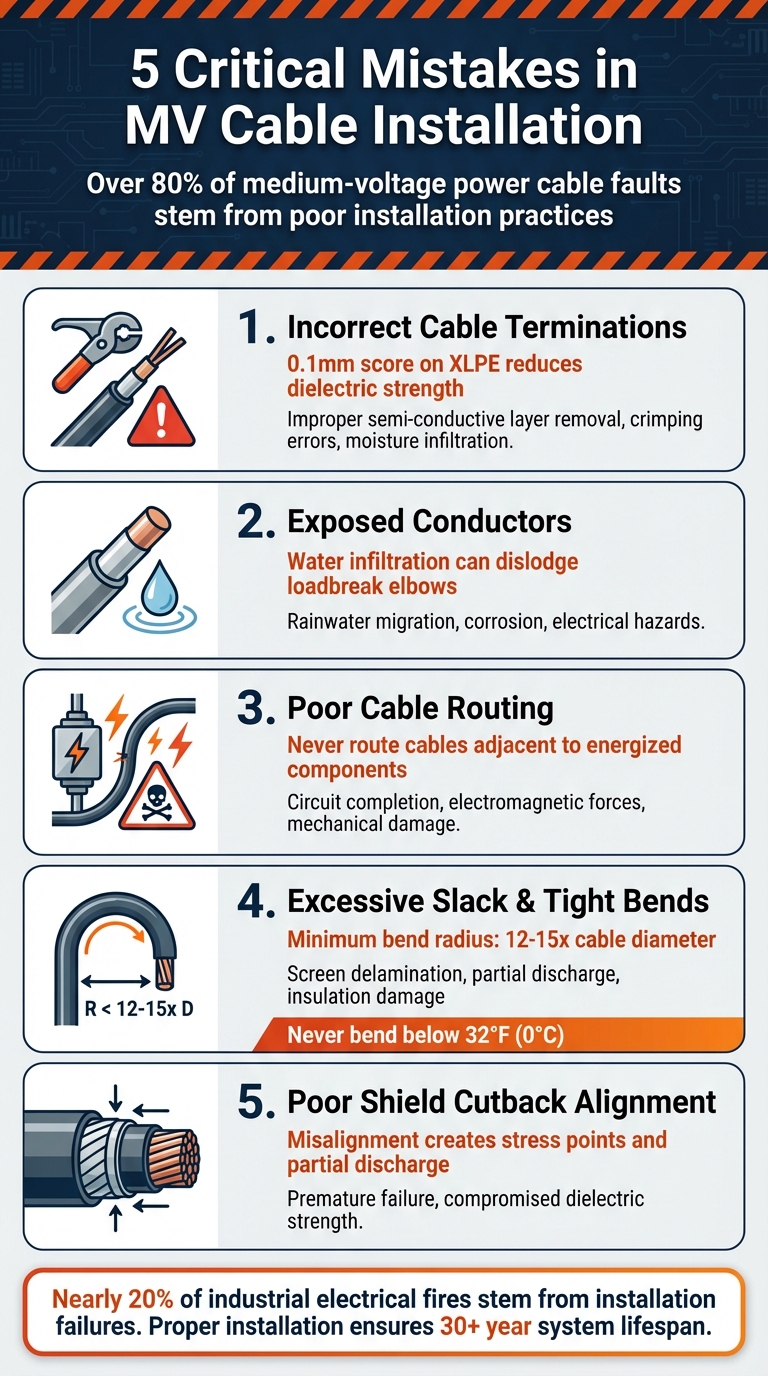
- Incorrect Cable Terminations: Using improper tools or techniques can cause insulation damage, poor connections, and moisture issues, leading to arcing and eventual failure.
- Exposed Conductors: Leaving conductors unprotected allows water infiltration, corrosion, and electrical hazards.
- Poor Cable Routing: Routing cables too close to energized components can cause faults, overheating, and mechanical damage.
- Excessive Slack and Tight Bends: Improper slack management and exceeding bend radius limits can damage insulation and create hotspots.
- Poor Shield Cutback Alignment: Misaligned shields create stress points, leading to partial discharges and insulation failure.
Proper tools, careful handling, and adherence to guidelines can prevent these issues and ensure long-term reliability.
5 Critical Mistakes to Avoid During Medium Voltage Cable Installation
Termination Kit Installation for MV Cables ✅
sbb-itb-501186b
1. Incorrect Cable Terminations
Faulty cable terminations can undermine both safety and the reliability of an electrical system.
One of the most critical errors is improper removal of the semi-conductive layer. When standard utility knives are used instead of specialized scoring tools, they leave behind microscopic cuts in the XLPE insulation. These tiny imperfections act as stress points, which can eventually lead to severe failure. Richard Zi, General Manager at ZW Cable, highlights this issue:
"A 0.1mm score on the XLPE induces a 'notch effect' that reduces dielectric strength".
Another major issue is crimping errors. Using mismatched die sets or applying the wrong compression can cause serious problems, including gaps, burrs, or excessive flash at connection points. Over-compressed lugs can create hotspots that degrade over time, while under-compressed terminals lead to poor electrical contact, causing arcing and overheating. To avoid these issues, always use crimping die sets and lugs from the same manufacturer. Mixing components from different suppliers compromises the connection’s integrity. Additionally, ensure the conductor is fully inserted into the lug barrel by checking through the inspection hole before crimping. These steps are essential to maintain a strong and reliable termination.
Moisture infiltration is another common problem that can severely impact cable terminations. Ben Jacomb, Director at WJCPC, explains:
"If the heat shrink tube is shrunk on top of a void there will be moisture and where there is moisture there will be arcing, burning and then failure".
To prevent this, ridges or marks on the XLPE insulation should be smoothed using 80, 120, and 240 grit emery cloth in sequence. Afterward, clean the surface with non-conductive wipes to remove any conductive particles before applying heat-shrink components. Even small voids under heat-shrink tubing can collect moisture through capillary action, creating pathways for electrical tracking. In outdoor installations, poorly sealed terminations may allow rainwater to migrate into conductor strands. This can build up enough pressure to dislodge loadbreak elbows from their bushings at the opposite end of the cable run. Proper moisture sealing ensures complete coverage of the lug barrel and a tight bond between the cable insulation and the terminal surface.
2. Exposed Conductors
Exposed medium voltage cable conductors pose serious risks, leading to dangerous situations and potential failures. When bare conductors are left unprotected - like at mechanical lugs on pole-mounted switches or outdoor terminations - they become vulnerable to rainwater infiltration. Mose Ramieh, Vice President of Business Development at CBS Field Services, explains:
"Rain will migrate into the cable conductor. The water will build up and create a water column... capable of building up enough pressure to push loadbreak elbows off their bushings".
A real-world example from a Florida utility installation highlights this issue. An inexperienced technician left bare conductors exposed at a pole-mounted cutout switch, allowing water to seep into the cable. Over time, the pressure from the water buildup was enough to dislodge loadbreak elbows from their bushings. In colder conditions, moisture inside the cables can freeze, expand, and cause catastrophic failures when temperatures drop below 32°F.
But water isn't the only concern. Exposed conductors can also lead to electrical hazards. Cuts or nicks in the cable's outer sheath can allow groundwater to corrode the copper tape screen. This corrosion compromises the earth path, potentially leading to safety failures. Even minor damage to the protective covering can weaken the cable's dielectric strength, increasing the risk of partial discharge over time.
To mitigate these risks, it's essential to take proper precautions. Use heat-shrink end caps to seal cable ends rather than relying on PVC tape, as medium voltage cables are hygroscopic and can absorb moisture through capillary action. For additional protection at termination points, apply silicon splicing tape to seal exposed insulation. Lastly, before backfilling any cable run, conduct a sheath integrity test. Apply 5,000–10,000 volts DC between the metallic screen and earth, and ensure the resistance is greater than 1 MΩ/km. These steps can significantly reduce the likelihood of failures and improve overall safety.
3. Poor Cable Routing Near Energized Components
Routing medium-voltage (MV) cables near energized components poses serious risks to system reliability and safety. The danger isn't limited to physical contact - the cable's metallic shield can unintentionally complete a grounded circuit near energized bus work, leading to catastrophic failures. Mose Ramieh, Vice President of Business Development at CBS Field Services, emphasizes this point:
"Never allow medium-voltage cable to be adjacent to energized components."
In February 2025, Ramieh shared an incident at a hospital where a contractor routed MV cables between switchgear bus and termination, relying only on insulation for protection. The grounded shield was positioned too close to energized bus work, ultimately causing a switchgear failure. Alarmingly, more than 80% of medium-voltage power cable faults stem from poor installation practices like this.
Improper cable routing not only increases the likelihood of electrical faults but also introduces mechanical risks. Electromagnetic forces in these cables can induce voltages that generate intense heat, damaging insulation and potentially displacing cables during faults .
Best Practices for Cable Routing
To avoid these issues, maintain a safe distance between MV cables and energized components. In tight spaces, use cable troughs or formed entries to keep cables secure and separated. For single-core cables, arrange them in a trefoil formation and secure them with stainless steel or composite cleats rated for your system’s fault level .
Proper grounding is equally critical. Always check shield ground placement when installing new cables, as improper grounding can create electrical stresses that lead to insulation failure. Additionally, in industrial environments, keep data and control cables away from high-EMI sources like variable frequency drives and welders to minimize interference.
4. Excessive Slack and Incorrect Bend Radius
Too much slack in cables can lead to cramming extra cable into tight spaces, which often results in bends that exceed manufacturer limits. This not only compromises the cable's grounded shield - bringing it dangerously close to energized components - but also jeopardizes the cable’s overall integrity during handling. Properly managing slack and bend radius is crucial for ensuring long-term reliability, as it prevents exposure, improper routing, and physical damage.
Tight bends under tension can cause serious internal damage. When the semiconductive screens inside the cable delaminate, voids form, creating hotspots for Partial Discharge. Over time, this degrades the insulation and can lead to failure during peak loads. Richard Zi, General Manager at ZW Cable, emphasizes the risks:
"Tighter bends under tension will delaminate the internal screens from the insulation, creating voids that lead to future Partial Discharge."
For cables with tape shielding, the consequences of tight bends can be even more severe. The overlapping tape may separate during bending and buckle when straightened, potentially slicing into the insulation.
Temperature adds another layer of complexity. Medium-voltage cables should never be bent when the temperature drops below 32°F (0°C). At such low temperatures, materials like PVC and XLPE become brittle, which can lead to cracks or even shattering. If installation must occur in cold weather, "hot soak" the cable drums in a heated space at 68°F (20°C) for 24 hours before handling .
The minimum bend radius depends on the cable type. When cables are under tension during installation, a dynamic radius of 15 times the cable’s outer diameter is commonly required. For metallic tape-shielded cables rated between 600V and 35kV, the minimum pulling radius is 12 times the overall diameter. To prevent damage at bend points, conveyor quadrants can help distribute the load evenly across a smooth arc. A practical tip: for four-core armored cables larger than 1.6 inches in diameter, a full-sized bicycle wheel should easily fit within the bend.
5. Poor Shield Cutback Alignment
Shield cutback alignment refers to where the semi-conductive insulation and metallic shield are terminated during cable preparation. Misalignment in this process creates electrical stress points, which often lead to partial discharges. These discharges are a major culprit behind systems failing shortly after power-up, rather than lasting the expected 40-50 years.
The impact of poor alignment can't be overstated. Over 80% of medium-voltage power cable line faults stem from improper installation of cable accessories. Richard Zi, General Manager at ZW Cable, underscores the importance of precision:
"Terminations require surgical cleanliness. Avoid knives; use dedicated, adjustable scoring tools to strip layers, as a mere 0.1mm score on the XLPE creates a 'notch effect' that compromises dielectric strength."
To avoid these pitfalls, follow manufacturer specifications meticulously. Cutback dimensions are designed for specific voltage classes (5kV to 35kV) to ensure stress cone terminations are positioned correctly, managing electrical stress effectively. Use the templates provided to mark cutback distances accurately, ensuring stress control components align with the electric field lines. Additionally, opt for Constant Force Springs instead of standard ties to bond the metallic screen securely, offering a vibration-resistant grounding path.
Proper alignment is just one piece of the puzzle. Correct CT (current transformer) wiring is equally critical for system protection. A common mistake occurs with zero-sequence current transformers (CTs): the shield wire must be routed back through the CT and terminated to the ground bus on the load side. Skipping this step compromises the ground fault relay's functionality. After removing the shield, clean the insulating surface thoroughly to remove any conductive particles or residue from the semi-conductive layer, as they can lead to surface flashover.
Once alignment and termination are complete, rigorous testing is essential. Partial Discharge (PD) testing should be performed to identify early insulation issues. Results showing less than 10pC at 1.5 U0 indicate no internal voids or workmanship errors in the terminations. Additionally, Very Low Frequency (VLF) testing is a non-destructive way to confirm termination and shield alignment integrity before the system is energized.
Conclusion
Installing medium voltage (MV) cables demands precision and strict adherence to best practices. The five common mistakes - incorrect terminations, exposed conductors, poor routing, improper bend radius, and shield cutback misalignment - are responsible for the majority of system failures. Even a tiny defect, as small as 0.1 mm on XLPE insulation, can jeopardize long-term reliability.
Richard Zi from ZW Cable emphasizes that even minor mishandling can compromise a cable's integrity. To avoid such issues, thorough pre-installation planning, maintaining proper environmental conditions, and conducting essential tests like VLF and sheath integrity checks are critical steps to identify potential problems before energizing the system.
While proper installation is crucial, the quality of the components used cannot be overlooked. For access to high-quality tools and accessories that comply with international standards like IEC 60502-2 and UL 1072, platforms like Electrical Trader provide a reliable marketplace for both new and used electrical equipment.
Nearly 20% of industrial electrical fires stem from installation failures. Adopting best practices isn't just about meticulousness - it's about preventing system breakdowns, ensuring personnel safety, and safeguarding the system's lifespan, which can exceed 30 years. As Mose Ramieh aptly puts it:
"Keep it clean, read the instructions, measure twice, and keep it clean".
FAQs
What problems can arise from improper cable terminations in medium voltage installations?
Improper cable terminations in medium voltage setups can cause major problems, including electrical breakdowns, arcing, and insulation failure. These issues can escalate into power outages, equipment damage, and even safety hazards like electrical fires or injuries.
To prevent such outcomes, it's essential to stick to proper installation practices, use the correct tools, and ensure terminations meet industry standards. Following these steps not only boosts system reliability but also makes the environment safer for everyone involved.
What’s the best way to prevent moisture from damaging medium voltage cable terminations?
To keep medium voltage cable terminations safe from moisture damage, it’s important to focus on proper sealing and insulation. Using high-quality water-blocking materials or water-resistant accessories can go a long way in stopping water from entering. Cold shrink terminations made of hydrophobic silicone are another great option - they not only protect against moisture but also handle temperature changes well, which helps prevent condensation and partial discharges.
Before starting the installation, make sure the cable surface is clean and free of any contaminants. This ensures a smooth and secure base for sealing. Apply the right sealing compounds and double-check that all connections are airtight. Routine inspections are also key - they help catch early signs of moisture problems, keeping the system reliable and avoiding expensive repairs down the road.
Why is maintaining the correct bend radius important when installing medium voltage cables?
Maintaining the right bend radius is critical for the safety, performance, and lifespan of medium voltage cables. If cables are bent too tightly, the insulation and conductors can suffer damage, which may lead to electrical stress, insulation breakdown, or even total cable failure. These problems not only come with high repair costs but also create potential safety hazards.
Sticking to the recommended minimum bend radius during installation helps prevent mechanical damage and minimizes the chance of faults caused by strained or weakened insulation. When possible, opting for a bend radius larger than the minimum adds an extra layer of protection. This is particularly important for medium voltage cables, as they are more prone to bending-related issues compared to low voltage cables. Proper care during installation can make all the difference.