Checklist for Choosing Voltage Regulation Devices
Voltage regulation devices are essential for protecting your equipment from power fluctuations that can lead to damage, inefficiency, or downtime. Here’s a breakdown of what you need to consider:
- Understand Your Power Source: Measure input voltage ranges and identify instability patterns like spikes, sags, or surges.
- Know Your Load Requirements: Calculate total power demand, account for inrush currents, and match the regulator's output to your equipment's sensitivity.
- Choose the Right Regulator Type: Options include Servo Electronic (high accuracy), Magnetic Induction (durable), Static (cost-effective), and Solid State (stable for sensitive electronics).
- Verify Performance and Compatibility: Check input/output voltage ranges, efficiency, response time, and system integration.
- Test Before Deployment: Run trial operations under different loads and ensure compliance with safety standards.
How to choose best regulator for an application
sbb-itb-501186b
Assess Your Power Source Characteristics
Before choosing a voltage regulator, it's crucial to understand the specifics of your power supply. The quality and behavior of your incoming power lay the groundwork for making informed decisions. Start by measuring actual voltage levels rather than relying solely on the nominal ratings provided by your utility company.
Measure Input Voltage Range
Even though utilities provide nominal voltages (like 120 V or 480 V), actual levels can fluctuate based on factors like demand and location. In the U.S., most utilities aim to keep voltage within ±5% of nominal. However, ANSI Standard C84.1 allows short-term variations of up to 6% above or 13% below nominal levels. For a 480 V system, this translates to an acceptable range of roughly 509 V to 420 V.
Track minimum and maximum voltage levels during both peak and off-peak times. Voltage tends to peak at night and on weekends when demand is lower, while it dips during weekday afternoons when usage is at its highest. To capture these variations, use a single-phase voltage recorder over several days. This will help you log changes caused by load patterns like HVAC systems cycling on and off or shifts in industrial operations. Analyze the collected data by calculating averages, standard deviations, and the percentage of readings that fall outside your desired range. These insights are vital for selecting a regulator that aligns with your power source and ensures compatibility with your equipment.
The sensitivity of your equipment determines how precise the voltage regulation needs to be. Devices with low sensitivity can operate within a ±10% voltage range, but more delicate electronics might require a tighter range of ±5% or less. While three-phase motors are generally tolerant of voltage swings, their electronic controls can be more vulnerable to fluctuations.
These measurements can help identify patterns in voltage behavior that directly impact your equipment’s performance.
Identify Voltage Instability Patterns
Understanding the types of voltage fluctuations in your system is key to selecting the right protection measures.
| Variation Type | Duration | Common Causes |
|---|---|---|
| Voltage Spike | Less than 3 ns | Lightning, static discharge, short circuits |
| Voltage Surge | 3 ns or longer | Equipment cycling, power transitions |
| Sags / Swells | Multiple cycles | Large motors starting, HVAC cycling, utility switching |
| Overvoltage | More than 1 min | Distribution system issues |
Pay special attention to fluctuations caused by the startup or shutdown of large equipment on the same circuit. Devices like compressors, elevators, or welding equipment that cycle on and off automatically are common culprits for spikes and surges. Lightning strikes during storms can also introduce sudden, high-energy transients, while storm damage may lead to higher-voltage primary wires coming into contact with lower-voltage secondary wires.
"Power increases or decreases which last multiple cycles are called swells or sags, respectively. An uninterrupted voltage increase that lasts more than a minute is called an overvoltage." - Wikipedia
Advanced voltage recorders can detect transients as brief as 100 microseconds, helping pinpoint exactly where on the AC waveform the event occurred. For generator-powered systems, it’s also important to document frequency variations in hertz, as these can result from changes in engine RPM due to shifting loads. If lighting flicker is an issue, measure short-term flicker (PST) over 10-minute intervals, aiming for values below 1.0, and long-term flicker (PLT) over two-hour periods, with ideal readings below 0.8.
Determine Load Requirements and Device Specifications
Once you've assessed your power source, the next step is to calculate your equipment's total power demand. This will help you select a regulator that can handle both load and surge requirements effectively.
Calculate Total Power Demand
Start by identifying the power demand of your equipment. Check each device's nameplate for details like voltage, frequency, phase, and current (measured in Amps or kVA). It's important to distinguish between nominal (steady-state) power and inrush (surge) power. Devices such as motors, compressors, and X-ray machines often draw much higher currents during startup compared to their regular operating levels.
For equipment with high starting currents - like welders or medical imaging devices - select a regulator rated 30%–50% above the full load. Once you've totaled the loads, include a safety margin of 10%–25% to allow for future expansions. For systems used continuously over long periods, consider adding an extra 20% to the nominal load to ensure durability.
Use the appropriate formula to calculate the kVA for your system:
- Single-phase systems: Multiply current (Amps) by voltage (Volts) and divide by 1,000.
- Three-phase systems: Multiply the square root of 3 (about 1.732) by current, voltage, and divide by 1,000.
Getting the phase calculation wrong can lead to an undersized regulator, which might fail prematurely. Once you've calculated the load, check your equipment's voltage tolerance to ensure the regulator's output aligns with these requirements.
Understand Load Sensitivity
After determining the regulator size, evaluate how voltage fluctuations affect your equipment. Load sensitivity refers to the acceptable voltage range within which your devices can operate without issues. For instance, sensitive electronics like programmable logic controllers (PLCs), medical devices, and lab instruments often require voltage stability within ±5% or tighter. In contrast, three-phase motors can typically handle variations up to ±10%.
The regulator's output regulation must be more precise than your equipment's sensitivity threshold. For example, a device needing ±2% voltage accuracy won't work properly with a regulator that only provides ±10% regulation. In such cases, ultra-precise servo-electronic regulators, which can deliver accuracy as tight as ±0.5%, are ideal for critical applications. For industrial three-phase systems, it's crucial to select regulators with independent phase regulation to avoid phase-to-phase imbalances, which can cause motor overheating and vibration.
Additionally, look for high-efficiency automatic voltage regulators with ratings above 97%. These reduce power waste and help lower operational costs. By understanding your equipment's sensitivity and matching it with the regulator's capabilities, you can ensure optimal performance while verifying compatibility with your system requirements.
Select the Right Voltage Regulator Type
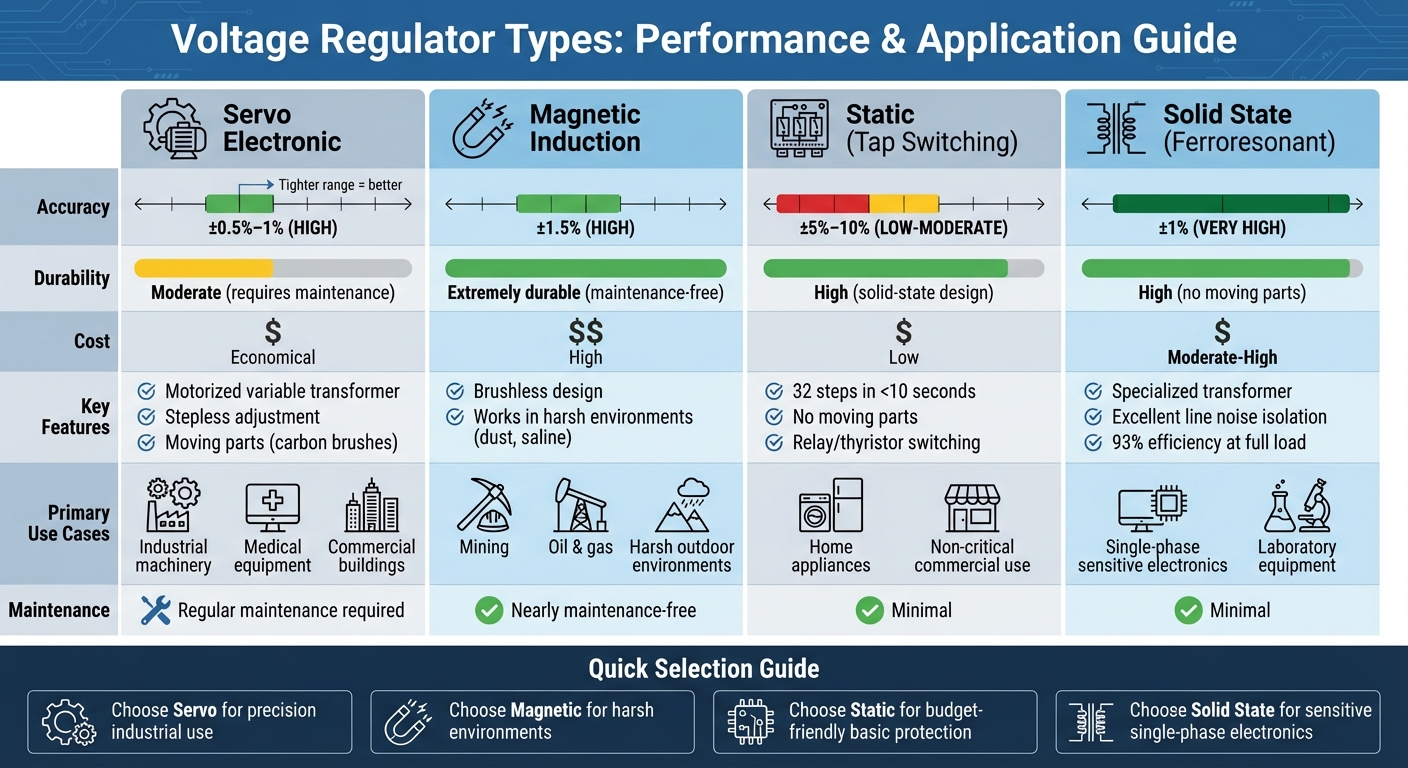
Voltage Regulator Types Comparison Chart
When choosing a voltage regulator, you have four main types to consider: Servo Electronic, Magnetic Induction, Static (Tap Switching), and Solid State (Ferroresonant). Each type offers different levels of accuracy, durability, and cost, making them suitable for specific applications.
Compare Voltage Regulator Designs
Servo Electronic regulators use a motorized variable transformer to provide continuous, stepless voltage adjustments. They’re widely used in industrial and commercial applications due to their high accuracy (±0.5% to ±1%). However, they include moving parts like carbon brushes, which require regular maintenance.
Magnetic Induction regulators are built to handle tough conditions. With a brushless design, they’re nearly maintenance-free, even in dusty or saline environments, and offer an accuracy of about ±1.5%. Their complex manufacturing process, however, makes them more expensive.
Static (Tap Switching) regulators stabilize voltage by switching between transformer taps using relays or thyristors. Modern versions can cycle through 32 steps in under 10 seconds, making them 5 to 10 times faster than older spring-loaded systems. While cost-effective and free of moving parts, their accuracy is limited to ±5% to ±10%, making them more suitable for less critical applications.
Solid State (Ferroresonant) regulators rely on a specialized transformer design with no moving parts. They provide stable regulation (±1%) for single-phase sensitive electronics and offer excellent isolation from line noise. However, while their efficiency is about 93% at full load, it drops significantly at lighter loads.
| Regulator Type | Accuracy | Durability | Cost | Primary Use Cases |
|---|---|---|---|---|
| Servo Electronic | High (±0.5%–1%) | Moderate (requires maintenance) | Economical | Industrial machinery, medical equipment, commercial buildings |
| Magnetic Induction | High (±1.5%) | Extremely durable (maintenance-free) | High | Mining, oil & gas, harsh outdoor environments |
| Static (Tap Switching) | Low to Moderate (±5%–10%) | High (solid-state design) | Low | Home appliances, non-critical commercial use |
| Solid State (Ferroresonant) | Very High (±1%) | High (no moving parts) | Moderate to High | Single-phase sensitive electronics, laboratory equipment |
Each regulator type has its strengths and trade-offs, so it’s essential to align your choice with your specific application needs.
Match Regulator Type to Application
Think about your operational environment and how sensitive your equipment is to voltage fluctuations when selecting a regulator. For residential use or home appliances, Static (Tap Switching) regulators strike a good balance between affordability and performance.
Data centers and IT setups require quick response times - around 1.5 milliseconds or less - to safeguard sensitive systems. Both Servo Electronic and Static regulators can handle these fluctuations effectively. Similarly, medical imaging equipment like X-ray machines or MRI scanners benefit from the precise voltage control of Servo Electronic regulators.
For industrial sites in extreme environments - like oil rigs or coastal facilities - Magnetic Induction regulators are a solid choice.
"Magnetic induction automatic voltage regulator is the go-to option when you require an AVR that is ultra-reliable, maintenance-free and works reliably in rugged environments or heavy industrial applications".
Utility distribution systems often rely on step-voltage regulators (SVRs) to maintain voltage within a ±10% range over long distances. These regulators typically offer 32 adjustment steps and, for three-phase setups, models with independent phase regulation help prevent motor overheating and vibration. If your equipment has high starting currents, such as welders or compressors, choose a regulator rated 30% to 50% above the full load requirement.
Verify Performance and Compatibility
Once you've selected a regulator type, the next step is making sure it works seamlessly with your system. This means checking both the technical specs and ensuring it integrates with your existing electrical setup.
Confirm Technical Specifications
Start by verifying the input voltage range. The regulator needs to handle the full range of fluctuations you measured earlier. For most grids, this could mean handling variations of +10% to -25%, but for more unstable power supplies, it might need to accommodate up to ±40% fluctuations. Also, review the output voltage accuracy. If you're dealing with sensitive electronics, precise regulation is a must. Servo-electronic designs typically offer around ±0.5% accuracy, while static tap switching systems might provide around ±5% accuracy.
Response time is another critical factor, especially for IT equipment or medical devices. Look for response times of 1.5 milliseconds or less to avoid disruptions. Efficiency is equally important - modern voltage regulators can reach efficiencies of up to 99%, while older ferroresonant transformers might only manage between 50% and 80%.
For three-phase systems, ensure the regulator provides independent phase regulation. This feature helps prevent imbalances that could lead to motor overheating or vibration issues. Lastly, check for proper thermal management, such as heat sinks or active cooling systems. This is especially vital if your system operates in high-temperature environments or under continuous, heavy loads.
These technical parameters must align with your system's needs to ensure everything runs smoothly.
Ensure System Compatibility
Once the technical specs check out, confirm that the regulator fits your existing electrical system. Based on your load and voltage profiles, ensure the design matches your installation's specific requirements.
First, identify whether your system uses a Wye or Delta configuration. Single-phase step voltage regulators can work with either, but for three-phase systems, you’ll typically need three separate units. Also, match the ANSI design type to your application. For standard loads, Type A (straight design) works well, while Type TX/AX is better suited for high-current applications exceeding 875 amps.
Consider oversizing if needed. Modern regulators are designed to match loads closely, but older ferroresonant transformers often require oversizing by a factor of 2x to 2.5x. Also, verify the dropout voltage, which ensures the regulator maintains a steady output during grid sags.
Finally, think about physical installation. Choose a form factor that suits your setup: pole-mounted for overhead lines, pad-mounted for underground systems, or rackmount/wall-mount for indoor installations. Make sure the enclosure meets an IP54 rating to protect against dust and moisture.
Conduct Pre-Deployment Testing
Before putting your system into action, it's crucial to conduct pre-deployment testing. This step ensures the equipment works as intended in real-world conditions and helps catch potential problems early, avoiding expensive downtime or damage.
Perform Trial Operation
Run the regulator through no-load, partial-load, and full-load scenarios to confirm it delivers a stable output, even with voltage fluctuations. For three-phase systems, check that each phase operates independently and that the regulator corrects voltage swings within 1.5 milliseconds. Also, verify that the tap changer can handle significant voltage drops, moving through all 32 steps in under 10 seconds.
Ensure the regulator starts in its neutral position before energizing, and follow proper disconnection procedures if adjustments are needed. The regulator should maintain an efficiency of over 97% and be rated 30%–50% higher than the full load, especially for equipment prone to high inrush currents. These steps are essential for reliable voltage regulation and minimizing operational risks.
Check for Compliance and Safety
To finalize the process, confirm that the equipment meets all certification and safety standards. Look for labels from Nationally Recognized Testing Laboratories (NRTLs) like UL, CSA, VDE, or ETL. Perform a dielectric withstand test by applying 1,000V plus twice the operating voltage between the conductors and the chassis to ensure proper insulation. Ground continuity tests are also vital to confirm the chassis is securely connected to the earth ground pin and capable of handling fault currents.
Verify compliance with the National Electrical Code (NEC/NFPA 70) and OSHA standards by cross-referencing the installation. Inspect the equipment for proper labeling, including manufacturer details, voltage, wattage, current ratings, and "High Voltage" warnings on covers. Conduct load bank tests by running the regulator at 25%, 50%, 75%, and 100% load for 15 minutes at each level, monitoring voltage, frequency, and temperature to ensure they meet the manufacturer's specifications. Lastly, ensure your hipot testing equipment is calibrated annually and perform daily functional checks with known "PASS" and "FAIL" samples.
These steps ensure both the safety and reliability of your system before deployment.
Conclusion
Selecting the right voltage regulator doesn't have to be overwhelming. By following a clear checklist, you can make a decision that's both technically sound and cost-conscious.
"The ultimate reason for using voltage regulation is financial – to avoid the costs associated with equipment damage and downtime caused by poor voltage levels." - UST
The key is matching the regulator to your specific needs. For instance, a Servo Electronic design offers ±0.5% accuracy for precision applications, while a Static Tap Switching unit is a budget-friendly option suited for less critical loads. Choosing the right type ensures your equipment stays protected while keeping costs in check.
Modern voltage regulators are designed to stabilize power quickly and efficiently, reducing energy waste and enhancing operational reliability. This not only safeguards your equipment but also helps control energy expenses.
When sizing your regulator, think ahead. A properly sized unit means you won’t face costly replacements if your facility grows. Whether you're purchasing through platforms like Electrical Trader (https://electricaltrader.com) or working directly with manufacturers, a systematic approach ensures you’ll make a well-informed choice. By doing so, you’re investing in the long-term reliability and protection of your electrical infrastructure, while also securing significant savings.
FAQs
Do I need a voltage regulator or just surge protection?
A voltage regulator plays a key role in keeping the voltage steady, ensuring your equipment operates smoothly without being affected by fluctuations. Meanwhile, surge protection focuses on shielding devices from sudden voltage spikes that could cause damage. Often, using both together is a smart choice to provide thorough protection, tailored to your specific power needs.
How do I choose the right kVA rating for my regulator?
To determine the right kVA rating, start by calculating the total power consumption of your load in kVA. Once you have that figure, add a safety margin of 20% to 25%. This extra buffer helps accommodate peak loads and fluctuations, ensuring the regulator runs smoothly and avoids any risk of overloading.
Which regulator type is best for sensitive electronics?
Low-noise voltage regulators are the go-to choice for sensitive electronics. These include low-noise linear regulators and low-ripple, EMI-rejecting regulators. Both options are designed to minimize electrical noise and interference, making them perfect for ensuring stable performance in circuits where noise can be a critical issue.