

Study: Energy Savings in Medium Voltage Systems
Medium voltage motor systems consume 10% of the world's electricity, yet only 10–15% use energy-saving variable speed drives (VSDs). This gap represents a huge opportunity to cut costs and reduce power usage in industries like manufacturing, utilities, and wastewater treatment.
Key findings from recent research:
- VSDs can lower energy use by 20–65%, especially in pumps, fans, and compressors.
- Soft starters reduce startup currents, saving 8.6% energy and protecting equipment.
- High-efficiency motors (IE4/IE5) slash energy losses by up to 20% compared to older models.
- ABB's MV Titanium motors (launched in 2024) integrate motors and drives, cutting energy use by 40%.
Upgrading medium voltage systems with these technologies can deliver rapid payback (1–3 years) while addressing rising energy costs and sustainability goals. The article explores how industries are adopting these solutions and the measurable benefits they achieve.
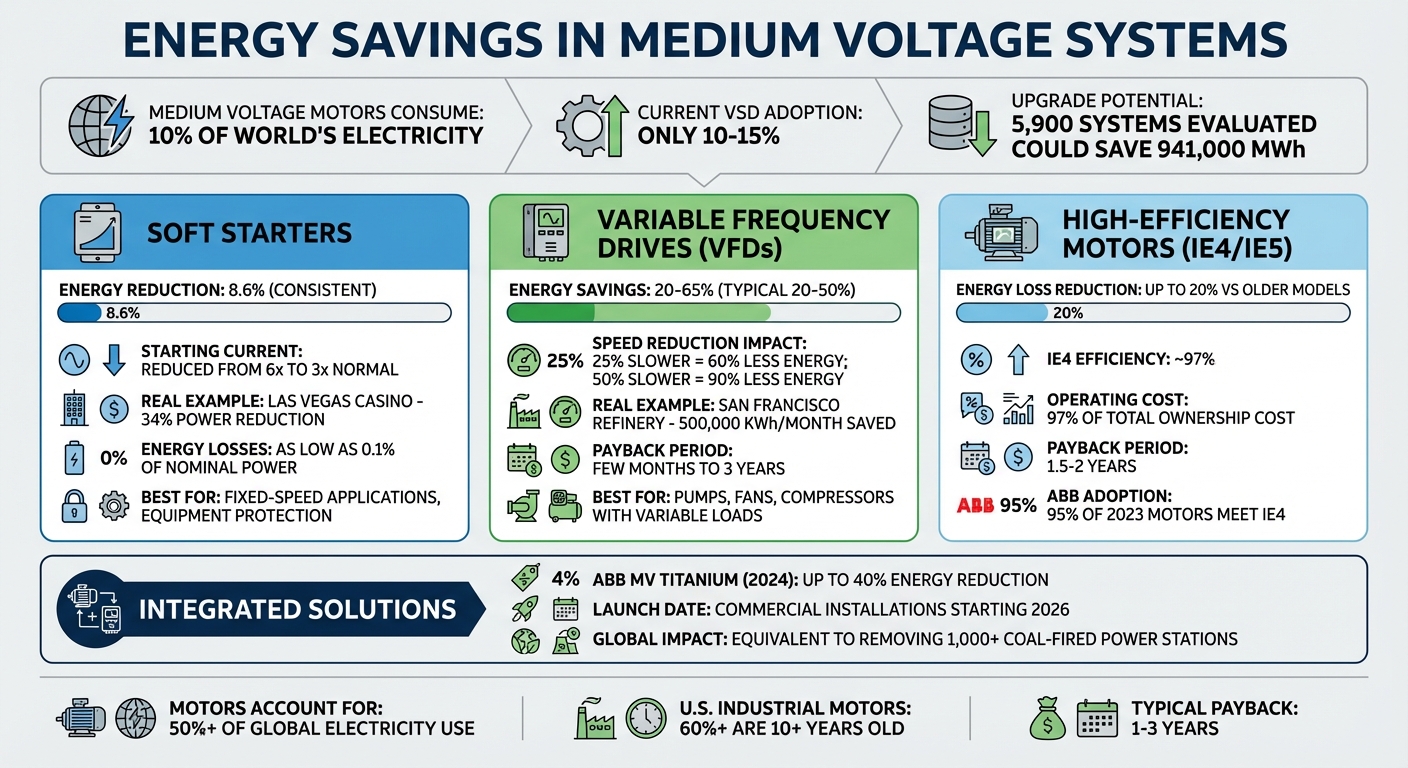
Energy Savings Comparison: Soft Starters vs VFDs vs High-Efficiency Motors
WEG Webinar: The Advantages of Using VSDs in Pump Applications

sbb-itb-501186b
Soft Starters and Energy Reduction
Soft starters tackle a significant energy challenge in medium voltage systems: motor startup. Traditional full-voltage starters force motors to draw about six times their normal running current during acceleration. This surge not only stresses equipment but also drives up energy expenses. Reduced-Voltage-Solid-State (RVSS) soft starters solve this by gradually increasing voltage, cutting the current draw to about three times the running current and ensuring smoother motor acceleration.
Lower Starting Currents
A striking example of soft starter efficiency comes from a 2003 ABB installation. They equipped a 5.6 MW soft starter for a 27 MVA synchronous motor powering a reciprocating compressor. The system limited the motor current during acceleration to just 386 A, a dramatic drop from the motor's rated current of 1,571 A. This controlled acceleration lasted 27 seconds.
Modern high-efficiency motors (meeting IE3 and IE4 standards) present additional challenges, with peak inrush currents 20% to 50% higher than older IE1 models. Without properly rated soft starters, facilities face risks like contact welding and nuisance tripping. Roland Weber from Eaton highlights the impact:
IE3 and IE4 motors have special properties that have a direct effect on the other components in the drive system - particularly the switchgear.
By managing these current surges, soft starters not only protect equipment but also contribute to energy efficiency and cost savings.
Efficiency Numbers and Cost Savings
Soft starters consistently deliver an 8.6% reduction in energy use, regardless of the power factor. More advanced "intelligent" soft starters take this further by dynamically adjusting voltage and current to match the motor's demand. This is especially useful for the 44% of industrial motors that operate below 40% load, maintaining full RPM while optimizing energy consumption.
One real-world example is a 2007 trial at a Las Vegas casino. Using ESS+ technology, the escalator motors saw a 34% reduction in average power consumption. John Hurst, Director of Engineering at Power Efficiency Corporation, explains:
Energy saving soft start technology has been proven to save 25–50% of the energy consumed by an electric motor, depending on the load and operation of the machine.
For fixed-speed applications where slowing the motor isn’t an option, soft starters remain a budget-friendly choice. They also minimize energy losses, which can be as low as 0.1% of nominal power.
Variable Frequency Drives for Motor Efficiency
Variable frequency drives (VFDs) go beyond the capabilities of soft starters by continuously adjusting motor speed to meet actual demand. Instead of running at full speed and relying on mechanical valves or dampers to control output, VFDs modify the motor's voltage and frequency. This approach avoids energy waste caused by maximum-speed operation and inefficient throttling. Over a 20-year lifespan, more than 90% of the cost of running a typical 200 Hp industrial motor comes from electricity consumption, while the initial purchase price represents less than 2%. Mark Gmitro from Baldor/ABB emphasizes this reality:
On average, electricity costs account for about 96 percent of the total life-cycle cost of a motor, while the purchase price accounts for only three percent.
In fact, a motor can consume electricity equal to its entire purchase cost in just three months of operation. This makes VFDs especially valuable for centrifugal loads, where efficiency improvements are most noticeable.
Speed Control and Load Matching
VFDs excel in applications with centrifugal loads, such as pumps, fans, and blowers. These systems follow the Affinity Laws, which reveal that power demand drops significantly with even small reductions in motor speed. For example, a 25% speed reduction can lower energy consumption by about 60%, while cutting speed by 50% results in nearly 90% energy savings. This cubic relationship between speed and power makes centrifugal systems ideal for VFD retrofits.
Industrial setups using VFDs often report energy savings between 20% and 65%, with pump and fan systems typically achieving 20% to 50% reductions. These savings far surpass the fixed 8.6% efficiency gains from soft starters. Considering that electric motors account for over 50% of global electricity use, VFDs offer significant cost-saving potential. Additionally, modern sync-transfer control technology enables a single medium-voltage VFD to sequentially manage up to 10 motors, cutting capital costs by up to 50% compared to equipping each motor with its own drive. These advantages highlight the value of upgrading older systems.
Retrofitting Older Systems with VFDs
For existing systems, retrofitting older motors with VFDs is an effective way to boost efficiency. In the U.S., over 60% of industrial motors are at least 10 years old, often with outdated efficiency ratings. Adding a VFD to a fixed-speed system that relies on mechanical throttling can improve system efficiency by as much as 25%.
A notable example is a 2012 San Francisco refinery retrofit, which eliminated flow control losses, saving 500,000 kWh per month and $750,000 overall. The cost of VFD installation varies, ranging from $3,000 for a 5 Hp motor to $45,000 for a 300 Hp motor designed for specialized applications. These retrofits typically pay for themselves within a few months to three years. Beyond energy savings, operating motors at lower speeds reduces mechanical stress, vibration, and heat - factors that extend the life of motor insulation and bearings.
Efficiency Standards and High-Performance Motors
Advances in controls and updated efficiency standards are transforming energy use in medium voltage systems, leading to significant energy savings.
IE4/IE5 Motor Standards
New international efficiency standards are reshaping how industrial motors consume energy. IE4 motors, known as "Super Premium Efficiency", deliver about 97% efficiency by leveraging enhanced rotor-stator designs and high-quality materials. The IE5 standard, or "Ultra Premium Efficiency", takes things a step further, cutting energy losses by roughly 20% compared to IE4 motors. These upgrades are crucial because electricity usage accounts for a staggering 97% of a motor's total cost of ownership, while the upfront purchase price makes up only 1%.
To put this into perspective, a 55 kW IE4 motor running continuously might cost around $56,000 annually in electricity, compared to its $3,600 purchase price. Additionally, the IEC 60034-30-3 standard now specifically targets medium and high-voltage motors operating above 1,000 VAC, with outputs ranging from 200 to 2,000 kW. This provides industries with clear benchmarks for applications like wastewater treatment and material handling, encouraging broader adoption of these energy-efficient technologies.
Industry Adoption Rates
Regulatory measures are accelerating the shift toward high-efficiency motors. For instance, the EU Ecodesign regulation (EU 2019/1781) made IE4 mandatory for motors between 75 kW and 200 kW starting in July 2023. ABB, a leader in industrial motors, reported that over 95% of the high-voltage motors they supplied in 2023 already met IE4 standards. Raimo Sakki, Product Manager at ABB, highlighted the industry's direction:
"In the next few years, we expect the EU will introduce minimum efficiency requirements for HV motors."
Globally, more than 40 countries - accounting for 80% of motor system electricity use - have enacted energy efficiency regulations. A 2022 energy audit program in Ohio demonstrated the potential impact: it saved $702 million in energy costs, avoided 2.7 million metric tons of CO₂ emissions, and created 3,445 jobs, contributing to a $788 million annual regional boost. These outcomes emphasize the economic and environmental advantages of adopting high-performance motors, which typically offer payback periods of just 1.5 to 2 years. Such results highlight the growing importance of efficiency standards in fostering sustainable energy practices.
Case Studies: Industry Applications
Wastewater Treatment Plants
Wastewater treatment facilities have made impressive strides in reducing energy consumption by upgrading to Variable Frequency Drive (VFD)-controlled systems. Take the Sni-A-Bar Municipal Wastewater Plant in Blue Springs, Missouri, for example. By replacing four 150-hp fixed-speed blowers with four 100-hp VFD-controlled centrifugal blowers, the plant cut its annual energy use by 442,664 kWh - a 37% reduction. This upgrade also saved $42,000 in electricity costs and $2,500 in maintenance expenses annually.
Over in Brazil, the Saneago water utility achieved even larger savings. With the installation of ACQ580 drives and high-efficiency motors, the utility saved 6,000 MWh annually, amounting to $700,000 in cost reductions. Osmar Qualhato Junior, the Energy Management Supervisor, noted:
"By installing the new ACQ580 drives and high-efficiency motors we have been able to reduce our energy consumption by 25 percent."
Another success story comes from the Albany County Sewage District, where a 20-hp pump motor was replaced with a Siemens copper-rotor motor paired with a VFD. This upgrade resulted in annual energy savings of 46,677 kWh, $6,535 in cost savings, and a rapid payback period of just 4.6 months.
These examples highlight how VFD upgrades can transform energy efficiency in wastewater treatment, offering a glimpse of their potential in other industries, like material handling.
Material Handling Operations
Material handling facilities have also reaped considerable benefits from motor control upgrades. At West Fraser's plant in Cowie, Scotland, installing three Allen-Bradley PowerFlex 6000T medium-voltage VFDs brought significant improvements. By reducing motor speeds by 25%, the plant optimized its raw material drying and product extraction fans, cutting energy use by about 60% in those applications. This translated to annual cost savings of over $266,000. Gordon McArthur, Engineering Manager, explained:
"We are now exactly where we need to be in terms of optimizing the speeds of our large process fans for improved process control and reliability."
These examples from wastewater treatment and material handling demonstrate that investing in VFDs and high-efficiency motors not only meets technical goals but also delivers major financial advantages.
Future Developments in Medium Voltage Systems
Next-generation medium voltage systems build on the energy-saving capabilities of soft starters and VFDs while introducing even more operational benefits.
Smart Monitoring and Predictive Maintenance
Modern medium voltage equipment is getting smarter. New motor designs now come with built-in analytics and connectivity, eliminating the need for extra sensors or separate monitoring systems. These integrated features transform raw machine data into actionable insights, helping operators detect potential problems before they escalate into costly downtime.
By combining motors and drives into a single package, manufacturers are also simplifying system setups. Traditional configurations often require separate electrical houses, transformers, and extensive cabling. These streamlined, integrated designs not only improve reliability but also make real-time process monitoring more straightforward by reducing unnecessary components.
These advancements pave the way for further progress in motor control technology, with significant innovations expected by 2026.
2026 Motor Control Advances
In the 1-to-5 megawatt range, only 10–15% of motors currently use variable speed drives. However, that’s about to change. The MV Titanium concept is evolving to deliver enhanced control and connectivity, offering easier installations starting in 2026. Heikki Vepsäläinen, President of ABB Large Motors and Generators, highlights the importance of this innovation:
"The MV Titanium concept... makes it cost-effective and straightforward to install a suitable matched motor, with increased control, monitoring, and connectivity in a single package."
These integrated systems promise to cut energy usage by up to 40% compared to traditional fixed-speed motors. Designed to replace direct-on-line motors - which dominate the global medium voltage motor market - the first commercial installations are set to roll out in 2026. Industries such as water and wastewater, mining, cement, and processing are expected to benefit significantly. With typical payback periods ranging from 1 to 3 years, these systems offer not only major energy cost savings but also a reduction in carbon emissions.
Conclusion
Medium voltage motor systems present a huge opportunity for cutting industrial energy use. These systems account for 10% of the world's electricity consumption, so even small efficiency gains can lead to significant cost savings and reduced environmental impact. Yet, only 10–15% of large industrial motors currently use variable speed drives, leaving a vast amount of potential improvements unrealized.
Between November 2024 and May 2025, ABB evaluated 10,500 industrial motor-driven systems and found 5,900 that could benefit from upgrades. These systems alone could achieve an average energy savings of 43%, which totals 941,000 MWh - enough to power over 91,000 U.S. homes for a year. On a global scale, the potential impact is massive. As Heikki Vepsäläinen, President of ABB Large Motors and Generators, explained:
If we retrofitted the entire installed base, it would be like taking just over 1000 coal-fired power stations offline.
The way forward lies in combining established technologies with newer advancements. Solutions like soft starters, variable frequency drives, and high-efficiency IE4/IE5 motors can provide immediate energy savings, while integrated motor-drive packages offer reductions of up to 40%. Beyond individual components, there’s a growing emphasis on optimizing entire Power Drive Systems, which can unlock even greater efficiencies. These findings highlight the importance of energy audits and system upgrades.
Facilities managers and engineers should focus on conducting energy audits to pinpoint retrofit opportunities, particularly in variable torque applications like pumps and fans. Integrated solutions not only lower energy use but also simplify installation processes. These upgrades deliver tangible savings while helping meet sustainability goals. The tools and technologies are ready - taking action now is essential to achieving both economic and environmental benefits.
FAQs
When should I use a soft starter instead of a VFD?
When you need a straightforward and budget-friendly solution to reduce inrush current during motor startup, a soft starter is the way to go. Soft starters are compact, affordable, and perfect for systems that operate at full speed, especially in lightly loaded applications.
On the other hand, if your setup requires precise speed control, improved energy efficiency, or the ability to manage variable torque, a VFD (Variable Frequency Drive) is the better choice. While VFDs are more expensive and take up more space, they provide the flexibility and control necessary for more demanding applications.
How do I estimate payback for a medium-voltage VFD or motor upgrade?
To figure out the payback period, compare the energy savings to the upfront costs. For example, lowering a motor's speed by 20-25% can slash energy consumption by 50-60%. Even larger reductions in speed lead to even greater energy savings. Start by calculating the total costs, including purchase, installation, and maintenance, then divide that by the yearly savings. In many cases, systems designed for efficiency can pay for themselves in 18-24 months. Tools like efficiency standards can also help fine-tune your estimates for smarter, cost-efficient upgrades.
Will a VFD work with my existing medium-voltage motor and switchgear?
A VFD (Variable Frequency Drive) can be used with your current medium-voltage motor and switchgear, provided it’s designed specifically for medium-voltage applications and aligns with your motor’s specifications. Many medium-voltage VFDs are built to integrate smoothly into existing setups, often requiring little to no major adjustments.