IE1 to IE5 Motor Classes Explained
Electric motors consume 50% of the energy used in U.S. manufacturing, making their efficiency a key factor in reducing costs and meeting regulations. The International Efficiency (IE) classification system, ranging from IE1 to IE5, defines motor efficiency levels under the IEC 60034-30-1 standard. Here’s what you need to know:
- IE1: Standard efficiency; outdated in most industrial applications.
- IE2: High efficiency; 3% better than IE1, suitable for specific use cases.
- IE3: Premium efficiency; 7% improvement over IE1, aligns with NEMA Premium in the U.S.
- IE4: Super Premium efficiency; 12% better than IE1, mandatory for certain motors in the U.S. starting June 2027.
- IE5: Ultra Premium efficiency; 20% better than IE1, relies on advanced designs like PMSM or SynRM.
Energy costs make up 90%-95% of a motor’s lifetime expenses, so higher efficiency motors can save thousands annually. With new DOE regulations requiring IE4 motors by June 1, 2027, upgrading now helps ensure compliance and long-term savings.
Key takeaway: Investing in higher IE classes reduces energy costs, aligns with future regulations, and provides a clear return on investment over a motor's lifecycle.
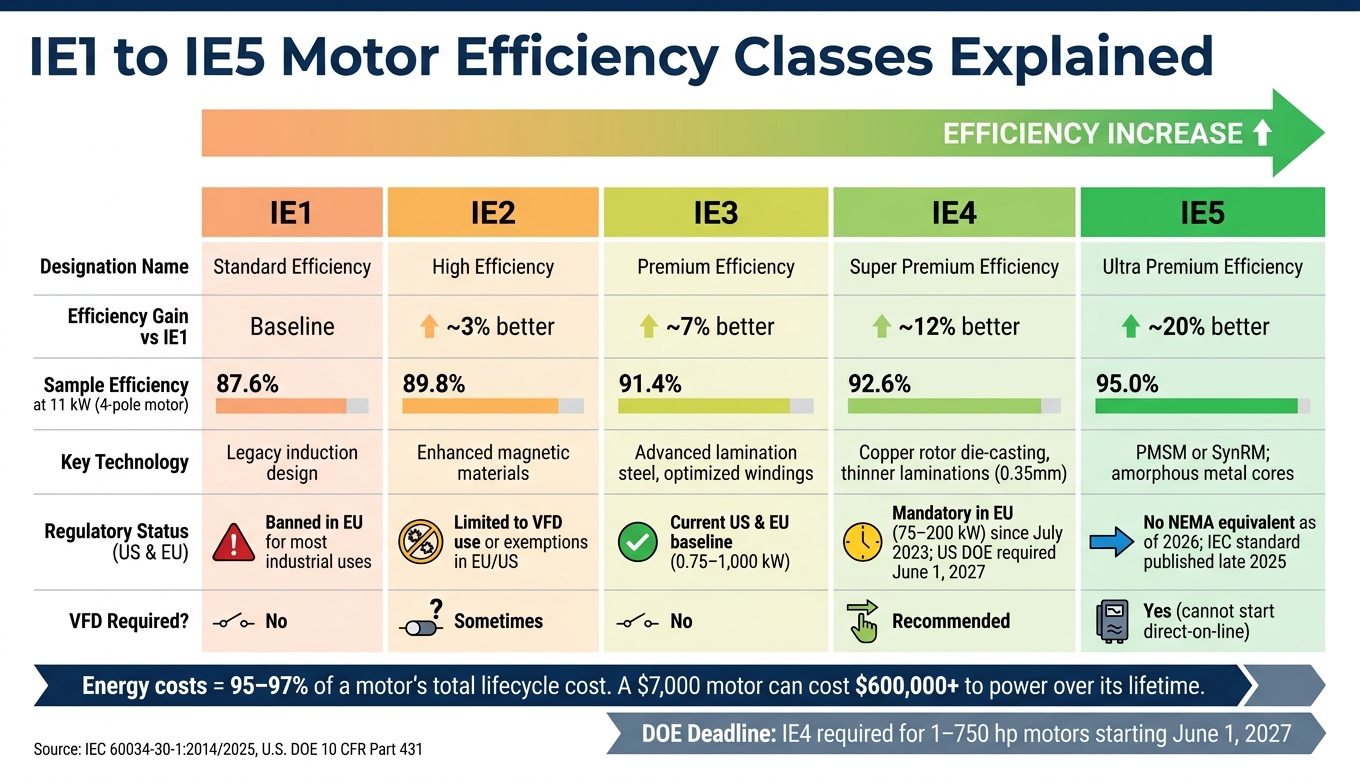
IE1 to IE5 Motor Efficiency Classes: Key Specs & Savings at a Glance
Energy Efficiency in Motor || IE1, IE2, IE3, IE4 and IE5 with Case Study
sbb-itb-501186b
IE1 to IE5: Definitions and Key Differences
Each IE class represents a step forward in how efficiently a motor converts electrical energy into mechanical output. While the efficiency gains might seem small, they translate into noticeable energy savings and reduced operational costs over a motor's lifespan.
IE1 and IE2: Standard and High Efficiency Motors
IE1 (Standard Efficiency) is the foundational level for motor performance. However, in the European Union, IE1 motors are no longer permitted for most industrial uses.
IE2 (High Efficiency) offers about a 3% improvement over IE1. This is achieved through better materials and design tweaks. In many regions, IE2 motors are typically limited to applications that use a variable frequency drive (VFD) or meet specific exemptions, as they are generally not approved for direct-on-line operation in industrial environments.
IE3 and IE4: Premium and Super Premium Efficiency Motors
IE3 motors deliver a roughly 7% efficiency improvement over IE1. This is achieved using advanced lamination steel and refined winding designs. IE3 motors are the baseline standard for motors ranging from 0.75 kW to 1,000 kW in both the U.S. and EU. In the United States, these motors align with the NEMA Premium designation.
IE4 motors push efficiency even further, with about a 12% gain over IE1. This level of performance is made possible by innovations like copper rotor die-casting, which cuts rotor losses by 15–25%, and the use of grain-oriented steel with thinner laminations (as slim as 0.35 mm). For example, a 200-horsepower motor must achieve 96.2% efficiency to meet IE4 standards under upcoming U.S. regulations. In the EU, IE4 has been mandatory for motors between 75 kW and 200 kW since July 2023, and the U.S. Department of Energy will require similar standards for mid-range motors starting June 1, 2027. In the U.S., IE4 corresponds to the NEMA Premium 4 designation.
IE5: Ultra Premium Efficiency Motors
IE5 (Ultra Premium Efficiency) represents the highest tier of motor efficiency, reducing losses by around 20% compared to IE1. For instance, at a power level of 250 kW, an IE5 motor can cut losses by 32.5% compared to an IE3 motor - lowering losses from 4.0% to 2.7%. To achieve this performance, IE5 motors rely on advanced designs like permanent magnet synchronous motors (PMSM) or synchronous reluctance motors (SynRM). Some even incorporate amorphous metal cores, which reduce core losses by 70–80% compared to traditional steel.
However, these motors come with unique requirements. IE5 PMSM motors cannot start directly from the grid and need a compatible VFD. They are also more compact and power-dense than traditional induction motors, but their reliance on rare-earth magnets makes repairs more specialized. The IEC established IE5 efficiency standards in the second edition of IEC 60034-30-1, published in late 2025. As of 2026, there is no NEMA equivalent for IE5.
This classification system sets the stage for understanding the testing standards used to measure these efficiency advancements.
| IE Class | Designation | Approx. Efficiency Gain vs. IE1 | Key Technology |
|---|---|---|---|
| IE1 | Standard | Baseline | Legacy induction design |
| IE2 | High | ~3% | Enhanced magnetic materials |
| IE3 | Premium | ~7% | Advanced lamination steel, optimized windings |
| IE4 | Super Premium | ~12% | Copper rotor die-casting, thinner laminations |
| IE5 | Ultra Premium | ~20% | PMSM or SynRM; amorphous metal cores |
How Motor Efficiency Is Measured
Motor efficiency boils down to a simple ratio: mechanical output power divided by electrical input power. However, accurately measuring this - especially for motors in the IE3 class or higher - requires precise testing under strict protocols.
IEC Testing Standards for Efficiency
Standardized testing plays a key role in determining motor efficiency. The go-to standard for this is IEC 60034-2-1, which outlines how losses are measured and efficiency is calculated. These tests are conducted under controlled conditions: a temperature of 25°C (77°F) and altitudes up to 3,281 feet (1,000 meters) above sea level. This ensures that efficiency ratings are comparable across manufacturers and motor types.
Different methods are used to measure efficiency, but not all are equally reliable. For instance:
- Direct Method (Method A): This approach measures input and output power directly. While straightforward, it struggles with accuracy once efficiency exceeds 93%, making it less suitable for IE3, IE4, and IE5 motors.
- Loss Analysis Method (Method B/C): This method calculates efficiency by measuring individual loss components, offering better precision for high-efficiency motors.
- Method H (EU): This statistically adjusts stray load losses to improve consistency.
To achieve higher IE classes, manufacturers work to minimize the five main types of losses: stator copper, rotor copper, core iron, friction and windage, and stray load losses.
The efficiency value you see on a motor's nameplate (denoted as "η") reflects the guaranteed efficiency for that motor. It often exceeds the minimum required for its IE class. Since IEC classes are defined at 100% rated load, partial load efficiencies can vary significantly. For example, asynchronous motors may lose 5–10 percentage points of efficiency at 25% load, whereas IE5 motors with PMSM designs maintain much steadier performance curves. This highlights the practical benefits of higher IE classes for applications with varying loads.
Efficiency Comparison Table: IE1 to IE5
Efficiency improvements may seem small on paper, but the impact adds up over thousands of operating hours. Here's a quick look at the minimum nominal efficiency values for 4-pole motors at common power ratings:
| IE Class | Designation | 4 kW | 11 kW | 75 kW |
|---|---|---|---|---|
| IE1 | Standard | 82.5% | 87.6% | 93.0% |
| IE2 | High | 86.0% | 89.8% | 94.6% |
| IE3 | Premium | 87.6% | 91.4% | 95.6% |
| IE4 | Super Premium | 89.5% | 92.6% | 96.5% |
| IE5 | Ultra Premium | 91.7% | 95.0% | 97.8% |
Source: IEC 60034-30-1:2014/2025 for 4-pole motors at 50 Hz
For example, at 11 kW, the efficiency difference between IE1 and IE3 is 3.8 percentage points. Over a 15-year lifespan, with a motor running 6,000 hours annually, this gap can translate into noticeable energy savings. Considering that energy costs often make up over 95% of a motor's total life-cycle cost, these efficiency gains aren't just technical - they're financially impactful too.
Applications and Benefits of Higher IE Classes
Common Applications by IE Class
Choosing the right motor efficiency class comes down to understanding operational needs and duty cycles. Industries that rely on motors for demanding tasks - like running pumps, fans, compressors, or conveyors - stand to gain the most from higher efficiency classes.
Water treatment plants, HVAC systems, and industrial manufacturing are key areas where IE4 and IE5 motors excel. These motors also make a significant impact in commercial settings like hospitals and universities, where they help balance energy costs while meeting sustainability goals such as LEED certification.
| Industry/Application | Recommended IE Class | Primary Reason |
|---|---|---|
| Water Treatment | IE4 or IE5 | High-intensity operation of pumps and fans; works well with VFDs |
| HVAC Systems | IE4 | Energy-demanding fans and compressors; aligns with LEED standards |
| Food & Beverage | IE4 | Continuous operation of mixers, pumps, and conveyors |
| Metals & Mining | IE4 | Handles heavy loads on crushers and mills; reduces energy losses by ~40% |
| Intermittent Duty | IE3 | Low runtime (under 2,000 hours/year) doesn’t justify IE4/IE5 costs |
For applications that involve fluctuating motor speeds, IE5 motors paired with Variable Frequency Drives (VFDs) offer notable advantages. Motors using Synchronous Reluctance (SynRM) technology, for instance, can achieve up to 96.8% efficiency while maintaining consistent performance even at partial loads. This tailored approach to motor selection maximizes both performance and energy savings.
Cost Savings and Return on Investment
Higher IE class motors are not just about energy efficiency - they’re about long-term savings. ABB highlights this with a striking example:
"A typical motor may cost about $7,000 to buy but more than $600,000 to power over its life."
Over a 15-to-20-year lifespan, energy costs make up 95% to 97% of a motor’s total expenses, while the upfront purchase price only accounts for 2% to 5%. For motors running continuously, investing in IE4 or IE5 models often pays off within 1 to 3 years.
This is especially true for motors operating over 4,000 hours annually. Plus, with new DOE standards set to take effect on June 1, 2027, requiring motors rated 1–750 hp to meet IE4 efficiency, upgrading now can help avoid costly redesigns later. Additionally, more than 160 utility programs across the U.S. offer rebates for motors that exceed DOE standards, potentially shaving a full year off payback periods.
"The 2027 DOE standards are more than a compliance requirement. They mark a turning point in how industry consumes energy and how engineers shape that future." - Ben Hinds, Vice President, NEMA Motors Division of ABB
How to Select the Right Motor Efficiency Class
Assessing Your Application Needs
When deciding on an IE class for your motor, the first thing to consider is how often the motor runs. If it operates fewer than 1,000 hours per year, investing in an IE4 motor likely won't be worth the extra cost since the energy savings won’t offset the higher price. On the other hand, motors running over 6,000 hours annually are usually better off with an IE4 or even an IE5 motor, as the long-term savings make up for the initial expense.
Next, think about the load profile. Standard induction motors perform best when operating at 75–100% of their rated load. If your motor runs below 50% load, downsizing it can boost efficiency by 8–12 points. For applications with variable loads, like pumps or fans using a Variable Frequency Drive (VFD), combining an IE3 motor with the VFD often provides more energy savings than simply upgrading the motor's efficiency class.
Environmental conditions also play a role in your decision. Motors used in specialized settings, such as explosive atmospheres (ATEX-rated), extreme temperatures (below –22°F or above 140°F), or submersible applications, may not need to meet standard IE requirements.
With these factors in mind, performing a detailed life-cycle cost analysis is the next logical step.
Life-Cycle Cost Analysis
The cost to run a motor typically dwarfs its purchase price. To figure out whether upgrading to a higher IE class makes financial sense, use this simple payback formula:
Payback (years) = Cost Premium ÷ Annual Energy Savings.
To calculate annual energy savings, use: Power (kW) × Hours/Year × Electricity Cost × (1/η_old – 1/η_new).
For example, upgrading a 110 kW motor running 8,000 hours per year from IE3 to IE4 may carry a 15–25% cost premium but could save $2,100–$2,800 annually. This results in a payback period of 1.5 to 2.5 years and total savings of $18,000–$25,000 over 10 years. Opting for IE5 motors, which use advanced technologies like PMSM or SynRM, costs 30–45% more than IE3 but can deliver $4,500–$5,200 in yearly savings and over $40,000 in savings over a decade.
Additionally, higher-efficiency motors tend to run cooler. Even a 10°F reduction in operating temperature can double the lifespan of the motor’s insulation.
Once you've determined the financial benefits, the next step is finding the right motor and compatible components.
Sourcing Motors and Components
After identifying the appropriate IE class, the challenge becomes finding the right motor at a competitive price. For those managing installations, upgrades, or replacements, platforms like Electrical Trader simplify the process. This site connects buyers and sellers of new and used electrical equipment, including motors, drives, and transformers, making procurement more efficient.
This is especially helpful when sourcing motors that require specific components, like Variable Frequency Drives (VFDs). Advanced IE5 motors, for instance, often need a VFD for optimal performance since they can't start directly from the grid.
Before finalizing a purchase, always verify the motor's nameplate. It should include the IE code, minimum efficiency value, and the relevant test standard (IEC 60034-2-1:2014 or newer). In the U.S., ensure the motor has a Compliance Certification number (CC#) and a nominal efficiency rating, as required by 10 CFR Part 431. This guarantees the motor meets current Department of Energy standards and any upcoming regulations.
Conclusion
Choosing the right motor efficiency class involves balancing technical requirements with financial considerations. This guide has highlighted the key specifications and cost factors to help you make informed decisions. With energy costs accounting for 95% to 97% of a motor's total lifecycle cost, the initial purchase price becomes a relatively small factor compared to long-term operating expenses.
By 2026, IE3 will be the standard worldwide for most industrial three-phase motors. However, efficiency benchmarks are tightening. In the U.S., the Department of Energy (DOE) will require IE4 motors for the 1–750 hp range starting June 1, 2027. This transition is expected to save businesses $8.8 billion and cut 92 million metric tons of CO₂ emissions over 30 years. Planning for IE4 compliance now, especially for projects set to begin in late 2026 or later, can help avoid expensive redesigns.
"Projects designed in 2025 and 2026 may not break ground until after the [DOE] rule takes effect. Engineers who plan ahead can help avoid redesign costs." - ABB News
For those looking at the highest efficiency levels, IE5 motors - which use PMSM or SynRM technology - offer roughly 20% lower losses compared to IE4. While these motors come with a price premium of 60%–100% over IE3, they can provide significant savings in high-duty-cycle operations, such as those running over 7,000 hours annually.
When selecting a motor, focus on the total cost of ownership rather than just the upfront cost. Confirm compliance with IEC 60034-30-1:2025 standards and verify compatibility with variable frequency drives (VFDs) for IE4 and IE5 models. Additionally, take advantage of utility rebate programs - more than 160 utilities across the U.S. offer incentives for motors that meet or exceed DOE standards. A well-chosen motor, tailored to its application, can deliver faster returns than many expect.
FAQs
How do I know what IE class my motor is?
You can locate your motor's IE class on the rating plate attached to its housing. Manufacturers are obligated to display the IE code (e.g., IE1, IE2, IE3, IE4, or IE5) on this plate. If the plate is damaged or missing, you can check the manufacturer's documentation using the motor's model number. The efficiency value listed on the plate indicates the motor’s adherence to IEC 60034-30-1 standards.
Do I need a VFD for an IE4 or IE5 motor?
Whether or not you need a Variable Frequency Drive (VFD) depends largely on the type of motor and how it’s being used. For IE5 permanent magnet synchronous motors (PMSMs), a VFD is essential for starting the motor. On the other hand, optimized asynchronous motors can operate directly on the grid without a VFD, but adding one can enhance their overall performance.
In general, pairing any IE4 or IE5 motor with a VFD is a smart move if energy efficiency is a priority. A VFD allows the motor's speed to adjust based on the specific demands of the process, which often leads to significant energy savings.
Will my motor need to meet the DOE IE4 rule after June 1, 2027?
Starting June 1, 2027, the U.S. Department of Energy will mandate IE4 efficiency standards for mid-range, three-phase induction motors ranging from 1 to 750 horsepower. Motors that fall outside this category will still adhere to the existing IE3 efficiency standards. Electrical Trader offers a marketplace for both new and used electrical components, helping you adapt to these changing regulations with ease.