

5 Benefits of APFC Panels Over Manual Systems
Automatic Power Factor Correction (APFC) panels outperform manual systems in managing power factor for facilities with fluctuating loads, like manufacturing plants and data centers. They reduce electricity costs, prevent utility penalties, and protect equipment from damage caused by poor power factor. Unlike manual systems, APFC panels automatically adjust capacitor banks in real time, ensuring optimal performance without human intervention. Here’s a quick summary of their advantages:
- Utility Compliance: Maintains a consistent power factor (0.95–0.99), avoiding penalties of 5–15% on electricity bills.
- Lower Costs: Cuts electricity expenses by up to 30% by reducing energy losses and penalties.
- Equipment Protection: Prevents overheating, voltage instability, and wear, extending equipment lifespan.
- Reduced Maintenance: Requires minimal oversight compared to manually operated systems.
- Scalability: Handles a wide range of capacities and integrates with modern power systems.
Quick Comparison:
| Feature | APFC Panels | Manual Systems |
|---|---|---|
| Response Time | Milliseconds | 30–60 seconds |
| Power Factor Range | 0.95–0.99 (consistent) | 0.70–0.90 (fluctuating) |
| Maintenance | Minimal | High |
| Risk of Overcorrection | None | High during low loads |
| Long-term Value | High (energy savings, ROI < 18 months) | Low (penalties, equipment strain) |
APFC panels provide a fast, efficient, and low-maintenance solution for improving power factor, saving costs, and ensuring system reliability.
APFC Panels Circuit |Explained
1. Consistent Power Factor Improvement and Utility Compliance
In the U.S., utilities require businesses to maintain a minimum power factor, typically between 0.85 and 0.90, though modern grid standards often push this to 0.95 or higher. Falling below these thresholds can lead to penalty surcharges, which usually range from 5% to 15% of your monthly electricity bill. For a mid-sized manufacturing facility, this could mean over $1,200 in additional charges every month. These penalties highlight the need for a quick and automated solution to avoid compliance issues.
Manual systems, however, are slow to react, taking 30–60 seconds to adjust to load changes. In facilities where motors frequently start and stop throughout the day, this delay can cause the power factor to drop below acceptable levels, often going unnoticed until penalties appear on the utility bill.
This is where APFC panels shine. They respond within milliseconds, ensuring the power factor remains within compliance. As TECO GROUP explains:
"As loads change throughout the day - motors starting and stopping, production lines ramping up and down - the APFC controller dynamically adds or removes capacitor banks to maintain optimal correction."
Another common issue is over-correction, which happens when manual capacitor banks remain active during low-load periods, such as nights or weekends. This can result in a leading power factor, causing the Ferranti Effect. This phenomenon destabilizes generators and can damage sensitive electronics. APFC panels eliminate this risk by continuously monitoring the load and applying only the necessary correction, ensuring equipment safety and stable system performance.
For optimal results, engineers recommend maintaining a power factor of 0.98–0.99 lagging. Achieving this level of precision with manual systems is rare, but APFC panels make it possible, offering a dependable way to meet utility requirements and avoid costly penalties.
2. Lower Electricity Bills and Better Energy Use
A poor power factor can quietly inflate your electricity bill. As Anubhav Electricals explains:
"Facilities with poor power factor often pay 10–25% higher electricity costs without realizing it."
This issue arises because a low power factor pushes more current through cables and transformers to deliver the same usable power. That extra current creates I²R losses, wasting energy and driving up costs.
APFC panels tackle this by maintaining the power factor between 0.95 and 0.99, which reduces total current and significantly cuts resistive losses. For instance, improving a power factor from 0.80 to 1.00 can lower distribution system losses by as much as 36%. According to the U.S. Energy Information Administration, implementing APFC panels can help businesses cut electricity costs by up to 30%.
Take this real-world example: an injection molding facility in Ohio discovered its power factor was 0.72, leading to a $3,200 monthly penalty. After installing a 400 kVAR Detuned APFC Panel, the power factor improved to 0.99, eliminating the penalty entirely. The investment paid for itself in just 7 months.
Improving the power factor also boosts usable kW capacity. For instance, raising the power factor from 0.80 to 0.95 increases usable kW capacity by approximately 19% for the same transformer rating. This means facilities can add equipment or expand operations without immediately investing in expensive infrastructure upgrades - a huge benefit for growing businesses.
3. Equipment Protection and Longer System Life
Protecting equipment is just as important as reducing energy costs or ensuring compliance, and APFC panels excel in this area. A poor power factor doesn’t just drive up expenses - it can also wear out equipment faster. When the power factor is low, extra current flows through cables, busbars, and transformers, leading to higher resistive losses and elevated operating temperatures. This heat buildup takes a toll on equipment. For instance, every 18°F (10°C) increase in operating temperature halves a capacitor’s lifespan.
APFC panels work to reduce this excess current, helping to keep component temperatures under control. Take the example of a mid-sized manufacturing plant in North India. The facility dealt with frequent transformer overheating due to heavy inductive loads from motors and welding machines. After installing an APFC panel, their power factor jumped from 0.72 to 0.99. This improvement significantly lowered transformer temperatures and cut down on maintenance costs. This case shows how thermal protection alone can make an APFC panel a smart investment. But it doesn’t stop there - voltage stability is equally critical for safeguarding sensitive control systems.
Voltage instability can be a major threat to equipment like PLCs and SCADA systems. APFC panels respond to reactive power fluctuations within milliseconds, preventing voltage sags and flickers that could otherwise cause damage. Manual correction methods simply can’t match this speed or precision.
Another issue with fixed manual capacitor banks is the risk of overcompensation. During light-load periods, these banks can create a leading power factor, resulting in over-voltage and putting stress on insulation. APFC panels avoid this entirely by automatically disconnecting capacitors when they aren’t needed.
"APFC panels act as silent power savers... preventing penalties and reducing wear and tear on electrical components, leading to significant cost savings and extended equipment life." - Synchro Electricals
For facilities using Variable Frequency Drives (VFDs) or other non-linear loads, detuned APFC panels offer even greater protection. These panels include series reactors that block harmonic currents, preventing issues like resonance, capacitor overheating, tripping, and early failure.
sbb-itb-501186b
4. Less Downtime and Lower Maintenance Demands
A standout benefit of APFC panels is how little daily attention they require, thanks to their automated functionality. Traditional manual capacitor systems demand constant monitoring - operators must track power factor levels, log readings, and manually switch capacitor banks on or off as load demands fluctuate throughout the day. In contrast, APFC panels, equipped with microprocessors, handle these adjustments in milliseconds. This automation eliminates the need for ongoing manual intervention, reducing the chance of human error and ensuring smoother operations. The result? Fewer disruptions and easier maintenance.
Manual systems also come with risks, such as operators forgetting to switch off capacitor banks during low-load periods like nights, weekends, or planned shutdowns. This oversight can lead to voltage spikes and unexpected trips of main breakers. APFC panels solve this issue by automatically disconnecting capacitor banks during low-load conditions, preventing voltage instability and costly shutdowns.
"In industries with dynamic loads, manual correction often worsens PF during low-load conditions - a problem APFC panels eliminate." - Anubhav Electrical
Another advantage is the simplicity of diagnosing faults. Modern APFC controllers are designed with user-friendly diagnostic displays that provide error codes and alarms for issues such as over-voltage, phase failure, or a faulty capacitor unit. This feature allows maintenance teams to quickly identify and address problems, saving time and effort.
Maintenance requirements for APFC panels are minimal. Regular inspections of cooling components and capacitor performance are typically sufficient. Compared to manual systems, this streamlined upkeep reduces daily oversight, contributing to both cost efficiency and operational reliability.
5. Scalability and Compatibility with Modern Power Systems
APFC panels are designed to grow alongside your facility. Thanks to their modular architecture, they can handle capacities ranging from 25 kVA to 10 MVA, making it easy to expand without needing a complete replacement. This flexibility simplifies upgrades and ensures the system can meet a variety of power requirements. Additionally, microprocessor controllers allow for reprogramming of target power factor settings, accommodating changes in utility regulations or facility demands over time. When planning a new panel, it's a good idea to include about 20% extra capacity above your calculated kVAR needs. This extra headroom ensures you can handle future load increases without requiring immediate upgrades.
APFC panels are versatile, integrating seamlessly with both high- and low-voltage systems as well as renewable energy setups. Using 4-quadrant controllers, they effectively manage bi-directional power flow. Many modern panels also come equipped with RS-485 Modbus communication, making it easy to connect them to plant SCADA systems or remote monitoring platforms.
As facilities incorporate more advanced equipment - like VFDs, LED lighting, or UPS systems - APFC panels can include detuned reactors to guard against harmonic resonance as the system grows. If your facility's Total Harmonic Distortion (voltage) exceeds 5%, detuned reactors are essential to protect the capacitors from premature wear and failure.
"A properly engineered Capacitor Bank Panel (or APFC panel) is arguably the only piece of equipment in your facility that offers an ROI of under 18 months. It doesn't just lower bills; it stabilizes voltage and frees up transformer capacity." - Arian Parto
In short, APFC panels are built to meet current needs while staying ready to adapt to future advancements in power systems.
APFC Panels vs. Manual Systems: Side-by-Side Comparison
APFC Panels vs. Manual Systems: Key Performance Differences
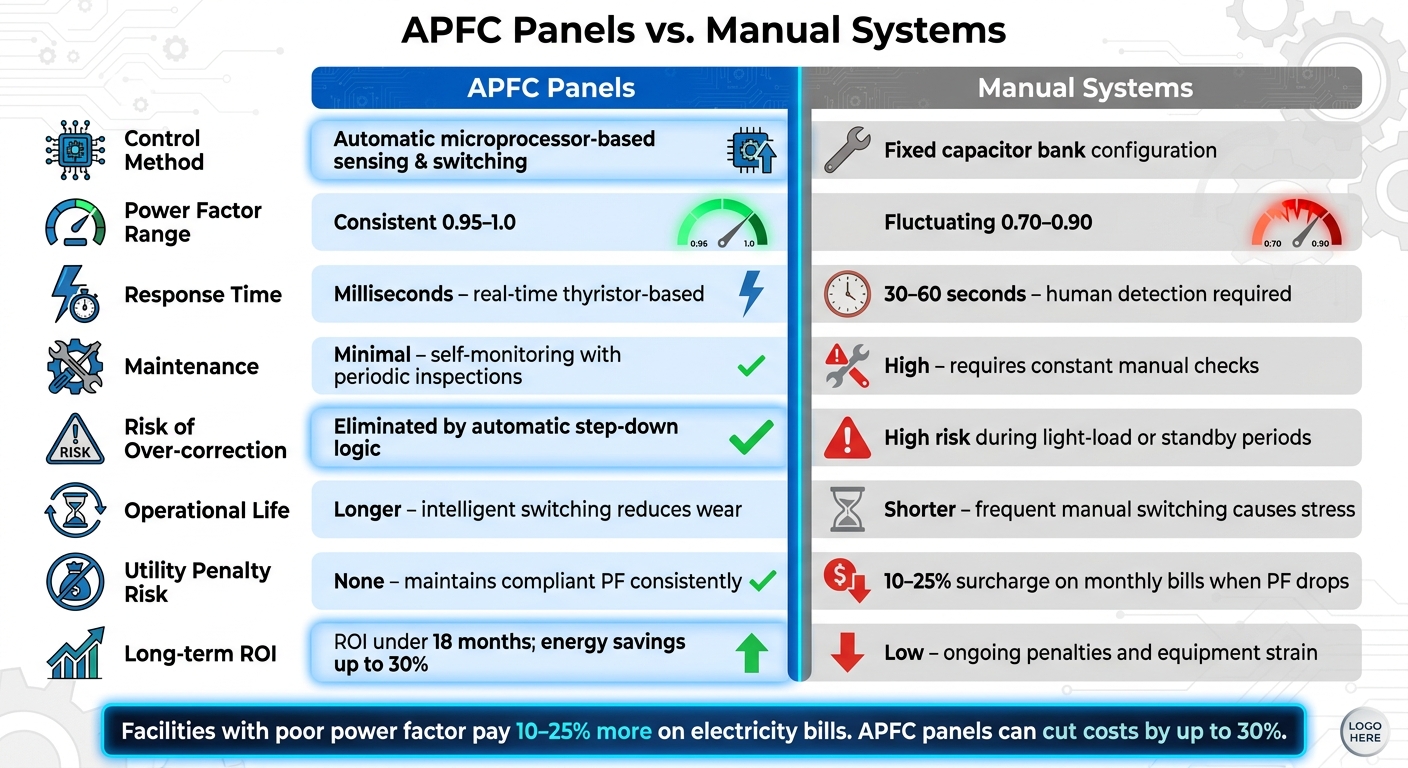
When comparing APFC panels to manual systems, the differences in performance, cost-efficiency, and equipment longevity are striking. Here's a closer look at how these systems stack up against each other:
| Feature | APFC Panels | Manual Systems |
|---|---|---|
| Control Method | Automatic microprocessor-based sensing and switching | Fixed capacitor bank configuration |
| Power Factor Range | Consistent 0.95–1.0 | Fluctuating, often 0.70–0.90 |
| Response Time | Milliseconds (real-time, thyristor-based) | Slow; depends on human detection and action |
| Maintenance | Minimal; self-monitoring with periodic inspections | High; requires constant manual checks |
| Load Suitability | Ideal for variable, fluctuating industrial loads | Best for constant, steady loads only |
| Risk of Over-correction | Eliminated by automatic step-down logic | High risk during light-load or standby periods |
| Operational Life | Longer; intelligent switching reduces wear | Shorter; frequent manual switching causes stress |
| Long-term Value | Higher; energy savings and equipment protection | Lower; risk of penalties and equipment strain |
Manual systems have a slower response time and depend on human intervention to detect and correct power factor drops. This delay not only increases operational costs but also makes it difficult to meet compliance standards. In contrast, APFC panels use thyristor-based switching to react in milliseconds, ensuring precise adjustments without delay.
Another drawback of manual systems is the risk of over-correction during low-load periods. These systems lack the automatic step-down logic of APFC panels, which disconnect unnecessary capacitor steps to prevent overcompensation. This dynamic adjustment capability is especially important for facilities with fluctuating industrial loads.
For businesses facing power factor penalties, the financial impact of sticking with manual systems can add up fast. Utilities often impose a 10%–25% surcharge on monthly bills when the power factor drops below the required threshold. APFC panels, with their ability to maintain a consistent power factor, help avoid these penalties while protecting equipment from unnecessary strain.
These differences clearly show why APFC panels are the go-to choice for modern facilities aiming for efficiency and long-term savings.
Conclusion
APFC panels provide a smart solution for automation, cost savings, and reliability. While manual systems may suffice for steady and predictable loads, they fall short in meeting the demands of modern industrial environments where load requirements fluctuate throughout the day.
By continuously adjusting to optimize power factor, APFC panels help avoid utility penalties and ensure smoother operation of equipment. This not only reduces electricity costs - potentially by up to 30% - but also extends the lifespan of your machinery. With a well-designed APFC system, businesses often see a return on investment in less than 18 months.
"A properly engineered Capacitor Bank Panel... is arguably the only piece of equipment in your facility that offers an ROI of under 18 months." - Arian Parto
To fully capitalize on these benefits, sourcing quality components is key. For a wide range of new and used electrical equipment - like capacitor banks, transformers, and power distribution parts - Electrical Trader is a reliable resource to help build or upgrade your APFC system effectively.
FAQs
How do I know if my facility needs an APFC panel?
Check your utility bills for terms like Reactive Power Charges or Low Power Factor Surcharges - these are clear signs of a low power factor. Facilities with varying inductive loads, such as manufacturing plants, data centers, hospitals, or buildings that rely heavily on HVAC systems, are prime candidates for addressing this issue. Installing an APFC panel can help you avoid the hassle of manual adjustments, cut down on energy waste, and steer clear of utility penalties by automatically correcting your power factor.
What size (kVAR) APFC panel should I choose?
To determine the correct kVAR size for your APFC (Automatic Power Factor Correction) panel, you’ll need to calculate your facility’s reactive power demand. Use this formula:
kVAR = kW × (tan θ₁ − tan θ₂)
Here’s what the terms mean:
- kW: Your real power demand.
- θ₁: The angle corresponding to your current power factor.
- θ₂: The angle corresponding to your target power factor.
For a more accurate assessment, it’s a good idea to perform a power factor audit. This helps ensure you’re making the best choice for your system's efficiency. Companies like Electrical Trader offer reliable equipment to meet your power factor correction needs.
Do I need a detuned APFC panel for harmonics and VFDs?
If your facility operates with variable frequency drives (VFDs) or other non-linear loads, using a detuned APFC panel is essential. VFDs produce harmonic currents that can lead to issues like overheating, blown fuses, or even equipment damage when they interact with standard capacitor banks. Detuned reactors, commonly rated at 5.67% or 7%, adjust the resonant frequency to safeguard your system and maintain efficient performance.