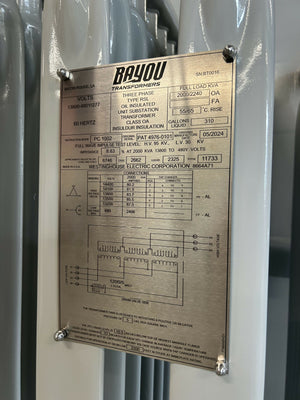
DOE Transformer Efficiency Standards Explained
Transformers waste energy through two main types of losses: no-load (constant energy loss) and load losses (vary with usage). To address this, the U.S. Department of Energy (DOE) has set minimum energy efficiency standards for distribution transformers. These regulations aim to reduce energy waste, cut costs, and lower emissions.
Here’s a quick breakdown:
-
Key Updates:
- The 2016 standards improved efficiency by 8–10% over older NEMA TP-1 levels, saving $12.9 billion over 30 years.
- The 2024 Final Rule, effective April 23, 2029, introduces stricter requirements, focusing on materials like amorphous steel to cut losses further.
- Projected savings: $14 billion in consumer energy costs, 85 million metric tons of CO₂ reduction over 30 years.
-
What’s Covered:
- Transformers with primary voltages ≤35 kV, secondary voltages ≤600 V, and frequency between 55–65 Hz.
- Includes liquid-immersed, low-voltage dry-type, and medium-voltage dry-type transformers.
- Exemptions: Specialized transformers, like autotransformers and welding transformers, are not regulated.
- Manufacturer Costs: Compliance requires production changes, with estimated costs of $270.6 million for liquid-immersed units and $69.4 million for low-voltage dry-type units.
SolaHD™ Energy Efficient Distribution Transformers
sbb-itb-501186b
History of DOE Transformer Standards
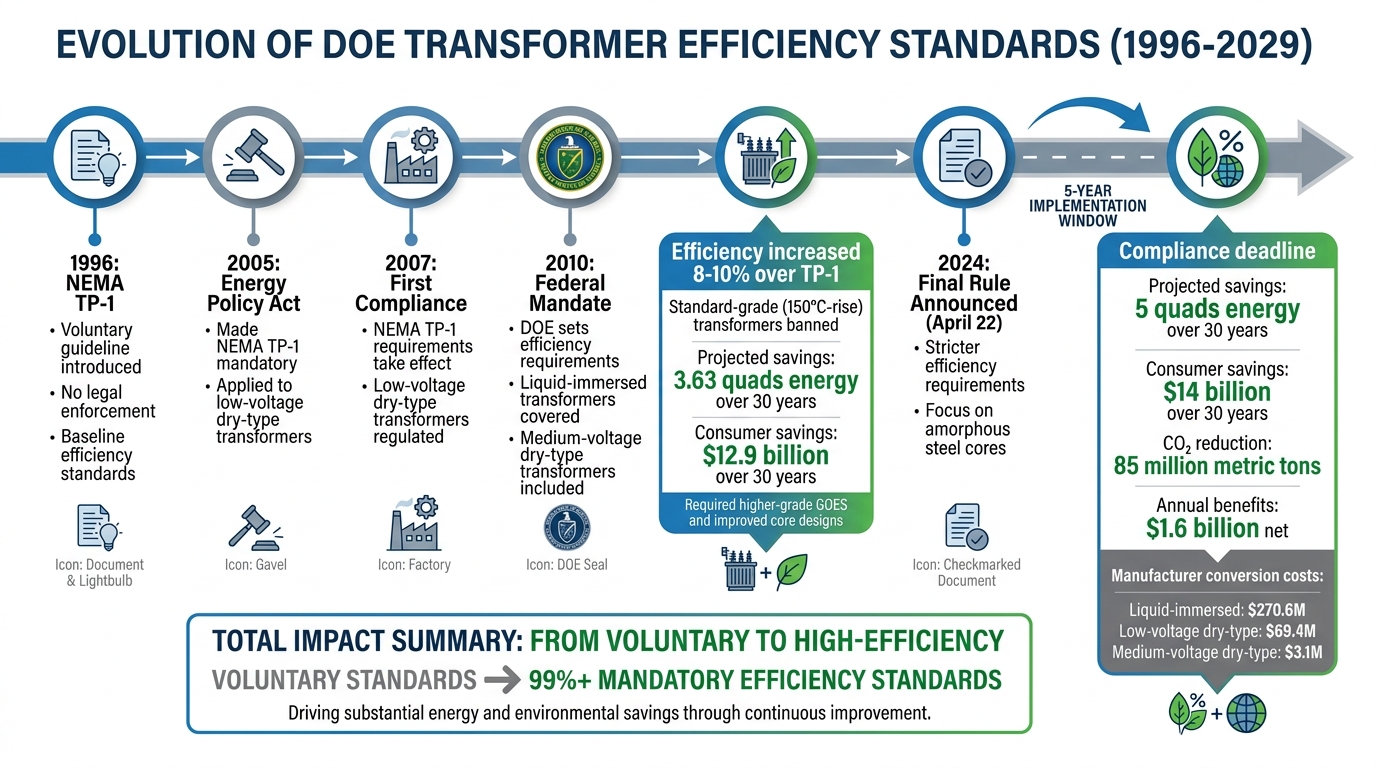
DOE Transformer Efficiency Standards Timeline: 1996-2029 Evolution and Impact
NEMA TP-1 to DOE 2016 Standards
The journey of DOE transformer efficiency standards began with the voluntary NEMA TP-1 guideline in 1996. At the time, manufacturers could choose whether to comply, as it wasn’t legally enforced. That changed with the Energy Policy Act of 2005 (EPAct 2005), which made NEMA TP-1 efficiency levels mandatory for low-voltage dry-type transformers starting in 2007.
The first federal mandate came into effect on January 1, 2010, when the DOE set efficiency requirements for liquid-immersed and medium-voltage dry-type transformers. Then, in 2016, the DOE raised the bar, increasing efficiency standards by roughly 8% to 10% over the NEMA TP-1 levels. This update effectively outlawed standard-grade (150°C-rise) transformers, which were less efficient by several percentage points. The Copper Development Association highlighted the importance of this change:
"The Final Rule raises the efficiency bar very little above TP-1, but the Rule's real value to national energy conservation is that it forbids the installation of standard-grade transformers, which are several percentage points less efficient".
These 2016 regulations were expected to save approximately 3.63 quadrillion British thermal units (quads) of energy over a 30-year span. To meet the stricter standards, manufacturers began using higher-grade grain-oriented electrical steel (GOES) and improved core designs to cut no-load losses.
2024 Final Rule and 2029 Implementation
Building on earlier standards, the DOE introduced a new efficiency rule on April 22, 2024, with a compliance deadline set for April 23, 2029. This five-year window gives manufacturers time to adapt their production processes. The new rule significantly raises efficiency requirements beyond the 2016 baseline, with a strong focus on amorphous steel cores - a thinner material that greatly reduces no-load core losses.
The 2024 Final Rule is projected to save nearly 5 quads of energy over 30 years, generate $14 billion in consumer savings, and cut carbon dioxide emissions by 85 million metric tons. On an annual basis, the benefits include $961.8 million in reduced operating costs, $664.2 million in climate-related benefits, and $665.2 million in health improvements, resulting in a net annual benefit of over $1.6 billion. U.S. Secretary of Energy Jennifer Granholm underscored the broader significance:
"These standards are going to make our grid more resilient, they're going to save American families and businesses money, and they're going to help us reach our climate goals".
However, these advancements come with costs for manufacturers. The estimated expenses for production conversions include $270.6 million for liquid-immersed transformers, $69.4 million for low-voltage dry-type units, and $3.1 million for medium-voltage dry-type transformers. The DOE justified these costs, stating:
"DOE has determined that the amended energy conservation standards for these products would result in significant conservation of energy, and are technologically feasible and economically justified".
These milestones in transformer efficiency standards highlight the ongoing efforts to reduce energy losses while delivering clear economic and environmental gains for industrial operations. They also illustrate how regulatory updates continue to shape the path toward a more energy-efficient future.
Which Transformers Are Covered by DOE Standards
Not all transformers in your facility fall under the DOE's efficiency standards. These regulations specifically target distribution transformers - the equipment responsible for stepping down voltage from a primary distribution circuit to a secondary circuit. To qualify under these standards, a transformer must meet specific criteria: a primary voltage of 35 kV or less, a secondary voltage of 600 V or less, and an operating frequency between 55 and 65 Hz. These parameters align with the DOE's mission to minimize energy losses and enhance power grid performance.
Capacity is another crucial factor. For liquid-immersed transformers, the capacity must range between 10 kVA and 2,500 kVA, while dry-type transformers are regulated if their capacity is between 15 kVA and 2,500 kVA. The U.S. Department of Energy reports that approximately one million distribution transformers are sold annually in the United States. Below, we break down which transformers are regulated and which are exempt.
Covered Transformer Types
The DOE has established specific classes of transformers that fall under its efficiency standards. These classifications are based on design features, such as whether the transformer is liquid-immersed or dry-type, single-phase or three-phase, and its Basic Impulse Insulation Level (BIL) rating. The main categories include:
- Liquid-immersed distribution transformers: Commonly oil-filled and widely used by utilities.
- Low-voltage dry-type transformers: Designed for primary voltages of 1,000 V or less.
- Medium-voltage dry-type transformers: Built for primary voltages exceeding 600 V.
To determine if a transformer meets these criteria, check its nameplate for details like kVA rating, voltages, and frequency. Importantly, transformers used for general power distribution must comply with DOE standards if they are manufactured on or after April 23, 2029.
Exempt Transformer Types
The DOE has identified 15 transformer categories that are exempt from federal efficiency standards. These exemptions account for transformers designed for specialized uses where standard efficiency metrics don't apply due to technical or economic reasons. Exempt transformers include:
- Autotransformers
- Drive (isolation) transformers
- Grounding transformers
- Machine-tool (control) transformers
- Non-ventilated transformers
- Rectifier transformers
- Regulating transformers
- Sealed transformers
- Special-impedance transformers
- Testing transformers
- Transformers with tap ranges of 20% or greater
- UPS transformers
- Welding transformers
- Mining transformers
- Step-up transformers
For a transformer to qualify as exempt, it must meet the DOE's strict definitions outlined in 10 CFR 431.192. These units are engineered for unique electrical demands that standard efficiency metrics cannot measure effectively. Before assuming a custom-built transformer is exempt, confirm it matches one of the DOE's defined categories. This understanding is essential when evaluating compliance with DOE efficiency requirements.
DOE 2016 Efficiency Requirements
The 2016 efficiency requirements set by the Department of Energy (DOE) introduced tighter standards aimed at cutting down energy waste in industrial operations. Outlined in 10 CFR Part 431, these regulations require distribution transformers to meet efficiency levels of 98%–99%. This marked a leap forward from the older NEMA TP-1 standards, driving manufacturers to adopt higher-quality materials, like improved core steel and better conductor materials, to comply with the updated benchmarks. According to DOE estimates, these changes could lead to $12.9 billion in consumer savings over a 30-year span.
Hammond Power Solutions highlighted the long-term benefits of even modest efficiency improvements:
"Considering the life expectancy of a transformer... even small energy efficiency improvements will pay dividends for decades".
Since transformers usually operate continuously at an average load of about 35%, cutting both no-load losses (which occur constantly) and load losses (which vary with usage) becomes essential for achieving energy savings over time. Another advantage of high-efficiency transformers is reduced heat generation, which can lead to lower cooling costs for facilities.
Liquid-Immersed Distribution Transformers
The 2016 standards also introduced specific efficiency requirements for different transformer types. Liquid-immersed transformers, commonly oil-filled units used by utilities to step down voltages between 4 kV and 34.5 kV, are subject to these rules. These standards apply to transformers with capacities ranging from 10 kVA to 2,500 kVA, primary voltages of 35 kV or less, and secondary voltages of 600 V or less. For instance, a three-phase 150 kVA liquid-immersed transformer must reach an efficiency of 99.16% when tested at 50% load.
Achieving this level of performance requires advanced materials. Manufacturers use high-grade core steels to reduce core losses, which occur regardless of load, and low-resistance copper conductors to minimize winding losses, which increase with load. While these upgrades make the transformers heavier due to the additional material, they significantly lower operating costs throughout their lifespan.
Dry-Type Distribution Transformers
Dry-type transformers also have their own set of efficiency standards based on voltage classifications. For low-voltage dry-type transformers (LVDT), designed for primary voltages of 1,000 V or less, a three-phase 150 kVA unit must achieve an efficiency of 98.83%. On the other hand, medium-voltage dry-type transformers (MVDT), built for primary voltages above 600 V, have a slightly lower efficiency requirement of 98.51% for a three-phase 150 kVA unit with a 45-95 BIL rating.
The 2016 standards brought significant improvements, particularly for medium-voltage dry-type transformers. For perspective, the voluntary NEMA Premium Efficiency guidelines call for losses that are roughly 30% lower than the older TP-1 standards, occasionally matching or even exceeding DOE’s mandatory 2016 benchmarks. These efficiency advancements not only cut energy costs but also reduce heat output, helping industrial facilities save money in multiple ways.
2029 Standards and Expected Changes
The 2029 transformer efficiency standards build on the progress made with the 2016 regulations, focusing on further reducing energy losses. The Department of Energy (DOE) finalized these rules in April 2024, giving manufacturers a five-year window to adapt to the stricter requirements.
U.S. Secretary of Energy Jennifer Granholm highlighted the financial and environmental benefits of these changes, stating:
"Ultimately, this improved final rule will save Americans over $14 billion in energy costs, and it'll also slash nearly 8 million metric tons of carbon dioxide pollution".
Efficiency Requirements by Transformer Type
The updated standards rely on Trial Standard Levels (TSLs) to define efficiency thresholds for various transformer types. Here’s a breakdown of the requirements:
- Liquid-immersed and low-voltage dry-type transformers must meet TSL 3.
- Medium-voltage dry-type transformers are required to comply with TSL 2.
For specific reductions:
- Smaller liquid-immersed transformers - single-phase units up to 100 kVA and three-phase units up to 500 kVA - must achieve a 5% reduction in losses, while larger units require a 20% reduction.
- Low-voltage dry-type transformers face a 30% reduction for single-phase models and 20% for three-phase models.
- Medium-voltage dry-type transformers, regardless of size, need to reduce losses by 20%.
The final rule represents a softened stance compared to the 2023 proposal, which aimed for 90% adoption of amorphous metal cores within just two years. Instead, the 2029 standards allow about 75% of transformers to continue using grain-oriented electrical steel (GOES) while encouraging a 10% to 25% increase in amorphous metal core availability. This approach balances the use of advanced materials like amorphous steel and higher-grade electrical steel. Scott Aaronson, Senior Vice President at the Edison Electric Institute, remarked:
"The revised rule marks a 'positive step forward,' because it 'helps to preserve the availability of both GOES and amorphous steel, and it provides the additional time needed to protect and expand domestic manufacturing capacity'".
These changes aim to improve efficiency while supporting the transition to advanced materials and maintaining market stability.
Energy Savings from Reduced Losses
The 2029 standards focus on cutting both no-load and load losses, which are major contributors to operating costs. Transitioning to these new requirements will involve significant upfront investments, including:
- $187 million for liquid-immersed transformers,
- $36.1 million for low-voltage dry-type units,
- $5.7 million for medium-voltage dry-type transformers.
While these costs are substantial, the long-term benefits are undeniable. Over 30 years, the standards are projected to save $14 billion, with annual electricity cost savings of approximately $824 million for utilities and commercial/industrial users. Additionally, the environmental impact is noteworthy, with an expected reduction of nearly 8 million metric tons of carbon dioxide emissions.
Canada, where over 90% of liquid-immersed distribution transformers already use amorphous cores, provides a strong example of the scalability of this technology. Louis Finkel of the National Rural Electric Cooperative Association commented on the final rule:
"The final rule... is much improved over its proposal, which would have upended the entire market for distribution transformers at a time when manufacturers could not keep up with demand".
Compliance and Testing Requirements
Manufacturers are required to follow the testing protocols outlined in 10 CFR Part 431, Subpart K, Appendix A [[11]](https://ecfr.gov/current/title-10/chapter-II/subchapter-D/part-431/subpart-K/subject-group-ECFR90521622529c7b7/appendix-Appendix A to Subpart K of Part 431). These protocols are designed to ensure compliance by measuring both no-load (core) and load (winding) losses.
No-load losses are measured at the rated voltage and a frequency of 60 Hz. For load losses, specific per-unit load levels must be tested: 50% for liquid-immersed and medium-voltage dry-type transformers, and 35% for low-voltage dry-type units.
Temperature corrections are also a critical part of the certification process. No-load losses must be measured at 20°C, load losses for liquid-immersed transformers at 55°C, and load losses for dry-type transformers at 75°C. Additionally, dry-type transformers must remain unenergized for 24 to 48 hours to allow winding temperatures to stabilize before testing.
Testing equipment must meet strict accuracy standards:
- Power loss measurements: ±3.0% accuracy
- Voltage, current, and resistance measurements: ±0.5% accuracy
- Temperature measurements: ±1.5°C for liquid-immersed units and ±2.0°C for dry-type units
Instrument transformers used during testing must meet a 0.3 metering accuracy class or better and be calibrated to national standards.
To simplify testing for multiple units of the same model, manufacturers are allowed to measure resistance on one unit and apply those values to identical units. However, all certification documentation must clearly demonstrate compliance with the required test conditions, including the 60 Hz frequency and the specified temperature corrections.
These stringent testing requirements ensure that transformers meet DOE standards, which play a crucial role in minimizing energy losses in industrial operations.
How DOE Standards Affect Industrial Operations
Reducing Energy Costs
The Department of Energy (DOE) transformer standards are designed to cut down on energy waste during voltage conversion, leading to considerable savings over a transformer's lifespan - typically 30 years. For example, a 40 kVA low-voltage transformer with just a 2% efficiency improvement can save around 7,000 kWh annually. To maximize these savings, operators are encouraged to focus on Total Owning Cost (TOC), which accounts for long-term operational costs rather than just upfront expenses.
The 2024 standards are expected to result in $15 billion in savings and reduce CO₂ emissions by 340 million metric tons over three decades. Andrew deLaski, Executive Director of the Appliance Standards Awareness Project, emphasized the importance of these updates:
"Most distribution transformers today use outdated technology that wastes electricity before it even gets to our homes and businesses. This standard would ensure all new models minimize waste and use materials with a robust long-term supply".
With the compliance deadline set for April 23, 2029, industrial facilities should start planning to replace older transformers with higher-efficiency models. However, newer transformers that meet the updated standards may be 2% to 25% heavier and larger than their predecessors. This means operators must ensure that their existing infrastructure - such as concrete pads, vaults, and hoisting equipment - can handle the increased size and weight.
These operational upgrades highlight the importance of sourcing compliant transformers from reliable suppliers.
Finding Compliant Transformers on Electrical Trader
For industrial operators aiming to meet the 2029 compliance deadline while reaping energy savings, sourcing the right transformers is crucial. Electrical Trader’s marketplace offers a range of new and used liquid-immersed and dry-type transformers that align with DOE efficiency standards, making it easier to find compliant equipment.
When browsing on Electrical Trader, check the nameplate efficiency ratings to ensure they meet the required standards for your specific needs. The platform's categorized listings allow users to filter by transformer type, voltage class, and capacity, simplifying the search process. For facilities preparing upgrades, exploring both new and high-quality used transformers can help balance initial costs with long-term energy savings.
Summary
Since 1996, DOE standards for distribution transformers have become increasingly stringent, with the latest 2024 rule setting a compliance deadline for 2029. These regulations define minimum efficiency levels for liquid-immersed and dry-type transformers, while exempting certain special-purpose units. By 2029, transformer losses are expected to drop by 40–70% compared to 2016 levels. For example, liquid-immersed transformers using amorphous steel can now achieve no-load losses as low as 0.5 W/lb.
The impact of these standards is significant. Nationally, they are projected to save $3.1 billion, cut 620 million metric tons of CO₂ emissions, and reduce energy use by 17.2 billion kWh over 30 years. At the industrial level, facilities could save $20–$50 per kVA on a 1 MVA transformer, which adds up to approximately $15,000 annually for a 2 MVA facility. These benefits not only support broader energy conservation goals but also provide immediate cost savings for industrial operations.
To comply, transformers must meet DOE efficiency levels, verified through NEMA TP-2 or TP-3 testing methods, with nameplate labels confirming adherence. After 2029, transformers that fail to meet these standards will be prohibited from import and sale. Operators should check for DOE labels or NEMA certification before purchasing and consult DOE Product Class tables for specific requirements. This compliance framework ensures long-term economic and environmental gains.
Although compliant transformers come with a 10–20% higher upfront cost, their reduced energy losses can deliver operational savings exceeding 50% over their lifespan. Most facilities can expect a payback period of 3–7 years. U.S. Secretary of Energy Jennifer Granholm emphasized the importance of these changes in April 2024:
"These standards will save Americans billions in energy costs while strengthening grid reliability".
For those planning upgrades, platforms like Electrical Trader (https://electricaltrader.com) provide access to new and used compliant transformers with verified documentation, simplifying the procurement process for electricians and industrial operators.
FAQs
Do I have to replace my existing transformers by April 23, 2029?
You need to make sure your distribution transformers meet the updated efficiency standards set by the Department of Energy by April 23, 2029. These regulations are mandatory and are designed to enhance energy efficiency in industrial settings.
How can I tell from the nameplate if a transformer is DOE-compliant?
To determine if a transformer meets DOE standards, check the nameplate for an efficiency label or marking. This label confirms that the transformer complies with the Department of Energy standards, which have been mandatory for transformers manufactured or sold in the U.S. since January 1, 2016.
Will 2029-compliant transformers be bigger or heavier than older models?
Transformers designed to meet the 2029 efficiency standards are expected to be larger or heavier. This is largely due to the use of amorphous metal (AM) cores, which enhance energy efficiency. However, these cores can also add to the size and weight of the equipment. These adjustments align with the stricter performance requirements set by the Department of Energy for transformers.