

Study: Coating Innovations Reduce Transformer Losses
Transformers constantly lose energy, even when idle. These "no-load losses" waste electricity 24/7, costing money and reducing efficiency. But new advancements in transformer core materials and coatings are cutting these losses significantly.
Key findings:
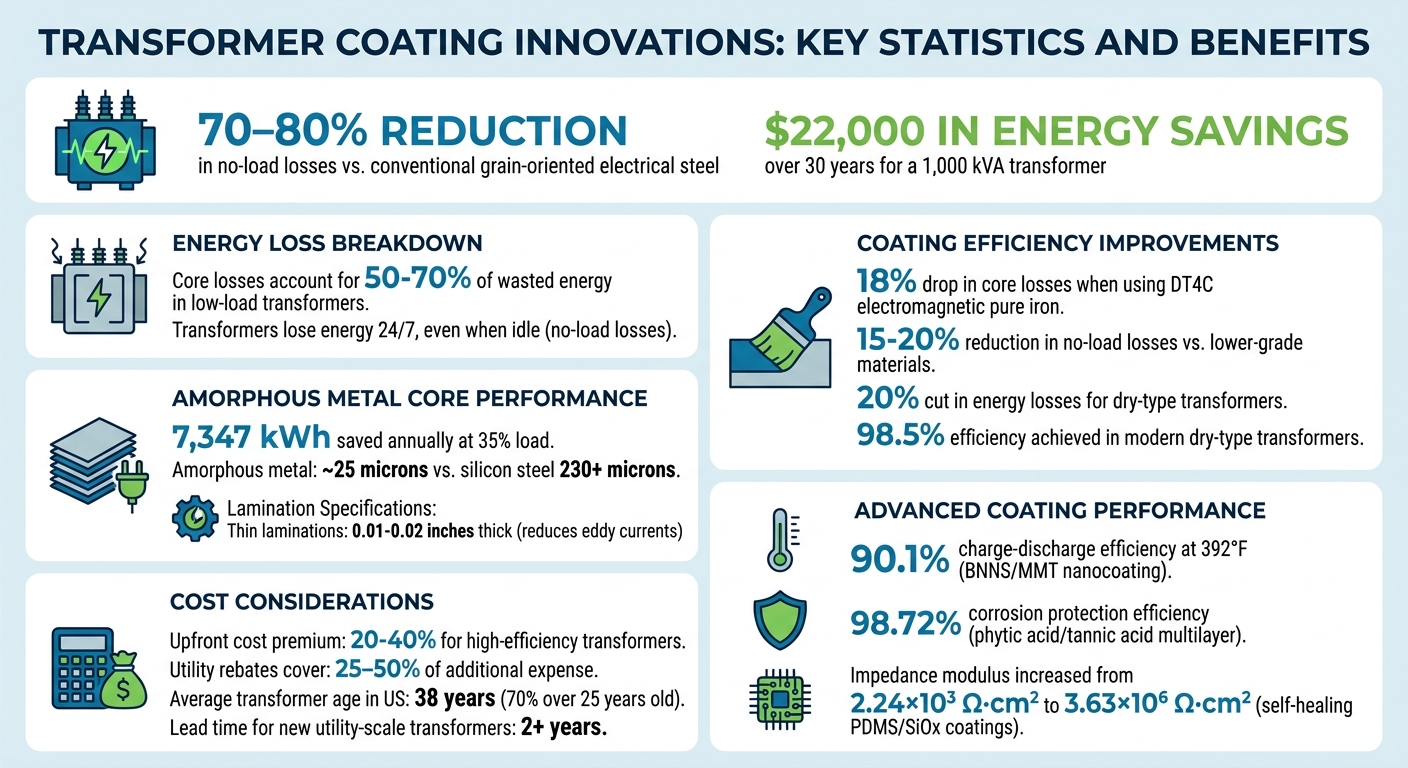
- Core losses account for 50–70% of wasted energy in low-load transformers.
- Amorphous metal cores reduce no-load losses by 70–80%, saving $22,000 over 30 years for a 1,000 kVA transformer.
- Coatings improve efficiency by:
- Reducing eddy currents through better insulation.
- Minimizing hysteresis losses by restoring core magnetism.
- New materials like nanocoatings and self-healing layers boost durability, thermal performance, and corrosion resistance.
With stricter energy standards coming in 2027, these innovations are critical for reducing energy waste, lowering costs, and extending transformer life.
Transformer Coating Innovations: Energy Savings and Efficiency Gains
Transformer Core Losses Explained | Hysteresis & Eddy Currents Made Easy
sbb-itb-501186b
How Coatings Reduce Core Losses
Modern efficiency standards demand solutions that address energy losses in transformers. Coatings play a crucial role here, tackling both eddy current losses and hysteresis losses through specialized mechanisms. Let’s break down how they work.
Reducing Eddy Currents
When alternating current flows through a transformer’s primary winding, it generates a rapidly changing magnetic field in the core. This fluctuating field induces circulating currents, known as eddy currents, within the core material. As Olin Lathrop aptly describes:
A conductive core acts like another secondary that is always shorted
. These currents waste energy by producing heat.
Coatings reduce eddy current losses by providing electrical insulation between the thin sheets of core material, often referred to as laminations. By insulating these layers, the coatings increase the core’s resistance and prevent electrical contact between laminations. This confines the currents to small loops within each lamination (typically 0.01–0.02 inches thick), significantly limiting energy loss. The result? A more efficient transformer with minimized wasteful current flow.
But eddy currents are only part of the story. Addressing hysteresis losses is equally important.
Minimizing Hysteresis Losses
Hysteresis losses occur during the repeated magnetization and demagnetization of the core with each AC cycle. As the Army Munitions Reference and Training Manual explains:
The friction caused by the little molecular magnets heat up as they try to align themselves with the constantly changing direction of the current flow in the primary
.
Stresses introduced during processes like cold rolling and cutting disrupt the core's crystal structure, making it harder for magnetic domains to align. This increases the energy required to flip these domains. Coatings, combined with annealing, restore the crystal structure and make it easier for these domains to shift, reducing energy loss.
Mr. Guo highlights the impact of material choice on hysteresis losses:
Hysteresis losses scale with coercivity. By employing DT4C instead of lower-grade materials, transformer manufacturers typically effect a reduction of 15-20% in no-load losses
. For instance, in 2023, a European transformer manufacturer switched to DT4C electromagnetic pure iron. This change led to an 18% drop in core losses and allowed the transformer design to be slimmed down by 12%.
New Materials in Transformer Coatings
Recent developments in coating formulations are pushing transformer performance to new heights. By leveraging advanced chemistry, researchers are creating multilayered nanocoatings and hybrid materials that tackle multiple challenges - such as heat management, electrical insulation, and protection from environmental factors - all at once.
Thermal and Electrical Performance
Researchers at Xi'an Jiaotong University have made strides with a bilayer nanocoating that integrates BNNS (Boron Nitride Nanosheets) and MMT (Montmorillonite) nanosheets on polyimide dielectrics. The BNNS layer acts as a barrier against charge injection, while the MMT layer dissipates charges in-plane. This combination achieves a remarkable 90.1% charge–discharge efficiency at temperatures as high as 392°F. It also delivers a discharged energy density of 1.6 J·cm⁻³ under an electric field of 250 MV·m⁻¹.
In liquid insulation, aluminum oxide (Al₂O₃) nanoparticles are being mixed into natural ester oils, as highlighted in Scientific Reports. This blend not only improves dielectric properties but also reduces oil viscosity and enhances thermal stability. These innovations have allowed dry-type transformers to reach 98.5% efficiency while cutting energy losses by 20%.
These advancements in thermal and electrical properties are complemented by enhanced corrosion protection, ensuring greater reliability and longevity for transformers.
Improved Corrosion Protection
New coatings are offering a significant boost to transformer durability by providing enhanced corrosion resistance. For example, Zinc-Aluminum-Magnesium (ZAM) coatings applied to transformer frames and switchgear housings outperform traditional galvanized steel, especially in humid or coastal areas. Additionally, multilayered coatings that pair a densified inner phytic acid conversion layer with an outer tannic acid sacrificial layer have achieved a corrosion protection efficiency of 98.72%. This approach, rooted in green chemistry, maintains the magnetic properties critical for transformer operation.
Another noteworthy innovation is the use of hybrid PDMS/SiOx coatings, which feature dynamic B–O bonds that autonomously repair cracks. This self-healing property increases the impedance modulus from 2.24×10³ Ω·cm² to 3.63×10⁶ Ω·cm². Meanwhile, silicone-coated bushings are now capable of resisting impulse voltages up to 70 kV. A study published in Surface Science and Technology highlights the broader implications of these advancements:
This study provides a green and effective strategy for durable corrosion protection of FeCo alloys and related metallic materials
.
These cutting-edge materials are not only improving transformer efficiency but also ensuring their resilience in challenging environments.
Coating and Lamination Design Integration
Modern transformer designs achieve better magnetic efficiency and lower losses by combining advanced coatings with carefully engineered laminations. As Maria Lamorey from PPG Industrial Coatings explains:
Whether that substrate is the industry-standard grain-oriented electrical steel or amorphous steel, protective coatings backed by the latest material science must play a greater role in the protection of the substrate
.
Working with Grain-Oriented Steel
Grain-oriented electrical steel demands specialized coatings to maximize its magnetic properties. Generic coatings simply don’t meet the performance needs of this material. Instead, coatings must be specifically formulated to provide strong adhesion and robust protection.
One of the biggest challenges lies in safeguarding the sharp edges and corners of steel laminations. These areas are prone to corrosion, which can harm the core's performance. High-edge powder primers address this issue by ensuring proper coverage in these critical zones, effectively preventing degradation. Additionally, modern epoxy and resin topcoats are designed to endure extreme thermal cycles and high humidity, offering long-lasting protection.
This level of precision in coating design is essential for unlocking the efficiency benefits of thinner laminations.
Benefits of Thin-Gauge Laminations
Thinner steel laminations, when paired with advanced coatings, provide a highly effective way to reduce core losses. Laminating the transformer core limits the formation of eddy currents, which would otherwise flow freely through a solid core, generating heat and reducing efficiency. The thinner the laminations, the greater the reduction in these losses.
However, thinner laminations come with their own challenges, as they create more edges and intricate shapes that require consistent coating. High-efficiency powder coatings are crucial here, ensuring uniform coverage even on the most complex surfaces. Beyond performance, these coatings also offer environmental advantages. Being solvent-free, they allow manufacturers to reclaim overspray, cut down on waste, and improve durability. These advancements align perfectly with the study’s focus on improving coating efficiency.
Performance and Cost Benefits
Advanced coatings play a key role in reducing energy waste and extending the lifespan of transformers. Together, these factors translate into significant cost savings and notable financial advantages.
Longer Transformer Life
Protective coatings act as a barrier against environmental threats. As Maria Lamorey and Barry Powell explain, "When it comes to the metal components on a transformer, corrosion is public enemy number one". Modern coatings provide robust protection against UV rays, high humidity, chemical exposure, and extreme temperatures - all of which contribute to metal deterioration. Considering that the average age of transformers in the United States is 38 years, with about 70% over 25 years old, this protection is more critical than ever. Adding to the urgency is the fact that lead times for new utility-scale transformers now exceed two years. By extending the life of existing equipment, these coatings help lower both maintenance and operational costs, while boosting overall durability. This added resilience also leads to notable energy savings over time.
Energy Savings and ROI
Advanced coatings not only enhance durability but also contribute to energy efficiency by reducing no-load losses. Over a lifespan of 30–40 years, these energy savings can significantly improve return on investment (ROI). For example, a 1,000 kVA transformer operating at 35% load can save approximately 7,347 kWh annually. With an electricity rate of $0.10 per kWh, this translates to over $22,000 in energy savings across 30 years.
In settings like residential distribution networks, rural feeders, and backup installations - where transformers often run at just 10–20% capacity - no-load losses can account for 50–70% of total annual energy waste. However, advanced cores reduce these constant losses by 70–80% compared to conventional grain-oriented electrical steel. While high-efficiency transformers come with an upfront cost premium of 20–40%, utility rebates often cover 25–50% of this additional expense. A Total Owning Cost analysis frequently demonstrates that these advanced units are more cost-effective over their entire lifespan.
Conclusion
Advanced coatings have a measurable impact on reducing transformer losses and extending the lifespan of equipment. For instance, amorphous metal cores can cut no-load losses by an impressive 70–80% compared to traditional silicon steel. On top of that, surface treatments like laser scribing push performance even further by refining magnetic domains. In December 2022, researchers Naoki Ito, Hajime Itagaki, and Motoki Ohta demonstrated that laser scribing reduced the building factor from 2 to 1.5 in a 53 kg single-phase core - a significant improvement confirmed by further research.
These advancements work by minimizing eddy currents and hysteresis losses, achieved through thinner laminations (about 25 microns compared to over 230 microns in silicon steel) and specialized insulation layers. These layers not only enhance efficiency but also provide protection against corrosion and moisture. Such technical improvements translate into considerable energy savings on a grid-wide scale.
No-load losses, which account for a large share of annual energy waste, are a key focus area. Cutting these losses helps meet increasingly stringent DOE standards while also reducing operating costs.
Sustainability is another area of progress. In 2023, a major manufacturer in China began mass-producing transformers with waterborne liquid coatings, marking a step forward in reducing environmental impact. Maria Lamorey of PPG Industrial Coatings highlights the importance of these advancements:
Smarter coatings lengthen transformer life span, offer extreme protection and improve ROI
.
These coating innovations not only deliver immediate energy savings but also offer long-term cost advantages by extending transformer life and reducing the need for maintenance. For those considering new transformers, platforms like Electrical Trader provide access to both conventional and high-efficiency models, enabling thorough Total Owning Cost analysis to guide purchasing decisions.
FAQs
How do I know if no-load losses are a big cost driver in my transformer?
Transformers' no-load losses can have a noticeable effect on overall costs, so it's worth examining the core material and efficiency. For instance, transformers built with amorphous steel cores can cut no-load losses by an impressive 70–80%. This highlights how choosing the right core material can play a key role in managing expenses. Paying attention to the core material is a smart way to gauge how much these losses might be adding to your costs.
Can existing transformers be upgraded with better coatings, or is replacement required?
Existing transformers can sometimes be improved by applying better coatings, which can boost both their performance and lifespan. However, if the core or other critical parts are heavily worn or damaged, replacing the entire unit might be the only viable option. Evaluating the transformer's overall condition is essential before determining the right course of action.
What should I look for to meet the 2027 U.S. efficiency standards?
To align with the 2027 U.S. efficiency standards for transformers, opt for models featuring amorphous steel cores, which can cut core losses by 70–80%. Another option is transformers made with advanced core materials, such as high-quality silicon steel or specialized coatings. These materials are designed to lower hysteresis and eddy current losses, improving both efficiency and lifespan.