

Transformer Core Materials: Cost vs Efficiency
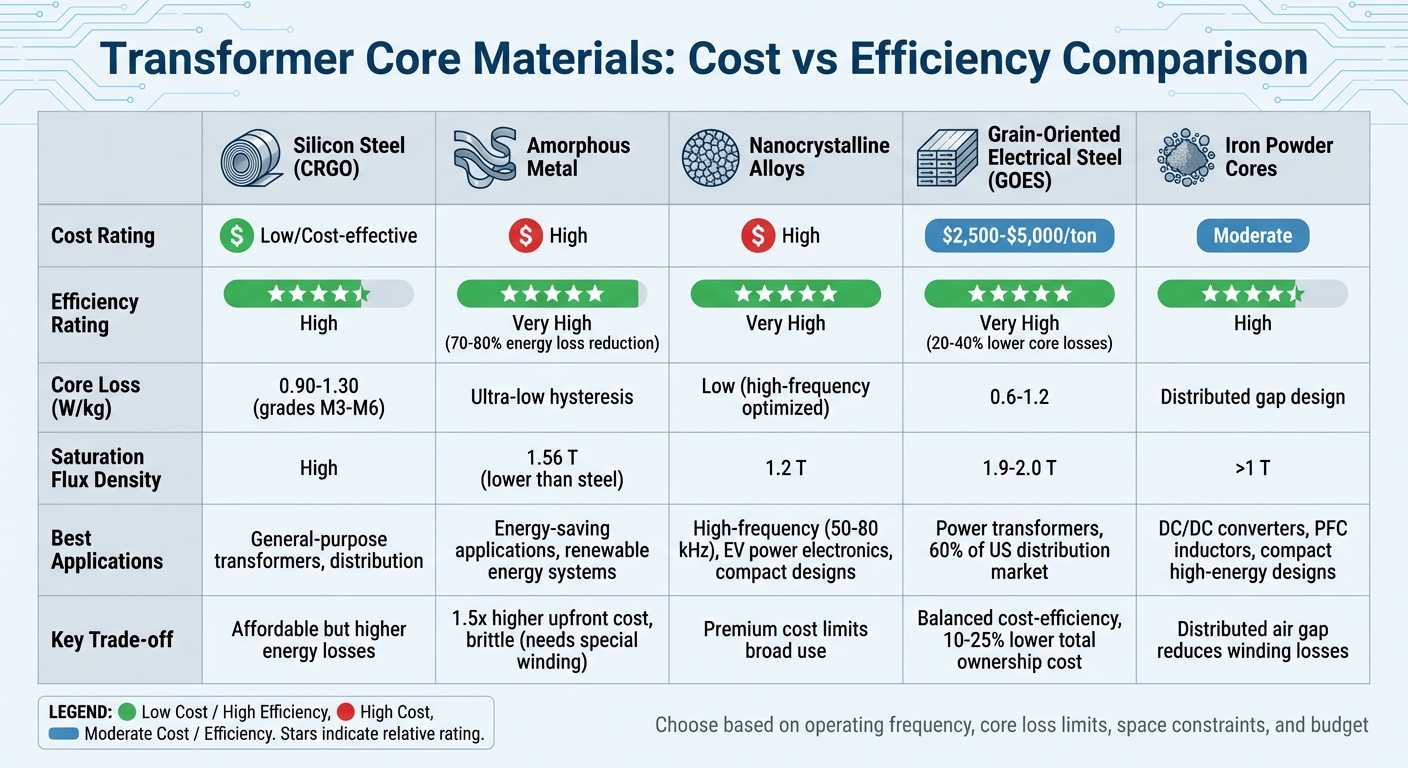
Transformer core materials significantly impact both initial costs and long-term efficiency. Choosing the right material depends on factors like energy losses, magnetic properties, and application needs. Here’s a quick overview of the most common options:
- Silicon Steel (CRGO): Affordable with good magnetic performance, but higher energy losses over time.
- Amorphous Metal: Higher upfront cost but reduces energy losses by 70–80%, ideal for energy-saving applications.
- Nanocrystalline Alloys: Excellent for high-frequency and compact designs, though costly.
- Grain-Oriented Electrical Steel (GOES): Balanced cost and efficiency with lower core losses for standard transformers.
- Iron Powder Cores: Best for compact, high-energy-density applications.
Each material offers trade-offs between cost, efficiency, and performance. For example, amorphous metal is a great choice for reducing energy waste, while nanocrystalline alloys excel in specialized, high-frequency applications. Choosing the right material requires balancing upfront costs with long-term savings and technical requirements.
Transformer Core Materials Comparison: Cost vs Efficiency Guide
How to choose transformer core materials?
sbb-itb-501186b
1. Silicon Steel (CRGO)
CRGO silicon steel is specially crafted by aligning its grains along the rolling axis. This alignment optimizes its magnetic properties, minimizing energy loss as heat. By reducing resistance to magnetic flux, it ensures more efficient transformer operation.
Initial Cost
CRGO steel comes with a higher upfront price compared to CRNO steel. This is due to the precise manufacturing process, which involves precision rolling and high-temperature annealing. For those prioritizing cost over peak performance, lower-grade options like M5 and M6 are available.
Core Loss Reduction
The core losses in CRGO depend on its grade and thickness. Modern CRGO materials are available in thicknesses from 0.18 mm to 0.35 mm. Thinner sheets provide better magnetic performance, and specialized insulation coatings help reduce eddy current losses, cutting down on energy waste.
| Grade | Typical Thickness (mm) | Core Loss (W/kg at 1.5T) | Application Area |
|---|---|---|---|
| M3 | 0.23 | ~0.90 | High-efficiency power transformers |
| M4 | 0.27 | ~1.00 | Distribution transformers |
| M5 | 0.30 | ~1.15 | General-purpose transformers |
| M6 | 0.35 | ~1.30 | Low-cost applications |
These specifications highlight the potential for better energy efficiency, especially in high-performance applications.
Total Ownership Cost
While the manufacturing process for CRGO is intricate, its long-term value stands out. Thanks to its high magnetic permeability, CRGO minimizes resistance to magnetic lines, making it a top choice for high-voltage power and distribution transformers. The energy savings over the lifespan of the transformer often outweigh the initial cost, making it a practical investment for energy-conscious applications.
2. Amorphous Metal
Amorphous metal, created through rapid cooling at an astonishing rate of about 1,000,000°C per second, doesn’t have the grain boundaries found in traditional materials. This unique structure allows it to switch magnetic states with much lower energy loss, making it a strong contender for transformer cores when balancing performance and cost.
Initial Cost
The upfront cost of amorphous metal cores is about 1.5 times higher than that of standard silicon steel cores. This price difference stems from the material's complex manufacturing process and its inherently costly properties. Additionally, because amorphous metal is brittle, specialized winding techniques are needed, which further adds to production costs.
Core Loss Reduction
The energy efficiency of amorphous metal cores is impressive. They reduce no-load losses by 70% to 80% compared to grain-oriented silicon steel. This is largely due to two factors: the absence of grain boundaries, which significantly lowers hysteresis losses, and the ultra-thin ribbon design - just 0.001 inches (0.025 mm) thick. This thickness is roughly one-tenth of conventional silicon steel and helps minimize eddy current losses. These characteristics make amorphous cores highly efficient in reducing energy waste.
Saturation Flux Density
One trade-off with amorphous metal is its lower saturation flux density, which typically reaches around 1.56 T, compared to about 2.03 T for conventional silicon steel. This means that transformers using amorphous cores may need to be larger to handle equivalent magnetic flux, especially in applications requiring high capacity.
Total Ownership Cost
While the initial cost of amorphous metal cores is higher, the long-term savings in energy expenses often make up for the price premium. Distribution transformers frequently operate at low load factors, meaning no-load losses dominate energy costs over their 20- to 30-year lifespan. As the Copper Development Association explains:
A premium-efficiency transformer costs more initially, but saves sufficient money over time to more than pay back the extra purchase cost.
For example, Siemens installed 800 EcoCore™ amorphous core transformers at Europe’s largest solar farm in Spain in early 2024. These transformers achieved a 21% reduction in transmission losses compared to traditional silicon steel models. Additionally, their cooler operating temperatures help extend insulation life, lowering failure rates and cutting maintenance costs over time.
3. Nanocrystalline Alloys
Nanocrystalline alloys are cutting-edge materials used in transformer cores, particularly effective for high-frequency applications like power electronics in electric vehicles and EMI filters. These alloys typically operate in the 50–80 kHz range, making them a better fit for modern power conversion systems compared to traditional 60 Hz distribution transformers. Their performance characteristics make them ideal for systems requiring high efficiency and compact design.
Core Loss Reduction
To understand their efficiency, it's essential to examine how they minimize energy losses. In high-frequency scenarios, the main source of core losses in nanocrystalline materials comes from eddy currents within their thin ribbon structure. Accurately modeling these losses requires considering the material's nonlinear and anisotropic properties, ensuring theoretical predictions align with real-world performance.
Efficiency Gains
A study on a 1 kW dual-active bridge converter demonstrated that nanocrystalline cores can deliver conversion performance comparable to ferrite cores while significantly reducing transformer size. This compactness is a major advantage in applications like electric vehicles, where space-saving designs contribute to overall system efficiency. However, these benefits must be weighed against factors like material costs and application-specific requirements.
4. Grain-Oriented Electrical Steel (GOES) Variants
Grain-Oriented Electrical Steel (GOES) plays a central role in U.S. transformer manufacturing, dominating about 60% of the distribution transformer market. What sets GOES apart from standard silicon steel is its grain alignment, which follows the rolling direction. This design minimizes energy losses and optimizes magnetic flux flow. Although the technology dates back to the 1930s, advancements like Hi-B steel have further enhanced efficiency through improved processing techniques. These developments highlight the ongoing push to balance cost and energy savings in transformer production.
Initial Cost
The cost of GOES varies depending on the grade. Conventional GOES is priced between $2,500 and $4,000 per ton, while the more advanced Hi-B grades range from $4,000 to $5,000 per ton. For a 1 MVA transformer core, this translates to an additional $5,000–$10,000 compared to basic CRGO. Recent improvements in supply chains have helped stabilize prices, with many grades now averaging around $3.00 per kilogram.
Core Loss Reduction
GOES stands out for its ability to significantly reduce core losses, thanks to its precise grain alignment. Compared to standard CRGO, it achieves 20–40% lower core losses by minimizing both eddy currents and hysteresis. Under typical U.S. grid conditions - 60 Hz frequency and 1.7 T flux density - conventional GOES records core losses of about 0.8–1.2 W/kg. Hi-B grades perform even better, with losses as low as 0.6–0.7 W/kg.
Saturation Flux Density
GOES variants maintain a high saturation flux density, typically ranging from 1.9 to 2.0 T. This is comparable to CRGO and significantly higher than the 1.5–1.6 T seen in amorphous metals. The higher saturation flux density allows for more compact transformer designs, which is especially beneficial for space-constrained installations like pole-mounted transformers in the U.S. However, under certain operating conditions, GOES may saturate earlier than nanocrystalline alloys, which have a saturation flux density of around 1.2 T under overvoltage scenarios.
Total Ownership Cost
Over a transformer’s 20-year lifespan, GOES variants deliver notable economic benefits. Their lower core losses translate to a total ownership cost reduction of 10–25% compared to standard CRGO. For instance, a 2 MVA substation transformer using GOES typically costs $45,000–$55,000, factoring in around $30,000 in energy savings at average U.S. electricity rates. In comparison, transformers with iron powder cores cost roughly $60,000. Studies show that 500 kVA transformers using GOES achieve approximately 15% lower lifetime losses, saving $500–$1,000 per unit and offering a payback period of 3–5 years. Additionally, GOES boasts a recyclability rate of about 98%, aligning well with grid modernization and sustainability goals.
Next, we’ll take a closer look at iron powder cores as an alternative option.
5. Iron Powder Cores
Iron powder cores play an essential role in transformer design, particularly in applications like DC/DC converters and PFC (Power Factor Correction) inductors. Unlike traditional cores that rely on a single air gap, these cores feature a distributed air gap. This design improves magnetic performance while maintaining efficiency, offering a practical balance between cost and functionality.
Saturation Flux Density
Iron powder cores stand out for their ability to handle strong magnetic fields, boasting a saturation flux density above 1 T. In comparison, ferrite cores typically have a saturation point of around 400 mT, which can drop even further as operating temperatures rise. This makes iron powder cores a better choice for applications that demand compact designs and high energy density.
Core Loss Reduction
The distributed air gap in iron powder cores helps minimize winding losses. In conventional gapped cores, magnetic flux tends to escape at the air gap, leading to eddy current losses in the copper windings. By containing the magnetic flux, iron powder cores significantly reduce these losses. Additionally, the distributed gap improves thermal management by spreading losses more evenly, preventing the formation of hot spots.
Advantages and Disadvantages
When it comes to transformer cores, the choice of material comes down to balancing upfront costs with long-term performance. Each core material has its own strengths and weaknesses, making it suitable for specific applications.
Silicon steel (CRGO) is a cost-effective option with good mechanical strength. However, its efficiency falls short when compared to newer materials, which may limit its appeal for energy-conscious designs.
Amorphous metal stands out for its extremely low hysteresis losses, translating to significant energy savings over time. While the initial investment is higher, this material is especially appealing for distribution transformers in renewable energy systems. That said, manufacturing challenges and lower ductility compared to traditional steel can be drawbacks.
Nanocrystalline alloys offer a combination of low core loss and high saturation flux density, making them ideal for compact designs. They are particularly useful in specialized applications where space and thermal stability are critical, though their higher cost limits their use in broader applications.
For niche applications, ferrites and permalloy provide unique advantages. Ferrites are lightweight and excel in high-frequency applications due to their low electrical conductivity, which minimizes eddy current losses. However, their low saturation flux density can restrict power handling. Permalloy, on the other hand, features low coercivity and stable magnetic properties across a wide frequency range, making it valuable in telecommunications. Its premium cost, however, restricts it to specialized uses.
| Core Material | Cost Rating | Efficiency Rating | Core Attributes |
|---|---|---|---|
| Silicon Steel (CRGO) | Low / Cost-effective | High | High magnetic permeability; good mechanical strength; high saturation |
| Amorphous Metal | High | Very High | Extremely low hysteresis loss; non-crystalline structure; eco-friendly focus |
| Nanocrystalline Alloys | High | Very High | High saturation flux density; low core loss; excellent thermal stability |
| Ferrites | Moderate | High (at High Freq) | Lightweight; low electrical conductivity; low saturation flux density |
| Permalloy | High / Specialized | High (at High Freq) | Low coercivity; stable across wide frequency ranges; fast magnetization switching |
Technical details based on data from.
This breakdown highlights the key trade-offs for each material, offering a clear starting point for those exploring core options on Electrical Trader.
Finding Transformer Cores on Electrical Trader
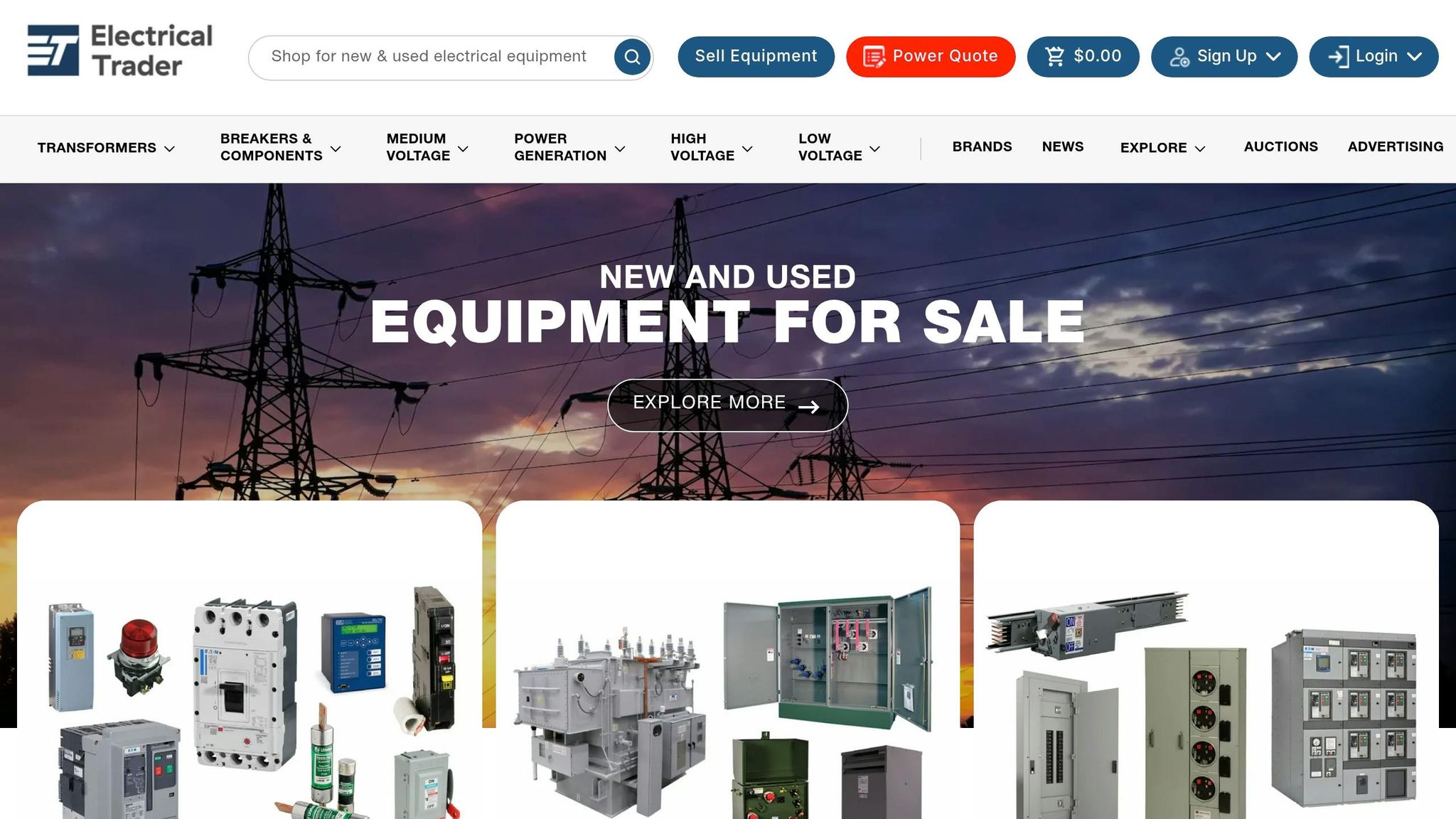
Electrical Trader simplifies the process of choosing transformer cores by categorizing products based on technical specifications. Whether you're focusing on cutting initial costs or optimizing long-term efficiency, the platform’s layout makes it easier to pinpoint the right options. This structure allows you to make more accurate choices by considering the performance of specific materials.
The platform offers a wide selection of both new and used transformer cores. You can filter these by material types like Silicon Steel, Amorphous Metal, Ferrite, Soft Magnetic Composite (SMC), and Nanocrystalline alloys. Additionally, you can sort by key magnetic properties, such as high permeability. For added convenience, collections of 3-phase and substation transformers are highlighted, and comprehensive buying guides are available to aid in your decision-making process.
If you're working within a tight budget, Electrical Trader makes it simple to compare material types and performance specs all in one place. This ensures you can find a balance between upfront costs and long-term savings.
Conclusion
Choosing the right transformer core material boils down to finding the balance between initial costs and long-term efficiency. For instance, Silicon Steel (CRGO) is a go-to option when upfront expenses need to be minimized, offering dependable magnetic performance and affordability widely recognized in the industry.
On the other hand, Amorphous Metal stands out for its ability to reduce hysteresis losses, making it a smart choice for applications focused on energy savings, such as renewable energy systems.
For specialized needs, nanocrystalline alloys deliver excellent performance in high-frequency and compact designs, while Ferrite cores are well-suited for lightweight, cost-sensitive projects.
Ultimately, the best material depends on factors like operating frequency, core loss limits, space constraints, and your budget - both for initial purchase and energy costs over time. Whether your priority is cutting initial expenses, maximizing energy efficiency, or meeting unique technical demands, understanding your application's specific needs will help you make the most informed decision. This guide has laid out the key trade-offs to help you navigate these choices effectively.
FAQs
How do I estimate payback time for a lower-loss core?
To figure out the payback period for a lower-loss core, start by comparing its upfront cost difference to that of a standard core. Next, calculate the annual energy savings by multiplying the reduction in energy losses (measured in kWh) by your electricity rate. Finally, divide the extra cost of the lower-loss core by the annual savings to determine how long it will take to recover the initial investment.
Which core material is best for 60 Hz vs high-frequency designs?
For transformers operating at 60 Hz, silicon steel or silicon iron cores are commonly used. These materials are affordable and perform well at lower frequencies. For high-frequency applications, ferrite cores are the go-to choice. Their high permeability and low eddy current losses make them more efficient at these frequencies. Each material is tailored to its specific frequency range, providing an effective balance between performance and cost.
Will an amorphous core make my transformer larger?
An amorphous core may result in a larger transformer due to specific design needs. However, it offers the advantage of reduced core losses, which can improve efficiency. The final size of the transformer depends on its intended application and how the design balances efficiency with physical dimensions.