

Hysteresis Losses in Amorphous vs Silicon Steel Cores
When choosing transformer cores, you’re deciding between efficiency and durability. Amorphous cores reduce energy loss by up to 75%, making them ideal for low-load scenarios like utility grids and renewable energy systems. Silicon steel cores, however, are stronger and handle higher loads, making them better for demanding environments.
Key Takeaways:
- Amorphous cores: Lower energy loss, cooler operation, but larger size and higher cost.
- Silicon steel cores: Stronger, compact, and cheaper, but less energy-efficient.
| Feature | Amorphous Cores | Silicon Steel Cores |
|---|---|---|
| Energy Loss | Up to 75% lower | Higher |
| Durability | Brittle | Stronger |
| Cost | Higher upfront | Lower upfront |
| Best Use Cases | Low-load operations | High-load environments |
Choose based on your priorities: energy savings or mechanical strength.
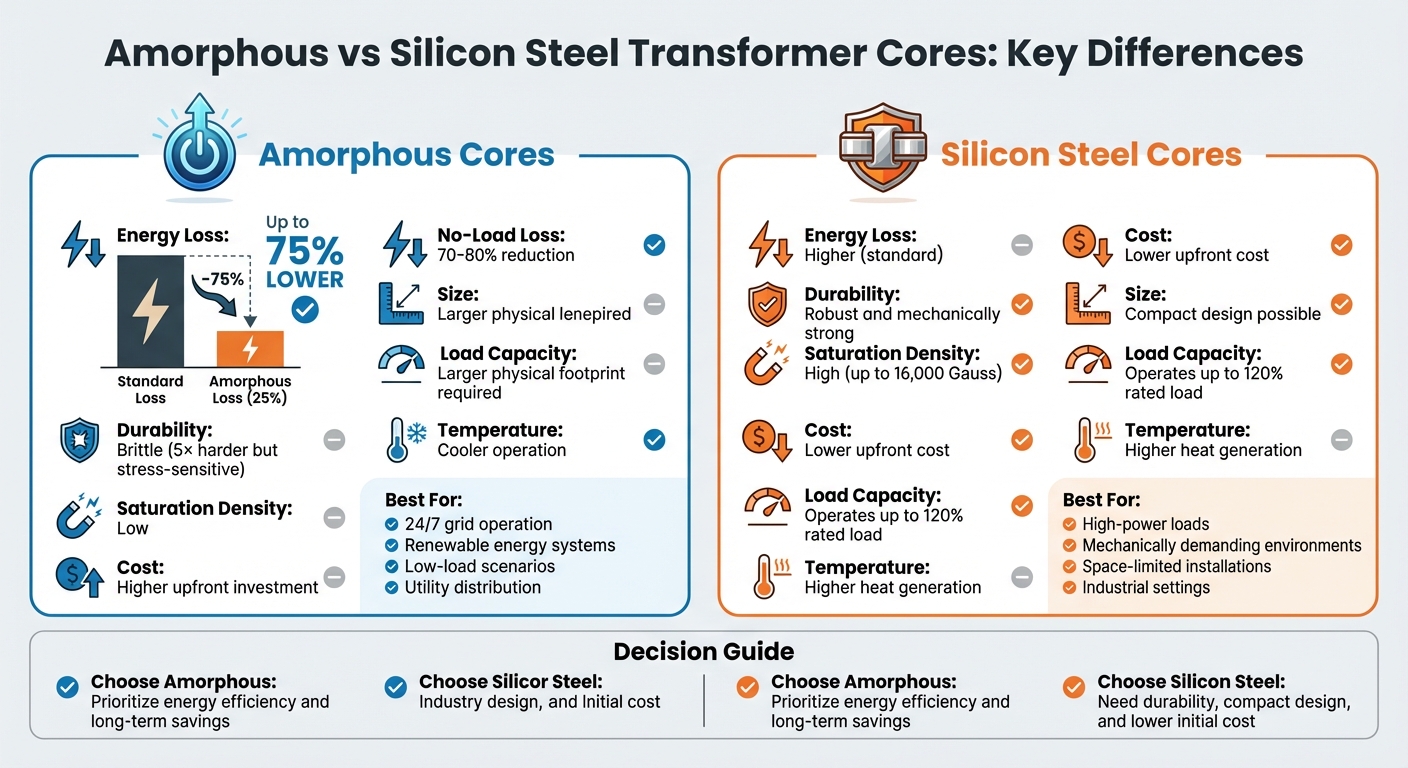
Amorphous vs Silicon Steel Transformer Cores Comparison Chart
Transformer Losses Explained | Core Loss, Copper Loss, Eddy Current, Hysteresis & Efficiency
sbb-itb-501186b
Transformer Core Material Properties
The key distinction between amorphous and silicon steel cores lies in how their atoms are arranged. Silicon steel features a crystalline, grain-oriented structure where atoms form a regular, repeating pattern. This structure usually includes silicon content between 0.8% and 4.8%. However, this orderly arrangement means more energy is needed to realign magnetic domains during each magnetization cycle, leading to higher energy usage.
Amorphous metal cores, on the other hand, have a non-crystalline or "glassy" structure. This random atomic arrangement lacks long-range order but allows for faster magnetization cycles, which significantly lowers hysteresis losses. For instance, transformers with amorphous cores can reduce iron loss by as much as 75% compared to those with silicon steel cores . Let’s take a closer look at the specific properties of each core type.
Amorphous Core Properties
Amorphous cores are manufactured as thin foils and have higher electrical resistance, which helps reduce energy losses. Thanks to their disordered atomic structure, magnetic fields pass through them more easily, enabling up to a 75% reduction in core loss compared to cold-rolled grain-oriented (CRGO) steel. However, this energy efficiency comes at a cost - amorphous alloys are mechanically fragile. They are about five times harder than silicon steel but are also much more brittle, with an elongation capacity of only 1.5% to 2.5%. This makes them vulnerable to mechanical stress, vibrations, and short-circuits, which can degrade their magnetic performance over time.
Silicon Steel Core Properties
While amorphous cores are known for their efficiency, silicon steel stands out for its mechanical strength. Its grain-oriented, crystalline structure provides excellent durability and a higher magnetic flux density, typically ranging from 12,000 to 16,000 Gauss. This higher flux density allows for smaller and lighter transformer designs without sacrificing capacity. However, the organized grain structure demands more energy to realign magnetic domains during each magnetization cycle, leading to increased hysteresis losses. These characteristics highlight the trade-off between improved energy efficiency in amorphous cores and the mechanical resilience offered by silicon steel cores.
How Hysteresis Losses Compare
Loss Value Differences
When comparing hysteresis losses, the gap between amorphous and silicon steel cores is quite striking. Amorphous cores show much lower hysteresis losses at typical grid frequencies (50–60 Hz). This is largely because their amorphous structure reduces the grain-boundary effects that hinder the movement of magnetic domains in silicon steel. As a result, amorphous cores lose less energy per unit volume, which is reflected in their narrower hysteresis loops - an outcome of their lower coercivity.
How Frequency Affects Losses
Hysteresis losses increase in direct proportion to the operating frequency. This relationship is often expressed through the Steinmetz empirical equation:
Pₕ = η B₍max₎^(1.6) f V
Here, f represents frequency (in Hz), and η is a constant specific to the material. Each magnetization cycle consumes energy to realign magnetic domains, so as frequency climbs, power loss rises accordingly. This effect becomes especially noticeable in high-frequency power electronics. While both amorphous and silicon steel cores experience greater energy loss at higher frequencies, amorphous cores remain more efficient, requiring less energy per cycle due to their lower coercivity. These differences in hysteresis behavior play a key role in determining transformer efficiency and the associated operating costs.
Efficiency and Performance Impact
Energy Efficiency and Heat Generation
Amorphous transformers can cut core losses by up to 75% compared to traditional silicon steel, significantly improving efficiency. This reduction in hysteresis loss also limits heat production, which in turn lowers the operating temperature and reduces cooling requirements. A cooler transformer not only lasts longer but also places less strain on nearby equipment. However, these efficiency improvements come with some design challenges.
To achieve the same capacity, amorphous transformers need a larger physical footprint because of their lower saturated flux density compared to silicon steel. This can be a drawback in installations where space is tight. Additionally, the brittle nature of amorphous metal makes it prone to breaking under mechanical stress, such as vibrations, step-loads, or short-circuits. Over time, this can lead to increased no-load losses. While the reduced heat generation extends the lifespan of components, the need for larger cores and the material's fragility must be carefully considered. Another limitation is their load-handling capacity - while silicon steel transformers can typically operate at up to 120% of their rated load, amorphous transformers are less reliable beyond about 80%.
Cost and Return on Investment
The choice of core material isn’t just about thermal performance - it’s also about economics. Amorphous core transformers are more expensive upfront due to the complex and labor-intensive processing required for their brittle materials. However, their ability to significantly reduce no-load losses can lead to long-term operational savings, potentially lowering the total cost of ownership over their lifespan. These financial considerations are closely tied to the efficiency and operational constraints mentioned earlier.
"The amorphous core transformer holds considerable promise, offering the potential for lowering the carbon emissions due to losses in the grid. However, early adopters are finding that the technology isn't quite ready for large-scale roll-out." - David Zucaro, Electrical Engineer and Managing Director, Teck Global
The payback period for these transformers depends on variables like electricity costs, usage patterns, and whether the installation site can accommodate the larger size and limited overload capacity of amorphous cores. These factors play a crucial role in determining whether the investment makes sense in the long run.
When to Use Each Core Type
When to Use Amorphous Cores
Amorphous cores are a great fit for transformers that run continuously at low load levels, such as those used in utility distribution for residential and rural areas. Over a lifespan of 20–30 years, they can achieve energy savings by reducing no-load losses by 70–80%.
These cores also shine in renewable energy systems. In solar and wind applications, where energy generation is not constant, transformers often operate during times of low demand. The lower hysteresis losses of amorphous cores minimize wasted energy during these idle periods, making them a smart, cost-conscious option for grid-connected setups.
When to Use Silicon Steel Cores
While amorphous cores are energy-efficient under steady, low-load conditions, silicon steel cores are better suited for high-demand and mechanically challenging environments.
Silicon steel excels in transformers that need to handle high saturation levels. It supports magnetic flux densities up to 16,000 Gauss, allowing for more compact designs - an advantage in installations where space is limited.
This material is also more reliable in settings with mechanical stress. Industrial environments with frequent vibrations, load changes, or potential short circuits can compromise the brittle structure of amorphous cores. Silicon steel, with its resilience to tensile and bending stress, ensures better performance in these tough conditions. Additionally, for projects with tighter budgets, silicon steel is a more economical choice due to its significantly lower upfront cost.
These scenarios highlight the balance between energy efficiency and mechanical strength, underscoring the importance of selecting the right material for specific transformer needs.
Core Material Comparison Table
| Feature | Amorphous Cores | Silicon Steel Cores |
|---|---|---|
| Best Applications | 24/7 grid operation, renewable energy, low load factor setups | High-power loads, mechanically demanding, space-limited installations |
| No-Load Loss | 70–80% lower | Standard industry levels |
| Saturation Density | Low | High (B values up to 16,000 Gauss) |
| Mechanical Durability | Brittle; 5× harder but highly stress-sensitive | Robust and easier to process |
| Initial Cost | Significantly higher | Lower and more economical |
Source:
Conclusion
When deciding between amorphous and silicon steel cores for transformers, it all boils down to understanding the specific operating conditions of your application. Amorphous cores excel in reducing no-load losses - by as much as 70–80% - making them a great fit for continuous, low-load scenarios. These include utility distribution networks and renewable energy projects, where energy efficiency directly translates to lower power generation needs and reduced greenhouse gas emissions.
On the other hand, silicon steel cores bring their own set of advantages. They can handle higher saturation levels, reaching up to 16,000 Gauss, which allows for more compact transformer designs. Their durability makes them well-suited for industrial settings that experience vibrations, frequent load changes, or other mechanical stresses. Plus, their lower initial cost makes them appealing for projects where budget constraints are a key factor.
David Zucaro, an Electrical Engineer and Managing Director at Teck Global, highlights the potential of amorphous core technology:
"The amorphous core transformer holds considerable promise, offering the potential for lowering the carbon emissions due to losses in the grid. However early adopters are finding that the technology isn't quite ready for large-scale rollout".
Ultimately, the choice depends on your priorities. Opt for amorphous cores in applications prioritizing energy efficiency and low-load operations, and go with silicon steel cores when durability, compact design, and cost-effectiveness are more critical.
FAQs
How do I estimate the payback time for an amorphous-core transformer?
To figure out the payback time, start by comparing the extra upfront cost of the amorphous-core transformer to the energy savings it provides over time. First, calculate the annual energy savings by multiplying the reduced core losses (measured in kWh) by your local electricity rate. Then, divide the additional cost of the transformer by the yearly savings. The result is the payback period, which tells you how many years it will take to recover your investment through lower energy bills.
Will an amorphous-core transformer survive vibration or a short-circuit event?
Amorphous-core transformers tend to be less durable when exposed to vibration or short-circuit events compared to those with silicon steel cores. This is due to the nature of amorphous metals, which are more prone to mechanical damage. Additionally, their magnetic saturation characteristics can affect how well they handle such stresses.
Does my load profile favor lower no-load loss or higher overload capacity?
Your load profile plays a key role in selecting the right core material. If minimizing no-load losses during low-load periods is a priority, amorphous metal alloys are a great choice. These materials excel due to their low hysteresis losses. However, keep in mind that they may degrade over time when exposed to prolonged stress.
On the other hand, if your load profile includes frequent overloads, silicon steel cores are a better option. They can handle higher overload capacities, though they come with the trade-off of increased no-load losses.
Ultimately, your decision should balance energy efficiency with durability, depending on your specific requirements.