

Grain-Oriented Steel vs Amorphous Alloy: Key Differences
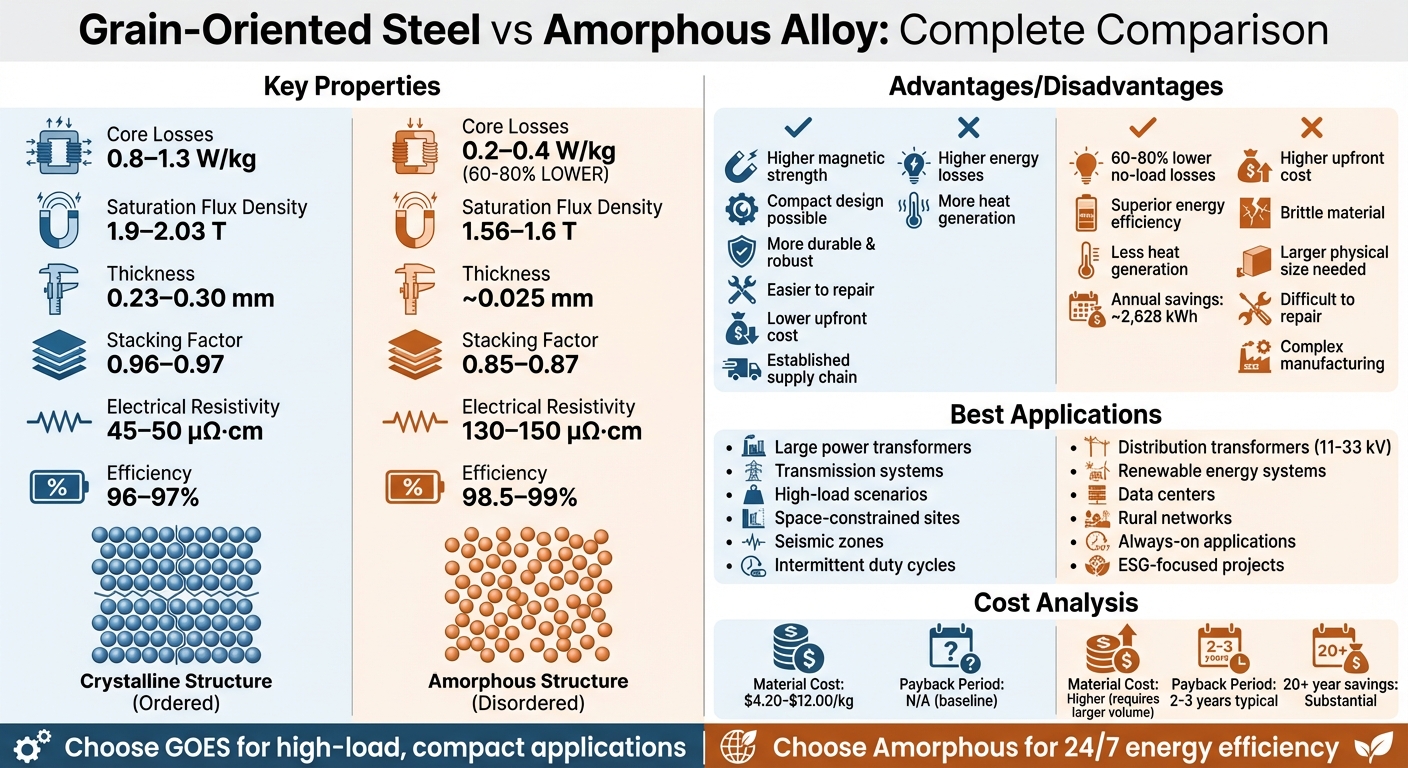
When it comes to transformer core materials, Grain-Oriented Steel (GOES) and Amorphous Alloys are two leading options, each with distinct strengths and trade-offs. Here's the short version:
- Grain-Oriented Steel (GOES): Known for its high magnetic strength and durability, GOES is ideal for large power transformers. It handles higher magnetic loads, operates efficiently in compact designs, and is easier to repair. However, it has higher core losses compared to amorphous alloys.
- Amorphous Alloys: These ultra-thin, non-crystalline materials excel in reducing energy losses - cutting no-load losses by 60–80%. They're perfect for distribution transformers and applications that run continuously, like renewable energy systems. But they’re more expensive upfront, brittle, and require larger designs due to lower magnetic strength.
Quick Comparison
| Feature | Grain-Oriented Steel (GOES) | Amorphous Alloy |
|---|---|---|
| Core Losses | Higher (0.8–1.3 W/kg) | Lower (0.2–0.4 W/kg) |
| Saturation Flux Density | 1.9–2.03 T | 1.56–1.6 T |
| Thickness | 0.23–0.30 mm | ~0.025 mm |
| Durability | High | Brittle |
| Efficiency | Moderate | Higher (98.5–99%) |
| Cost | Lower upfront | Higher upfront |
| Best Use | Power transformers | Distribution transformers |
Bottom Line: Choose GOES for high-load, compact applications and Amorphous Alloys when energy efficiency is a priority, especially in always-on systems.
Grain-Oriented Steel vs Amorphous Alloy Transformer Core Materials Comparison
Grain-Oriented Electrical Steel: Properties and Performance
Grain Structure and Magnetic Alignment
Grain-oriented electrical steel stands out due to its Goss texture, which aligns the metal grains in the rolling direction. This alignment is key to directing magnetic flux efficiently, significantly reducing both hysteresis and eddy current losses. In fact, core loss in the rolling direction is only about one-third of that in the transverse direction, with a permeability ratio of 6:1.
"I have experimental evidence which leads me to believe that there is an apparent relation between the grain size and ductility of a specimen and its magnetic properties. This evidence shows that small, uniform grains and high ductility accompany high permeability."
- N. P. Goss, Inventor of the CRGO process
The steel typically contains around 3% silicon, which enhances electrical resistivity and further reduces eddy current losses. This composition allows for magnetic induction levels ranging from 1.7 to 1.9 Tesla. What's more, the material's magnetic permeability in the rolling direction can be as much as 30 times higher than that of conventional steel, enabling transformers to handle higher magnetic flux with minimal energy loss. Additionally, its low magnetostriction helps limit dimensional changes and mechanical stress, reducing audible noise in transformer operations.
These properties make grain-oriented electrical steel indispensable for power transformer applications, where efficiency and reliability are critical.
Use in Power Transformers
Thanks to its superior magnetic performance, grain-oriented steel has become the go-to material for power and distribution transformers, particularly in unidirectional magnetic field applications. As of 2023, power generation accounted for 40% of the electrical steel market, highlighting the material's importance in large-scale energy infrastructure.
"Grain-oriented laminations are well suited to unidirectional field applications, such as in static machines like transformers, where the electrical efficiencies targeted are very high."
- Régis Lemaître and Thierry Belgrand, ThyssenKrupp Electrical Steel
For high-load scenarios, grain-oriented steel delivers exceptional performance, handling heavy power demands and fluctuations with ease. Its use in transformers can enhance energy efficiency and reduce energy consumption by 45% to 50% compared to older hot-rolled steel. With the U.S. grain-oriented electrical steel market projected to hit $3.29 billion by 2035, the adoption of high-grade GOES has surged by 44%, driven by the growing need for energy-efficient solutions.
sbb-itb-501186b
Amorphous Alloys: Properties and Performance
Non-Crystalline Structure and Magnetic Behavior
Amorphous alloys stand apart from conventional core materials due to their unique atomic structure. Unlike the ordered crystalline patterns found in grain-oriented electrical steel, amorphous alloys have a completely disordered atomic arrangement. This is achieved through an incredibly rapid cooling process - molten alloys containing iron, silicon, and boron are solidified at an astonishing rate of about 1,000,000 °C per second. This extreme cooling prevents the formation of crystals entirely.
This lack of grain boundaries has a profound impact on magnetic properties. Without a rigid crystalline structure, magnetic domains can change direction with minimal resistance, eliminating the issue of magnetic domain pinning. As a result, hysteresis losses during magnetization cycles are significantly reduced.
Additionally, amorphous alloys are manufactured as thin ribbons rather than traditional laminations. Their higher electrical resistivity - ranging from 130 to 150 µΩ·cm compared to 45 to 50 µΩ·cm in silicon steel - further minimizes eddy current formation, a major source of energy loss in magnetic materials.
That said, there are trade-offs. Amorphous alloys have a lower saturation flux density (1.56–1.6 T) compared to CRGO steel, which ranges from 1.9 to 2.03 T. They also have a magnetostrictive coefficient that is 3 to 5 times larger than silicon steel, resulting in noise levels that are 3 to 5 dB higher. However, they perform better under grid distortions - while silicon steel losses can spike by 23% under 5% distortion, amorphous alloys see only about a 6% increase.
These structural and magnetic advantages make amorphous alloys highly efficient, especially in applications where reducing core losses is critical.
Use in Distribution Transformers
Thanks to their magnetic properties, amorphous alloys are particularly well-suited for use in distribution transformers operating at 11–33 kV. These transformers are energized 24/7 but often run at low load levels. Since core losses remain constant regardless of load, the reduced losses of amorphous materials translate into substantial energy savings during off-peak hours.
Efficiency is a standout feature. Transformers with amorphous cores typically achieve efficiencies of 98.5% to 99%, compared to 96% to 97% for conventional CRGO transformers. In studies focused on EV charging distribution, amorphous transformers demonstrated approximately 18.6% lower load losses than their CRGO counterparts.
This makes amorphous cores an excellent choice for energy-efficient applications like renewable energy systems, data centers, and smart city infrastructure. As utilities face mounting pressure to cut carbon emissions and meet stricter standards such as DOE 2016 regulations, the advantages of amorphous alloy cores become even more appealing. While the thin, brittle ribbons require careful handling and protective casings during assembly, the long-term energy savings often outweigh these challenges. These efficiency benefits set the groundwork for a deeper comparison with grain-oriented electrical steel.
Performance Comparison: Grain-Oriented Steel vs Amorphous Alloy
Core Losses: Hysteresis and Eddy Currents
The key difference between grain-oriented steel and amorphous alloys lies in how they handle energy losses. Grain-oriented steel's crystalline structure resists magnetic domain movement, leading to higher energy losses. In contrast, the disordered atomic structure of amorphous alloys allows magnetic domains to move more freely, significantly cutting energy losses.
Amorphous alloys, free of grain boundaries, experience much lower hysteresis losses compared to grain-oriented steel. Their thinner ribbons - just 0.025 mm thick, about one-tenth the thickness of standard CRGO sheets (0.23–0.30 mm) - and higher electrical resistivity (130–150 µΩ·cm versus 45–50 µΩ·cm for CRGO) also minimize eddy current losses.
| Material | Core Loss at 1.5T, 50Hz |
|---|---|
| Grain-Oriented Steel | 0.8–1.3 W/kg |
| Amorphous Alloy | 0.2–0.4 W/kg |
| Loss Reduction | 60–80% lower |
These figures highlight why amorphous alloys are often the preferred choice for transformers that prioritize energy efficiency, especially under varying operational conditions.
Efficiency and Operating Temperature
Lower core losses in amorphous alloys translate into better energy efficiency, less heat generation, and an overall improvement in performance during continuous operation. This is especially noticeable in no-load conditions - when transformers are energized but not actively supplying power - common in distribution transformers.
"Amorphous steel core transformers can reduce no-load losses by up to 70%, which means they waste much less energy when idle."
Field tests back up these claims. In high-demand situations like EV charging, transformers with amorphous cores show around 18.6% lower load losses and generate less heat than their CRGO counterparts. This results in cooler oil temperatures, reduced thermal stress on insulation, and lower cooling needs.
| Metric | Grain-Oriented Steel | Amorphous Alloy |
|---|---|---|
| No-Load Loss Reduction | Baseline | 60–80% lower |
| Operating Temperature | Higher heat levels | Lower oil/hotspot temps |
The thermal advantages of amorphous alloys make them a compelling option for applications where efficiency and heat management are critical.
Magnetic Properties and Design Considerations
While amorphous alloys shine in efficiency, grain-oriented steel holds the edge in magnetic strength and compact design. CRGO boasts a higher saturation flux density (1.9–2.03 T) compared to amorphous alloys (1.56–1.6 T). This allows CRGO cores to handle higher magnetic loads in a smaller physical footprint, making them ideal for large power transformers.
The stacking factor is another key difference. CRGO achieves a stacking factor of 0.96–0.97, while amorphous alloys, due to their thin and irregular surface, only reach about 0.85–0.87. This means amorphous cores often need to be physically larger to achieve the same power rating. Additionally, the brittle nature of amorphous materials requires extra care during assembly, often needing protective casings or epoxy coatings to prevent damage.
| Property | Grain-Oriented Steel | Amorphous Alloy | Design Impact |
|---|---|---|---|
| Saturation Flux Density | 1.9–2.03 T | 1.56–1.6 T | Larger core volume for amorphous |
| Stacking Factor | 0.96–0.97 | 0.85–0.87 | More space needed for amorphous cores |
| Mechanical Durability | Robust, easy to handle | Brittle, stress-sensitive | Requires protective measures |
| Permeability | High | Very high | Faster response to magnetic changes |
These trade-offs underscore the importance of selecting the right material based on the specific demands and constraints of the transformer application. Each material brings its own strengths, whether it's CRGO's compact design or the energy efficiency of amorphous alloys.
Cost, Manufacturing, and Application Selection
Initial Costs and Payback Periods
Amorphous alloys come with a higher upfront price tag compared to grain-oriented electrical steel. For context, standard CRGO (Cold Rolled Grain Oriented steel) costs between $4.20 and $7.50 per kg, while high-grade Hi-B GOES (Grain-Oriented Electrical Steel) ranges from $6.50 to $12.00 per kg. Adding to the expense, amorphous metals require a larger volume to match the same power output as CRGO, further driving up costs.
However, the story doesn’t end with initial costs. Over the long run, amorphous alloys can prove more economical in the right applications. Take, for example, a cost analysis by Huaxiao-Alloy in June 2025 for a 500 kVA transformer project. Upgrading from standard CGO, with material costs of $13,920, to Hi-B steel at $22,800 added $8,880 to the upfront costs. But this switch delivered $4,200 in annual energy savings, resulting in a payback period of just 2.1 years. Similarly, in distribution transformers, amorphous cores typically save around 2,628 kWh annually, and for units running continuously, these savings compound significantly over their 20+ year lifespan.
These economic benefits, however, are closely tied to the challenges of manufacturing these materials.
Manufacturing Challenges
Producing amorphous alloys is no easy feat. Their extreme brittleness makes them prone to breaking into small fragments during manufacturing or in service. This brittleness can lead to issues like partial discharge, oil degradation, and higher failure rates. Additionally, the ultra-thin ribbons - about 25 microns thick compared to the 0.23–0.30 mm thickness of CRGO - require advanced, high-precision cutting and stacking machinery, which slows down production.
"Amorphous metal is very brittle and does not withstand continuous mechanical stress. Vibrations, step-loads and the short-circuits will degrade the amorphous metal and its efficiency permanently."
Manufacturing also demands exceptionally fast cooling rates - over 1,000,000 K/s - to prevent crystallization. To optimize magnetic properties, amorphous cores need precise field annealing at around 680°F (360°C). Any misstep during this process can negate their energy-saving advantages.
Grain-oriented steel, on the other hand, benefits from a streamlined global supply chain and well-established production methods like standardized punching or laser-cutting. CRGO transformers are also easier to repair or rebuild in the field, whereas amorphous wound cores are nearly impossible to modify once completed. Another limitation of amorphous alloys is their sheet width, which restricts design flexibility and often necessitates rectangular shapes. These shapes are less resistant to short-circuit forces compared to the rounder designs achievable with CRGO.
Best Applications for Each Material
The choice between these materials often comes down to the specific demands of the application. Grain-oriented steel is well-suited for large power transformers, transmission systems, and environments with intermittent duty cycles or mechanical stress. Its higher saturation flux density and better stacking factor allow for smaller, more compact designs - ideal where space is tight or when the transformer must endure physical stress during transport or seismic activity.
Amorphous alloys shine in areas like distribution transformers, renewable energy systems, and data centers, where the equipment operates continuously. Their ability to cut no-load losses by 60–80% makes them particularly appealing for low-load, always-on scenarios. However, if a transformer is frequently turned off or used as a backup, the energy savings diminish, making CRGO the more cost-effective choice.
| Material | Ideal Applications | Key Benefits |
|---|---|---|
| Grain-Oriented Steel | Large power/transmission transformers, seismic zones, space-constrained sites | High flux density, mechanical stability, compact design, field repairability |
| Amorphous Alloy | Rural distribution, renewable energy, data centers, ESG projects | 60–80% lower no-load losses, reduced heat generation, long-term energy savings |
A real-world example highlights the importance of matching materials to applications. In 2025, a German EV manufacturer switched from M330-35A steel to JNEH8000 grade. While the material cost was 88% higher, the change saved the company $28,000 annually through reduced core losses and even boosted driving range by 5.3%. This case demonstrates how the right material choice can deliver returns that far outweigh initial cost differences. While amorphous alloys may demand more in terms of production and cost, their efficiency can translate into substantial operational benefits over time.
How to choose transformer core materials?
Conclusion: Selecting the Right Core Material
Choosing the best transformer core material comes down to its intended use. For transformers that operate continuously - like those in rural networks, data centers, or renewable energy systems - amorphous cores offer a compelling advantage. They can reduce no-load losses by 60–80%, which translates into significant energy savings over a lifespan of 20+ years. While the upfront costs are higher, the long-term savings, calculated through the Total Cost of Ownership (TCO = Price + [Cost of No-Load Losses × Hours × Years]), often offset the initial expense.
On the other hand, grain-oriented steel (CRGO) is generally the better choice for large power transformers, backup units, or applications where the transformer frequently cycles on and off. Its higher saturation flux density (up to 2.0 T compared to 1.56–1.6 T for amorphous cores) allows for more compact designs. Additionally, its mechanical durability makes it ideal for environments with high vibrations or seismic activity. In cases where a transformer is de-energized frequently or serves mainly as a backup, the energy-saving advantage of amorphous cores diminishes, making CRGO the more economical option.
"The choice between the two types of transformers depends on the specific application requirements, budget constraints, and the desired level of efficiency and performance." - UTB Transformers
Other factors also influence the decision. Space limitations, for instance, often favor CRGO. Amorphous cores have a lower stacking factor (~0.85–0.87 compared to ~0.96–0.97 for CRGO), which means they require a larger tank and more oil to achieve the same kVA rating. This makes CRGO a better fit for retrofits or compact designs. Repairability is another consideration - CRGO transformers are generally easier to repair or rebuild on-site, whereas amorphous wound cores are nearly impossible to modify once damaged.
For those weighing their options, platforms like Electrical Trader (https://electricaltrader.com) provide access to a wide range of new and used transformers with various core materials, making it easier to find a solution that aligns with both efficiency goals and budgetary needs.
FAQs
How do I calculate payback for an amorphous-core transformer?
To figure out the payback period, start by comparing the upfront cost of an amorphous-core transformer to that of a traditional silicon steel core. Next, estimate the energy savings by calculating the reduction in core losses - typically between 65% and 75% - and multiply that by your local energy rate (e.g., $0.10 per kWh). Finally, divide the difference in cost by the annual savings to see how many years it will take to recoup the investment through energy savings.
Will an amorphous-core transformer be louder than GOES?
Amorphous-core transformers are known for operating more quietly compared to their grain-oriented electrical steel (GOES) counterparts. This difference comes down to physics: amorphous cores have lower hysteresis and eddy current losses, which means less vibration and fewer magnetostriction effects - the main culprits behind transformer noise. On the other hand, GOES transformers, made with laminated silicon steel, tend to produce more noise due to higher core losses and the vibrations they create. If minimizing noise is a priority, amorphous-core transformers are typically the preferred option.
Which core type is better for frequent on/off switching?
Grain-oriented electrical steel (CRGO) cores are generally a better choice for applications involving frequent on/off switching. Unlike amorphous alloy cores, which are more prone to brittleness and can be easily affected by mechanical stress, vibrations, and overloads, CRGO cores offer greater durability. These characteristics allow CRGO cores to withstand the mechanical demands of frequent switching, reducing the risk of efficiency loss and failure over time. This makes them a more reliable option in such scenarios.