

Transformer Core Losses: Material Impact Explained
Transformers are highly efficient devices, operating at 95–99% efficiency. However, even minor energy losses can accumulate significantly over time, increasing costs. These losses, known as core losses or iron losses, occur in the transformer's magnetic core and are constant whenever the transformer is energized.
Core losses are caused by two primary mechanisms:
- Hysteresis loss: Energy lost as heat when magnetic domains realign during each AC cycle.
- Eddy current loss: Heat generated by circulating currents induced within the core material.
The choice of core material directly influences these losses. High-grade materials like amorphous metals and nanocrystalline alloys significantly reduce energy loss compared to traditional silicon steel. Here's a quick overview of how different materials perform:
- Silicon Steel: Cost-effective and widely used for 50/60 Hz applications but has moderate losses.
- Amorphous Metals: Reduce losses by up to 70%, ideal for energy-efficient systems.
- Nanocrystalline Alloys: Offer the lowest losses, especially in high-frequency applications, but are more expensive.
- Ferrites: Virtually eliminate eddy currents, suitable for high-frequency, low-power applications.
Selecting the right core material depends on factors like operating frequency, load requirements, and long-term cost savings. Advanced materials often justify their higher upfront costs through reduced energy losses and improved efficiency over a transformer's lifespan.
Transformer Core Losses Explained | Hysteresis & Eddy Currents Made Easy
sbb-itb-501186b
Types of Core Losses
Transformer core losses stem from two main sources: hysteresis and eddy currents. Grasping these mechanisms is key to choosing the right core materials and minimizing energy loss.
Hysteresis Losses
Hysteresis loss arises from the friction caused by magnetic domains aligning and realigning with each AC cycle. As R. W. Hurst from Electricity Forum explains:
Hysteresis is the tendency for a core material to act 'sluggishly' in accepting a fluctuating magnetic field.
Inside the transformer core, magnetic domains are separated by domain walls, which don’t move freely. Energy is required to overcome the resistance and friction during their movement, converting electrical energy into heat.
This energy loss is represented by the B-H loop, a graph showing the relationship between magnetic flux density (B) and magnetic field strength (H). DiGi-Electronics notes:
The area inside the [B-H] loop stands for the energy lost in the core during each cycle; a larger area means higher hysteresis loss.
Materials with narrow B-H loops, such as high-grade silicon steel or amorphous metals, consume less energy during domain realignment, reducing losses. Hysteresis loss also increases linearly with the AC frequency, meaning higher frequencies lead to greater losses.
Now, let’s look at how eddy currents contribute to energy loss in transformers.
Eddy Current Losses
Eddy current losses occur due to circulating currents induced within the core material. According to Faraday's Law of Induction, a changing magnetic flux generates a voltage in the core, which causes small loops of current to flow perpendicular to the magnetic field. These currents, encountering resistance in the material, dissipate energy as heat.
Unlike hysteresis losses, eddy current losses grow with the square of the frequency (f²), making them a bigger issue in high-frequency applications. They are also proportional to the square of the maximum flux density and the square of the core’s lamination thickness.
To reduce eddy currents, transformer cores are made from thin, electrically insulated sheets (laminations) instead of solid blocks. These laminations limit the paths for current flow and increase electrical resistance, cutting losses significantly. Additionally, using materials with high electrical resistivity, such as silicon steel or ferrites, further reduces the magnitude of these currents.
How Different Core Materials Affect Losses
The choice of core material plays a major role in determining transformer energy losses, primarily through its impact on hysteresis and eddy current losses.
Silicon Steel Cores
Silicon steel strikes a balance between performance and cost. By adding 2–4% silicon to iron, manufacturers increase its electrical resistivity, which helps cut down on eddy current losses. Grain-oriented silicon steel further enhances efficiency by aligning the metal grains during production, making it more responsive to magnetic fields and reducing the energy required for domain realignment.
At 50 Hz, standard silicon steel (30Q130) typically experiences core losses of about 1.30 W/kg, while higher-grade options like 23Q120 reduce losses to approximately 0.90 W/kg. This makes silicon steel a cost-efficient choice for distribution transformers operating below 10 kV and power transformers up to 35 kV.
However, for applications demanding even lower energy losses, amorphous materials offer a significant advantage.
Amorphous Core Materials
Amorphous metals, created by rapid cooling, have a disordered atomic structure that minimizes magnetic domain formation, leading to much lower hysteresis losses. At 50 Hz, these materials achieve core losses as low as 0.10 W/kg compared to 1.30 W/kg for standard silicon steel. Overall, amorphous cores can reduce total core losses by 60–70% when compared to cold-rolled grain-oriented (CRGO) steel.
"Amorphous metal cores can achieve up to 60% lower losses than conventional silicon steel."
– ZTELEC GROUP
This makes amorphous cores especially suitable for grid distribution transformers and renewable energy systems, where continuous operation is common. The significant reduction in no-load losses - energy wasted even when the transformer isn't actively powering a load - helps offset the higher upfront costs with long-term energy savings. However, these materials are brittle and require protective casings to prevent damage during transport and installation.
For even greater efficiency, nanocrystalline materials take performance to the next level, particularly at high frequencies.
Nanocrystalline Core Materials
Nanocrystalline materials feature ultra-fine grains (less than 100 nanometers) embedded in an amorphous matrix. This structure results in extremely low coercivity, meaning the material can magnetize and demagnetize with minimal energy loss. Their standout feature is high-frequency performance: nanocrystalline cores maintain a high saturation flux density, allowing engineers to design smaller transformers without compromising power capability. Additionally, these materials offer excellent temperature stability, maintaining consistent magnetic properties across a wide range of operating conditions.
"Nanocrystalline alloys... combine the high magnetic permeability of amorphous alloys with the mechanical strength of traditional metals."
– Lamnow
These characteristics make nanocrystalline cores ideal for demanding applications like EV charging stations, medical devices, aerospace systems, and high-frequency power supplies. The downside? Their production involves advanced heat treatment processes, which significantly increases costs compared to silicon steel or amorphous cores.
Ferrite Core Materials
Ferrite cores, made of ceramic compounds, have exceptionally high electrical resistivity, which virtually eliminates eddy current losses. This makes them perfect for high-frequency applications, such as telecommunications equipment, RF systems, and switching power supplies. Ferrites also have high magnetic permeability, allowing efficient operation at frequencies where silicon steel would struggle. However, their lower saturation flux density limits their use in high-power applications.
The frequency range is key here. While silicon steel performs well at grid frequencies of 50–60 Hz, ferrites and nanocrystalline alloys dominate at kilohertz and megahertz frequencies. Transformers using these advanced materials can achieve efficiency ratings exceeding 98%. The choice of material ultimately determines the transformer's optimal use case and overall performance.
Core Material Performance Comparison
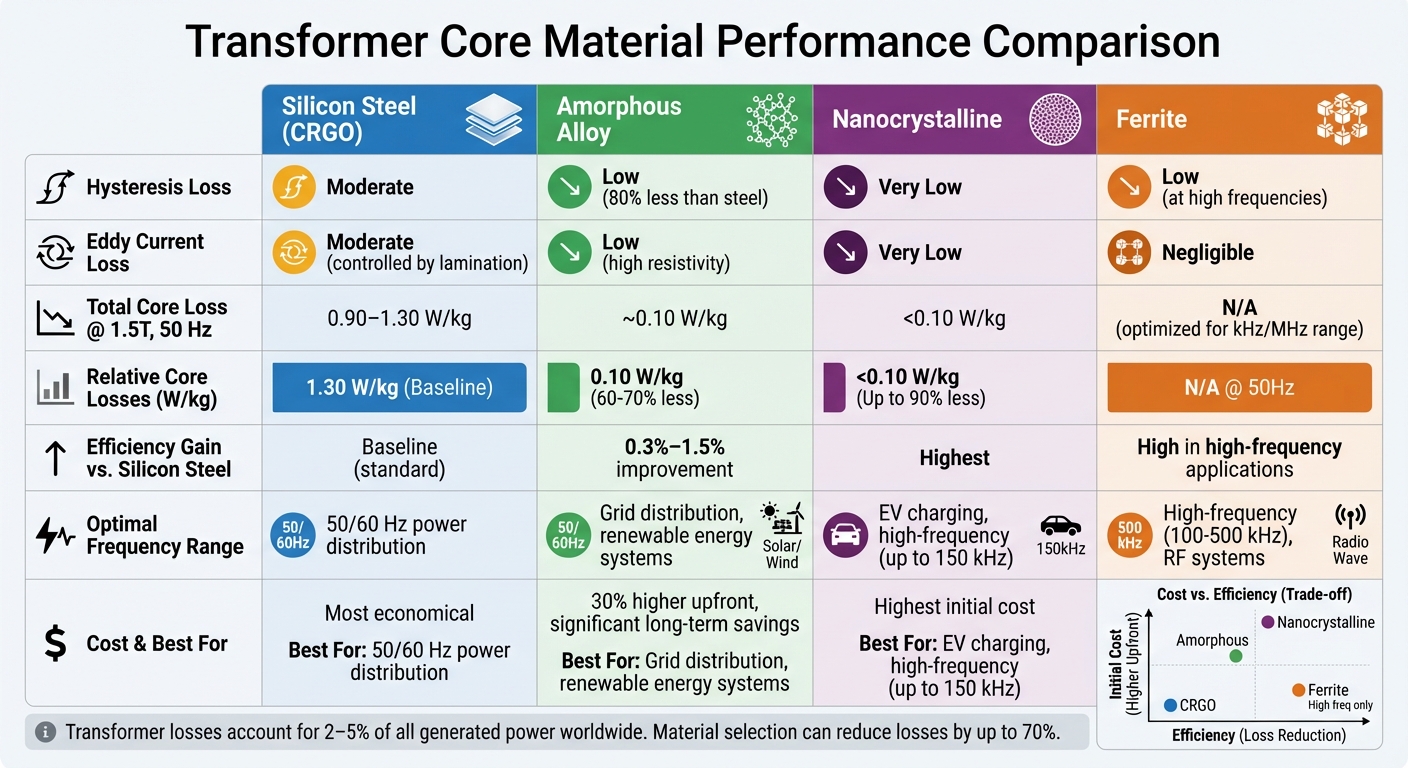
Transformer Core Material Performance Comparison Chart
Choosing the right core material means understanding how different options perform in practical scenarios, especially when it comes to efficiency and long-term operating costs. These performance metrics play a key role in improving transformer efficiency for industrial applications.
Loss and Efficiency Comparison Table
Here's a breakdown of how the four main core materials stack up under typical operating conditions. Ferrite cores are excluded from the 1.5T comparison because they saturate at much lower flux densities (around 0.4T–0.52T), making them unsuitable for standard power distribution systems.
| Core Material | Hysteresis Loss | Eddy Current Loss | Total Core Loss @ 1.5T, 50 Hz | Efficiency Gain vs. Silicon Steel |
|---|---|---|---|---|
| Silicon Steel (CRGO) | Moderate | Moderate (controlled by lamination) | 0.90–1.30 W/kg | Baseline (standard) |
| Amorphous Alloy | Low (80% less than steel) | Low (high resistivity) | ~0.10 W/kg | 0.3%–1.5% improvement |
| Nanocrystalline | Very Low | Very Low | <0.10 W/kg | Highest (ideal for high-frequency) |
| Ferrite | Low (at high frequencies) | Negligible (ceramic structure) | N/A (optimized for kHz/MHz range) | High in high-frequency applications |
This table highlights the strengths of each material, helping you weigh efficiency gains against costs when selecting the right core material.
Amorphous alloys, for example, can reduce total core losses by up to 70% compared to CRGO silicon steel. Nanocrystalline materials go even further, offering the lowest losses, though they come with higher costs due to their intricate manufacturing processes. Even a small 1% reduction in core loss can translate into thousands of dollars saved annually.
"Transformer losses account for nearly 2–5% of all generated power worldwide, with the majority of these losses originating in the core."
– Chandrasekar C, Co-Founder, Frigate
Silicon steel remains the go-to choice for standard 50/60 Hz applications because of its cost-effectiveness. Meanwhile, amorphous and nanocrystalline materials cater to high-efficiency requirements, with nanocrystalline cores excelling in high-frequency settings. Ferrite cores, though unsuitable for high-power grid applications, dominate in high-frequency switching applications above 100 kHz due to their exceptional electrical resistivity.
Selecting the Right Core Material
Choosing the right core material isn't just about finding the option with the lowest losses - it’s about aligning performance with your specific operating conditions while keeping overall costs manageable. While operating frequency is the most important factor, other considerations like load requirements, thermal conditions, and regulatory compliance also play a big role.
Matching Material to Application
The operating frequency of your system largely dictates which core material will work best. For low-frequency applications like power distribution at 50/60 Hz, laminated silicon steel stands out for its efficiency and affordability, making it the go-to material for grid transformers. On the other hand, Manganese-Zinc (MnZn) ferrite is preferred for high-frequency systems operating between 100–500 kHz.
For applications that fall between these ranges, amorphous alloys are a strong choice for frequencies below 80 kHz. These alloys are particularly effective in solar inverters and high-efficiency distribution systems, where they can cut hysteresis losses by up to 80% compared to silicon steel. Nanocrystalline materials, ideal for frequencies under 150 kHz, are commonly used in EV chargers and common-mode chokes, offering a combination of compact size and high efficiency.
When compact designs need to handle high loads, saturation flux density (Bs) becomes crucial. Materials like nanocrystalline alloys, with flux densities of 1.2–1.3 T, allow for smaller cores without sacrificing power throughput.
In harsh environments, mechanical durability is key. For high-vibration applications like aerospace or wind power, rugged materials such as laminated steel or powdered iron are better suited. Although ferrite cores excel electrically at high frequencies, they are brittle and prone to damage unless properly encapsulated.
These material-specific traits are essential when evaluating long-term performance, cost, and reliability.
Balancing Cost and Efficiency
When assessing the total cost of ownership (TCO) over a transformer's 30–40 year lifespan, premium materials often prove to be the smarter investment. As Elecbase notes:
The cumulative cost of these losses can be substantial, often exceeding the initial purchase price of the transformer.
Modern cost models now factor in energy losses over time, revealing the true financial impact. For example, a transformer with an amorphous core may cost 30% more upfront than one with a silicon steel core, but its ability to reduce total losses by 60% could save thousands of dollars in annual operating costs.
For standard 50/60 Hz applications, silicon steel remains the most economical option due to its mature supply chains and large-scale production. Similarly, ferrite cores are cost-effective for mainstream high-frequency designs. However, amorphous and nanocrystalline materials, though more expensive initially, offer substantial energy savings that can offset their higher price - especially in scenarios where regulations prioritize long-term efficiency.
Economic evaluations like these highlight the growing importance of regulatory compliance in transformer design.
Meeting Regulatory and Environmental Standards
Stricter energy efficiency regulations are driving the adoption of premium, low-loss materials. In many regions, minimum efficiency standards now make traditional silicon steel unsuitable for certain applications. Advanced materials like amorphous and nanocrystalline alloys enable transformers to achieve efficiency levels exceeding 98%.
Beyond efficiency, environmental impacts are also a factor. Producing amorphous alloys generates fewer greenhouse gas emissions compared to traditional laminated steel manufacturing. Since transformer losses account for 2–5% of all power generated globally, improving core efficiency can significantly reduce the carbon footprint across the power grid.
In renewable energy applications - such as solar inverters, wind turbines, and EV charging systems - amorphous and nanocrystalline materials are increasingly favored. These materials not only improve energy capture but also reduce heat generation in compact designs, helping meet both performance and sustainability goals. Selecting the right core material ensures transformers meet modern demands while advancing energy efficiency and environmental responsibility.
Finding Transformer Cores on Electrical Trader
Why Use Electrical Trader?
Electrical Trader acts as a one-stop marketplace for electrical professionals, offering both new and used transformers with a variety of core materials. Whether you're working with silicon steel, amorphous, nanocrystalline, or ferrite cores, the platform eliminates the hassle of dealing with multiple suppliers. This makes it an efficient solution for replacing outdated equipment or sourcing cores for projects like renewable energy systems.
The platform caters to a wide range of industry needs, enabling easy comparison across different materials and price points. For those working with limited budgets, the availability of used equipment provides a budget-friendly option without compromising on quality. This approach ensures access to core materials that align with your technical and performance needs, all in one convenient place.
Available Transformer Core Options
Electrical Trader offers a variety of transformer cores tailored for diverse operational requirements. For standard power and distribution systems running at 50/60 Hz, silicon steel cores - both Grain Oriented (GO) and Non-Grain Oriented (NGO) - remain a popular choice. On the other hand, amorphous metal cores deliver a 60–70% reduction in core losses, making them ideal for energy-intensive setups like solar inverters and wind power systems, despite their higher upfront cost.
For high-frequency applications, ferrite cores support devices like switch-mode power supplies and compact electronics. Meanwhile, nanocrystalline materials are perfect for high-performance inverters. The platform also includes specialized alloys and powdered iron cores for more demanding applications. With configurations like toroidal, EI types, laminated, and wound designs, there’s a solution for various spatial and magnetic circuit requirements.
Simplifying Equipment Procurement
Electrical Trader takes the complexity out of transformer core procurement. You can filter options based on key factors like frequency, efficiency, and size, helping you make informed decisions that balance upfront costs with long-term savings. Whether you’re opting for the affordability of silicon steel or the ultra-low losses of amorphous alloys, the platform’s inventory is designed to meet both immediate and future needs, supporting transformer lifespans of 30–40 years.
Conclusion
Key Takeaways
The transformer core material you choose plays a major role in energy efficiency, cost management, and reliability. For example, amorphous metals can slash no-load losses by 60–70%, while nanocrystalline alloys can cut core losses by as much as 90% in high-frequency applications. The trick lies in selecting materials with the right properties - like saturation flux density, electrical resistivity, and thermal stability - that align with your transformer's operating frequency and load demands.
"The choice of core material has a substantial impact on energy losses and overall transformer efficiency." - Catech
Silicon steel remains a cost-effective option for standard 50/60 Hz applications. However, advanced materials, though pricier upfront, can significantly lower operating costs over the 30–40 years a transformer typically operates by minimizing energy waste. Even with modern transformers achieving efficiencies above 98%, the remaining 2% loss can still lead to thousands of dollars in wasted energy over time.
Understanding these material performance factors is essential when making procurement decisions. Platforms like Electrical Trader simplify this process by offering tools to compare core materials and evaluate the trade-offs between initial costs and long-term savings. Whether you're working with budget-friendly silicon steel or exploring amorphous and nanocrystalline options, the marketplace helps you find the right fit for applications ranging from renewable energy systems to industrial automation - whether you're upgrading old equipment or starting fresh with new designs.
FAQs
How do I estimate payback for an amorphous or nanocrystalline core?
To figure out the payback period, you’ll need to weigh the higher upfront cost of the core against the energy savings it provides. These savings can be substantial - core losses may be reduced by as much as 80% compared to traditional materials.
-
Step 1: Calculate energy savings
Start by estimating the reduction in energy losses. Then, convert those savings into dollar amounts based on your local electricity rates. -
Step 2: Determine the payback period
Take the additional cost of the core and divide it by the annual savings. This will give you the number of years it will take to recover your investment.
By breaking it down this way, you can see how long it will take for the energy savings to offset the initial expense.
What flux density and frequency should I design for to avoid saturation?
To avoid saturation in a transformer, it's important to keep the flux density below the material's rated limit. For most applications, a frequency of 50-60 Hz is standard. Operating at higher flux densities can lead to saturation issues, so adhering to these guidelines helps maintain reliable performance.
Which core material best meets U.S. efficiency rules for my application?
Materials like electrical steel and ferrite are often top choices for core applications. Their high magnetic permeability and low core losses make them ideal for reducing hysteresis and eddy current losses. This helps meet U.S. efficiency standards effectively.