Checklist for Choosing Grid-Scale Energy Storage
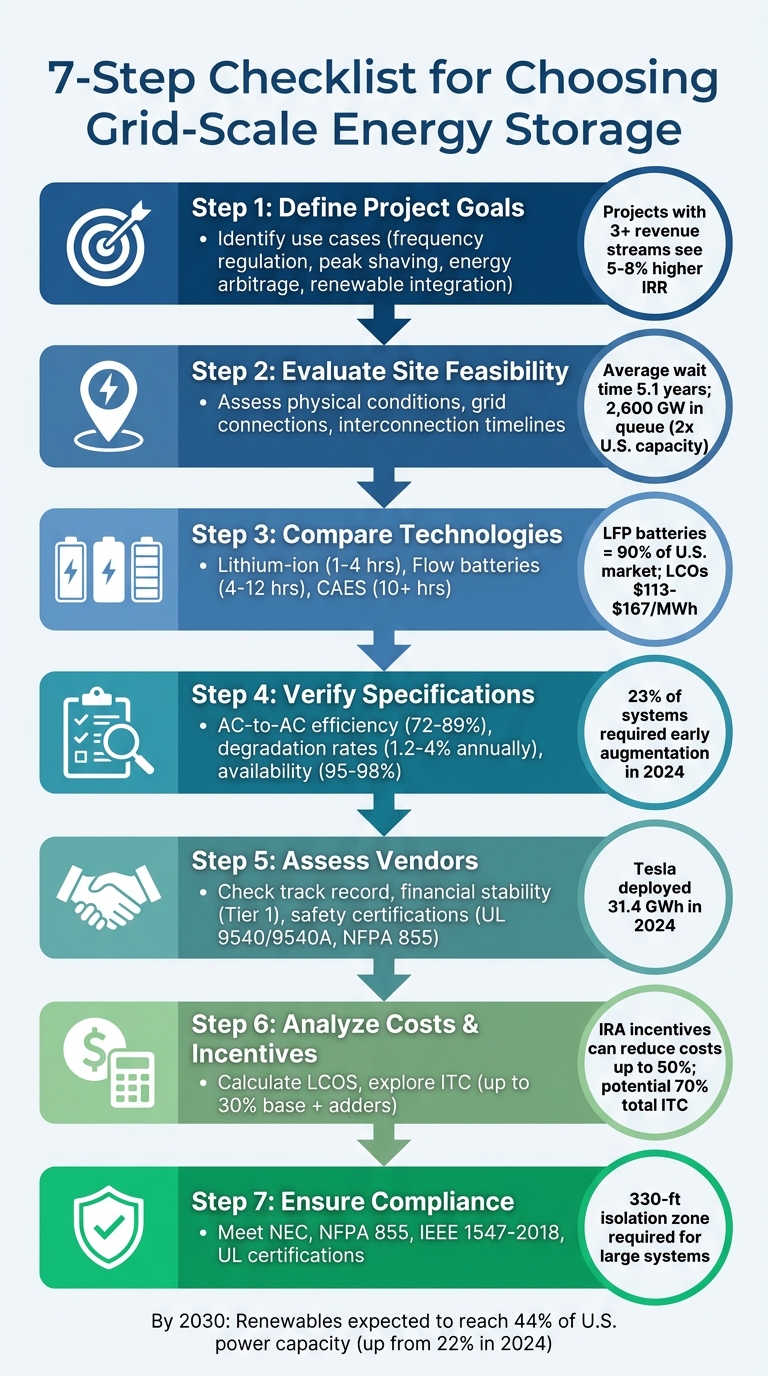
Grid-scale energy storage is essential as renewable energy sources like solar and wind expand. By 2030, these sources are expected to account for 44% of U.S. power capacity, up from 22% in 2024. However, their intermittent nature creates challenges for grid reliability, requiring efficient storage solutions. Selecting the right system involves balancing technical needs, costs, and long-term performance. Here's a quick overview of the key steps:
- Define Project Goals: Identify use cases (e.g., frequency regulation, peak shaving), power/energy needs, and budget constraints.
- Evaluate Site Feasibility: Assess physical conditions, grid connections, and interconnection timelines.
- Compare Technologies: Weigh options like lithium-ion, flow batteries, and compressed air systems based on efficiency, lifespan, and costs.
- Verify Specifications: Focus on efficiency, degradation rates, and system availability to ensure performance aligns with goals.
- Assess Vendors: Check reliability, financial stability, warranties, and maintenance offerings.
- Analyze Costs and Incentives: Calculate Levelized Cost of Storage (LCOS) and explore federal/state incentives like the Inflation Reduction Act.
- Ensure Compliance: Meet safety, regulatory, and grid standards to avoid delays and risks.
Each step ensures a well-informed decision, maximizing storage performance and financial returns over the project's lifespan.
7-Step Checklist for Choosing Grid-Scale Energy Storage Systems
Grid-Scale Energy Storage: 5 Technologies Explained
sbb-itb-501186b
Step 1: Define Your Project Requirements
Before diving into storage technology options, it’s crucial to establish clear goals for your project. A well-defined starting point ensures every step of the process aligns with your objectives.
Identify Primary Use Cases
Grid-scale storage systems are designed to handle a variety of tasks, each with its own technical demands. For example:
- Frequency regulation requires quick, second-by-second responses to stabilize grid imbalances.
- Peak shaving typically involves 2–4 hours of discharge to lower demand charges during high-load periods.
- Energy arbitrage focuses on buying electricity during off-peak hours and discharging when prices surge.
- Renewable integration helps store excess solar or wind energy and delivers firm capacity during evening ramps or periods of low renewable output.
Projects that combine multiple revenue streams - known as revenue stacking - can significantly improve returns. In fact, projects capturing three or more revenue streams often see internal rates of return increase by 5 to 8 percentage points compared to single-use deployments.
Determine Power and Energy Capacity Needs
Understanding your system’s power and energy needs is essential. Here’s the breakdown:
- Power capacity (MW): The maximum electricity the system can deliver at any moment.
- Energy capacity (MWh): The total amount of energy the system can sustain over time.
To calculate energy needs, use this simple formula:
Energy (MWh) = Power (MW) × Duration (hours).
For example, a 100 MW system operating for 4 hours would require 400 MWh of capacity.
It’s also important to account for system losses. Lithium-ion systems typically achieve 85–92% round-trip efficiency, while LFP systems can discharge 80–95% of their total capacity. This means that to achieve 100 MWh of usable energy, you’d need to install 110–120 MWh of nominal capacity. Over time, systems degrade, losing 2–3% of capacity annually, which could add 25–40% to lifecycle costs over 20 years.
"Application determines duration, and duration defines MWh sizing." – Leoch Lithium America
Set Budget and Timeline Constraints
Your budget should account for both upfront installation costs and long-term lifecycle expenses (LCOS). Currently, top-performing 4-hour lithium-ion storage systems can be installed for less than $170/kWh, while average costs range between $220 and $280/kWh. However, a system with lower upfront costs but higher degradation rates may end up costing more over its lifetime compared to a pricier but more durable option.
Timelines are often dictated by grid connection rather than the availability of technology. As of 2025, the average time from entering the interconnection queue to commercial operation was 5.1 years. The U.S. interconnection queue had surpassed 2,600 GW by the end of 2023 - double the nation’s current installed generation capacity. Transmission projects can take 7 to 12 years to complete, and "restudy cycles" may add an extra 18–24 months to your timeline.
When setting your budget, don’t overlook hidden costs such as:
- Permits (often 15–20 separate ones).
- Necessary grid upgrades.
- Insurance premiums tied to compliance with safety standards like UL 9540A and NFPA 855.
Additionally, the Inflation Reduction Act offers significant incentives, potentially reducing costs by up to 50% for qualifying projects. This includes a 30% base Investment Tax Credit, with added benefits for projects meeting domestic content requirements.
Once you’ve outlined your project’s requirements and constraints, you’ll be ready to assess site and grid connection feasibility in the next step.
Step 2: Evaluate Site and Grid Connection Feasibility
Once you've outlined your project requirements, the next step is ensuring your site is suitable for installation and grid connection. Without this, your project could face significant obstacles or even become a stranded asset.
Assess Physical Site Conditions
Battery storage systems typically require less space than traditional power plants, making them a great fit for utility-owned land near substations. However, specific site conditions can make or break the success of your project.
One critical factor is ambient temperature. It directly impacts battery cycle life, efficiency, and charging capabilities. To address this, integrated thermal management systems are essential for maintaining safe operating conditions. Recent incidents, such as those at Moss Landing, underscore the importance of robust thermal management and safety measures.
Early assessments of subsurface and environmental conditions are also vital. Issues like contaminated soil, archaeological discoveries, or unstable ground can lead to costly delays. Don't overlook fire safety requirements, which may dictate minimum distances from nearby structures and whether the installation will be indoors or outdoors.
Review Grid Interconnection Requirements
The feasibility of connecting to the grid often plays a bigger role in project viability than any other factor. One major consideration is the distance to substations, as this significantly affects costs. Developers often aim for a threshold of less than 0.6 miles (1 km) from a viable connection point to keep the project economically feasible.
You'll also need to confirm the available capacity at your target substation. Some utilities provide capacity maps, like California's Integration Capacity Analysis (ICA) maps, which show circuit-level hosting capacity. It's crucial to verify megawatt headroom for both exporting (injection) and importing (withdrawal) energy. Small-to-midsize systems typically connect at medium voltage (20–33 kV), while large-scale projects require high voltage connections (90–132 kV or more).
One of the biggest hurdles is the interconnection queue. By the end of 2023, about 2,600 GW of generation and storage capacity was stuck in U.S. interconnection queues - double the country's installed generation capacity. The average wait time had climbed to 5.1 years by 2025, and only 20% of queued projects ever made it to commercial operation. High saturation in certain regions can result in years-long delays or even queue freezes.
"The best technology is worthless if it can't be connected to the grid." – Sustainability Atlas
Be ready for potential interconnection upgrade costs. Under FERC Order 2023, projects over 20 MW require study deposits of $5,000 per megawatt. Large-scale projects have faced grid connection fees as high as $48 million. Additionally, transmission equipment lead times have ballooned from 12–18 months to 36–48 months as of 2026, which can further delay grid connection even after permits are in hand.
It's critical to evaluate grid and land feasibility simultaneously. Never secure land control before confirming grid feasibility. Also, identify whether your connection point is managed by a Distribution System Operator (DSO) or a Transmission System Operator (TSO), as this will dictate your permitting process, application format, and technical requirements.
Once you've confirmed both site and grid feasibility, you can move on to selecting the right storage technology for your project.
Step 3: Compare Energy Storage Technologies
Once you've confirmed site and grid connection feasibility, it's time to choose a storage technology that aligns with your project's needs, especially in terms of duration and budget. The technology you select will shape your project's performance, costs, and lifespan.
Overview of Key Technologies
Lithium-ion batteries dominate short-duration applications, typically ranging from 1 to 4 hours. By 2025, lithium iron phosphate (LFP) batteries accounted for over 90% of the U.S. utility-scale storage market. These systems boast round-trip efficiencies of 80% to 92%. A noteworthy example is NextEra Energy Resources’ 460 MW/1,840 MWh lithium-ion project, which set a cost benchmark of $168/kWh in 2025. However, keep in mind their 2–3% annual capacity loss, which can impact long-term financial planning.
For medium-to-long duration needs, flow batteries are worth considering. These systems are designed for applications lasting 4 to 12 hours, offering a cycle life exceeding 100,000 cycles and low annual degradation rates of just 0.1–0.5%. Their modular design allows power and energy capacities to scale independently. However, flow batteries have lower round-trip efficiencies, typically between 50% and 75%. In 2025, Form Energy began pilot projects with Great River Energy and Xcel Energy to test iron-air batteries capable of 100-hour storage at costs below $20/kWh.
Compressed Air Energy Storage (CAES) is an established option for large-scale, long-duration needs (10+ hours). The U.S. has one operational CAES plant in Alabama with a capacity of 110 MW. This technology offers some of the lowest potential costs per kWh and a lifespan of around 30 years. However, CAES requires specific geological conditions, such as underground caverns or salt domes, and has relatively low round-trip efficiencies of 42% to 55%.
"A system with lower installed cost but higher degradation can have a worse LCOS than a more expensive but durable alternative." – Sustainability Atlas
Technology Comparison Table
When comparing energy storage options, upfront costs only tell part of the story. The Levelized Cost of Storage (LCOS) incorporates factors like degradation, efficiency, and maintenance over the system's life, providing a clearer picture of long-term value. For example, utility-scale lithium-ion systems (4-hour duration) range from $113 to $167 per MWh, while flow batteries and iron-air systems (8+ hours) range from $88 to $145 per MWh.
Here's a quick comparison of the main technologies:
| Technology | AC Efficiency | Operational Life | Annual Degradation | Best Use Case | LCOS Range |
|---|---|---|---|---|---|
| Lithium-ion (LFP) | 80–92% | 10–20 years; 3,000–10,000 cycles | 2–3% | Short-duration (1–4 hrs); frequency regulation, energy arbitrage | $113–$167/MWh |
| Flow Batteries | 50–75% | 20 years; >100,000 cycles | 0.1–0.5% | Medium-duration (4–12 hrs) | $88–$145/MWh |
| CAES | 42–55% | ~30 years | Minimal | Long-duration (10+ hrs); bulk storage | Lowest $/kWh |
| Iron-Air | N/A | N/A | 0.1–0.5% | Ultra-long duration (100 hrs) | Target: <$20/kWh |
Selecting the right technology depends on your project’s duration and operational needs. Lithium-ion is ideal for short-duration, high-power applications, while flow batteries or iron-air systems are better suited for projects requiring long lifespans and low degradation. If you're considering CAES, ensure your site meets the geological requirements - this is a dealbreaker for the technology.
Once you've chosen a technology, confirm that its specifications align with your project's performance demands.
Step 4: Verify System Specifications
Make sure the system's performance metrics align with your project requirements. Manufacturer spec sheets often present ideal conditions, but actual grid-connected systems can fall short due to factors like inverter losses, thermal issues, and auxiliary loads. For example, lithium-ion systems in 2025 averaged just 72% round-trip efficiency, despite being advertised at 85–90%.
Technical Performance Metrics
Focus on AC-to-AC efficiency data that reflects the entire conversion process - from grid input through the inverter, into storage, back through the inverter, and finally out to the grid. While lithium-ion systems typically achieve system-level efficiencies between 72–89%, this is lower than the often-quoted 83–92% cell-level efficiency. Be sure to collect efficiency data for different power levels and ambient temperatures during the commissioning phase.
Cycle life and degradation rates are key to estimating the system's longevity. LFP cells generally offer 6,000–10,000 cycles at 80% depth of discharge, while NMC cells deliver 3,000–5,000 cycles. Annual capacity fade varies from 1.2% to 4.0%, depending on the cell chemistry and usage patterns. In 2024, 23% of utility-scale battery energy storage systems (BESS) required earlier-than-expected augmentation due to higher-than-modeled degradation in the field. It’s vital to define the State of Health (SoH) calculation in your contracts, as it determines remaining capacity and helps plan for augmentation costs.
System availability measures how often the system is ready for dispatch, factoring in forced outages and software failures but excluding scheduled maintenance. Utility-scale BESS typically aim for availability rates between 95% and 98%. For example, AES Corporation’s Alamitos facility in Long Beach, California, achieved a 97.8% availability rate in 2024, outperforming its 2.0% annual degradation warranty by achieving a 1.6% degradation rate.
Once technical metrics are verified, shift your focus to environmental and safety factors that are crucial for long-term success.
Environmental and Safety Considerations
Beyond performance, safety and environmental standards are critical to protect both your investment and operational reliability. Liquid cooling systems are standard for mid-to-high-end projects, offering better temperature control and reduced degradation compared to air cooling. For instance, Vistra Energy’s Moss Landing Phase III project, commissioned in late 2024, maintained cell temperatures within a 3°C range, resulting in a degradation rate below 1.9% annually. Be sure to request details on coolant replacement intervals and leak detection protocols to reduce long-term operational risks.
Fire suppression systems deserve close attention. Differentiate between module-level suppression, which limits fire damage to specific areas, and container-level suppression, which often leads to a total asset loss if activated. Compliance with safety standards like NFPA 855 (installation), UL 9540 (system safety), and UL 9540A (thermal runaway testing) is mandatory for permitting and insurance. A 2019 incident in Surprise, Arizona, involving a 2 MWh lithium-ion battery system highlighted the risks of inadequate thermal barriers and missing explosive gas detection, leading to injuries and significant damage.
"Insurability is the ultimate test of safety. In many 2026 projects, the system's ability to obtain insurance coverage - and the resulting premium level - directly determines whether the ROI model is viable." – PVB Energy Storage
Before signing contracts, share UL 9540A thermal runaway reports with insurance brokers, as these reports often determine whether a system can be insured. Avoid vague claims like "fire suppression included." Instead, demand detailed documentation on sensor logic, suppression triggers, and recovery procedures. These specifics can make the difference between a manageable incident and a catastrophic loss.
Step 5: Assess Vendor Reliability and Support
Choosing a vendor isn’t just a matter of comparing technical specs. The vendor you select will play a major role in your project's success - or its challenges - over the next 15 to 20 years. Their track record, financial health, and support network directly impact whether your system hits its revenue goals or becomes a costly maintenance burden.
Vendor Credentials and Performance History
Start by checking how much energy storage the vendor currently has in operation - not just what they have under contract. For instance, Tesla deployed 31.4 GWh of grid storage in 2024, while BYD secured a 15.1 GWh deal in Saudi Arabia for its MC Cube-T systems. Ask for examples of installations that match your project’s scale and duration, and request historical data on key metrics like round-trip efficiency, annual degradation rates, and system availability. Long-term reliability and return on investment (ROI) depend heavily on the vendor's ability to provide consistent support.
Financial stability is another critical factor. Vendors with a "Tier 1" ranking from organizations like BloombergNEF are generally more reliable, as this ranking reflects their ability to honor 15- to 20-year warranties. Also, ensure the vendor develops its own Energy Management Systems (EMS) and Battery Management Systems (BMS) in-house. This ensures long-term software updates, better system coordination, and compliance with cybersecurity standards like IEC 62443.
Safety certifications are non-negotiable. Insist on UL 9540 (system-level safety), UL 9540A (thermal runaway fire testing), and adherence to NFPA 855 installation standards. Updated UL 9540A reports are crucial for insurance purposes. As PVB Energy Storage puts it, "Insurability is the ultimate test of safety". By 2026, a project's ability to secure insurance often determines whether it can move forward at all.
Once you’ve vetted the vendor’s credentials, take a close look at their warranty and maintenance offerings to protect your investment over the long haul.
Warranty and Maintenance Services
A vendor’s track record is important, but so are the specifics of their warranty and maintenance terms. Make sure you understand the difference between device warranties and performance guarantees. Device warranties cover hardware repairs, while performance guarantees compensate you if the system fails to meet agreed-upon thresholds for usable capacity, round-trip efficiency, or availability. Since lithium-ion batteries typically degrade by 2% to 3% annually, performance guarantees tied to specific degradation curves are essential.
It’s also important to demand transparency. Vendors should provide online access to State of Health (SoH) metrics and degradation trends. Clearly define how SoH is measured in your contract, whether through lab-based or field-based testing, and account for temperature normalization to avoid disputes during audits. Over a 20-year lifespan, battery augmentation costs can add 25% to 40% to total lifecycle expenses, so ensure the contract includes clear terms for adding new cells to maintain capacity.
Some vendors now offer AI-powered predictive maintenance, which can catch early issues like string imbalances or cooling inefficiencies. Many also use digital twins to forecast revenue, shorten commissioning times, and monitor SoH in real time.
"The goal is to shift O&M from 'fault response' to 'health assurance,' maximizing asset availability, extending useful life, and protecting bankability".
Finally, don’t just confirm that fire suppression systems are in place - ask for detailed sensor logic and recovery procedures. This ensures downtime is minimized in the event of an incident.
Step 6: Consider Economic Viability and Incentives
Once you've confirmed vendor performance, it's time to dig into the project's financial details. Even if a grid-scale storage project looks promising on paper, the real difference between a profitable investment and a financial misstep often lies in how well you model costs and take advantage of available incentives.
Calculate Total Costs and ROI
Start by focusing on the Levelized Cost of Storage (LCOS) - a key metric that reflects the all-in cost per megawatt-hour (MWh) discharged over the project's lifespan. LCOS factors in everything: capital expenses (batteries, inverters, system components, fire suppression, and controls), operational costs (fixed and variable O&M, and energy used for thermal management), charging expenses, performance losses (like round-trip efficiency and degradation), augmentation needs, and end-of-life decommissioning.
For context, utility-scale lithium-ion projects in 2025 showed a wide range in LCOS. The best-performing projects had costs below $120/MWh, while less efficient ones exceeded $220/MWh. That’s nearly double the cost, often due to underestimated battery degradation and augmentation expenses. To avoid this, build contingencies into your financial model using data-backed degradation curves instead of relying solely on manufacturer warranties.
Revenue modeling is equally important. Successful projects maximize returns by "stacking" multiple revenue streams, such as energy arbitrage, capacity market payments, frequency regulation, and transmission deferral.
"The ability to transfer IRA tax credits, including for energy storage facility ITCs, has completely changed the financing opportunities and structures for both sponsors and investors".
Additionally, verify round-trip efficiency with AC-coupled measurements during commissioning. For lithium-ion batteries, efficiency typically ranges from 82% to 89% after accounting for losses. Even small differences in efficiency can significantly impact revenue projections over a 15- to 20-year period.
Don’t forget to account for interconnection delays in your ROI model. As of 2025, the average time from interconnection application to commercial operation was over 4.5 years. Once you’ve calculated a comprehensive LCOS, look into available incentives to improve your financial outlook.
Explore Federal and State Incentives
Federal tax credits can dramatically lower upfront costs. Under the Inflation Reduction Act, standalone energy storage projects qualify for an Investment Tax Credit (ITC) of up to 30%, provided they meet Prevailing Wage and Apprenticeship (PWA) requirements. If these standards aren’t met, the credit drops to just 6% - a steep reduction. To avoid this, bring in a Davis-Bacon Act consultant early to ensure compliance with wage and apprenticeship rules.
You might also qualify for additional "adders" that can further increase the ITC. For example:
- A 10% Energy Community adder applies to projects located on brownfields or near closed coal mines (post-1999) or retired coal plants (post-2009).
- An extra 10% is available if you meet Domestic Content requirements, which involve using U.S.-produced steel, iron, and manufactured products. However, as of January 2025, battery cells now account for 52% of the domestic content calculation, up from 38% in 2024, making it harder to qualify if foreign-made cells are used.
If your project meets all the criteria, you could potentially secure an ITC covering up to 70% of eligible costs.
For tax-exempt entities, including state and local governments, Tribal governments, and rural electric cooperatives, the credit can be received as a direct cash refund from the IRS. Meanwhile, taxable entities can sell their tax credits under the IRA’s transferability provision, providing immediate cash without the complexities and high costs of traditional tax equity partnerships.
Step 7: Confirm Compliance and Safety Standards
After completing technical and economic evaluations, the final step before project approval is ensuring your system meets all regulatory, safety, and operational standards. Skipping this step could lead to delays or expensive redesigns.
Regulatory and Grid Standards
First, identify which versions of the National Electrical Code (NEC) and NFPA 855 (Standard for the Installation of Stationary Energy Storage Systems) are enforced in your area. These codes vary by state, and using outdated versions can create significant issues during inspections. For example, the 2026 edition of NFPA 855 includes new updates developed with input from fire safety experts.
You’ll also need to meet the requirements of IEEE 1547-2018, which includes anti-islanding protections, and ensure UL 1741 SA certification for advanced grid-support functions.
Confirm that your system has UL 9540 certification and obtain UL 9540A test data to assess thermal runaway risks. This data is crucial for fire risk assessments and permitting.
"BESS projects require coordination across building, electrical, and fire code permitting." - National Electrical Authority
Additionally, make sure you comply with NEC Article 706.7, which requires permanent labeling for energy storage systems. Having compliant labels ready before installation ensures smooth integration with earlier technical evaluations.
Environmental and Sustainability Criteria
Meeting grid and fire codes is just part of the equation. Environmental safeguards are also essential to ensure the long-term success of your project. Recent incidents, like the May 2024 Gateway Energy Storage Facility fire in San Diego, highlighted the importance of environmental monitoring. This fire, involving 15,000 NMC batteries, caused flare-ups lasting seven days and led the EPA to strengthen monitoring requirements during battery handling and disposal. Similarly, the January 2025 Moss Landing fire, which prompted the evacuation of 1,200 residents, resulted in stricter EPA mandates for work plans and progress reports on handling undamaged batteries.
To mitigate risks, monitor emissions such as carbon monoxide, hydrogen fluoride, hydrogen cyanide, and hydrogen chloride during incidents. Establish a minimum 330-ft isolation zone for large systems and collaborate with local first responders. Equip these responders with self-contained breathing apparatuses (SCBA) to protect them from toxic byproducts of combustion.
Battery chemistry also plays a key role in safety. For instance, LFP (lithium iron phosphate) batteries present a lower fire risk compared to NMC (nickel manganese cobalt). A notable example is Tesla's Megapack technology, which deployed 31.4 GWh of grid storage in 2024 using LFP chemistry. These systems comply with NFPA 855 safety standards and offer 20-year warranties.
Lastly, address hazardous waste considerations in your decommissioning plan. Damaged batteries are classified as hazardous waste and must be packaged and transported in compliance with both DOT and EPA regulations. Proper handling at this stage is critical to ensuring environmental and operational safety.
Conclusion
Grid-scale energy storage goes beyond just buying hardware - it's a long-term investment that impacts both project performance and revenue over 15–25 years. As outlined earlier, aligning technology choices, safety considerations, and economic goals is critical for success.
The best projects seamlessly combine technical performance, commercial terms, and deployment feasibility. Take the AES Corporation’s Andes Solar project in California as an example. In early 2026, this 400 MW / 1,600 MWh project achieved 22% higher combined revenues by leveraging storage to capture evening peak pricing that standalone solar couldn't reach. This success was only possible because the team carefully analyzed revenue stacking opportunities, grid interconnection timelines, and system requirements before construction began.
To streamline your decision-making, create a decision matrix. Compare vendors, technologies, and configurations against your specific use cases, budget, and safety needs. This clear and concise document will not only help with stakeholder communication and securing financing but also assist with troubleshooting down the line. A thorough review process like this ensures your technical and financial decisions are well-supported and points you toward the best resources for execution.
For trusted equipment and expert advice, check out Electrical Trader (https://electricaltrader.com).
FAQs
How do I pick the right storage duration (hours) for my project?
When deciding on the right storage duration, it's crucial to consider your project's specific energy needs, objectives, and how it operates. For example, longer storage durations are ideal for uses like managing peak load shifts or providing backup power. On the other hand, shorter durations are better suited for tasks such as frequency regulation.
Take a close look at factors like your load profile, how long peak demand typically lasts, and the economic trade-offs involved. Industry standards and detailed technical specifications can also guide you in customizing the solution to match your project's requirements.
What should I check in an interconnection study before committing to a site?
Before choosing a site, it's crucial to carefully review the details of the interconnection study. This can help you avoid unexpected delays and ensure the project is practical. Pay attention to a few key aspects: clear interconnection requirements, any potential delays or bottlenecks in the process, whether the site aligns with your electrical design, and compliance with local rules and environmental limitations. By tackling these factors upfront, you can uncover potential challenges and confirm whether the site is a good fit for your energy storage project.
Which battery warranty terms matter most for long-term ROI?
When evaluating battery warranties, three critical factors stand out: lifespan coverage, capacity retention guarantees, and performance metrics assurances. These terms are essential because they directly impact how long the battery will perform effectively and how much value it will deliver over its lifetime. A well-structured warranty ensures both reliability and cost-efficiency, making it a crucial consideration for maximizing your investment.