Top Brands for Grid-Scale Energy Storage Systems
Grid-scale energy storage systems are critical for stabilizing renewable energy sources like solar and wind. They store excess energy during low demand and release it during peak times, ensuring a steady power supply. With the global energy storage market projected to surpass 2 TWh by 2030 and major companies like Tesla reporting a 125% year-over-year growth in storage deployment, the industry is rapidly expanding.
Here’s a breakdown of the top brands leading in grid-scale energy storage:
- CATL: Dominates with 40% market share and advanced zero-degradation technology for long-term reliability.
- Tesla: Offers integrated hardware and software solutions with its Megapack line, known for high efficiency and modular scalability.
- LG Energy Solution: Provides versatile systems with a focus on safety and lifecycle management, supported by a strong North American footprint.
- Siemens Energy: Specializes in hybrid energy solutions and grid stabilization with decades of engineering expertise.
- Fluence: Combines AI-powered software with flexible hardware for optimized grid performance, active in over 80 markets.
Each brand excels in specific areas like reliability, scalability, and system integration. Your choice should align with your project's goals, considering factors like cost, safety, and compatibility with existing infrastructure.
Quick Comparison
| Brand | Reliability | System Integration | Scalability | Global Support |
|---|---|---|---|---|
| CATL | High | Moderate | Very High | High |
| Tesla | High | Very High | High | High |
| LG Energy Solution | High | High | High | High |
| Siemens Energy | Very High | Very High | Moderate to High | High |
| Fluence | High | Very High | High | Very High |
Choose a partner that aligns with your energy storage needs for long-term success.
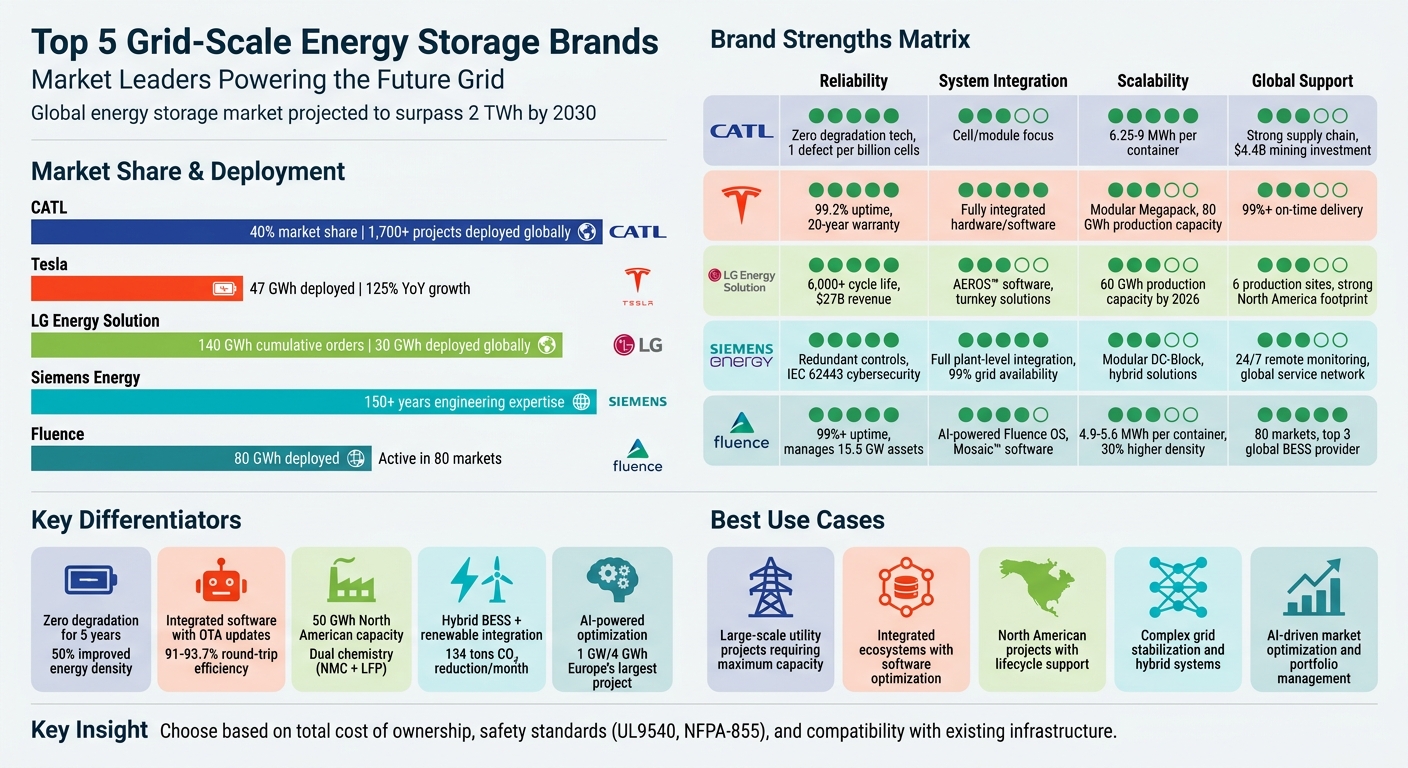
Top 5 Grid-Scale Energy Storage Brands Comparison: Market Share, Capabilities & Performance
The Battery Boom: Why Grid Storage Is the Backbone of Clean Power! | The Fully Charged Show Podcast
sbb-itb-501186b
1. CATL
CATL holds a commanding position in the global energy storage market, accounting for 40% of battery shipments as of 2023. By November 2024, the Chinese manufacturer had deployed systems in more than 1,700 projects worldwide, making it a trusted name for utilities looking for large-scale, reliable energy solutions.
Reliability in Grid-Scale Applications
CATL’s Tener system stands out with its zero degradation technology, maintaining full capacity and power output for the first five years of operation. This is made possible through advanced LFP chemistry and SEI technology, which preserve lithium-ion mobility. The company has also achieved exceptional manufacturing quality, with a defect rate as low as one per billion cells.
The system’s physical design further underscores its durability. Tener systems meet IEEE693 seismic standards, allowing them to withstand magnitude 9 earthquakes and Category 5 hurricanes. Enhanced gas sensors boost sensitivity by 40%, enabling fire suppression to activate 35% faster than earlier models. In early 2025, CATL was awarded AAA-rated bankability status by PV Tech Research, solidifying its reputation as a top-tier supplier.
Scalability for Utility Projects
CATL offers impressive scalability, delivering 6.25 MWh per standard 20-foot container and 9 MWh with the Tener Stack. This 9 MWh capacity marks a 50% improvement in energy density compared to traditional systems. For an 800 MWh deployment, utilities can reduce the number of containers by nearly one-third, cutting construction costs by around 20%.
"9 MWh is not the limit of the energy capacity or space. Every breakthrough in energy density in the future will unleash greater energy value from a smaller footprint."
– Hank Zhao, CTO of ESS Europe, CATL
The "two-in-one" split design of the system ensures each half-height unit weighs under 36 tonnes (40 short tons), meeting transport regulations in 99% of global markets. This design also reduces specialized shipping costs by up to 35%. In April 2026, CATL took a significant step into next-generation battery chemistry by signing a 60 GWh sodium-ion battery order with system integrator HyperStrong. These scalable systems are supported by a robust supply chain strategy, ensuring reliability and growth.
Global Supply Chain and Support
CATL’s technical achievements are backed by a strong supply chain. The company has invested $4.4 billion in upstream mining operations to secure essential materials like lithium. Its manufacturing capacity is evident in its delivery of 56.9 GWh of batteries within the first two months of 2026. Key projects include a large-scale supply agreement with Grenergy in Chile and a 4.4 GWh contract with Fidra Energy in the UK, facilitated through Sungrow.
2. Tesla
Tesla continues to make waves in the energy storage industry by delivering advanced grid-scale solutions. With over 47 GWh of energy storage deployed, the company has cemented its position as a leader in utility-scale battery systems. Its Megapack product line integrates hardware and software into a single platform, designed to simplify operations and enhance control.
Reliability in Grid-Scale Applications
Tesla prioritizes reliability through its integrated design approach. The Megapack 3, for example, features a thermal bay with 78% fewer connections compared to earlier models, which minimizes failure points. Tesla's proprietary software, offering over-the-air updates and 24/7 remote diagnostics, ensures an impressive average uptime of 99.2%. On-site support is also available when needed. Additionally, the systems come with a 20-year warranty and comply with more than 40 global safety standards.
This focus on reliability, paired with streamlined design, not only enhances performance but also simplifies installation.
System Integration Capabilities
Tesla's Megapack units arrive fully assembled, including battery modules, inverters, thermal systems, and wireways. This approach reduces installation costs by 25%. The company has further refined integration with its Megablock solution, which pre-engineers four Megapacks alongside a transformer and switchgear into a single 20 MWh unit. This setup offers a site density of 248 MWh AC per acre and lowers construction costs by up to 40%, while installation time is reduced by 23%.
The systems deliver round-trip efficiency ranging from 91% to 93.7%, depending on the configuration. Tesla is also advancing grid-forming technology, enabling Megapacks to stabilize voltage and frequency independently. This positions them as viable alternatives to fossil-fuel-powered peaker plants.
Scalability for Utility Projects
Tesla's modular design makes scaling up for various projects - from small commercial installations to multi-GWh utility-scale deployments - straightforward. The Megapack 3 increases capacity while maintaining this modular scalability. Adding more units is all it takes to expand, and Tesla boasts an on-time delivery rate exceeding 99% for its deployments.
The company’s robust manufacturing capacity supports its scalability goals. Tesla’s facilities in Lathrop, California, and Shanghai, China, produce a combined 80 GWh annually, equivalent to 20,000 units. Expansion plans include a 50 GWh facility in Houston, with cells sourced from the US, Southeast Asia, and China to strengthen the domestic supply chain.
3. LG Energy Solution
LG Energy Solution operates with a vertically integrated approach, handling everything from cell and module production to delivering turnkey solutions through its subsidiary, LG Energy Solution Vertech. This integrated model ensures seamless delivery of battery supply, system integration, software, and ongoing support - all under one contract. By December 2025, LG Energy Solution had secured cumulative ESS orders totaling 140 GWh, with a goal to expand its global production capacity to over 60 GWh by the end of 2026.
Reliability in Grid-Scale Applications
LG Energy Solution prioritizes reliability with its AEROS™ software suite, which provides advanced monitoring and lifecycle management for energy systems. The company also offers flexible, system-level warranties, supported by projected revenues of $27 billion in 2024 - reinforcing confidence in its long-term financial stability for utility-scale projects. Additionally, US-based teams ensure fast and localized support.
To meet diverse grid application needs, LG utilizes both Nickel Manganese Cobalt (NMC) for high energy density and Lithium Iron Phosphate (LFP) for enhanced thermal stability and safety. Its TR1300 system has undergone rigorous fire testing, verifying that fires do not spread to adjacent containers, and meets IFC and NFPA 855 standards. This focus on safety and reliability underscores its effectiveness in system integration.
System Integration Capabilities
LG Energy Solution's TR1300 racks are designed for efficiency, arriving factory pre-assembled to reduce installation time and costs. A prime example of this is the Moss Landing Energy Storage Facility in California. In June 2021, LG supplied over 4,500 TR1300 battery racks to Vistra's 300 MW / 1.2 GWh facility, where double-stacked racks maximized energy storage within an existing turbine hall.
Partnerships also play a key role in extending LG's reach. In February 2026, LG expanded its agreement with Qcells, adding 5 GWh of deliveries scheduled for 2028–2030, following an earlier 4.8 GWh deal. Additionally, LG signed a contract with Terra-Gen to supply up to 8 GWh of energy storage systems between 2026 and 2029.
Global Supply Chain and Support
LG Energy Solution strengthens its position with a robust global supply chain, operating six production sites to ensure reliable delivery worldwide. The company is heavily investing in North American manufacturing, dedicating 50 GWh of its planned 60 GWh capacity to the region by the end of 2026. This includes a $70 million investment to convert EV battery lines at its Spring Hill, Tennessee facility into ESS-focused LFP production lines.
"LG Energy Solution is virtually the only company with a strong manufacturing footprint in North America, years of regional operating experience, and SI-based turnkey solution capabilities that enhance ESS efficiency and resilience." - LG Spokesperson
The company has 19 GWh of integrated energy storage projects either installed, under construction, or in the contracting phase in the United States, with a total of 30 GWh deployed globally. Starting in 2026, LG will also supply 7.5 GWh of energy storage systems to Excelsior Energy Capital, a US-based renewable energy investment firm.
4. Siemens Energy
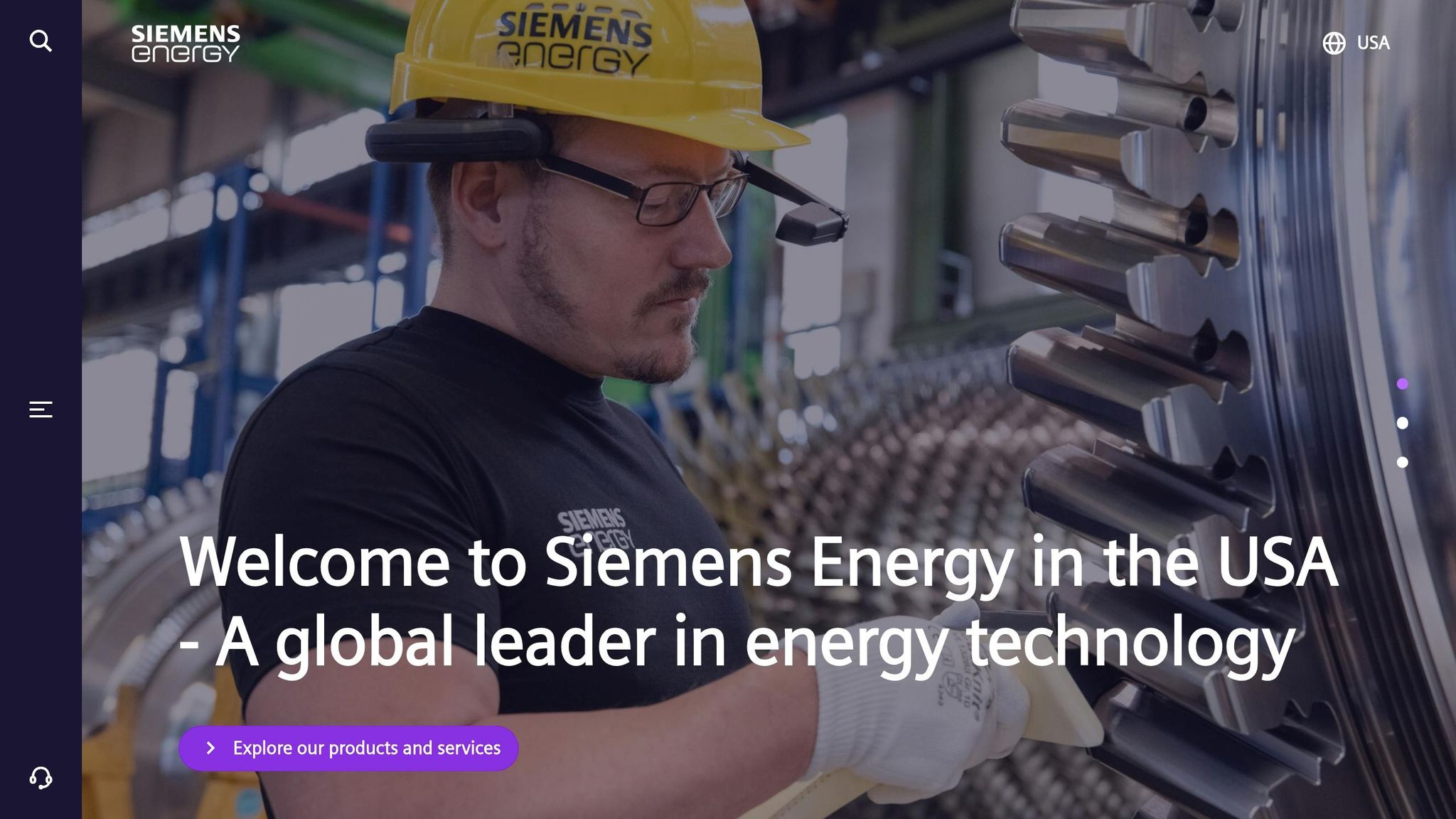
Siemens Energy draws on over 150 years of engineering expertise in electrification to offer solutions for grid-scale energy storage. With its Qstor™ BESS and BlueVault™ product lines, the company focuses on integrating battery storage with renewable energy systems. These "Hybrid BESS" setups combine batteries with wind farms, solar plants, or even thermal assets like gas turbines, creating flexible and sustainable energy solutions.
Reliability in Grid-Scale Applications
Siemens Energy prioritizes reliability in its systems, employing the Omnivise T3000 platform with redundant controls to maintain operations during faults. At their Mülheim Integration Center in Germany, rigorous testing ensures system reliability. This includes cell and module validation, Hardware-in-the-Loop (HIL) testing for controls, and system validation at 6kV levels. To further safeguard grid assets, the company adheres to IEC 62443-4-1 cybersecurity standards, embedding protection at every system level.
A prime example of their work is the Shannonbridge project in Ireland, where Siemens Energy implemented a hybrid grid stabilization plant. This system combines a BESS with a synchronous condenser to deliver fast active power injection and short-circuit support. In Norway, the Aneo Hydro Power Plant features a containerized BlueVault™ system that supports peak power control, energy allocation, and frequency stabilization.
"The system contains a containerized BlueVault battery storage, inverter system and transformer connection to power station. Based on the BlueVault technology we deliver a system that enables the customer Aneo to optimize the production of energy from the power station by peak power control, energy allocation and frequency stabilization." - Ketil Aagesen, Head of BlueVault Technology, Siemens Energy
This focus on reliability extends into Siemens Energy's advanced control strategies, ensuring dependable performance across diverse applications.
System Integration Capabilities
Siemens Energy offers turnkey solutions that integrate high-voltage (HV) and medium-voltage (MV) connections with substations, transformers, and switchgear. Their Omnivise Hybrid Control system autonomously manages decentralized energy sources, including storage and renewables. Using real-time weather forecasts and load data, the system's dispatch optimizer calculates the most economical energy dispatch. Advanced grid-forming controls and virtual inertia enable weak grids to handle high renewable penetration without sacrificing stability.
On a UNESCO World Heritage Site island, Siemens Energy deployed a cutting-edge solution combining solar, biofuel, and an energy storage system with a smart hybrid control system. This setup achieved 99% grid availability while reducing 134 tons of CO₂ emissions monthly. Additionally, the company made history at the HYFLEXPOWER Project in France, where a combined heat and power plant operated with 100% hydrogen using its SGT-400 turbine.
Global Supply Chain and Support
The Qstor™ Core modular DC-Block comes pre-assembled and pre-tested, reducing the complexity of on-site installation for large-scale projects. Siemens Energy ensures transparency and sustainability in its supply chain through a Battery Passport system and a Supplier Quality Management process. This is especially critical as the EU introduces new regulations requiring carbon footprint declarations for batteries over 2 kWh by August 2025, with full Battery Passports mandated by February 2027.
To support its systems, Siemens Energy offers 24/7 remote monitoring through its Remote Expert Centre. This centralized service allows for efficient management of complex systems, while a global network of localized service teams ensures quick response times and on-site support. From engineering and design to commissioning and maintenance, Siemens Energy commits to managing the entire project lifecycle.
"Siemens Energy can be your long-term partner, supporting projects anywhere, anytime – even over decades." - Siemens Energy
5. Fluence
Fluence stands out in the energy storage industry with its software-driven storage platform that combines turnkey hardware and AI-powered controls for grid-scale applications. By the end of 2025, Fluence had deployed 80 GWh of energy storage across 80 global markets. This extensive reach places the company among the top three global BESS (Battery Energy Storage System) providers.
Reliability in Grid-Scale Applications
Fluence's commitment to reliability is evident in its more than 99% system uptime, achieved through its Ultrastack and Gridstack Pro platforms. These systems meet the rigorous demands of grid infrastructure while optimizing market operations with AI-driven tools. At the core of this effort is the Fluence OS, an integrated control system that handles dispatch and monitoring, along with patent-pending technologies for stabilizing the grid. These include synthetic inertia, power oscillation damping, and frequency control during contingencies.
All systems undergo rigorous burn testing and comply with UL9540, UL9540A, and NFPA-855 standards. Additionally, the Nispera platform leverages AI and machine learning to manage and optimize a global portfolio of over 15.5 GW of wind, solar, hydro, and storage assets, ensuring real-time performance management across diverse installations.
System Integration Capabilities
Fluence's platform integrates battery modules, a battery management system (BMS), and the Fluence OS, allowing seamless communication with ISOs, external grids, and third-party systems using standard APIs.
The company's Fluence Mosaic™ software, powered by AI, oversees 13.3 GW of assets in volatile wholesale markets. Meanwhile, the Gridstack Pro line incorporates OS-controlled chillers, cutting auxiliary power consumption by up to 20% compared to earlier models. With 70% fewer connections and chillers, installation times for large utility projects are significantly reduced. This streamlined integration ensures Fluence can adapt to a wide range of utility project requirements.
Scalability for Utility Projects
Fluence's modular design offers flexibility, enabling a "mix and match" approach to enclosure sizes and energy density. For example, the Gridstack Pro 5000 Series provides between 4.9 and 5.6 MWh in a 20-foot enclosure, while the 2000 Series delivers 2.4 MWh in a 40-foot container, designed for easier logistics. The Smartstack platform further enhances efficiency with approximately 30% higher energy density than competing solutions, optimizing land use for large-scale installations.
In December 2025, Fluence collaborated with LEAG to deliver Europe's largest battery storage project - 1 GW/4 GWh, powered by the Smartstack™ platform. This project supports renewable energy integration into the continental grid.
"Fluence is repeatedly trusted by lenders and asset owners to deliver these large, grid-critical projects. This report displays Fluence in the top tier of global storage system providers and sends a clear signal to customers, lenders, and regulators that our technology, execution, and service platform is designed for long-term reliability and risk reduction." - Julian Nebreda, President and Chief Executive Officer, Fluence
Certain configurations also include DC-DC converters, simplifying future capacity upgrades. This adaptability, combined with the ability to adopt emerging cell technologies, ensures Fluence remains agile in its supply chain and scalable for expanding utility portfolios.
Brand Comparison Table
Here's a quick snapshot of how leading grid-scale storage brands perform across key areas like reliability, integration, scalability, and global support. This table highlights each brand's strengths based on the details provided earlier.
| Brand | Reliability | System Integration | Scalability | Global Support |
|---|---|---|---|---|
| CATL | High (Tianheng zero-fade tech) | Moderate (Focus on cell/module platforms) | Very High (Massive manufacturing capacity) | High (Global R&D and regional hubs) |
| Tesla | High (Proven Megapack track record) | Very High (Fully integrated hardware/software) | High (Modular, stackable Megapack units) | High (Global service network) |
| LG Energy Solution | High (6,000+ cycle life) | High (Vertech lifecycle services) | High (Integrated utility-grade BESS) | High (Regional service centers) |
| Siemens Energy | Very High (Engineering-led grid solutions) | Very High (Full plant-level integration) | Moderate to High | High (Extensive global energy footprint) |
| Fluence | High (Backed by Siemens/AES expertise) | Very High (Fluence IQ AI optimization) | High (Gridstack Pro next-gen density) | Very High (Active in 47+ markets) |
Key Insights
- CATL dominates the market with a 40% share as of 2023. Its Tianheng system boasts zero capacity fade within the first two years. However, its integration strategy leans more toward cell and module platforms rather than complete turnkey solutions.
- Tesla and Fluence stand out in software-driven integration. Tesla’s Megapack combines proven performance with fully integrated hardware and software systems. Fluence, on the other hand, uses its Fluence IQ platform to optimize grid assets with AI, operating in over 47 countries and holding an 18% share of the premium BESS market.
- Siemens Energy is a leader in handling complex grid stabilization projects. Its Qstor portfolio includes critical components like transformers, medium-voltage switchgear, and black-start capabilities, making it a go-to choice for modernizing energy infrastructure.
- LG Energy Solution offers premium modules with over 6,000 cycles. Their Vertech division recently secured a 7.5 GWh agreement with Excelsior Energy Capital in early 2024, which includes full lifecycle services.
Conclusion
When choosing grid-scale energy storage solutions, it's essential to draw insights from the strategies of leading brands and focus on key factors that align with your project's unique needs.
CATL is a powerhouse in manufacturing capacity, making it a strong candidate for large-scale projects. Tesla and Fluence shine in software-driven optimization and integrated ecosystems, ideal for utilities seeking advanced energy arbitrage solutions. Siemens Energy excels in plant-level integration and grid stabilization, while LG Energy Solution provides comprehensive energy storage systems with dependable lifecycle support.
"A smart shortlist should compare not only battery specs, but also controls, safety engineering, service model, software stack, and project execution capability." - Ryan, Energy Expert, Avepower
When evaluating options, consider the total cost of ownership, including upfront costs, degradation rates, replacement schedules, and maintenance over a 10–20 year period. Safety is another critical aspect - ensure systems meet stringent fire risk standards. Engaging suppliers early can help fine-tune system architecture and confirm compatibility with existing infrastructure like inverters, transformers, and controls. This proactive approach ensures your project is built on a foundation of reliable technology and solid financial planning.
Each brand discussed has distinct strengths in areas like reliability, integration, and scalability. Whether your project focuses on frequency regulation, peak load shifting, or long-duration storage, selecting a manufacturer that aligns with your specific deployment scenario is crucial.
With the global battery energy storage market projected to reach $40.45 billion by 2026, the decisions you make today will have a lasting impact. Choosing a partner whose capabilities match your project's goals is the key to unlocking the potential of grid-scale energy storage.
FAQs
How do I choose between LFP and NMC for a grid battery project?
Choosing between LFP (Lithium Iron Phosphate) and NMC (Nickel Manganese Cobalt) batteries boils down to factors like cost, safety, energy density, and lifespan.
- LFP batteries are a great choice for grid storage. They come with a lower price tag, better safety features, and a longer cycle life.
- On the other hand, NMC batteries pack a higher energy density, making them suitable for applications needing more compact energy solutions. However, they tend to be more expensive and face challenges in the supply chain.
Your decision should align with the specific needs of your project, budget constraints, and performance goals.
What does “grid-forming” capability mean for a BESS?
The term “grid-forming” in the context of a Battery Energy Storage System (BESS) refers to its ability to function as a voltage source. This capability plays a crucial role in maintaining grid stability by providing essential services like stability, inertia, and system strength. These features become increasingly vital as traditional synchronous generators are gradually retired from the energy grid.
What safety and fire standards should a US utility require for BESS?
US utilities must ensure that Battery Energy Storage Systems (BESS) comply with all relevant safety and fire standards, including UL (Underwriters Laboratories), NEC (National Electrical Code), and NERC (North American Electric Reliability Corporation) regulations.
This involves integrating comprehensive fire suppression systems to enhance safety measures and meet regulatory requirements. These systems are critical for maintaining operational safety and adhering to the stringent standards set by these regulatory bodies.