Top 5 Electrical Brands for UV Resistance
Outdoor electrical products face constant exposure to UV rays, which can degrade materials, cause cracking, and lead to system failures. Choosing UV-resistant products reduces maintenance costs, ensures safety, and prolongs durability. Here are five leading brands offering solutions for UV resistance:
- LAPP: Known for carbon black-infused cable jackets and UV-C resistant products like the ÖLFLEX® series, designed for extreme conditions. Products meet UL and NEMA standards.
- SOLSQUARE: Combines carbon black and Hindered Amine Light Stabilizers (HALS) for long-lasting performance in solar installations and outdoor power systems.
- Southwire: Offers PVC and XLPE cables with "Sun Res" labeling, tested for 720 hours of UV exposure, ideal for outdoor lighting and industrial use.
- Integra: Specializes in polycarbonate and stainless steel enclosures with f1 UV ratings, NEMA 4X compliance, and resistance to corrosion and impact.
- Jiangnan Cable: Features UV-XLPE materials with a 25-year lifespan, designed for solar energy systems and harsh weather conditions.
Quick Comparison
| Brand | Key Products | UV Protection Features | Typical Uses | Compliance Standards |
|---|---|---|---|---|
| LAPP | ÖLFLEX® cables, UV-stable glands | Carbon black jackets, UV-C tested | Solar, industrial, robotics | UL, NEMA 4X, IP68 |
| SOLSQUARE | Photovoltaic cables, connectors | HALS, fluoropolymers | Solar arrays, EV stations | NEC, UL 4703 |
| Southwire | SIMpull® THWN-2, UF-B cables | 720-hour UV testing, PVC/XLPE jackets | Outdoor lighting, pool equipment | UL 44, NEC compliant |
| Integra | Polycarbonate enclosures | f1 UV rating, NEMA 4X, IK10 impact | Marine, coastal, patio setups | UL-50E, NEC compliant |
| Jiangnan | UV-XLPE photovoltaic cables | UV stabilizers, 25-year lifespan | Solar energy, industrial outdoor setups | NEC, TUV, CE, RoHS |
These brands address UV challenges with advanced materials and rigorous testing, ensuring reliability in outdoor applications.
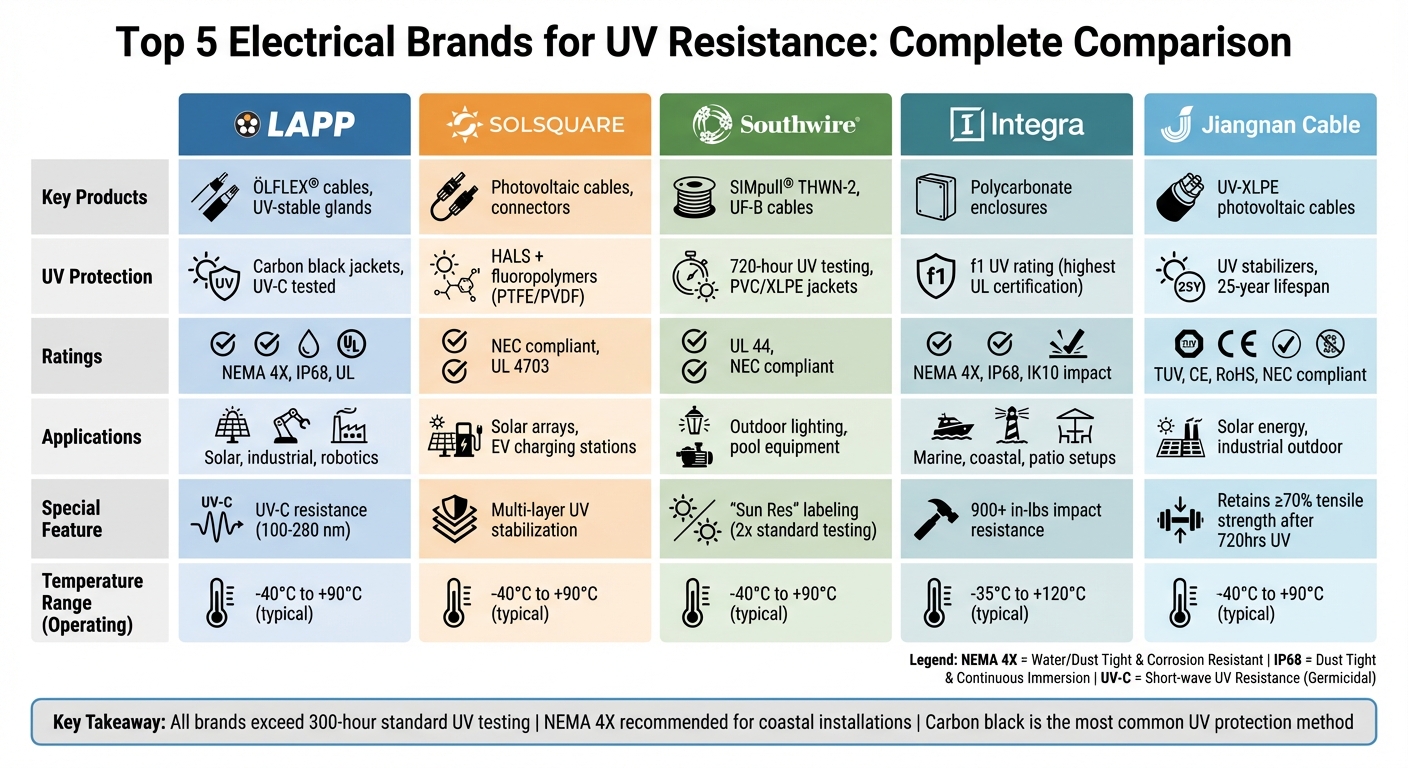
UV-Resistant Electrical Brands Comparison Chart: Features, Standards & Applications
Proper Cable Installation: Avoiding UV Damage and Ensuring Longevity of Outdoor Cable.
1. LAPP
LAPP has developed a solid UV protection strategy centered around industrial soot integration - specifically, carbon black in cable jackets. This material acts as a shield by absorbing UV radiation at the surface and converting it into heat. By doing so, it prevents harmful rays from penetrating and degrading the plastic sheath or core insulation of the cables. The soot particles are carefully engineered through optimized combustion to achieve the ideal particle size, porosity, and surface area for maximum UV protection. This approach forms the backbone of LAPP's efforts to ensure superior UV resistance.
"Anything that damages our health is also not good for cables – they can also get 'sunburn'. Over time, the high energy of UV light will cause the jacket to disintegrate and eventually will damage the insulation of the conductors as well." - LAPP
UV Resistance Rating
LAPP's ROBUST series takes UV resistance to the next level by standing up to aggressive UV-C radiation (100–280 nm). This makes it especially useful in environments like pharmaceutical and food processing facilities, where continuous UV sterilization is common. Since no international standards currently exist for measuring the effects of UV-C on cable materials, LAPP has developed its own testing procedures to ensure reliability in these conditions.
Durability in Outdoor Applications
By incorporating soot-filled jackets that convert UV rays into heat, LAPP ensures its cables can handle the resulting thermal stress. Products like the ÖLFLEX® HEAT series are specifically designed for extreme temperature conditions. For dynamic applications, such as robotics or cable chains, the ÖLFLEX® FD series uses PUR (Polyurethane) jackets. These jackets resist environmental wear and tear while maintaining flexibility, even in harsh outdoor settings. Additionally, the SKINTOP® ST-HF-M Black cable glands, featuring an IP 68 rating (tested at 5 g/cm² for 30 minutes), are ideal for challenging environments like rail transport and building exteriors, where moisture, dust, and intense sunlight converge.
Compliance with US Standards
LAPP's UV-resistant cables, such as the ÖLFLEX FD 855 P and ÖLFLEX SERVO FD 798 CP series, boast UL recognition. The brand’s EPIC® connector enclosures offer environmental protection ratings, including IP 65, 67, 68, and NEMA 4, 4X, and 12. Certain configurations can handle up to 1,000 Volts and 125 Amps. All EPIC® connectors meet UL and CSA standards, ensuring they are suitable for North American applications and providing extra reliability in demanding outdoor environments. Moreover, many of LAPP’s UV-resistant products are halogen-free, which reduces the risk of releasing corrosive vapors during a fire.
2. SOLSQUARE
SOLSQUARE employs a sophisticated multi-layer system that begins with carbon black pigmentation. This pigment provides high opacity, acting as a shield to prevent UV rays from penetrating the material. By doing so, it significantly reduces material degradation over time.
UV Resistance Rating
To combat the harmful effects of UV exposure, SOLSQUARE integrates Hindered Amine Light Stabilizers (HALS). These stabilizers neutralize UV-induced free radicals, while fluoropolymers like PTFE and PVDF offer an added layer of UV resistance. This combination ensures the material performs reliably even in harsh conditions involving extreme heat and moisture. The result? Enhanced durability for outdoor environments.
Durability in Outdoor Applications
The blend of carbon black and fluoropolymers in SOLSQUARE's materials ensures they maintain their structural integrity despite prolonged exposure to intense sunlight, high temperatures, and moisture. This makes them an excellent choice for applications like solar installations, outdoor power distribution, and exposed cable runs - situations where constant UV exposure is unavoidable.
Compliance with US Standards
SOLSQUARE adheres to the National Electrical Code (NEC) standards by utilizing UV-stabilized materials and corrosion-resistant components. This includes screws and mounting straps specifically designed to withstand wet locations, ensuring safety and reliability.
3. Southwire
Southwire offers power cables, underground feeders, medium voltage cables, and flexible conduits with Polyvinyl Chloride (PVC) and Cross-Linked Polyethylene (XLPE) jackets specifically designed for sunlight resistance. These materials undergo rigorous testing to ensure durability and reliable performance.
UV Resistance Rating
When you see "Sun Res" or "SR" on Southwire products, it means they’ve passed 720 hours of UV/moisture testing - more than doubling the standard 300-hour test typically used for residential installations. To achieve this level of UV resistance, Southwire incorporates carbon black into its jacket materials. This additive absorbs harmful UV rays and converts them into heat, helping to prevent brittleness and extending the cable's lifespan.
Durability in Outdoor Applications
Southwire’s UF-B cables are built to handle sunlight, moisture, and fungus, making them ideal for high-exposure outdoor environments. These cables are rated for 600 volts and can be directly buried without a protective conduit, making them perfect for outdoor post lamps, pumps, and even agricultural setups. For medium voltage applications, the company’s MV-105 cables feature SIM technology that reduces friction with a coefficient of 0.2, allowing them to operate at conductor temperatures up to 105°C (221°F). Additionally, some outdoor cables are UL listed for cold bend performance at temperatures as low as -35°C.
Compliance with US Standards
Southwire products are designed to meet stringent US standards, including UL 44, UL 493, UL 1277, and UL 1660. The Ultratite® Type NM conduit, for example, adheres to NEC Article 356 and is resistant to salt air, spray, and corrosive fumes, making it a go-to choice for marinas, swimming pools, and coastal installations. Furthermore, Southwire has over 100 products with independently verified Environmental Product Declarations (EPDs), covering more than 90% of its wire and cable product sales.
Suitability for Harsh Weather Conditions
Southwire’s cables are built to endure extreme weather. The combination of sunlight-resistant PVC jackets and XLPE insulation allows for continuous operation at conductor temperatures up to 90°C (194°F) in both wet and dry environments. Emergency overload capacities can reach 130°C (266°F), while the Ultratite conduit functions reliably in temperatures ranging from -30°C to 80°C (-22°F to 176°F). For cables subjected to heavy mechanical stress, certain products can withstand up to 1,000 lbs./ft. of sidewall pressure. In the most demanding industrial settings, Southwire’s SPEC 45002 cables can handle short-circuit temperatures as high as 250°C (482°F), making them a robust choice for environments where UV exposure and mechanical stress are constant challenges.
sbb-itb-501186b
4. Integra
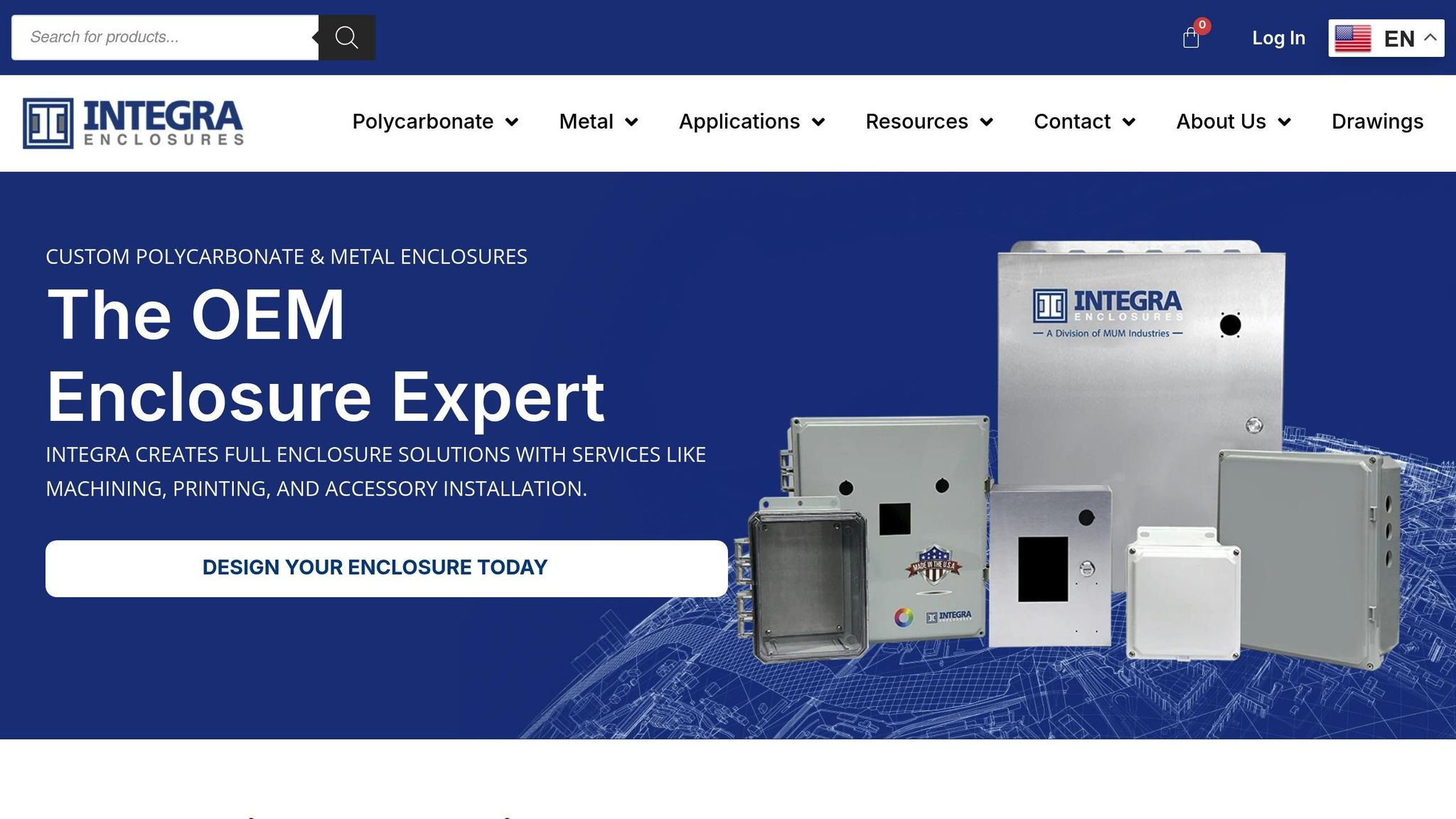
Integra focuses on creating polycarbonate and stainless steel enclosures that naturally resist UV damage. Their polycarbonate enclosures hold an "f1 rating", which is the highest UL certification for outdoor UV exposure. This ensures they maintain their structural strength and appearance even after long periods under the sun.
UV Resistance Rating
Integra's material choices and design deliver exceptional UV resistance. Unlike fiberglass enclosures that degrade and "chalk" when exposed to sunlight, Integra's polycarbonate enclosures stay intact. For applications requiring metal, their stainless steel enclosures offer reliable UV resistance without the rusting or oxidation issues commonly found in carbon steel. Additionally, the polycarbonate enclosures are rated IK10 for impact resistance, withstanding over 900 in-lbs of force - more than four times the typical 220 in-lbs rating of fiberglass options.
Durability in Outdoor Applications
Every Integra enclosure meets or exceeds a NEMA 4X rating, ensuring they are dust-tight and water-tight, capable of withstanding windblown dust, rain, and hose-directed water. This makes them a dependable choice for outdoor use. The Genesis line takes it a step further with NEMA 6P and IP68 ratings, allowing these enclosures to endure submersion in up to 6 feet of water for 24 hours. Their convex covers and reinforced sidewalls prevent warping, ensuring water-tight seals even during temperature shifts. Integra also equips its polycarbonate enclosures with 100% non-metallic hinges, solving the corrosion problems that often affect metal hinge pins in coastal or high-humidity areas.
Compliance with US Standards
Integra enclosures are UL-listed under UL-50/c-UL (File #E207562) and adhere to UL-50E standards for cabinets and cutout boxes. These certifications ensure compliance with NEC requirements for outdoor and harsh environment installations. For extreme conditions, Integra's NEMA 3SX stainless steel enclosures are specifically engineered to function even when covered in thick layers of ice.
Suitability for Harsh Weather Conditions
Designed to handle extreme environments, Integra enclosures can operate within a temperature range of -31°F to 266°F. In freezing conditions, their NEMA 3SX and 4X rated models resist damage from ice buildup and allow external components to function smoothly even when encased in ice. With their superior impact resistance, the polycarbonate enclosures are also well-suited to withstand hail, debris, and accidental impacts, making them highly durable for demanding outdoor applications.
5. Jiangnan Cable
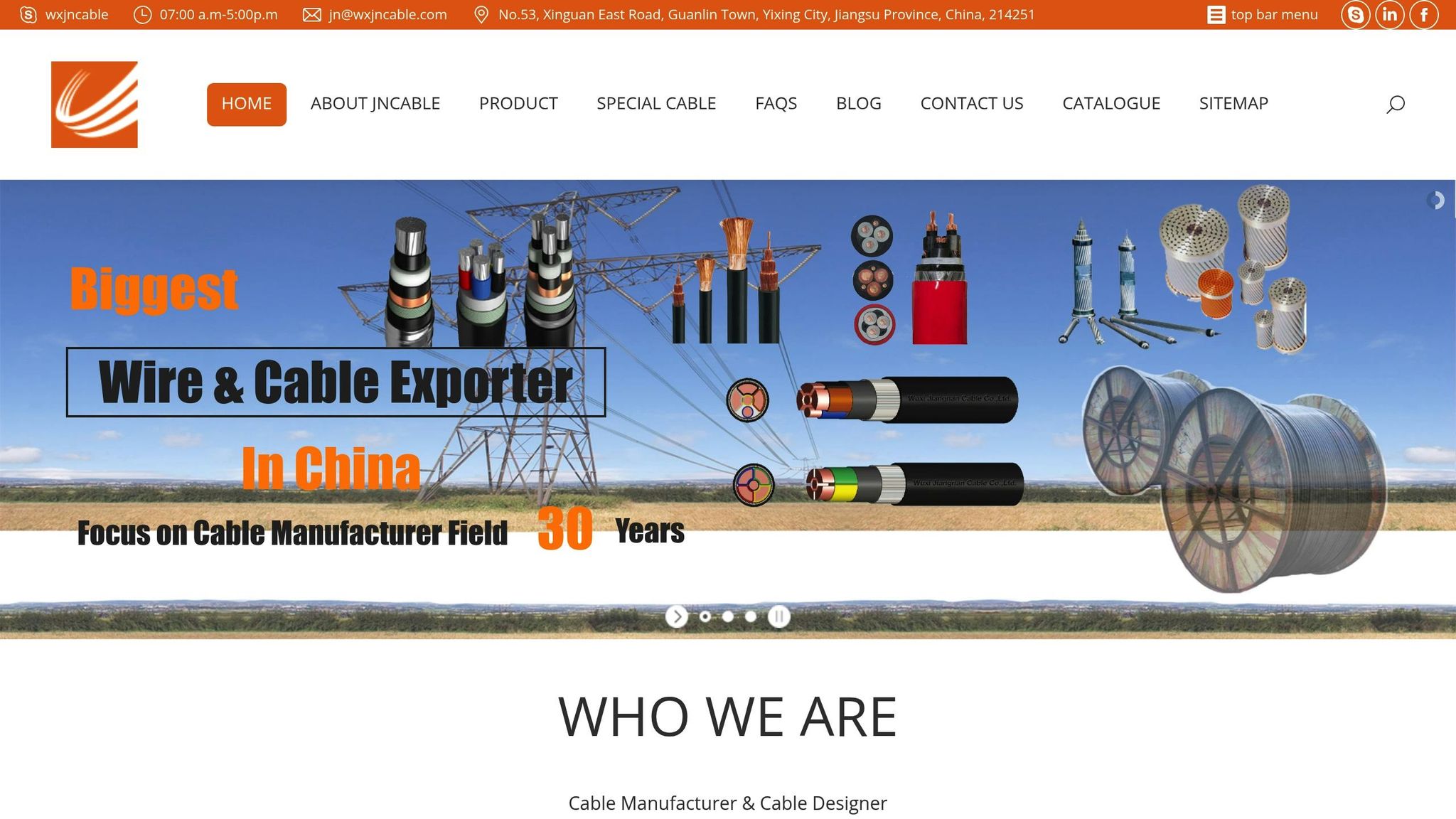
Jiangnan Cable, like other leading brands, leverages advanced material science to deliver cables with strong UV resistance. The company incorporates UV-cross-linked polyethylene (UV-XLPE) and cross-linked polyolefin (XLPO) materials, which are enhanced with UV stabilizers to combat aging, cracking, and embrittlement caused by prolonged UV exposure.
UV Resistance Rating
Jiangnan's XLPO compounds, created through irradiation cross-linking, extend cable service life to an impressive 25 years. Even after 720 hours of UV exposure, these cables retain ≥70% tensile strength and ≥65% elongation. In contrast, standard PVC materials can start showing chalking and surface peeling after just 12–24 months outdoors, while UV-XLPE maintains its mechanical properties for much longer.
Durability in Outdoor Applications
Designed to endure intense sunlight and high temperatures, Jiangnan's photovoltaic cables are ideal for solar energy systems. Their PVC-sheathed cables offer excellent protection against moisture, chemicals, and abrasion. Additionally, they feature flame-retardant and self-extinguishing properties, with water absorption levels of ≤0.1% at 73°F over 24 hours.
Compliance with US Standards
Jiangnan Cable products adhere to National Electrical Code (NEC) guidelines and hold certifications from TUV Rheinland, CE, RoHS, and SABS. They are marked with labels like "Sunlight Resistant", "Sun Res", or "SR", indicating they have passed testing for 720 hours of UV exposure. The company has also contributed to over 80 national and industry standards, showcasing its dedication to compliance and quality.
Suitability for Harsh Weather Conditions
Jiangnan cables are built to handle continuous operating temperatures of up to 194°F and short-circuit temperatures of 482°F. The XLPO materials resist hydrolysis, preventing potential leakage or short circuits even after prolonged exposure to rain, fog, or water vapor. These cables are also resistant to weak acids and alkalis, making them a reliable choice for industrial areas affected by acid rain. Beyond UV-resistant options, Jiangnan offers specialized cables for extreme conditions, including cold-resistant, fire-resistant, and flexible mineral-insulated varieties. This level of durability makes them well-suited for demanding outdoor applications throughout the U.S.
Brand Comparison Table
Here's a detailed comparison of five brands, focusing on their UV-resistant product offerings and key specifications for outdoor use:
| Brand | Main UV-Resistant Products | NEMA/IP Ratings | Typical Outdoor Uses | US Code Compliance |
|---|---|---|---|---|
| LAPP | ÖLFLEX® SOLAR cables, UV-stabilized cable glands, outdoor conduit systems | NEMA 4X, IP66/IP68 | Solar installations, rooftop power distribution, industrial outdoor control panels | NEC compliant, UL listed |
| SOLSQUARE | Photovoltaic cables, solar connectors, UV-resistant junction boxes | NEMA 3R, NEMA 4, IP65 | Residential and commercial solar arrays, outdoor EV charging stations | NEC Article 690 compliant, UL 4703 certified |
| Southwire | SIMpull® THWN-2 wire, outdoor extension cords, weather-resistant outlets | NEMA 3R, NEMA 4 | Exterior lighting circuits, pool equipment, outdoor receptacles | NEC compliant, Weather-Resistant (WR) rated |
| Integra | Weatherproof enclosures, outdoor switches, GFCI outlets with UV-stabilized covers | NEMA 3R, NEMA 4X, IP66 | Marine installations, coastal power distribution, patio electrical boxes | NEC compliant, corrosion-resistant hardware |
| Jiangnan Cable | UV-XLPE photovoltaic cables, XLPO solar wire, PVC-sheathed outdoor cables | Meets NEMA 3R standards | Solar energy systems, industrial outdoor applications, acid rain environments | NEC compliant, TUV Rheinland, CE, RoHS certified |
Schneider Electric highlights that "NEMA 4X enclosures are the 'standard' for protecting today's plant instrumentation". For coastal areas where corrosion resistance is critical, NEMA 4X or NEMA 3RX ratings are ideal. Meanwhile, residential applications, such as poolside or patio setups, benefit from Weather-Resistant (WR) devices. Leviton explains that "Weather-Resistant wiring devices differ in construction from indoor devices because they must be able to withstand the rigors of exposure to the elements. They are made with UV stabilized materials and have corrosion resistant screws".
For general outdoor power needs, NEMA 3R enclosures offer sufficient protection from rain and ice. However, for applications requiring protection against hose-directed water, NEMA 4 enclosures are a better choice. These enclosures must pass a demanding "Hose Test", where 65 gallons of water per minute are sprayed from 10 feet away for 5 minutes without any leakage. These distinctions underline the importance of selecting the right UV-resistant equipment for specific outdoor environments.
Conclusion
UV resistance plays a crucial role in ensuring the safety and durability of outdoor electrical installations. Without proper UV protection, polymers can break down over time, leading to brittleness, cracking, and eventual failure. As MOCO Connectors explains, "By using UV-resistant cables, electrical contractors can ensure the longevity and reliability of their outdoor installations, reducing the need for costly maintenance and repairs down the line".
Different brands cater to specific needs across solar, residential, industrial, and marine applications. These differences emphasize the importance of choosing products that meet the unique environmental challenges of your project.
When evaluating UV-resistant products, certifications such as UL 746C for electrical plastics are essential. Additionally, matching NEMA ratings to the installation environment is key - NEMA 4X is suitable for coastal areas, while NEMA 3R works well for general outdoor use. Material selection is equally important: options like polycarbonate and fiberglass-reinforced polyester maintain their structural integrity in temperatures ranging from -40°F to 250°F, making them ideal for extreme conditions. In hotter climates, light-colored enclosures can help reflect sunlight, reducing heat buildup and prolonging equipment life.
FAQs
Why are UV-resistant electrical products crucial for outdoor use?
UV-resistant electrical products play a key role in outdoor applications. Sunlight's ultraviolet (UV) rays can gradually break down materials like cables and enclosures, leading to serious issues. UV exposure weakens plastics, causing them to discolor, crack, and become brittle. This deterioration can compromise safety by allowing moisture or contaminants to reach live electrical parts, increasing the likelihood of short circuits, corrosion, or even fire hazards.
To combat this, manufacturers use UV-stabilized materials, such as carbon-black pigments or UV-absorbing additives. These materials help outdoor electrical systems maintain their durability and functionality over time. For example, cables retain their insulation, enclosures stay intact, and color coding remains visible - critical for safe maintenance and troubleshooting. By reducing wear and avoiding frequent replacements, UV-resistant products significantly extend the lifespan and reliability of outdoor installations. They’re an indispensable choice for projects exposed to the elements.
How do the top electrical brands ensure UV resistance in their products?
Top electrical brands employ a variety of methods to ensure their products can withstand UV exposure, making them ideal for outdoor and demanding environments. Leviton uses UV-stabilized plastics along with corrosion-resistant components in its outdoor switches and outlets, adhering to rigorous weather-resistance standards. Allied Moulded opts for fiberglass in its enclosures, a material that naturally resists UV damage and maintains structural integrity over time. Similarly, MOCO Connectors incorporates UV-resistant additives into cable sheaths, helping to prevent brittleness and fading when exposed to sunlight.
Meanwhile, Schneider Electric and Hubbell emphasize durable enclosure designs crafted from tough materials that can endure prolonged UV exposure. Prysmian takes a different approach by creating UV-stable PVC sheaths specifically for outdoor cables. Each of these brands employs a unique strategy to ensure their products perform reliably in harsh, UV-intensive conditions, offering durability and peace of mind for outdoor applications.
What certifications should I check for in UV-resistant electrical products?
When selecting UV-resistant electrical products, it's crucial to ensure they meet important safety and durability standards for outdoor use. Start by checking for a UL listing and NEC compliance, as these indicate the product has been tested to meet essential safety benchmarks. Additionally, look for certification under the ANSI/NEMA 250-2020 enclosure rating, which verifies the product's ability to withstand environmental challenges. Lastly, ensure the product adheres to IEC 60287 testing, which assesses its performance during extended UV exposure. These certifications provide confidence that the products are built to endure tough outdoor conditions while delivering dependable results.