




Understanding NEMA Ratings for Hazardous Locations
In hazardous areas like refineries or grain mills, choosing the correct NEMA-rated enclosure is critical for safety and compliance. NEMA ratings classify enclosures based on their ability to protect against specific risks, such as flammable gases, dust, or extreme conditions. For hazardous locations, Types 7–10 are designed to prevent internal sparks or heat from igniting the surrounding atmosphere. Here’s what you need to know:
- NEMA 7: Explosion-proof for gases/vapors (Class I, indoor use).
- NEMA 8: Oil-immersed for gas/vapor protection (Class I, indoor/outdoor).
- NEMA 9: Dust-ignition-proof for combustible dust (Class II, indoor use).
- NEMA 10: Meets mining safety standards (underground coal mines).
Using the wrong enclosure can lead to equipment failure, safety hazards, and costly downtime. Always match the NEMA rating with the specific hazards and consult NEC standards for proper classification. For example, NEMA 7 enclosures are suited for flammable gases (Groups A, B, C, D), while NEMA 9 handles dust hazards like coal or grain.
Quick Comparison:
| NEMA Type | Primary Hazard | Location | Protection Method | Typical Industry |
|---|---|---|---|---|
| 7 | Flammable Gases/Vapors | Indoor | Explosion Containment | Refineries, chemical plants |
| 8 | Flammable Gases/Vapors | Indoor/Outdoor | Oil Immersion | Hazardous locations |
| 9 | Combustible Dust | Indoor | Dust-Ignition Prevention | Grain elevators, flour mills |
| 10 | Methane/Coal Dust (Mining) | Indoor/Outdoor | MSHA Compliance | Underground coal mines |
Selecting the right NEMA enclosure ensures safety, compliance with NEC/MSHA standards, and avoids costly mistakes. Always consider the specific risks of your environment before making a decision.
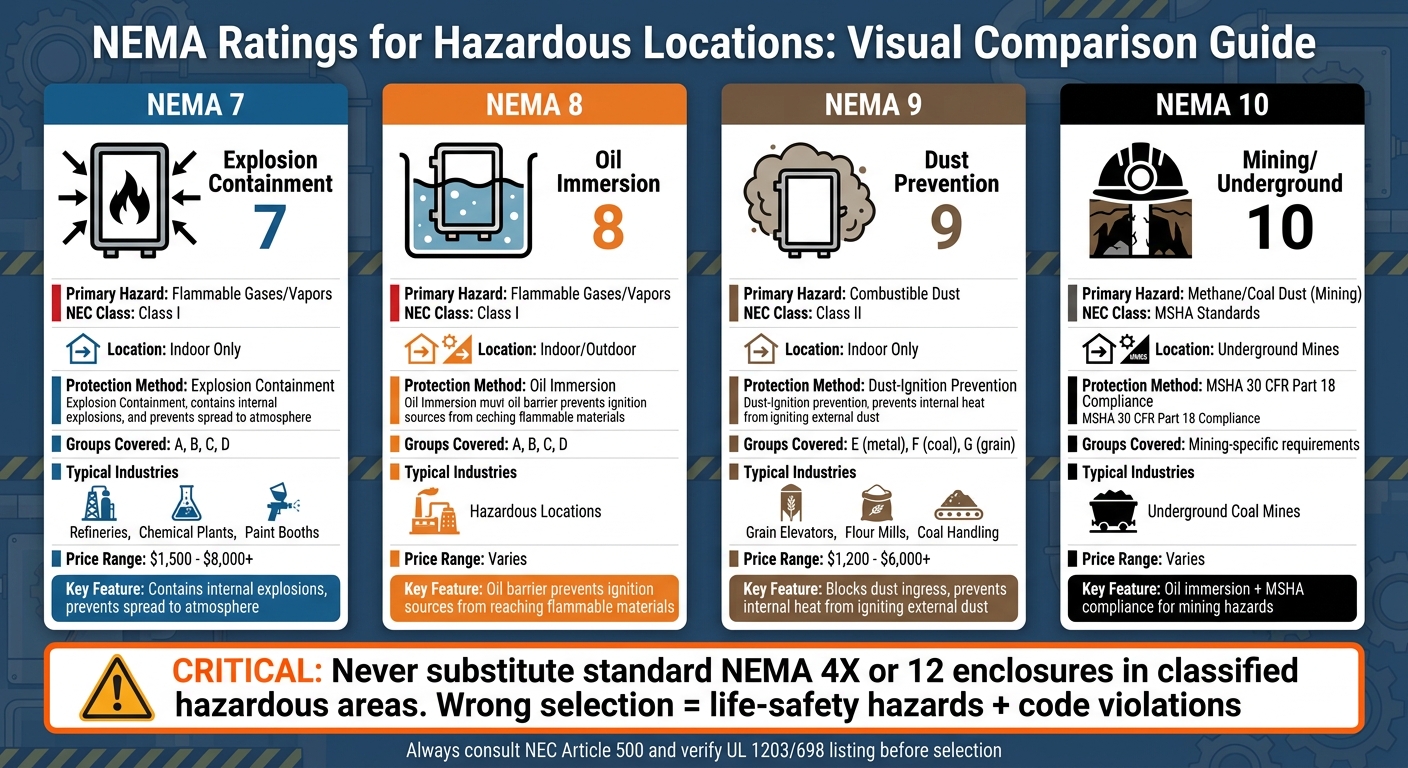
NEMA Ratings 7-10 for Hazardous Locations: Quick Reference Guide
NEMA Ratings - The Complete Step-by-Step Guide for Beginners
sbb-itb-501186b
What Are NEMA Ratings for Hazardous Locations
NEMA ratings classify how well electrical enclosures can withstand specific environmental threats. Defined in ANSI/NEMA 250-2020, these ratings outline protection levels against hazards like dust, water, and corrosion. Choosing the right rating is essential - mistakes can lead to unsafe conditions or even disasters.
For non-hazardous environments, enclosures are designed to block rain, dust, and debris, making them suitable for areas like factories, outdoor utilities, or washdown zones. However, hazardous locations require specialized enclosures with much stricter safety measures.
Hazardous location ratings (Types 7 through 10) are specifically engineered for areas where flammable gases, vapors, or combustible dusts pose ignition risks. Unlike standard enclosures, these are built to contain internal explosions and prevent the ignition of surrounding atmospheres, as outlined in NEC Article 500. These enclosures are crucial in environments like refineries, chemical plants, grain elevators, and underground mines.
Joe from Viox highlights the risks of using the wrong enclosure:
Never substitute a standard NEMA 4X or 12 in a classified area - ignition risk creates life-safety hazards and massive code violations.
The price difference underscores the importance of proper selection. While NEMA 4X enclosures typically cost $600 to $1,850, NEMA 7 enclosures can range from $1,500 to over $8,000, reflecting their advanced safety features.
Non-Hazardous vs. Hazardous Location Ratings
Non-hazardous enclosures rely on seals and gaskets to block environmental elements. On the other hand, hazardous enclosures feature heavy-wall castings and flame-arresting joints to handle internal explosions. Along with meeting ANSI/NEMA standards, hazardous enclosures must comply with UL 1203 standards and NEC requirements, backed by more than 600 electrical safety standards.
| NEMA Type | Environment Category | Primary Protection | Typical Applications | Price Range |
|---|---|---|---|---|
| 1-6, 12-13 | Non-Hazardous | Dust, water, corrosion, oil ingress | General manufacturing, coastal areas, washdown zones | $50 - $1,850 |
| 7 | Hazardous (Class I) | Contains internal explosions of gas/vapor | Refineries, chemical plants, paint booths | $1,500 - $8,000+ |
| 8 | Hazardous (Class I) | Oil-immersed to prevent gas ignition | Hazardous locations | Varies |
| 9 | Hazardous (Class II) | Prevents combustible dust ignition | Grain elevators, flour mills, coal handling | $1,200 - $6,000+ |
| 10 | Hazardous (Mining) | Meets MSHA requirements for methane hazards | Underground coal mines | Varies |
It’s a common mistake to assume that higher NEMA numbers mean better protection. Instead, each rating is tailored to specific risks. For example, NEMA 12 is designed for indoor use, protecting against dust and drips, while NEMA 4 can handle outdoor hose-down conditions. Using the wrong type can lead to equipment failure and safety code violations.
NEMA Ratings for Hazardous Locations Explained
This section dives into NEMA 7-10 ratings, each designed to address specific hazardous conditions. These ratings provide tailored solutions for different types of risks, building on earlier discussions.
NEMA 7: Explosion-Proof for Class I Locations
NEMA 7 enclosures are built for indoor Class I, Division 1 hazardous areas where flammable gases or vapors (Groups A, B, C, and D) may exist. They are specifically engineered to contain internal explosions, ensuring that any ignition inside the enclosure doesn’t spread to the surrounding environment. These enclosures also have temperature limits, typically based on a 104°F (40°C) ambient temperature, to maintain their protective capabilities.
NEMA 8: Oil-Immersed Enclosures
NEMA 8 enclosures use oil immersion to shield internal components from flammable atmospheres, making them suitable for both indoor and outdoor environments. This design is effective for handling Groups A through D gases and vapors, as the oil acts as a barrier, preventing ignition sources from interacting with flammable materials.
NEMA 9: Dust-Ignition-Proof for Class II Locations
For areas where combustible dust is the main hazard, NEMA 9 enclosures are the go-to choice for indoor applications. They are designed to block dust ingress while ensuring that internal heat doesn’t ignite dust on the exterior. These enclosures protect against dust types classified under Groups E (metal dusts), F (coal and other carbonaceous dusts), and G (agricultural dusts like grain). Industries such as flour milling, grain processing, and coal handling often rely on these enclosures.
NEMA 10: Oil-Immersed for Mining Environments
NEMA 10 enclosures are tailored for mining operations, particularly in underground coal mines. They comply with Mine Safety and Health Administration (MSHA) standards under 30 CFR Part 18. By combining oil immersion with these strict requirements, NEMA 10 enclosures address the unique hazards found in mining environments.
| NEMA Rating | Primary Hazard | Location | Protection Method | Groups Covered |
|---|---|---|---|---|
| Type 7 | Flammable Gases/Vapors | Indoor | Explosion Containment | A, B, C, D |
| Type 8 | Flammable Gases/Vapors | Indoor/Outdoor | Oil Immersion | A, B, C, D |
| Type 9 | Combustible Dusts | Indoor | Dust-Ignition Prevention | E, F, G |
| Type 10 | Mining Hazards | Indoor/Outdoor | MSHA 30 CFR Part 18 Compliance | MSHA Requirements |
Selecting the right NEMA rating is critical for protecting equipment and ensuring compliance with NEC standards.
How NEMA Ratings Align with NEC Hazardous Location Standards
The National Electrical Code (NEC) plays a key role in defining hazardous environments, while NEMA ratings specify how enclosures protect against those hazards. Together, they provide a framework for ensuring safety and compliance in hazardous locations. As TE Connectivity explains, "The National Electrical Code (NEC) is a standard primarily used in the United States for electrical installations in hazardous locations". These NEC classifications directly influence the design and application of NEMA-rated enclosures.
The NEC organizes hazardous locations into Classes, Divisions, and Groups:
- Classes: Define the type of hazard (e.g., gases/vapors or dust).
- Divisions: Specify whether hazards are present under normal conditions (Division 1) or only under abnormal conditions (Division 2).
- Groups: Categorize specific materials within a Class, like gases or dust types.
For example, Class I environments, which involve flammable gases or vapors, align with NEMA 7 and NEMA 8 enclosures. Meanwhile, Class II environments, dealing with combustible dust, correspond to NEMA 9 enclosures.
It’s important to check the NEC Group listed on an enclosure label - not just the NEMA rating. A NEMA 7 enclosure rated for Group D (common industrial gases like propane or gasoline) might not be suitable for Group A (acetylene), which involves a much higher level of risk. Group A gases are the most volatile and demand the strictest protection standards.
| NEMA Rating | NEC Class | NEC Division | Applicable NEC Groups | Protection Method |
|---|---|---|---|---|
| NEMA 7 | Class I (Gases/Vapors) | 1 & 2 | A, B, C, D | Explosion-proof (contains internal explosion) |
| NEMA 8 | Class I (Gases/Vapors) | 1 & 2 | A, B, C, D | Oil-immersed (prevents ignition) |
| NEMA 9 | Class II (Combustible Dust) | 1 & 2 | E, F, G | Dust-ignition-proof (excludes dust) |
| NEMA 10 | MSHA (Mining) | N/A | Methane/Coal Dust | Meets MSHA standards for mines |
This table highlights how NEMA ratings align with NEC classifications, providing a clear guide for matching enclosures to specific hazardous conditions.
Temperature ratings are just as critical. They range from T1 (842°F / 450°C) to T6 (185°F / 85°C), ensuring that the enclosure’s surface temperature won’t ignite the surrounding atmosphere. This alignment between NEMA and NEC standards is essential for preventing accidents in industries like oil and gas, chemical processing, and mining, where safety is paramount.
How to Choose NEMA Ratings for Industrial Applications
When selecting a NEMA-rated enclosure for your industrial application, it's crucial to align the enclosure's specifications with the specific hazards and conditions of your site. As Ryan Svilar from PanelShop.com explains:
accurately identify the application and environment for your NEMA rated control panel will certainly lead to better end results, and proper protection for electrical components
To start, consult NEC Article 500 to classify the type of hazard present. Here's a quick breakdown:
- Class I Hazards: These involve flammable gases or vapors. Use NEMA 7 or NEMA 8 enclosures for protection.
- Class II Hazards: Found in environments with combustible dust, such as grain mills, coal handling facilities, or metal powder operations. These require NEMA 9 enclosures.
- Class III Hazards: For methane risks in underground coal mines, NEMA 10 enclosures are mandatory, meeting MSHA standards.
Standard enclosures won't cut it in hazardous locations. As Integra Enclosures points out:
Standard NEMA enclosure ratings aren't designed for hazardous locations involving flammable gases, vapors, or combustible dust. For those applications, you need specially rated enclosures
For example, while a NEMA 4 or NEMA 12 enclosure might handle water or dust in non-hazardous environments, they lack the explosion-proof or dust-ignition-proof features necessary for Class I or Class II hazards.
Corrosion Resistance and Environmental Factors
When dealing with hazardous locations, corrosion resistance often becomes a critical consideration - especially in settings like chemical plants, offshore platforms, or coastal facilities. If your environment includes salt spray or chemical exposure, look for enclosures with the "X" suffix (e.g., NEMA 4X) or materials like 316 stainless steel. These enclosures must pass rigorous tests, including a 600-hour salt spray test and a 1,200-hour corrosive gas exposure test, to earn their rating. While 316 stainless steel comes at a higher cost compared to mild steel, it can prevent premature failure in highly corrosive conditions.
Factors to Consider When Choosing NEMA 7–10 Ratings
Once you've classified the hazard, practical considerations come into play. Hazard zones are divided into Division 1 and Division 2:
- Division 1: Hazards are present during normal operations. This requires enclosures like NEMA 7 for gases or NEMA 9 for dust.
- Division 2: Hazards exist only during abnormal conditions. In this case, NEMA 8 enclosures might suffice for Class I environments.
Make sure the enclosures are UL 1203/698 listed and meet the necessary sealing and conduit standards for hazardous locations. For example, enclosures often need sealing fittings within 18 inches of the entry point and threaded conduit connections. You’ll also need to decide between enclosures without knockouts (like NEMA 12) for a permanent seal or those with pre-cut knockouts (NEMA 12K) for easier cable entry. Keep in mind that sealed enclosures often require closed-loop cooling systems, which can add anywhere from $800 to $3,500 to your total costs.
If your hazardous zone also involves washdown requirements, opt for Type 4 or 4X enclosures with the appropriate hazardous rating (7, 8, or 9). Placement is another key factor - outdoor installations in freezing climates may require NEMA 3S or 3SX ratings to ensure external handles remain functional even in icy conditions.
Conclusion
Grasping NEMA ratings for hazardous locations is critical for protecting both lives and property in high-risk environments. Whether it’s chemical plants (NEMA 7), grain elevators (NEMA 9), or coal mines (NEMA 10), these ratings ensure that internal arcs or heat won’t ignite external dangers.
Prioritizing safety also helps meet tough regulatory requirements. These ratings ensure compliance with NEC and OSHA standards, shielding you from legal and operational setbacks. As EE Power School explains:
Implementing and strictly following the NEMA enclosure ratings not only provide free-standing safety but also protects you from getting into trouble with the law.
Ignoring these standards isn’t just risky - it can result in fines, operational disruptions, or, even worse, accidents that could have been avoided.
FAQs
How do I know if my area is Class I or Class II?
To figure out whether your area falls under a Class I or Class II hazardous location, look for specific risks. Class I locations involve the presence of flammable gases, vapors, or liquids, while Class II locations deal with combustible dust. These categories are outlined by the National Electrical Code (NEC) and NEMA standards, which set guidelines for hazardous environments.
What’s the difference between NEMA 7 and NEMA 8?
The main distinction between NEMA 7 and NEMA 8 enclosures lies in their intended use and the level of protection they provide against explosive hazards.
- NEMA 7 enclosures are designed for indoor use in hazardous areas. They are built to contain and control explosions caused by gases or vapors, ensuring safety within the surrounding environment.
- NEMA 8 enclosures, while offering similar explosion-proof capabilities, are engineered for even more demanding hazardous environments. They provide an added layer of protection against explosive atmospheres, making them suitable for more extreme conditions.
Do I need to check the NEC group and T-code?
Making sure to check the NEC group and T-code is crucial when dealing with hazardous location classifications. These classifications help ensure compliance with electrical safety standards, which are designed to protect both people and equipment.
By understanding these codes, you can determine the right type of equipment required for specific environments, whether it's a factory handling flammable materials or a storage area for combustible dust. Selecting the correct equipment minimizes risks and ensures safer operations in potentially dangerous settings.





