




How to Choose Wiring for Gas and Dust Zones
When dealing with areas prone to gas, vapor, or dust hazards, choosing the right wiring is non-negotiable for safety. A single spark can trigger catastrophic explosions or fires. Here's what you need to know:
- Classifications Matter: Hazardous zones are categorized into Class I (gases/vapors), Class II (dust), and Class III (fibers/flyings). Each has unique wiring needs.
- Division Levels: Division 1 zones face constant hazards, requiring explosionproof or dust-ignitionproof wiring. Division 2 zones are less risky and allow for more relaxed methods.
- Wiring Methods: Threaded RMC or IMC conduits, explosionproof enclosures, and specific cable types (e.g., MC-HL, ITC-HL) are essential for high-risk areas.
- Temperature Ratings: Equipment must stay below the ignition temperature of the gas or dust present.
- Grounding and Bonding: Ensures fault currents are safely redirected to prevent sparks or overheating.
Wiring Methods for Pump Motors in Hazardous Locations
Hazardous Location Classifications Explained
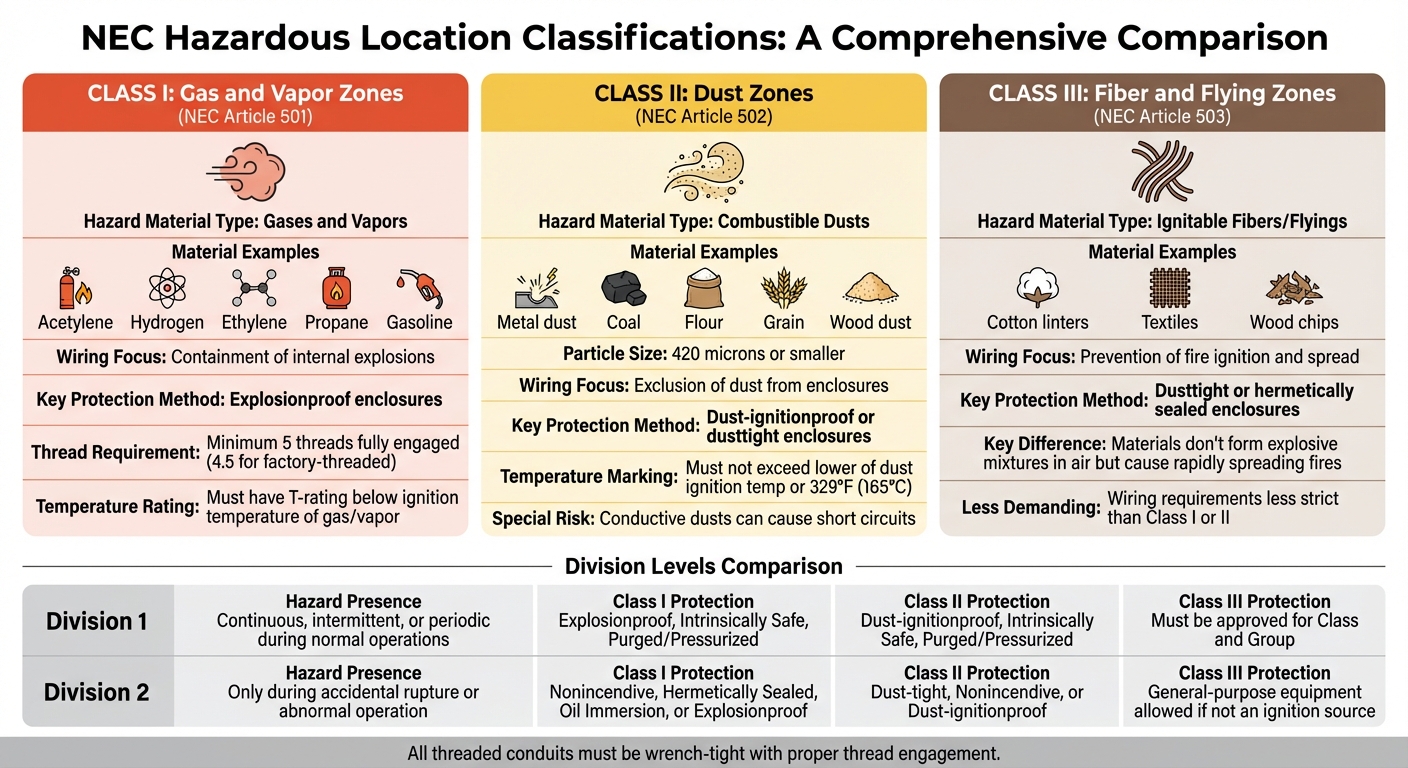
NEC Hazardous Location Classifications: Class I, II, and III Wiring Requirements
Building on the safe wiring practices discussed earlier, it's crucial to understand how hazardous locations are classified. The National Electrical Code (NEC) divides these areas into three categories, each requiring specific wiring methods. For instance, while an explosionproof enclosure is effective for gas hazards, it won't protect against dust-related dangers.
Class I locations are areas where flammable gases, vapors from flammable liquids, or vapors from combustible liquids are present in quantities that can create explosive or ignitable mixtures. Class II locations involve the presence of combustible dust that poses a fire or explosion hazard. Class III locations are zones with easily ignitable fibers or flyings - like wood chips or textiles - that are more likely to cause a fire that spreads quickly rather than an explosion.
Understanding these classifications is key to selecting the right wiring methods. As NEC expert Mike Holt explains:
"Locating wiring and equipment outside of the classified location provides the safest electrical installation - usually at the least cost".
Here’s a closer look at each classification and its specific wiring requirements.
Class 1: Gas and Vapor Zones
Class I environments are defined by the presence of flammable gases or vapors mixed with air, which can ignite with a spark or hot surface. Typical examples include areas with acetylene (Group A), hydrogen (Group B), ethylene (Group C), or propane and gasoline (Group D).
The primary focus for Class I wiring is containing internal explosions. Explosionproof enclosures are designed to trap an explosion inside the device and cool the escaping gases to prevent ignition of the surrounding atmosphere. As Mike Holt explains:
"Explosionproof means the device contains the explosion so external temperature won't ignite the surrounding flammable atmosphere. It does not mean the device protects against explosion".
To ensure this protection, threaded NPT conduit entries must have at least five threads fully engaged (or 4.5 threads for factory-threaded, listed equipment), allowing enough time for expanding gases to cool before escaping. Additionally, equipment must have a T-rating, which indicates that its maximum surface temperature is below the ignition temperature of the specific gas or vapor present.
Now, let’s move to environments involving dust hazards.
Class 2: Dust Zones
Class II locations deal with combustible dust - finely divided solid particles that are 420 microns or smaller. These areas present two main risks: explosive dust clouds and conductive dusts (like aluminum or magnesium in Group E) that can cause short circuits by bridging electrical components. Settled dust can also act as an insulator on equipment, leading to dangerous heat buildup.
In these areas, wiring must prevent dust entry and minimize heat buildup. Instead of explosionproof designs, dust-ignitionproof or dusttight methods are used to keep particles away from potential ignition points. Equipment in Class II zones must also have temperature markings that don’t exceed either the ignition temperature of the dust or 165°F (329°F), whichever is lower. Common materials in these zones include metal dusts (Group E), carbonaceous dusts like coal (Group F), and agricultural dusts such as flour, grain, and wood (Group G).
Finally, let’s address hazards related to fibers and flyings.
Class 3: Fiber and Flying Zones
Class III locations involve ignitable fibers or flyings, such as cotton linters, textiles, or wood chips. These materials are larger than dust particles and typically don’t form explosive mixtures in the air. However, they are highly flammable and can cause fires that spread rapidly.
In these areas, the focus is on preventing fire ignition and spread rather than containing explosions. Dust-tight or hermetically sealed enclosures are sufficient, as the larger particles tend to settle rather than remain suspended in the air. While Class III locations present significant fire risks, their wiring requirements are less demanding compared to Class I or Class II zones.
| NEC Classification | Hazard Material Type | Material Examples | Wiring Focus |
|---|---|---|---|
| Class I | Gases and Vapors | Acetylene, Hydrogen, Ethylene, Propane, Gasoline | Containment of internal explosions |
| Class II | Combustible Dusts | Metal dust, Coal, Flour, Grain, Wood dust | Exclusion of dust from enclosures |
| Class III | Ignitable Fibers/Flyings | Cotton linters, Textiles, Wood chips | Prevention of fire ignition/spread |
Division Levels and Wiring Requirements
Division levels help determine how often hazardous substances are present and guide the selection of appropriate wiring methods. These classifications, as outlined in the NEC, are designed to ensure safety under both normal and unexpected conditions by addressing the frequency and likelihood of exposure to dangerous materials.
Division 1 refers to areas where hazardous substances are present during normal operations. This includes places where flammable gases, vapors, or combustible dust are consistently or periodically encountered. It also applies to locations where maintenance activities or equipment leaks routinely introduce hazardous materials. For instance, a paint spray booth with solvent vapors or a grain elevator with constant dust generation would fall under Division 1.
Division 2 covers areas where hazardous conditions only occur under unusual circumstances. In these environments, hazardous materials are typically contained within closed systems or sealed containers, only escaping in cases of accidental damage, equipment failure, or other abnormal events. A storage room with flammable liquids in sealed drums is a good example - vapors only pose a risk if a container breaks or leaks.
The wiring requirements differ significantly between Division 1 and Division 2, reflecting the varying levels of risk. Division 1 mandates the use of explosionproof equipment, intrinsically safe wiring, or purged and pressurized systems. In contrast, Division 2 allows for more relaxed options, such as nonincendive circuits or hermetically sealed equipment, provided they don't produce sparks under normal conditions. OSHA Standard 1910.307 emphasizes this distinction:
"General-purpose equipment or equipment in general-purpose enclosures may be installed in Division 2 locations if the employer can demonstrate that the equipment does not constitute a source of ignition under normal operating conditions".
Additionally, all threaded conduits must be wrench-tight, engaging at least five threads (or 4.5 threads for factory-threaded, listed equipment). Mike Holt of Mike Holt Enterprises underscores the importance of this requirement:
"This requirement [wrench-tight conduit] ensures that if an explosion occurs within a raceway or enclosure, the expanding gas will sufficiently cool as it dissipates through the threads. This prevents hot flaming gases from igniting the surrounding atmosphere".
Below, you'll find a breakdown of wiring requirements for Division 1 and Division 2 environments.
Division 1: Frequent or Continuous Hazards
In Division 1 areas, stringent wiring methods are essential due to the constant presence of hazardous materials. For Class I, Division 1 (gases and vapors), explosionproof, intrinsically safe, or purged and pressurized equipment is required. Class II, Division 1 (combustible dust) demands dust-ignitionproof protection, while Class III, Division 1 applies to areas where ignitable fibers are actively handled or processed.
To meet these demands, the use of Type MC (Metal-Clad) cable is permitted, but standard flexible conduit connections are insufficient. Flexible cord connectors and fittings must be specifically listed for Division 1 applications. Proper bonding is critical, achieved through threaded entries, bonding-type locknuts, wedges, or bushings with jumpers.
When using liquidtight flexible metal conduit, it cannot serve as the sole ground-fault path. An internal or external bonding jumper must be installed. Any unused openings in enclosures must be sealed with fittings that engage at least five threads. These measures are designed to prevent the electrical system itself from becoming a source of ignition.
Division 2: Infrequent Hazards
Division 2 environments allow for more flexible wiring options since hazardous conditions only arise under abnormal conditions. In Class I, Division 2 areas, nonincendive circuits, hermetically sealed equipment, oil immersion for current-interrupting contacts, or explosionproof methods can be used. Class II, Division 2 permits dust-tight equipment instead of requiring full dust-ignitionproof protection. Class III, Division 2 applies to areas where fibers are stored or handled but not actively processed.
Type ITC-ER (Instrumentation Tray Cable - Exposed Run) is acceptable for Class I, Division 2 installations. General-purpose enclosures are also allowed if the equipment doesn't produce sparks or high temperatures during normal operation. However, if the equipment could act as an ignition source during regular use, Division 1-rated protection is still required.
Equipment approved for Division 1 can also be used in Division 2 areas of the same class. While Division 2 wiring is less restrictive, it still requires wrench-tight threaded connections and proper bonding throughout the system.
| Feature | Division 1 (Frequent Hazard) | Division 2 (Infrequent Hazard) |
|---|---|---|
| Presence of Hazard | Continuous, intermittent, or periodic during normal operations | Only during accidental rupture or abnormal operation |
| Class I (Gas) Protection | Explosionproof, Intrinsically Safe, Purged/Pressurized | Nonincendive, Hermetically Sealed, Oil Immersion, or Explosionproof |
| Class II (Dust) Protection | Dust-ignitionproof, Intrinsically Safe, Purged/Pressurized | Dust-tight, Nonincendive, or Dust-ignitionproof |
| General Equipment | Must be specifically approved for the Class and Group | General-purpose equipment may be used if not an ignition source under normal conditions |
Approved Wiring Methods for Each Zone Type
Choosing the correct wiring method hinges on the hazard classification and division level. The National Electrical Code (NEC) outlines specific requirements for each zone, ensuring systems are installed to reduce ignition risks while adhering to safety standards.
Wiring for Class 1 (Gas and Vapor) Zones
Class I, Division 1 areas require the strictest wiring protocols due to the constant presence of flammable gases or vapors. Threaded RMC or IMC is mandatory, along with approved cables like Type MI, MC-HL, ITC-HL, or TC-ER-HL. These must include listed fittings, a bare grounding conductor, and sealing fittings to block gas passage. Thread engagement must meet NEC explosionproof standards. As the NEC explains:
"The goal of the Code is to contain any explosion that occurs inside the raceway so the event won't ignite the flammable mixture outside the raceway system".
Sealing fittings must be installed at conduit entry points into explosionproof enclosures and at transitions to unclassified areas. These seals prevent gas or vapor movement and stop flames from traveling through the conduit system. The sealing compound must withstand temperatures up to 200°F (93°C), and conductor fill is limited to 25% of the conduit’s cross-sectional area.
Class I, Division 2 environments allow for more flexibility since hazardous conditions occur only under abnormal circumstances. While Division 1 methods are still acceptable, additional options such as threadless fittings, enclosed gasketed busways, wireways, and a broader range of cables (e.g., PLTC, PLTC-ER, ITC, ITC-ER, MC, MV, and TC-ER) can be used. Intrinsically safe systems are another option, as David Herres explains:
"Intrinsically safe systems protect against hazard by limiting the amount of power to a level where any spark or thermal effect is incapable of igniting the mixture of flammable or combustible material".
This approach eliminates the need for heavy explosionproof equipment, as general-purpose enclosures can be used instead. Relocating equipment outside hazardous zones or downgrading from Division 1 to Division 2 can also save costs. In areas prone to moisture, approved drainage systems are essential to protect conductor insulation.
Wiring for Class 2 (Dust) Zones
Dust hazards demand measures to prevent contamination through proper sealing. In Class II, Division 1, wiring must use threaded RMC or steel IMC. Approved cables such as Type MI, MC-HL, and ITC-HL with listed fittings are also permitted. Equipment must be dust-ignitionproof, designed to keep out dust that could ignite from internal sparks or arcs.
Sealing requirements are less stringent in Class II because dust particles are larger and easier to exclude than gases. Permanent seal fittings or extended raceways - 10 feet horizontally or 5 feet vertically from enclosures - help achieve this. Mark Lamendola emphasizes:
"An underlying goal of Art. 502 is to keep ignitable dust from building up in enclosures. If you're unsure about how far you need to go to satisfy a particular requirement, think about whether you might violate this goal".
In Class II, Division 2, additional wiring methods like unthreaded RMC, IMC, EMT, and dusttight wireways are allowed, along with cable types such as MC, TC, and PLTC. In restricted industrial areas, Schedule 80 PVC or RTRC-XW conduit may also be used. Equipment temperature markings must not exceed the lower of the dust’s ignition point or 329°F (165°C). Proper bonding is critical - standard locknuts are insufficient, so use bonding jumpers and fittings to avoid sparks.
Wiring for Class 3 (Fiber and Flyings) Zones
Class 3 zones focus on preventing fires caused by large fibers or flyings, such as textiles, wood chips, or cotton lint. These materials are unlikely to be suspended in the air in ignitable quantities.
Both Division 1 and Division 2 in Class 3 allow the same wiring methods: RMC, IMC, EMT, and dusttight wireways. Unlike Class 1 and Class 2 Division 1 areas, EMT is fully acceptable here, offering a cost-effective option. Approved cables include Type MC, MI, PLTC, PLTC-ER, ITC, ITC-ER, MV, TC, and TC-ER, which can also be installed in cable trays.
Sealing fittings are not required in Class 3 zones since the wiring methods already block fibers and flyings. Equipment must be dusttight to prevent fiber buildup on heat-producing components, though enclosure requirements are less strict than in explosionproof or dust-ignitionproof systems. Electrical continuity should be maintained with threaded entries or bonding jumpers, not standard locknuts. Temperature markings are generally unnecessary for non–heat-producing equipment like junction boxes.
| Feature | Class 1 (Gas/Vapor) | Class 2 (Dust) | Class 3 (Fibers/Flyings) |
|---|---|---|---|
| Primary Hazard | Explosion | Explosion/Fire | Rapidly Spreading Fire |
| Div 1 Conduit | Threaded RMC or IMC | Threaded RMC or IMC | RMC, IMC, or EMT |
| Sealing Required | Extensive | Minimal | None |
| Enclosure Type | Explosionproof | Dust-Ignitionproof | Dusttight |
| Div 2 Cable Options | PLTC, ITC, MC, MV, TC-ER | MC, TC, PLTC | MC, PLTC, ITC, TC |
sbb-itb-501186b
Grounding, Bonding, and Electrical Continuity
Grounding and bonding are critical safety measures in hazardous locations, designed to prevent explosions and fires. When a ground fault occurs, these systems provide a low-impedance path back to the power source. This allows overcurrent protection devices to activate quickly, cutting off the electrical flow before sparks can ignite a flammable atmosphere. Without proper bonding, metallic equipment can develop different electrical potentials, which may lead to arcs that ignite gases or dust. Together with proper wiring methods, grounding and bonding form a comprehensive safety system for hazardous environments.
Grounding Requirements for Hazardous Locations
In hazardous areas, metal raceways, cable armor, and enclosures must form a continuous electrical path back to the service panel or grounding electrode. Licensed Master Electrician David Herres emphasizes the importance of redundancy:
"Redundant bonding, using grounding lugs designed for the purpose, ensures that there will be no interruption in the low-impedance ground path".
Threaded conduits must be wrench-tight to prevent arcing when fault currents pass through the raceway. This also helps contain internal explosions by cooling expanding gases as they escape through the threads. For metric raceways, full thread engagement is required to meet NEC standards.
Intrinsically safe systems, which use Zener barriers, demand even stricter grounding measures. These barriers redirect excess voltage to the ground, so the connection must be extremely reliable. Herres advises:
"Two separate ground connections are desirable, each with a resistance of less than 1 ohm".
Ground cables in such systems should be insulated and protected against damage, with the grounding electrode placed as close as possible to the barrier. These grounding practices, combined with earlier wiring strategies, play a vital role in protecting hazardous locations.
Bonding and Electrical Continuity Standards
After grounding, ensuring electrical continuity through proper bonding is just as crucial. Standard locknuts are not suitable for hazardous areas. NEC expert Mike Holt points out:
"Standard locknuts alone aren't suitable for this purpose".
Instead, bonding-type locknuts, bushings with bonding jumpers, or threaded bosses should be used to establish a reliable connection. Before making any connections, remove nonconductive coatings like paint or enamel from threads and contact surfaces, unless the fittings are specifically designed to bypass this step.
Liquidtight flexible metal conduit (LFMC) presents unique challenges. It cannot serve as the sole ground-fault path. To address this, install a dedicated bonding jumper (green or bare wire) inside or alongside the conduit. Keep the jumper under 6 feet in length, running it parallel to the raceway rather than wrapping it, to avoid creating an inductive choke . The jumper size must align with NEC Table 250.122, based on the overcurrent device rating.
| Connection Type | Requirement for Hazardous Locations |
|---|---|
| NPT Thread Engagement | Minimum 5 threads fully engaged (4.5 for factory entries) |
| Metric Thread Engagement | Minimum 8 threads fully engaged (Class I, Groups A & B) |
| Flexible Conduit Bonding | Must include a wire-type bonding jumper (internal or external) |
| Standard Locknuts | Not permitted as the sole bonding means |
| Zener Barrier Grounding | Ideally two connections; resistance < 1 ohm |
Proper bonding prevents static charge buildup, reducing the risk of ignition. By keeping all metallic components at the same electrical potential and using appropriately sized conductors, you minimize the chances of sparking between equipment or overheating the grounding path during faults.
Gas and Dust Group Classifications
Group classifications build on wiring methods and bonding techniques to further define hazards, ensuring the right equipment is chosen for specific environments.
These classifications focus on the chemical properties of gases and dusts, such as flame temperature, ignition energy, and explosion pressure. For gases, technical standards like the Maximum Experimental Safe Gap (MESG) and the Minimum Igniting Current (MIC) ratio are used to determine their groupings. This is crucial because equipment approved for one group might not be suitable for another, even within the same class.
In the Division system, gases are grouped from A to D. For example:
- Group A: Acetylene
- Group B: Hydrogen
- Group C: Ethylene
- Group D: Propane and similar gases
In the Zone system, these are categorized as:
- IIC: Covers Groups A and B
- IIB: Corresponds to Group C
- IIA: Matches Group D
Group IIC gases are the most hazardous, as they require the least energy to ignite. Equipment rated for IIC can be used in less severe environments like IIB or IIA, but the reverse is not true.
For dusts, classifications are based on whether they are conductive, non-conductive, or combustible. In the Division system:
- Group E: Conductive metal dusts (e.g., magnesium)
- Group F: Carbonaceous dusts (e.g., charcoal)
- Group G: Non-conductive dusts (e.g., grain or plastic)
In the Zone system, these groups are labeled:
- IIIC: Conductive dusts
- IIIB: Non-conductive dusts
- IIIA: Combustible flyings, like cotton lint
Each group has specific installation requirements. For instance, in Class I, Groups A and B, conduits must have eight threads fully engaged, while other groups might have different standards.
It’s vital to ensure the equipment is marked for the correct Class, Group, and temperature rating. OSHA Standard 1910.307 emphasizes this:
"Equipment shall be approved not only for the class of location, but also for the ignitable or combustible properties of the specific gas, vapor, dust, or fiber that will be present".
Proper documentation of site hazards plays a key role in choosing the right equipment.
Group classifications work alongside temperature codes (T1–T6), which indicate the maximum surface temperature of equipment. The equipment’s temperature rating must remain below the ignition temperature of the gas or dust present. For example, in a Group IIC environment, components must be rated below hydrogen’s ignition point to ensure safe operation and thermal containment. Both group and temperature ratings must align with the specific hazards on site.
Regulatory Compliance and Standards
Adhering to strict regulatory guidelines is essential for ensuring that wiring safety measures meet both legal and safety requirements, especially when dealing with hazardous locations. Choosing the right wiring isn’t just about safety - it’s also a legal necessity.
The National Electrical Code (NEC), officially known as NFPA 70, is the cornerstone of electrical safety regulations. Within NEC Chapter 5, starting with Article 500, the code outlines the classification of hazardous areas. These classifications include:
- Article 501: Class I locations (gases and vapors)
- Article 502: Class II zones (dust)
- Article 503: Class III environments (ignitable fibers or flyings).
For specific guidance, NFPA 497 provides recommendations for classifying flammable liquids, gases, and vapors in chemical areas, while NFPA 499 addresses combustible dusts.
The Occupational Safety and Health Administration (OSHA) enforces these standards through regulations like 29 CFR 1910.307 (general industry) and 29 CFR 1926.407 (construction). These rules mandate compliance with the NEC, effectively making it a legal requirement. OSHA inspectors frequently issue citations, with fines averaging $15,000, for missing or incomplete hazardous location documentation.
For those working internationally or with offshore installations, the NEC offers an alternative classification system. Articles 505 and 506 describe the "Zone" system, which aligns with international standards. This system categorizes hazardous areas into:
- Zones 0, 1, and 2 for gases
- Zones 20, 21, and 22 for dust.
This approach provides flexibility when specifying equipment from global manufacturers. Additionally, Underwriters Laboratories (UL) establishes safety standards for wiring components, such as UL 6 for Rigid Metal Conduit and UL 1242 for Intermediate Metal Conduit. The UL AAIZ guide specifically lists equipment approved for Class I, II, and III locations.
Maintaining accurate documentation of hazardous area classifications is non-negotiable. This information must be readily available for anyone involved in designing, installing, or inspecting the system. Without proper records, you risk not only regulatory penalties but also critical safety failures.
Conclusion
Proper classification is the cornerstone of ensuring safe wiring methods in hazardous areas. It helps keep equipment surface temperatures below ignition thresholds, minimizing the risk of fires or explosions in areas with flammable vapors, gases, or combustible dusts. The wiring method you choose must align with the specific Class, Division (or Zone), and Group classification of the area.
Before investing in costly explosionproof enclosures, consider strategies that reduce risks at the source, like relocating equipment or improving ventilation. For example, providing four air changes per hour can transform a commercial garage floor from a hazardous area to an unclassified one. Similarly, relocating equipment outside hazardous zones often proves more economical. For instrumentation and controls, intrinsically safe systems are a smart option. These systems limit energy to levels that can't ignite flammable substances, allowing the use of standard enclosures instead of expensive explosionproof ones. As Licensed Master Electrician David Herres emphasizes:
"The preferred strategy is to mitigate risk as opposed to reducing protection".
These proactive measures work hand-in-hand with the wiring and bonding techniques discussed earlier.
When dealing with hazardous zones, always use approved threaded RMC or IMC conduits. Ensure wrench-tight connections with at least five fully engaged threads to cool expanding gases in the event of an internal explosion. Enhanced grounding and bonding are equally critical, as they provide a low-impedance path to prevent dangerous arcing.
Keep classification documents accessible, follow manufacturer control drawings for intrinsically safe equipment, and confirm that every component is approved for its designated environment. Missing or incomplete hazardous location records can lead to costly OSHA citations, which average $15,000 per violation.
By combining accurate classification, approved wiring methods, and thorough documentation, you can create a secure electrical system. As Herres aptly puts it:
"Careful planning, compliant design work, and flawless installation will ensure a safe electrical infrastructure for those whose lives depend upon it".
The key to safety lies in getting the classification right, selecting the appropriate wiring methods, and maintaining meticulous records to safeguard your facility.
FAQs
What are the differences between Class I, II, and III hazardous locations?
The distinctions between Class I, Class II, and Class III hazardous locations stem from the types of flammable or combustible materials present and the potential risks they pose.
- Class I: These are areas where flammable gases, vapors, or liquids exist in quantities that could form explosive or ignitable mixtures. Such conditions can arise during regular operations or due to equipment malfunctions.
- Class II: Locations where combustible dust is present in the air or accumulates on surfaces. Dust can ignite or trigger explosions if disturbed or exposed to heat or sparks.
- Class III: Environments where ignitable fibers or flyings are handled, processed, or manufactured. While these materials are less likely to become airborne in hazardous amounts, they still present a fire hazard.
Each class is further divided into Division 1 and Division 2. Division 1 refers to areas where hazardous materials are present during normal operations, while Division 2 applies to spaces where these materials are only present under unusual or abnormal conditions. Safety precautions, such as explosionproof or dust-ignitionproof enclosures, are designed to address the specific dangers associated with each classification.
What’s the difference between Division 1 and Division 2 wiring requirements in hazardous zones?
Division 1 and Division 2 classifications outline the wiring requirements for hazardous areas, based on how likely it is for flammable substances to be present.
Division 1 areas are those where flammable gases, vapors, or liquids are present during normal operations or show up frequently. In these zones, wiring must be designed to prevent ignition. This is achieved with explosion-proof enclosures, sealed connections, or intrinsically safe systems that can contain sparks and heat.
Division 2 areas, however, are places where flammable substances are usually absent but could appear due to unusual circumstances, like equipment malfunctions or leaks. While the wiring standards here are less strict, they still require safety measures, such as approved conduits or cables that can prevent ignition if hazardous materials unexpectedly appear.
Knowing these classifications helps ensure the right wiring systems are used to keep hazardous environments safe and compliant.
Why is grounding and bonding so important in hazardous areas?
In hazardous environments, grounding and bonding are critical safety measures. They prevent the buildup of static electricity or sparks that could ignite flammable gases, vapors, or dust, significantly reducing the risk of fires or explosions. These precautions are key to safeguarding both lives and property.
When all conductive components are properly connected and grounded, they provide a safe path for electrical currents to flow. This drastically lowers the chances of dangerous electrical discharges in areas where even a tiny spark could lead to catastrophic outcomes. It's essential to adhere to established safety standards and regulations to ensure these systems work effectively and offer the highest level of protection.





