

Class III Equipment for Fiber-Rich Areas
Class III hazardous locations are areas where ignitable fibers or debris create fire risks. These environments, such as textile mills, woodworking plants, and paper manufacturing facilities, require specialized electrical equipment to prevent fires caused by fiber accumulation and sparks. Regular electrical enclosures and devices are not sufficient due to their inability to block fibers and manage heat effectively.
Key takeaways for safe operations in fiber-rich areas:
- Dusttight Enclosures: Prevent fibers from entering equipment and igniting.
- Temperature Limits: Equipment must operate below 329°F (165°C) or 248°F (120°C) depending on overload potential.
- Arc and Spark Prevention: Features like sealed switches, proper grounding, and low-voltage operation reduce ignition risks.
- Regulatory Compliance: NEC Article 503 and OSHA standards outline wiring, installation, and testing requirements for Class III environments.
- Routine Maintenance: Inspections, fiber removal, and adherence to safety protocols are critical for long-term safety.
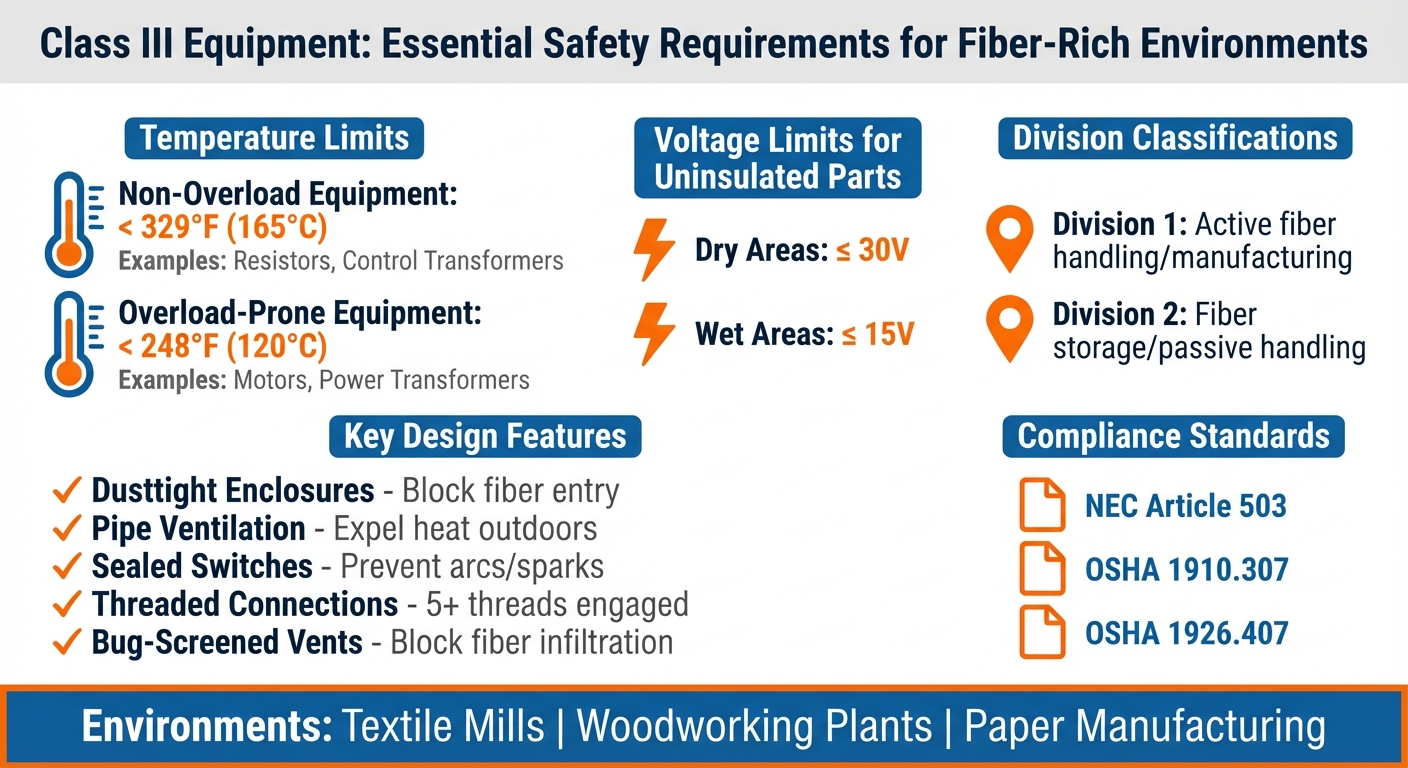
Class III Equipment Safety Requirements: Temperature Limits and Design Features
Design Features of Class III Equipment
Enclosure Design and Fiber Exclusion
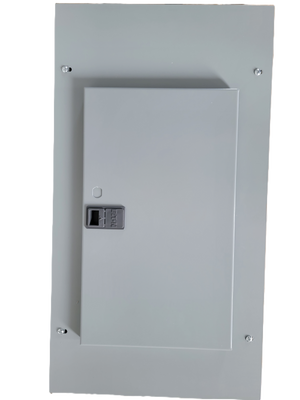
Class III equipment uses dusttight enclosures to keep combustible fibers out of critical components. Unlike the explosion-proof designs used in Class I locations - which are built to contain internal explosions - Class III equipment focuses on preventing fibers from entering these components altogether.
Motors, generators, and dry-type transformers are built with fully enclosed, pipe-ventilated designs. These include bug-screened vents and sealed housings to block fiber entry and contain any sparks that may occur. Flexible cords in these settings must be rated for heavy-duty use and terminated with dusttight connectors. Additionally, conduits must have threaded, wrench-tight connections to further reduce the risk of fiber infiltration and sparking.
While keeping fibers out is critical, controlling surface temperatures is just as important to prevent potential ignition.
Surface Temperature and Thermal Management
Thermal management plays a key role in ensuring safety. Even the best-sealed enclosures can pose a fire risk if their surfaces get hot enough to ignite fibers. To address this, the NEC sets strict limits on surface temperatures: equipment not prone to overload, such as resistors and control transformers, must remain below 329°F (165°C). For equipment that can experience overloading, like motors and power transformers, the limit is capped at 248°F (120°C).
Pipe-ventilation systems are designed to expel heat outdoors, helping to maintain safe internal and external temperatures. Dusttight enclosures also contribute by dissipating heat from components, reducing the likelihood of nearby fibers catching fire due to hot surfaces.
Arc and Spark Prevention Features
In addition to physical design and temperature control, Class III equipment incorporates features to prevent arcs and sparks, which could ignite fibers. For example, uninsulated parts are limited to operating at 30V in dry areas and 15V in wet areas, minimizing the risk of sparking. Sealed switching mechanisms and proper bonding further reduce arc and spark hazards.
Pipe-ventilation systems also help by containing potential ignition sources. As EC&M explains, "The pipes must be sufficiently tight to keep appreciable amounts of flying fibers from entering. They should also prevent the escape of ignition sources, such as sparks." Proper bonding and grounding eliminate dangerous voltage differences, which could lead to static or fault-induced sparking. Additionally, flexible cords are supported to prevent undue tension at terminal connections. Together, these measures create a layered defense against ignition risks in environments with combustible fibers.
Electric Motors for Hazardous Locations
Regulatory Compliance and Safety Standards
In addition to advanced design features, following NEC and OSHA standards is essential to ensure safe operations in Class III environments.
NEC Classifications for Class III Equipment
NEC Article 503 outlines the requirements for installations in Class III hazardous locations, which are areas containing ignitable fibers like cotton lint, sawdust, or textile fibers. These locations are divided into two categories: Division 1, where ignitable fibers are actively manufactured, handled, or used, and Division 2, where fibers are stored or handled outside of manufacturing processes. Alternatively, Article 506 introduces a "Zone" classification system, dividing areas into Zones 20, 21, and 22.
Permitted wiring methods include rigid metal conduit, intermediate metal conduit, electrical metallic tubing, PVC, and Type MC or MI cables. All of these must use dusttight boxes and fittings. Unlike Class I and II locations, Article 503 does not mandate sealing requirements for conduit systems. Electrical consultant Mark Lamendola explains:
"The smaller the particle size, the harder the particles are to control, contain, or keep out. This particle size difference is why, for example, Art. 502 has you using fittings, and Art. 503 does not."
Since fibers are larger than dust particles (over 420 microns), they are easier to manage with properly designed dusttight enclosures. This regulatory framework shapes the testing and certification protocols needed to ensure equipment safety in these environments.
Inspection, Testing, and Certification Requirements
To complement design safeguards, rigorous testing and certification processes are vital for ensuring equipment performs reliably in fiber-rich environments. Equipment intended for Class III locations must be identified or approved for use in these specific conditions. Certification ensures that enclosures are dusttight, effectively preventing the entry of fibers and the escape of sparks or burning material. Testing is typically conducted at an ambient temperature of 104°F (40°C).
OSHA provides three compliance options under 29 CFR 1910.307: equipment can be intrinsically safe, approved for the classified location, or designed to offer equivalent protection. Installation inspections confirm proper wiring methods, such as conduits being threaded with a National Pipe Taper of 3/4 inch per foot and tightened wrench-tight with at least five threads fully engaged. Additionally, unused enclosure openings must be sealed with approved metal close-up plugs, and flexible cords should be rated for extra-hard usage and terminated with dusttight connectors.
Workplace Safety and Compliance Considerations
Ensuring safety in Class III environments involves more than just equipment specifications - it requires detailed documentation and strict operational practices. All hazardous locations must be thoroughly documented and accessible to those responsible for design, installation, inspection, maintenance, or operation.
Battery rooms, for instance, must be housed in separate, noncombustible spaces with adequate ventilation to prevent fiber accumulation. Vent pipes for motors and generators should be made of metal, lead directly outdoors, and include bug screens to block fiber entry.
For employers looking to source compliant equipment, platforms like Electrical Trader offer a range of new and used electrical components that meet stringent Class III standards, helping facilities stay compliant while managing costs.
Interestingly, OSHA regulations specify that fixed dusttight equipment (excluding lighting fixtures) used in Class III locations does not need to be labeled with the specific class, group, division, or operating temperature. However, keeping detailed records of equipment specifications and hazard classifications is vital for maintaining compliance and ensuring workplace safety.
sbb-itb-501186b
Selecting the Right Class III Equipment
Choosing the right equipment for Class III environments involves aligning your selections with the specific needs of your facility. This means considering both environmental and operational factors, as well as planning ahead to accommodate future changes in your operations.
Evaluating Environmental and Operational Needs
Start by determining whether your facility falls under Division 1 (active fiber handling) or Division 2 (passive storage). This classification will guide your equipment choices.
Pay close attention to moisture and temperature limits. For dry areas, uninsulated parts should not exceed 30V, while in wet areas, the limit drops to 15V. Additionally, ensure that equipment operates below critical temperature thresholds - 165°C (329°F) for general equipment and 120°C (248°F) for motors or transformers.
Expert Mark Lamendola highlights the benefits of a proactive approach:
"If you classify the whole warehouse as Class III, rather than classifying only the west end, this small investment frees operations managers to use the building as needed."
This strategy can save you from expensive electrical retrofits when operational needs evolve. Furthermore, evaluate ventilation systems to prevent fiber buildup at air intakes and ensure wiring is protected from physical damage. These assessments are essential for identifying the right equipment for your facility.
Key Selection Criteria for Equipment
When choosing equipment, focus on the following features:
- Dusttight enclosures: Essential for preventing fiber infiltration.
- Fully enclosed motors with pipe ventilation: Helps maintain safe operating conditions.
- Compliant wiring methods: Use options like RMC, IMC, EMT, MC, or MI.
- Extra-hard rated flexible cords with dusttight connectors: Ensures durability and safety.
Unlike installations for Class I and II environments, Class III setups don’t require extensive sealing, making the implementation process more straightforward. Once you’ve identified your equipment needs, the next step is sourcing products that meet these specifications.
Where to Source Class III Equipment
Finding certified Class III equipment that complies with NEC Article 503 is relatively simple. Platforms like Electrical Trader specialize in components for hazardous locations. Their inventory includes dusttight enclosures, pipe-ventilated motors, certified conduit systems, and power distribution equipment - everything you need for environments with high fiber content.
Whether you’re setting up a new textile facility or upgrading a woodworking plant, Electrical Trader’s offerings make it easier to meet the necessary dusttight and temperature safety requirements for Class III environments.
Maintenance and Best Practices for Class III Equipment
As we've discussed earlier, while proper design helps limit ignition risks, regular maintenance is key to keeping Class III equipment safe in fiber-rich environments. Routine upkeep not only prevents fiber buildup but also reduces the risk of fires.
Routine Inspection and Maintenance Protocols
To ensure the ongoing safety of Class III equipment, routine inspections are a must. Dusttight enclosures on switches, circuit breakers, motor controllers, and fuses should be checked regularly to prevent fiber entry. Mike Holt, a recognized expert on the National Electrical Code (NEC), underscores this necessity:
"All threaded conduits must be made wrenchtight to prevent arcing when ground-fault current flows through the raceway system and to ensure the explosionproof or dust-ignitionproof integrity of the raceway system."
Temperature monitoring is another critical step - surface temperatures should stay below 329°F (165°C), while motors and transformers should not exceed 248°F (120°C) to avoid ignition risks. Ventilation pipes and bug screens also need frequent checks to prevent fiber accumulation. Flexible cords should be inspected to ensure they have extra-hard ratings and dusttight terminations.
It's important to note that standard locknuts are inadequate for bonding in hazardous locations. Instead, installations must use bonding-type locknuts, wedges, or bushings with proper bonding jumpers. Intake filters should be cleaned or replaced regularly, and any unused enclosure openings must be sealed with fittings that have at least five fully engaged threads.
Proper Handling and Storage of Ignitable Fibers
In addition to equipment maintenance, managing ignitable fibers is crucial. Fibers accumulating on electrical equipment can disrupt heat dissipation and increase ignition risks. Maintain at least 36 inches of clearance in front of panels and disconnect boxes to allow safe operation. In Division 2 locations, where fibers are stored rather than actively handled, proper containment helps prevent ignitable concentrations from forming under normal conditions.
Battery backup systems also require special precautions. These systems should be housed in separate rooms made from noncombustible materials, such as cinderblock, and equipped with adequate ventilation to keep fibers out. During maintenance, always use lockout/tagout procedures to prevent accidental energization near fibers.
Worker Safety Measures
Worker safety is a top priority in hazardous areas. Employees should have access to hazardous area classification documents and receive arc hazard training. Flame-resistant (FR) clothing is essential, as it provides protection during arc flash incidents. Workers should avoid synthetic materials that could melt in such scenarios.
FR clothing must also be kept clean and free from contaminants. According to OSHA:
"FR clothing that becomes contaminated with grease, oil, solvents, or other flammable substances should not be used because such contamination greatly reduces the effectiveness of the clothing material."
When working near exposed energized conductors, use insulated tools, and ensure that ropes and handlines are nonconductive. Safety signs and barricades should be in place to warn of electrical hazards. If FR clothing requires repair, follow the manufacturer’s guidelines carefully - using ordinary nylon thread can compromise the garment’s thermal protection.
Conclusion: Ensuring Safety and Compliance in Fiber-Rich Areas
In environments filled with combustible fibers - like textile mills or woodworking facilities - adhering to NEC Article 503 and OSHA standards is non-negotiable. These regulations demand dust-tight enclosures and strict temperature controls: surface temperatures for non-overloaded equipment must stay below 329°F (165°C), while overloaded devices should not exceed 248°F (120°C). OSHA standards 1910.307 and 1926.407 legally enforce these measures to minimize fire risks.
Practical installation strategies can further bolster safety. For example, placing equipment outside hazardous zones is a smart move. As Mike Holt, a well-known NEC expert, explains:
"Locating wiring and equipment outside of the classified location provides the safest electrical installation - usually at the least cost".
When relocating equipment isn’t an option, it’s critical to ensure all devices are clearly marked with their Class, Division, and T-rating. These labels not only support compliance but also simplify inspections and maintenance. Keep detailed records of hazardous area classifications and equipment markings to ensure easy access for inspectors and maintenance teams. If you’re sourcing compliant Class III equipment, platforms like Electrical Trader offer a centralized resource for finding NEC- and OSHA-certified breakers, transformers, and power distribution systems.
Safety doesn’t stop at installation. Long-term protection requires consistent maintenance, proper fiber management, and clear worker safety protocols. Actions like sealing raceways, using intrinsically safe systems for instrumentation, and maintaining at least 36 inches of clearance in front of electrical panels can significantly reduce ignition risks. By keeping fuel, oxygen, and ignition sources strictly separated, you create a layered safety system that’s essential for fiber-rich environments.
FAQs
What makes Class III equipment ideal for environments with ignitable fibers?
Class III equipment is built to prioritize safety in environments where ignitable fibers or flyings - common in industries like textiles, paper, or woodwork - pose a hazard. These devices come with dust-tight, non-incendive enclosures designed to block fibers from entering and prevent sparks or hot surfaces from causing ignition.
To comply with safety regulations, manufacturers rely on approved materials such as rigid metal conduits (RMC), intermediate metal conduits (IMC), and dust-tight wireways. They also use certified cable types like Type PLTC, ITC, MC, or MI. In addition, exposed parts are never energized above 30 volts (or 15 volts in wet conditions), minimizing the chance of electrical arcs.
These features make Class III equipment an excellent fit for facilities like paper mills and textile plants. Electrical Trader provides a variety of Class III-rated components, offering dependable options for environments where fiber safety is critical.
What safety standards apply to electrical equipment in Class III hazardous locations?
Class III hazardous locations are areas where materials like ignitable fibers or flyings - think textile or pulp dust - might be present. While these materials aren’t usually airborne in concentrations that could cause explosions, they still pose a fire risk. To address this, the National Electrical Code (NEC) has established safety measures. These include limiting exposed electrical parts to 30 volts (or 15 volts in wet areas), using dust-tight enclosures, and ensuring proper grounding and bonding. Specific wiring methods, like rigid metal conduit or MC/MI cable, are also required to prevent sparks or hot surfaces that could ignite these fibers.
The Occupational Safety and Health Administration (OSHA) adds another layer of safety by mandating that employers clearly identify and label Class III areas, install equipment rated for these environments, perform regular inspections, and train employees on safety protocols. Together, NEC and OSHA regulations work to create safer conditions in workplaces where fiber-related hazards exist.
When it comes to equipment for Class III locations, it’s crucial to select products that meet both NEC and OSHA standards. Electrical Trader offers a variety of Class III-rated equipment, including breakers, transformers, and conduit systems, all designed to operate safely and in compliance with these strict requirements.
What are the best maintenance practices to prevent fires in fiber-rich environments?
Preventing fires in environments with high levels of fibers requires diligent cleaning and regular equipment upkeep. Fibers, lint, and dust are serious fire risks, so it’s essential to clean these areas frequently to avoid buildup. Set up a routine inspection schedule - whether weekly or monthly, depending on activity levels - to keep lint traps, ventilation ducts, and equipment enclosures free of debris.
It’s also important to maintain sealed enclosures and dust-tight fittings to stop fibers from becoming airborne. Regularly inspect seals, gaskets, and conduits to ensure they’re intact and free of cracks. Additionally, make sure no exposed conductive parts exceed safe voltage thresholds (30 volts in dry areas, 15 volts in wet areas) to minimize the chance of sparks.
Implement a documented maintenance program that includes a cleaning log, an inspection checklist, and routine equipment testing. By pairing consistent cleaning efforts with proper equipment care, you can greatly reduce the risk of fires in fiber-heavy environments.