

IEC 61850 Applications in Utility Networks
IEC 61850 is a global standard for communication in power substations and utility networks. It simplifies operations by replacing extensive copper wiring with fiber-optic communication, improving speed, reducing costs, and increasing reliability. Key benefits include faster fault detection, easier upgrades, and streamlined maintenance.
Key Highlights:
- Faster Communication: GOOSE messaging transmits protection signals in 1–4 milliseconds, outperforming older protocols.
- Cost Savings: Substations using IEC 61850 save up to 30% in construction costs by reducing wiring and panel requirements.
- Improved Fault Response: Systems like FLISR react to outages in under a second, minimizing downtime.
- Scalability: Supports integration of distributed energy resources (DERs) and electric vehicles (EVs) for modern grid demands.
- Enhanced Safety: Fiber optics and digitized data reduce risks associated with traditional wiring.
Utilities worldwide, including Southern California Edison and Hydro-Quebec, have implemented IEC 61850 to modernize their grids, achieving faster fault isolation, lower maintenance times, and improved operational efficiency. However, challenges like network latency, cybersecurity, and time synchronization require careful planning and advanced solutions to maximize performance.
IEC 61850 Applications in Medium Voltage Systems
Substation Automation
IEC 61850 organizes medium voltage substations into three distinct levels: Process (physical devices like sensors and actuators), Bay (local Intelligent Electronic Devices or IEDs), and Station (SCADA systems and Human-Machine Interfaces). This structure replaces traditional copper wiring with software-driven configurations for protection and control. The result? Engineers can modify digital settings when interlocking schemes change or new devices are added - no need to install additional cables. This approach cuts commissioning time and significantly reduces wiring errors.
Distribution Automation
Beyond substations, IEC 61850 plays a crucial role in automating distribution networks. For example, in medium voltage systems, it supports advanced Fault Location, Isolation, and Restoration (FLISR) systems, which can react to outages in mere fractions of a second. A standout case is Southern California Edison's Next Generation Distribution Automation project. Here, a legacy 900 MHz mesh network that required manual intervention over several minutes was replaced with IEC 61850's high-speed GOOSE messaging over cellular LTE. The new system integrated 16 Remote Integrated Switch (RIS) field devices and 6 circuit breakers, achieving sub-second fault detection and automatic circuit reconfiguration. Additionally, the project demonstrates how decentralized grid-edge controllers use a "logical bridge" to exchange operational data, enabling rapid responses and handling complex network setups seamlessly.
Protection Using Peer-to-Peer Messaging
IEC 61850 also transforms protection systems through its peer-to-peer messaging capabilities, ensuring near-instantaneous responses to faults. GOOSE (Generic Object-Oriented Substation Events) messaging eliminates the need for physical wiring by replacing it with virtual connections operating at 100 Mbps - far outpacing older protocols like Modbus, which operates at 19.2 kBps. When a fault occurs, GOOSE uses a publisher–subscriber model, allowing one IED to multicast protection signals to all necessary devices at the same time. The standard specifies "Fast Messages" (Type 1A) with transmission speeds between 3 and 10 milliseconds, and real-world systems routinely meet these benchmarks.
For instance, Commonwealth Edison has already implemented this technology across seven Digital Smart Substations as of August 2023, with plans to expand to about 10 more in a brownfield project. GOOSE also includes continuous supervision through heartbeat retransmissions. This ensures that if communication fails, subscribing devices automatically switch to a safe state - something traditional copper wiring cannot achieve.
Adding to this, Sampled Values technology digitizes current and voltage measurements directly at the source using Merging Units. This eliminates the need for analog CT/VT wiring, reducing safety risks and improving system reliability. Standard setups typically use 80 samples per cycle (equivalent to 4,000 samples per second at 60 Hz), but high-speed protection applications can push this to 256 samples per cycle.
sbb-itb-501186b
Research Studies and Case Implementations
Utility Deployments Across the U.S.
Several major utilities in the U.S. have implemented IEC 61850, achieving measurable improvements. For instance, the Western Area Power Administration (WAPA) retrofitted its Fort Thompson substation, a 345/230 kV facility, and saw impressive results: a 75% reduction in DC terminations, a 40% smaller control building, and $29,000 saved in cable costs.
Kansas City Power & Light (KCP&L) utilized funding from the American Recovery and Reinvestment Act (ARRA) to upgrade a key substation serving 14,000 customers. The project included four automation schemes, such as automatic load transfer during transformer lockouts and faster bus clearing in the event of feeder breaker failures. Similarly, Commonwealth Edison (ComEd) expanded its digital substation capabilities to approximately 10 additional brownfield sites, incorporating Software-Defined Networking (SDN) for enhanced fault detection.
The New York Power Authority (NYPA) tackled space constraints in one of its stations by integrating advanced protection schemes, which also sped up configuration processes. In Mexico, Comisión Federal de Electricidad (CFE) achieved a 50% reduction in commissioning time during its La Venta II project. This was made possible by replacing copper control cables with fiber-optic links and using the OpenSCLConfigurator tool to validate IED configuration files across multiple vendors.
These examples highlight how utilities are leveraging IEC 61850 to streamline operations, save costs, and modernize infrastructure.
Integration with Advanced Network Infrastructure
Building on these deployments, utilities are now pairing IEC 61850 with IP/MPLS infrastructure to create more resilient networks spanning substations, wide-area networks (WANs), and field areas. Hydro-Quebec, for example, modernized its Generation Rejection and Remote Load Shedding system between 2020 and 2024. By transitioning from legacy PLCs to IEC 61850, they ensured that their Remedial Action Scheme could complete generation rejection within 180 milliseconds, even over a distance of 1,000 km (approximately 621 miles). To validate this performance, Hydro-Quebec developed a detailed network test bed.
"The new RPTC system is significantly faster, even though there is more equipment in the chain (remote IOs)".
This demonstrates IEC 61850's ability to meet demanding performance requirements, even across long distances.
Commonwealth Edison’s third-generation design took a different approach by separating the station bus from the process bus. They used SDN for the process bus and the Parallel Redundancy Protocol (PRP) for the station bus (LAN A and B), ensuring zero-delay recovery with no data loss during network disruptions. Meanwhile, CFE addressed environmental challenges by requiring that outdoor I/O cabinets maintain internal temperatures below 113°F (45°C) to safeguard digital components. They also added front-panel Ethernet ports, enabling technicians to test and configure systems without opening the cabinets.
These advancements showcase how IEC 61850, combined with advanced network technologies, continues to push the boundaries of substation performance and reliability.
IEC 61850 Substation Modernization and Wire Reduction
Technical Challenges and Solutions
To make the most of IEC 61850 in utility networks, overcoming technical hurdles is essential.
Time Synchronization and Network Latency
Modern substations depend heavily on Global Navigation Satellite System (GNSS) clocks for precise timing. However, these systems are vulnerable to interference, jamming, and spoofing, which can disrupt critical protection algorithms like Line Current Differential (87L). For smart grids, the required time stamp accuracy is under 1 microsecond, while IEC 61850 protection systems need end-to-end latency of less than 4 milliseconds.
"If GNSS signals are lost, the algorithms relying upon it may become unavailable or misoperate. Redundant GNSS clocks are still susceptible to interference, spoofing, and jamming." - Dustin Williams, David G. Williams, and Motaz Elshafi
In November 2025, FirstEnergy successfully tested a resilient timing solution at their Center for Advanced Energy Technology (CAET). During a simulated 14-day GNSS outage, a system combining Enhanced Primary Reference Time Clocks (ePRTC), a telecom network, and Time Distribution Gateways (TDGs) maintained sub-100 nanosecond accuracy to UTC. Importantly, Sampled Values (SV) and 87L protection applications continued operating without errors or interruptions throughout the outage.
Reducing latency further requires specialized hardware and network configurations. Tests show that GOOSE messaging experiences an average end-to-end delay of 26 µs at 30% load, but this increases to 310 µs at 50% load. To address this, utilities can deploy PTP-aware devices like Boundary Clocks and Transparent Clocks, which account for packet delays and minimize jitter. Additionally, implementing IEEE 802.1Q VLANs and 802.1p priority tagging (level 4 or higher for GOOSE messages) ensures critical data gets priority over less urgent traffic. As networks grow, these measures become even more important to handle data surges and maintain scalability.
Bandwidth and Scalability
While normal operations require minimal bandwidth, electrical faults can trigger bursts of MMS reports and GOOSE messages, quickly pushing the network toward saturation. Networks typically struggle when bandwidth usage exceeds 80%, leading to slower message transit. In large systems, physical limitations also come into play - when multiple 100 Mbps ports feed into a single 100 Mbps uplink, oversubscription creates bottlenecks.
For example, the Indira Gandhi Super Thermal Power Project, managed by NTPC Limited in 2010, integrated 600 IEDs generating 50,000 data points using IEC 61850. To handle this scale, they divided the network into six Ethernet rings, each managed by a data concentrator handling data from around 100 relays. Southern California Edison took a different approach with their RIS Project, transitioning to IEC 61850 over LTE. They segmented large operational groups into smaller, circuit-based teams, achieving sub-second system response times while avoiding the limitations of older 900 MHz radio systems.
Optimizing IED data sets to include only necessary information for specific clients can reduce SCADA traffic. Dead-band settings for analog data further limit reports to significant variations. Modern nonblocking substation switches, with capacities ranging from 9.6 to 13.6 Gbps, provide the bandwidth needed for future expansion. However, as networks scale, resilience and security become increasingly critical.
Resilience and Cybersecurity
Traditional networks relying on Rapid Spanning Tree Protocol (RSTP) use an "allowlist" approach, which leaves them open to cyberattacks. Software-Defined Networking (SDN), on the other hand, operates with a "deny-by-default" architecture, allowing only pre-approved traffic flows. This approach significantly enhances security. SDN also offers faster recovery times, reducing network healing to under 100 microseconds in some cases, compared to the hundreds of milliseconds required by RSTP.
"The standout feature of SDN is its deny-by-default architecture and rapid failover times, reducing the times to under 1 millisecond, which makes it vital for time-critical applications of protection and control systems." - Tarek Kaddoura, Muhammed Sheraz, and Kotb Eldeihey, Schweitzer Engineering Laboratories, Inc.
Network segmentation using IEEE 802.1Q VLANs isolates substation traffic, separating IED, SCADA, and engineering access. This limits the impact of potential breaches. In tests simulating "GOOSE flood" attacks, network performance remained steady at 40% bandwidth utilization but began dropping packets when malicious traffic reached 85% of network capacity (85 Mbps). Utilities can further protect networks by disabling unused ports and stopping dynamic trunk port negotiation, which helps prevent Layer 2 attacks like VLAN hopping and MAC flooding. Precision Time Protocol (IEEE 1588) ensures sub-microsecond synchronization, enabling accurate event correlation across devices to detect potential security breaches.
Benefits and Future Impact of IEC 61850
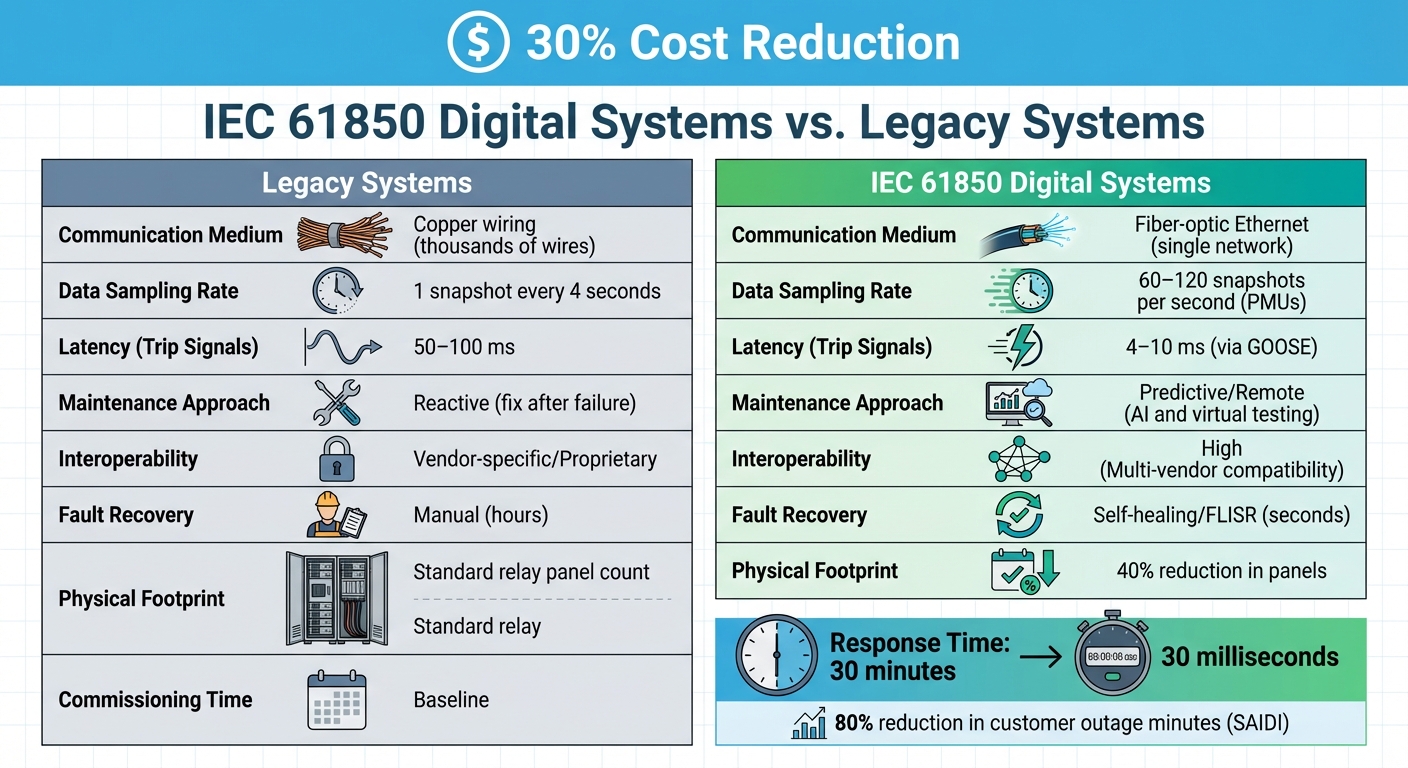
IEC 61850 vs Legacy Systems: Digital Substation Comparison
Improved Efficiency and Cost Savings
Switching to IEC 61850 brings immediate financial and operational benefits for utilities. For example, constructing a 230 kV substation with traditional technology costs around $10 million - broken down into $5 million for equipment, $3 million for copper wiring, and $2 million for installation. Digital substations using IEC 61850, however, cost roughly $7 million: $6 million for equipment, and just $500,000 each for fiber optics and installation. That’s a 30% reduction in capital costs.
Space savings are another advantage. Thanks to advanced protection and automation protocols, digital substations require 40% fewer relay panels compared to older designs. Maintenance also gets a boost in both speed and safety through remote testing. For instance, Landsnet in Iceland reduced signal validation times from weeks to just 1–3 hours across their 12 digital substations by employing automated Python-based testing as of March 2025. These combined benefits are driving the push toward modern utility networks.
DER and EV Integration Support
Beyond cost and efficiency, IEC 61850 is paving the way for better integration of distributed energy resources (DERs) and electric vehicles (EVs). With the growing adoption of renewable energy and EVs, utilities need grids capable of managing bidirectional power flow. IEC 61850-7-420 offers standardized data models for DERs like solar panels, wind farms, battery systems, and EV chargers, enabling seamless monitoring and control, much like traditional generators.
A great example of this is Southern California Edison’s Remote Integrated Switch (RIS) project. Using IEC 61850 GOOSE messaging over LTE networks, they achieved sub-second response times for fault detection, isolation, and service restoration across 16 field devices and 6 circuit breakers in complex distribution setups. This kind of speed is essential, especially as unmanaged EV charging can cause significant peak demand spikes for utilities.
IEC 61850 also supports Virtual Power Plants (VPPs), which aggregate millions of devices - like smart inverters and EV chargers - into unified, coordinated resources. For instance, Con Edison’s Brooklyn Queens Demand Management program deployed 52 MW of battery storage and 41 MW of demand response between 2014 and 2018. This $200 million project avoided a $1.2 billion substation upgrade, saving $1 billion in capital expenses.
IEC 61850 vs. Legacy Systems Comparison
The table below highlights the stark differences between legacy systems and IEC 61850 digital systems, showcasing the advantages of modernizing grid operations.
| Feature | Legacy Systems | IEC 61850 Digital Systems |
|---|---|---|
| Communication Medium | Copper wiring (thousands of wires) | Fiber-optic Ethernet (single network) |
| Data Sampling Rate | 1 snapshot every 4 seconds | 60–120 snapshots per second (PMUs) |
| Latency (Trip Signals) | 50–100 ms | 4–10 ms (via GOOSE) |
| Maintenance Approach | Reactive (fix after failure) | Predictive/Remote (AI and virtual testing) |
| Interoperability | Vendor-specific/Proprietary | High (Multi-vendor compatibility) |
| Fault Recovery | Manual (hours) | Self-healing/FLISR (seconds) |
| Physical Footprint | Standard relay panel count | 40% reduction in panels |
| Commissioning Time | Baseline | 50% faster with pre-tested FAT |
This comparison makes it clear how IEC 61850 transforms grid operations. Traditional systems rely on human operators who may take up to 30 minutes to respond to alarms, while digital grids can react in just 30 milliseconds. This rapid response allows for self-healing grids that can isolate faults and restore power automatically, cutting customer outage minutes (SAIDI) by around 80%.
Conclusion
IEC 61850 is transforming utility networks by swapping out traditional copper wiring for digital fiber-optics. This shift upgrades conventional grids into smarter systems capable of detecting and isolating faults much faster than older methods.
Real-world utility deployments, as mentioned earlier, highlight how digital substations can scale effectively in practice.
"The IEC 61850 is pivotal in facilitating the digitization of the grid and achieving the goal of automating all the relevant functions".
This move toward digitization is critical for navigating the complexities of today’s power grids. From managing bidirectional power flows created by rooftop solar panels to coordinating electric vehicle charging and integrating battery storage systems, the standard helps utilities address these modern challenges while avoiding costly infrastructure upgrades.
That said, these advancements don’t come without hurdles. Utilities face steep learning curves, the need for standardized implementation practices, and the requirement to invest heavily in training to build internal expertise. Still, the benefits are hard to ignore - like achieving 30–50% cost savings on monitoring equipment and enabling fault responses in under a second. These advantages make IEC 61850 a cornerstone for modernizing the grid.
FAQs
What is needed to implement IEC 61850 in a medium-voltage network?
To set up IEC 61850 in a medium-voltage network, you'll need a few key components. First, ensure you have compatible devices, such as relays or Intelligent Electronic Devices (IEDs). A dependable communication infrastructure - like Ethernet cables or fiber optics - is also critical for smooth data transfer.
Next, proper configuration of object-based assets is necessary to align with the standard. You'll also want tools designed for testing and commissioning to verify everything is working as expected. Finally, expertise in IEC 61850 protocols, such as GOOSE (Generic Object-Oriented Substation Event) and MMS (Manufacturing Message Specification), is crucial to guarantee both system performance and seamless interoperability between devices.
How do utilities keep GOOSE and Sampled Values fast during heavy traffic?
Utilities ensure the speed and reliability of GOOSE (Generic Object Oriented Substation Event) and Sampled Values messages, even during periods of heavy network traffic, by leveraging multicast, event-driven protocols over high-speed Ethernet.
GOOSE messages use a publisher-subscriber model, enabling instantaneous delivery of critical updates. Meanwhile, Sampled Values provide a steady stream of real-time data. Together, these methods minimize latency and maintain reliability, which is crucial for avoiding delays that could disrupt system protection or automation processes.
What’s the backup plan if GNSS time sync is jammed or lost?
If GNSS time synchronization is interrupted, backup solutions such as enhanced primary reference time clocks (ePRTCs) and time distribution gateways (TDGs) step in to maintain accurate timing. These systems are essential for keeping critical substation operations running smoothly, as they depend on precise time synchronization to avoid disruptions.