Wireless Transformers for Smart Grids: Benefits
Wireless transformers, also known as smart transformers (STs) or solid-state transformers (SSTs), are reshaping modern power grids. Unlike conventional transformers, these devices use advanced power electronics and wireless communication to manage voltage, frequency, and power flow dynamically. Here's why they matter:
- Efficiency: They reduce energy losses and improve grid efficiency, achieving 93–96% efficiency in low-voltage applications.
- Reliability: Real-time monitoring and predictive maintenance minimize downtime and enhance system performance.
- Renewable Energy Integration: They handle bidirectional power flows and support solar, wind, and battery storage systems.
- Compact Design: Wireless transformers are 20–50% smaller and lighter than traditional models, saving space.
- Scalability: Wireless mesh networks and reduced infrastructure needs make them easier to scale for growing grids.
While they cost 15–20% more upfront, the long-term benefits - like reduced operational costs and better support for renewable energy - make them a strong option for modernizing power systems. Conventional transformers remain a cost-effective choice for simpler, static grid setups but struggle with the demands of renewable energy and dynamic grids.
Quick Comparison:
| Feature | Conventional Transformers | Wireless/Smart Transformers |
|---|---|---|
| Initial Cost | Lower | 15–20% higher |
| Efficiency | Standard | 93–96% |
| Physical Size | Bulky | 20–50% smaller |
| Power Flow | One-way | Bi-directional |
| Maintenance | Reactive, on-site | Predictive, remote |
| Renewable Integration | Limited | Excellent |
Wireless transformers are ideal for grids integrating renewable energy and electric vehicles, while conventional models are better suited for simpler, budget-conscious applications.
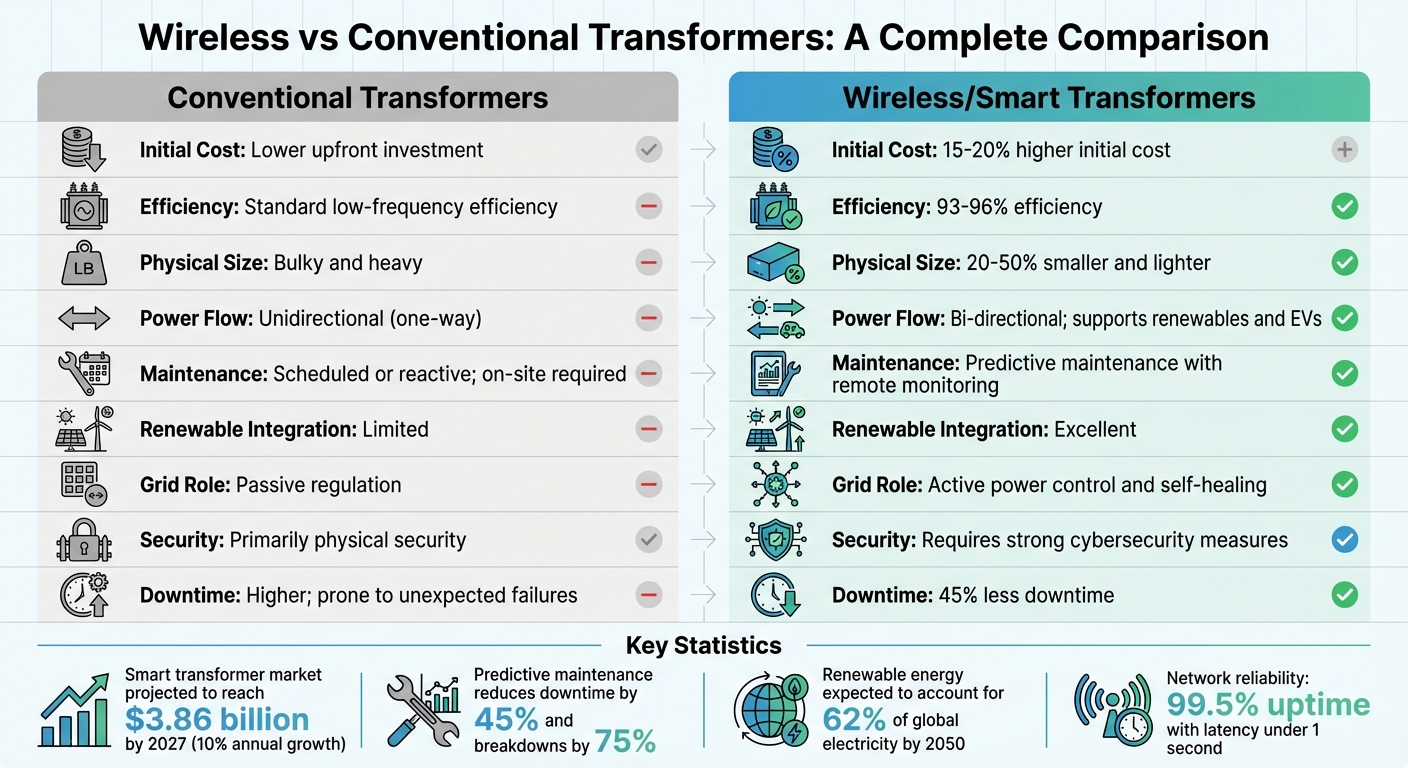
Wireless vs Conventional Transformers: Key Differences Comparison
IEEE PESGRE2025 SYPA Winner - Smart Transformers for Meshed Hybrid Power Grids

1. Wireless Transformers
Wireless transformers - commonly referred to as Smart Transformers (STs) or Solid-State Transformers (SSTs) - are reshaping how power is managed and distributed. Unlike traditional transformers, these advanced systems use power electronics to actively regulate both voltage and power flow across the grid. They rely on high-frequency isolation techniques and solid-state switches to handle the usual transformer tasks, while also providing enhanced control capabilities.
The "wireless" aspect comes from integrated sensor networks and communication technologies (ICTs) that enable real-time, two-way monitoring. Technologies like ZigBee for home networks, WiMAX for neighborhood grids, and 5G slicing for low-latency operations work in harmony to create a seamless system. As Rongwu Zhu, Marius Langwasser, and Chandan Kumar explain:
The ST is a solid-state transformer with smart control functionalities.
These advanced features unlock improvements in efficiency, reliability, renewable energy management, and scalability.
Efficiency
Smart transformers significantly cut energy losses by dynamically regulating voltage and balancing loads in real time. This reduces both copper and core losses. By allowing distributed generation systems to deliver active power closer to load points, they also minimize transmission losses. Documented efficiency gains range from 93% to 96%.
Reliability
Wireless transformers enhance reliability through continuous, sensor-driven monitoring. These systems perform real-time "heartbeat" checks to assess device health, enabling predictive maintenance. Communication networks supporting these transformers are designed for high reliability, maintaining at least 99.5% uptime. Latency requirements are strict, with Neighborhood Area Networks operating under 1 second and Home Area Networks under 5 seconds. For critical tasks like fault isolation in high-voltage lines, wireless LTE networks achieve one-way latencies as low as 25–50 milliseconds.
Renewable Energy Integration
Smart transformers are also redefining how renewable energy sources are managed. They are particularly effective at handling the bidirectional power flow required by renewable systems. By separating upstream voltage and frequency from downstream distribution, they allow for independent regulation - an essential feature for hybrid AC/DC networks that include solar panels, battery storage, and EV chargers. Justino Rodrigues from CPES - INESC TEC highlights this role:
Smart Transformers (STs) are being envisioned as a key element for the controllability of distribution networks in a future context of Renewable Energy Source (RES), Energy Storage System (ESS) and Electric Vehicle (EV) massification.
Scalability
Wireless transformers bring scalability advantages by reducing the need for extensive cable installations. Wireless mesh networks provide self-healing capabilities, automatically rerouting data if a node fails. Additionally, their compact design reduces the physical footprint, cutting the overall size by 20% to 50%.
2. Conventional Transformers
Conventional transformers were originally designed to handle static, one-way power flows, making them a cornerstone of traditional power distribution systems.
These transformers, often referred to as low-frequency transformers (LFTs), have been the backbone of 50-Hz distribution networks for decades.
As highlighted in an industry analysis:
The actual electric distribution system limits the use of renewable energy resources, offers poor EV infrastructure, and is based on a unidirectional information flow from sources to control centers. (IEEE Industrial Electronics Magazine)
Efficiency
Traditional transformers are known for their bulky and heavy design, which can be a significant drawback in applications where space is limited, such as traction systems. While they perform well under standard loads, they lack the advanced features - like voltage regulation and load balancing - that newer, smarter transformer technologies bring to the table.
Reliability
The rise of low-carbon technologies is putting conventional transformers under increasing strain. For example, the high power demands of electric vehicle charging stations and integration of renewable energy sources can lead to overheating, voltage issues, and current congestion. Levy Ferreira Costa and colleagues describe the changing nature of the grid:
The grid, once passive and static with a limited number of distributed generators, is now active and dynamic. (Levy Ferreira Costa et al.)
Although the wired communication between substations remains reliable, these transformers were not built to handle the dynamic and demanding conditions of modern grids. Their static design makes it difficult to integrate with renewable and distributed energy systems.
Renewable Energy Integration
Conventional transformers struggle to handle the bidirectional power flows required by renewable energy systems. Without real-time monitoring or automated controls, they are vulnerable to rapid voltage changes caused by intermittent sources like solar and wind. Additionally, harmonics and transient overvoltages from renewable inverters can accelerate wear and lead to core saturation. With renewable energy expected to account for 62% of global electricity by 2050 - up from 27% in 2019 - the challenges of integrating these variable energy sources are becoming even more pressing.
Scalability
Scaling up conventional transformer systems is costly and complex, as it requires significant physical infrastructure upgrades, including new lines and equipment. These systems also lack the local monitoring and interoperability needed for efficient integration with distributed energy generation. Compounding the issue, many conventional transformers are nearing the end of their operational lifespan, leading to increased energy losses. Their static design simply cannot keep up with the active and dynamic demands of modern smart grids.
sbb-itb-501186b
Advantages and Disadvantages
When deciding between wireless and conventional transformers, it's essential to weigh their pros and cons, as these choices impact performance, costs, and long-term reliability.
Wireless smart transformers bring advanced capabilities like remote monitoring and bi-directional power flow, making them a great fit for grids incorporating renewable energy sources and electric vehicles. These transformers are highly efficient and take up much less physical space compared to traditional models. Predictive maintenance is another standout feature, reducing downtime by 45% and cutting breakdowns by 75% through early fault detection. However, these advantages come with a higher price tag - smart transformers typically cost 15–20% more upfront than conventional ones. Additionally, their reliance on digital connectivity introduces cybersecurity risks and requires specialized expertise in IT and electrical engineering for proper upkeep.
Conventional transformers, on the other hand, are known for their affordability and reliability in static grid setups. As STEM writer Megan R. Nichols explains:
Conventional transformers perform basic functions without digital controls. However, they have no connection to the digital world.
Their simpler design minimizes cybersecurity concerns and reduces the need for specialized maintenance. However, they lack features like real-time optimization, remote diagnostics, and compatibility with distributed energy resources, which can limit their effectiveness in modern, dynamic grids. The table below highlights the main differences:
| Feature | Conventional Transformers | Wireless/Smart Transformers |
|---|---|---|
| Initial Cost | Lower upfront investment | 15–20% higher initial cost |
| Efficiency | Standard low-frequency efficiency | 93–96% efficiency |
| Physical Size | Bulky and heavy | 20–50% smaller and lighter |
| Maintenance | Scheduled or reactive; on-site required | Predictive maintenance with remote monitoring |
| Power Flow | Unidirectional (one-way) | Bi-directional; supports renewables and EVs |
| Grid Role | Passive regulation | Active power control and self-healing |
| Security | Primarily physical security | Requires strong cybersecurity measures |
| Downtime | Higher; prone to unexpected failures | Up to 45% less downtime |
These comparisons highlight the trade-offs utilities must consider when choosing the right transformer for their needs. For grids looking to integrate renewable energy or modernize outdated infrastructure, the operational savings and advanced features of wireless transformers can justify their higher initial cost. Meanwhile, conventional transformers remain a practical choice for static networks with tighter budgets, though their limitations may become more apparent as grid demands continue to evolve.
Finding Wireless Transformer Equipment
As smart grids continue to advance, having the right equipment in place is absolutely essential. Electrical Trader provides a convenient marketplace for sourcing both new and used wireless transformers, along with other smart grid components, making it easier for buyers to find what they need. These equipment choices play a key role in supporting the grid improvements discussed earlier.
One standout offering is Solid-State Transformers (SSTs), often referred to as smart transformers. These advanced units enable real-time monitoring of key metrics like voltage, current, temperature, and load. They’re especially useful for grids incorporating renewable energy sources and electric vehicle charging stations, where adaptability and monitoring are critical.
For those needing 3-phase distribution transformers, options include 600V class configurations with either aluminum or copper windings. Many of these transformers come equipped with Intelligent Electronic Devices (IEDs) and sensors, allowing for remote monitoring and predictive maintenance. The growing interest in such technology is reflected in the smart transformer market, which is expected to hit $3.86 billion by 2027, growing at an annual rate of 10%. This demand is largely driven by the need for bidirectional power flow and support for distributed energy generation.
Considering that building operations account for over 40% of energy use in the U.S., energy-efficient equipment is more important than ever. Electrical Trader’s platform makes it easy to compare products from various manufacturers and price ranges, whether you’re upgrading outdated infrastructure or starting fresh with a new smart grid project. With organized listings, buyers can quickly locate specific types of transformers, from low-voltage distribution models to high-capacity substation equipment, streamlining the process of planning and purchasing.
Conclusion
Wireless transformers are reshaping how power is delivered in today's world. Their compact design makes them an ideal choice for installation in densely populated urban areas, where space is often at a premium.
With features like bi-directional power flow and active/reactive power control, these transformers help stabilize voltage levels and reduce grid congestion. This, in turn, can delay the need for costly grid infrastructure upgrades.
"To avoid or defer the replacement of these traditional assets, the network of the future needs an intelligent solution such as smart transformers (STs)." - IEEE Industrial Electronics Magazine
Scalability further amplifies their advantages. Wireless mesh networks, for instance, ensure resilience by rerouting data automatically when nodes fail. Combined with real-time monitoring, these systems deliver an impressive 99.5% reliability rate with latency under one second.
FAQs
What are the long-term savings of using wireless transformers despite their higher upfront cost?
Wireless transformers might come with a steeper upfront price tag, but they deliver notable savings in the long run. Thanks to their lower energy losses, cooler performance, and reduced maintenance needs, they help cut down on overall ownership expenses over time. For utility companies, these efficiencies can translate into millions of dollars saved over the lifespan of the equipment.
On top of that, wireless transformers play a key role in creating a more dependable and efficient energy grid. By cutting down on wasted energy and minimizing operational hiccups, they pave the way for smarter energy management - a smart choice for the future of power distribution.
How do wireless transformers enhance the use of renewable energy in smart grids?
Wireless transformers, equipped with advanced communication modules, bring real-time data exchange to the table, connecting seamlessly with control centers and other grid components. This capability allows operators to respond swiftly to fluctuations caused by renewable energy sources like solar panels or wind turbines. How? By automatically fine-tuning voltage, adjusting tap settings, and managing reactive power - keeping the grid stable without the need for manual intervention.
The wireless setup also trims down installation costs and speeds up deployment since it eliminates the need for extensive wired infrastructure. This makes it especially practical for remote locations or areas experiencing rapid renewable energy growth. Plus, with cutting-edge technologies like LTE and 5G, these systems ensure secure and dependable communication, paving the way for smoother integration of renewable energy into the grid. By embracing these advancements, utilities can boost energy efficiency, reduce dependency on backup systems, and take meaningful steps toward clean energy objectives.
What cybersecurity risks do wireless transformers face, and how can they be addressed?
Wireless transformers, like any connected device, face cybersecurity challenges. Attackers might exploit their communication systems to eavesdrop on sensitive data, alter commands, or even launch denial-of-service attacks, potentially disrupting critical monitoring and protection functions. Features like remote diagnostics and firmware updates, while convenient, can also become entry points for malware or unauthorized access, especially in remote or less secure locations.
To address these vulnerabilities, utilities should prioritize strong encryption, mutual authentication, and role-based access controls to safeguard their systems. Regular checks of firmware integrity are essential to prevent malicious code from being introduced. On a broader scale, network defenses like segmentation, intrusion detection systems, and continuous traffic monitoring play a key role in spotting and addressing threats early. For an added layer of protection, advanced algorithms designed to detect unusual activity in transformers can help identify potential security breaches before they escalate.
For those seeking secure wireless transformer solutions, Electrical Trader provides a range of certified devices built to meet strict industry cybersecurity standards, ensuring dependable and compliant grid operations.