How Hydrogen Blends Impact Power Plant Performance
Hydrogen blending is transforming power plants by mixing hydrogen with natural gas to lower carbon emissions without major infrastructure changes. This method is gaining traction as the U.S. pushes for cleaner energy solutions, with hydrogen concentrations ranging from 5% to 30% already tested. Here's what you need to know:
- Lower Emissions: Hydrogen burns cleaner than natural gas, cutting CO₂ emissions by up to 18% in field tests. A 100% hydrogen blend eliminates CO₂ entirely.
- Efficiency Boost: Hydrogen’s faster burn rate and unique exhaust composition improve turbine efficiency, but this comes with challenges.
- Challenges: Higher flame temperatures and reactivity increase risks like flashback, NOₓ emissions, and material wear.
- Cost and Upgrades: Blends over 10% often require turbine modifications, updated materials, and pipeline adjustments due to hydrogen’s lower energy density and risk of embrittlement.
Hydrogen blending offers a practical way to reduce emissions while using existing infrastructure, but it demands careful planning, safety measures, and significant investments to address its unique properties.
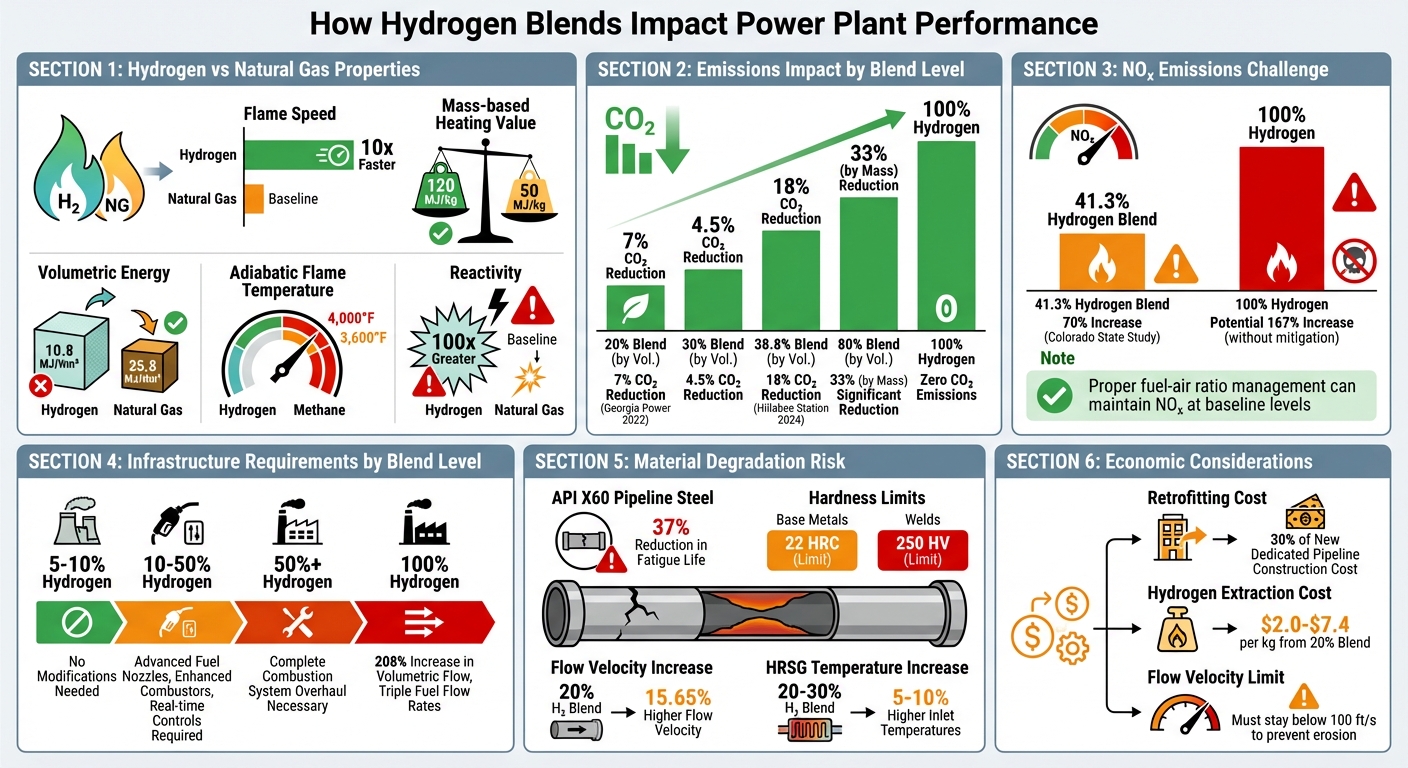
Hydrogen Blending Impact on Power Plant Performance: Key Metrics Comparison
How Hydrogen Blending Affects Combustion Efficiency
Efficiency Gains from Hydrogen's Faster Burn Rate
Hydrogen’s flame speed is about 10 times faster than that of natural gas, resulting in a compact flame with peak energy concentrated near burner nozzles. While hydrogen boasts a high mass-based heating value (120 MJ/kg compared to natural gas’s 50 MJ/kg), its lower volumetric energy (10.8 MJ/Nm³ vs. 35.8 MJ/Nm³) means higher flow rates are required for comparable energy output.
One of the major efficiency gains comes from changes in exhaust composition. As hydrogen replaces natural gas, carbon dioxide in the exhaust is replaced with water vapor. This shift increases the specific heat of the exhaust, allowing turbines to extract more energy at the same exhaust temperature. Bobby Noble, Program Manager of Gas Turbine R&D at EPRI, explained it well: “The change in exhaust products results in an exhaust with a higher energy content relative to its temperature (specific heat, cp). This results in more work for the same temperature and/or higher efficiency of the gas turbine”.
A practical example of these benefits was demonstrated in 2022 at Georgia Power’s Plant McDonough-Atkinson near Atlanta. In collaboration with Mitsubishi Power, a hydrogen blending test was conducted using a 265 MW Mitsubishi Power M501G turbine. The project achieved a 20.9% hydrogen blend by volume and confirmed improved turbine efficiency due to the higher specific heat of the water vapor–rich exhaust. However, while these efficiency improvements enhance turbine performance, hydrogen’s rapid burn rate and high reactivity bring significant stability challenges.
Challenges in Maintaining Stable Combustion
Hydrogen blending introduces some tough operational challenges. Its reactivity is about 100 times greater than that of natural gas, which increases the risk of flashback - when the flame moves backward into the fuel mixing zone, potentially damaging critical hardware. Additionally, hydrogen’s fast burn rate can lead to thermo-acoustic instabilities, where pressure oscillations exceed 10% of the combustion chamber’s average pressure. The much shorter ignition delay also raises the risk of premature autoignition in the premixer.
Hydrogen’s adiabatic flame temperature, around 4,000°F (compared to methane’s 3,600°F), adds further stress to turbine components due to increased thermal loads. The lower volumetric energy of hydrogen means fuel systems must handle much higher flow rates. As turbines approach 100% hydrogen operation, total fuel flow can more than triple.
In early 2024, Constellation Energy, Siemens Energy, and EPRI conducted a hydrogen blending test at the Hillabee Generating Station in Alabama. Using an unmodified Siemens Energy SGT6-6000G gas turbine, they blended up to 38.8% hydrogen by volume over a 12-hour period. The project achieved an 18% reduction in CO₂ emissions while maintaining steady NOₓ levels by carefully managing combustion temperatures and fuel splits.
Mitsubishi Power and Georgia Power Achieve 50% Hydrogen Blending at Plant McDonough-Atkinson

Emissions Impacts: CO₂ Reductions and NOₓ Increases
Improving combustion efficiency with hydrogen blending brings notable changes to its emissions profile.
CO₂ Reduction Potential
Hydrogen blending reduces CO₂ emissions, but the effect is not proportional to the volume blended. This is because hydrogen has a low mass density. For example, a 20% blend by volume translates to only about 3% by mass , so the reduction in CO₂ emissions is smaller than the volume percentage might imply.
As the hydrogen concentration rises, the impact on CO₂ reductions becomes more pronounced. An 80% blend by volume (around 33% by mass) delivers a much greater reduction . Burning 100% hydrogen eliminates CO₂ emissions entirely . Field tests back these findings. At Plant McDonough-Atkinson in 2022, Georgia Power achieved a 7% reduction in CO₂ emissions using a 20.9% hydrogen blend . Similarly, stationary power engines running on a 30% hydrogen blend by volume can cut CO₂ emissions by nearly 4.5%, provided the fueling rate is adjusted to maintain steady combustion conditions.
NOₓ Emission Challenges
While hydrogen blending helps with CO₂ reductions, it also creates challenges with NOₓ emissions. Hydrogen’s higher flame temperature leads to increased thermal NOₓ formation, which is highly sensitive to temperature changes. Even small increases in flame heat can cause significant spikes in NOₓ emissions.
For instance, in 2024, researchers at Colorado State University tested a Cooper-Bessemer GMV-4TF 2-stroke engine with hydrogen blends up to 40% by volume. They observed a linear increase in NOₓ emissions as hydrogen content rose. At a 41.3% hydrogen blend, NOₓ emissions were 70% higher than baseline levels. Without intervention, transitioning to 100% hydrogen could result in NOₓ emissions increasing by as much as 167%.
Power plants, however, have strategies to tackle these challenges. At the Hillabee Generating Station in Alabama in early 2024, Constellation Energy and Siemens Energy successfully blended up to 38.8% hydrogen by volume without increasing NOₓ emissions. They achieved this by fine-tuning fuel-to-air ratios, adjusting combustion fuel splits, and carefully managing turbine exhaust temperatures during a 12-hour test.
"This allows the industry and society to view H2 as a potentially viable fuel for modern turbines to reduce CO₂ emissions... with no, or minimal, changes to NOₓ emissions compared to traditional NG gas turbines." - Bobby Noble, EPRI
sbb-itb-501186b
Equipment and Infrastructure Requirements
Switching to hydrogen blending changes how combustion systems operate, often requiring updates to existing equipment. The extent of these changes largely hinges on the concentration of hydrogen in the mix.
Turbine Compatibility and Upgrade Needs
Most turbines can handle low hydrogen blends (5–10%) without needing modifications. But when moving to medium blends (10–50%), upgrades like advanced fuel nozzles, enhanced combustors, and real-time control systems become necessary to ensure proper fuel-air mixing.
For high hydrogen blends (above 50%), retrofitting becomes unavoidable. Hydrogen's triple flame speed increases the risk of flashback, where flames travel backward into areas not designed to handle such heat. To counter this, a complete overhaul of the combustion system is usually required.
A good example of hydrogen blending in action comes from Georgia Power's Plant McDonough-Atkinson. In June 2022, the facility successfully tested a 20.9% hydrogen blend using a 256 MW Mitsubishi M501G turbine. The trial involved adjustments from the original equipment manufacturer (OEM) and the addition of a Centaurs gas pressure reduction skid. Despite these changes, the plant maintained stable operations and met emissions standards.
Hydrogen also has a lower heating value - about one-third that of natural gas - which means fuel systems must accommodate a 208% increase in volumetric flow when using 100% hydrogen.
"Hydrogen readiness is not a single specification but a combination of design features. These include advanced combustors capable of managing hydrogen's higher flame speed, control systems that adjust fuel-air mixing in real time, and materials that withstand increased temperatures." - James Cook
Beyond turbine upgrades, the infrastructure delivering hydrogen fuel also needs significant adjustments.
Piping and Material Considerations
Hydrogen's unique properties pose challenges for fuel transport systems. Its small molecular size can cause hydrogen embrittlement, where hydrogen seeps into metals, creating microcracks. This weakens the material, making it more prone to sudden failure under normal stress.
Pipeline materials like API X65, X70, and X80 steels are especially vulnerable. For instance, tests on API X60 pipeline steel showed that hydrogen exposure reduced its fatigue life by 37%. Harder materials face even greater risks, which is why standards often limit hardness to 22 HRC for base metals and 250 HV for welds. Combustion system materials, such as stainless steels and nickel alloys, are also more susceptible to damage at the high temperatures typical in turbine operations.
"Because hydrogen can easily diffuse through metal surfaces, some metal pipes used for transporting natural gas may degrade when exposed to hydrogen, particularly at high temperatures and pressures, leading to cracking or pipeline embrittlement." - Exponent
Polymer components like seals, gaskets, and valve seats are similarly affected. Hydrogen diffuses through certain plastics much faster than methane, making these materials brittle or prone to leaks. While most natural gas pipelines can handle hydrogen blends of 5–15% with few changes, higher concentrations require adherence to stricter standards, such as ASME B31.12 (Hydrogen Piping and Pipelines), instead of the usual ASME B31.8 (Natural Gas) standards.
For power plants planning to incorporate hydrogen, a gap analysis is essential. This process compares the current infrastructure against ASME B31.12 requirements, pinpointing areas that need upgrades before hydrogen use begins. For new facilities, designing with hydrogen-ready features upfront - such as larger piping, hydrogen-compatible valves, and specialized seals - can save significant costs compared to retrofitting later.
Upgrading infrastructure is a critical step for ensuring efficient and reliable operations when transitioning to hydrogen-based power systems.
Economic and Operational Impacts
Cost Implications of Hydrogen Infrastructure
Integrating hydrogen blending into existing systems comes with hefty expenses, primarily due to the need for specialized equipment like injection skids, flowmeters, analyzers, mixers, and actuated control valves.
The cost of turbine modifications escalates as hydrogen concentrations rise. For blends under 15%, changes are minimal. However, blends in the 30%–70% range require significant upgrades, including burner modifications, flashback supervision systems, enclosure gas detection, and improved ventilation. Since hydrogen has only a third of the volumetric energy density of natural gas, turbines must also be equipped with resized nozzles, upgraded fuel skids, and larger fans to maintain performance.
Heat Recovery Steam Generators (HRSGs) face unique challenges. Hydrogen combustion leads to higher flame temperatures and increased moisture, which can cause greater thermal stress and corrosion. To prevent premature failure, advanced materials like T91, austenitic steels, or duplex alloys must be used - adding to the overall costs. For context, a hydrogen blend of 20%–30% can increase HRSG inlet temperatures by 5%–10% compared to natural gas firing.
"Natural gas generation with 30% hydrogen by volume delivers an 11% reduction in CO2." - Richard Saab, Sales Manager, Siemens Energy
Fuel transport systems also face rising operational costs due to hydrogen's lower energy density. Higher flow velocities are required, which increases compression and operational expenses. For instance, a 20% hydrogen blend leads to a 15.65% increase in flow velocity. Facilities that need pure hydrogen from blended streams must invest in deblending equipment, such as pressure swing adsorption systems, which adds both capital and energy expenses. Extraction costs for a 20% hydrogen blend range from $2.0–$7.4 per kg. These factors significantly impact the economic feasibility of hydrogen-blended power plants.
Operational Adjustments and Best Practices
Adapting to hydrogen blending requires more than just financial investment - it demands operational changes to ensure systems run efficiently and safely.
One of the key adjustments involves combustion control. Hydrogen's faster flame speed necessitates precise management of fuel–air ratios to prevent flashbacks and maintain stable combustion. Installing online temperature monitoring in high-heat-flux areas can help identify thermal stress before it leads to equipment damage.
Condensation management becomes a critical task due to the higher water content in exhaust gases. Increased moisture raises the risk of condensation, especially in cooler sections of the HRSG. To combat this, operators should implement additional drainage systems and drying measures to prevent corrosion. Hydrogen detection technologies and specific purge cycles are also essential to avoid the accumulation of unburned hydrogen in enclosed areas.
For new facilities, obtaining a "hydrogen-ready" certification during the design phase can streamline future upgrades and improve financing options. This approach includes designing larger steam turbines upfront to counteract potential performance losses in the superheater section when hydrogen is introduced. Retrofitting existing natural gas infrastructure for hydrogen use is a more cost-effective option, requiring only about 30% of the expense of building new dedicated pipelines.
"Those wanting to burn hydrogen in the future should set up the HRSG for it upfront. Those that do receive a hydrogen-ready stamp, that can help with financing and will minimize costs." - Richard Saab, Sales Manager, Siemens Energy
Operators should also focus on frequent inspections of high-risk components like headers and tubes as hydrogen concentrations increase. To avoid material failure caused by higher flow rates, flow velocity should remain below the erosional velocity of pipe materials, ideally under 100 ft/s. These operational practices are essential for maintaining system efficiency and protecting equipment as the energy industry transitions to hydrogen.
Conclusion
Field trials at Constellation's Hillabee Power Plant and Georgia Power's facility have shown that blending hydrogen into existing systems can cut CO₂ emissions by up to 18%, all while utilizing current turbine infrastructure.
That said, hydrogen blending introduces challenges. The higher thermal loads and faster combustion speeds require meticulous control and more durable materials. Additionally, the increased water vapor in exhaust gases heightens the risk of condensation and corrosion, especially in the cooler sections of the Heat Recovery Steam Generator.
Adapting to hydrogen also comes with notable costs. Retrofitting plants and making operational adjustments are expensive, which is why early planning for "hydrogen-ready" infrastructure is crucial. To manage hydrogen’s lower energy density, facilities will need turbine upgrades, advanced materials, and improved fuel delivery systems. For older plants, operators must weigh the costs of retrofits against the plant's remaining lifespan. Enhanced monitoring systems and strict safety protocols will also be essential to address hydrogen's unique properties. These steps are key to aligning current operations with the future of hydrogen-powered energy production.
FAQs
What hydrogen blend level usually triggers turbine upgrades?
When using hydrogen blends with around 50% hydrogen content, gas turbines often need upgrades to handle the increased hydrogen levels while maintaining their performance. For instance, Georgia Power conducted a successful test using a 50% hydrogen blend in their gas turbine, highlighting the importance of making modifications to accommodate such blends effectively.
How can plants control NOₓ as hydrogen percentages rise?
Controlling NOₓ emissions becomes increasingly important as hydrogen blending rises. Plants can adopt several strategies to address this challenge. One effective method is lean premixed combustion, which lowers combustion temperatures, directly reducing NOₓ formation. Other techniques include mixing hydrogen with natural gas (hybrid combustion), using inert gas dilution, or employing staged combustion processes. Additionally, advanced combustor designs specifically engineered for high hydrogen content play a key role in balancing efficiency with reduced emissions. These solutions help meet environmental regulations while maintaining operational performance.
What pipeline and seal risks increase with higher hydrogen blends?
Using higher hydrogen blends in pipelines can pose serious challenges. One key issue is pipeline embrittlement, where hydrogen interacts with materials like steel, reducing their strength and making them more susceptible to cracking. This increases the likelihood of failures and leaks, which can be both costly and dangerous.
To address these risks, it’s critical to focus on choosing the right materials and implementing robust maintenance practices. Careful planning and regular inspections are essential to maintaining pipeline integrity when dealing with hydrogen blends.