

Digital Twins for Predictive Maintenance in Power Plants
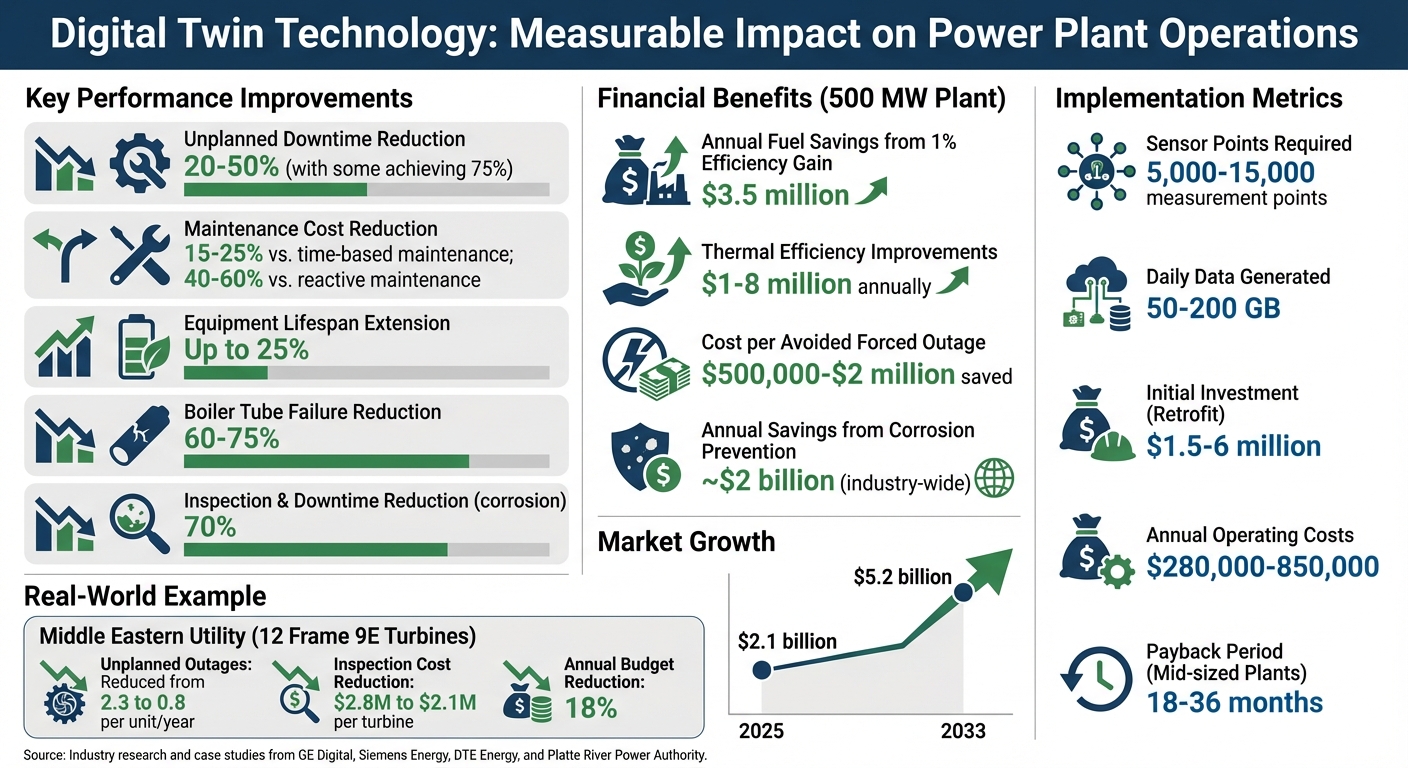
Digital twin technology is changing how power plants handle maintenance. By creating virtual replicas of equipment, it uses real-time data and AI to predict failures before they happen. This approach helps reduce unplanned downtime by 20–50%, cut maintenance costs by 15–25%, and improve efficiency, saving millions annually.
Key Takeaways:
- What it is: A digital twin is a virtual model of physical assets like turbines or boilers, updated with real-time sensor data.
- Why it matters: It shifts maintenance from reactive (fixing after failure) or time-based schedules to condition-based, saving costs and downtime.
- Benefits: Extends equipment lifespan by up to 25%, improves thermal efficiency, and prevents costly forced outages.
- Real-world results: Examples include cutting turbine inspection costs by $700,000 and reducing outages from 2.3 to 0.8 per year.
By combining sensors, physics-based models, and AI, digital twins provide precise insights into equipment health, making maintenance smarter and more efficient.
Digital Twin Technology Benefits and ROI for Power Plants
TCS Cognitive Digital Twin for Predictive Maintenance in Power Plants
sbb-itb-501186b
Core Components of Digital Twin Technology
Digital twins rely on three interconnected elements: real-time sensor networks for data collection, physics-based engineering models to simulate equipment behavior, and machine learning algorithms to predict failures. Each plays a unique role, but their integration is what makes accurate maintenance predictions possible.
Real-Time Sensor Networks
At the heart of digital twin systems are sensors that continuously track parameters like temperature, vibration, pressure, flow rates, and emissions. These sensors transform a static model into a dynamic, real-time replica of equipment conditions. For instance, a typical 500 MW power plant might monitor 5,000 to 15,000 measurement points, sampling data every 1 to 60 seconds. This setup can generate 50 to 200 GB of raw sensor data daily. Such detailed monitoring allows for early detection of subtle anomalies - like a slight oil temperature rise or minor vibrational shifts - that might escape human observation but serve as critical flags for AI systems.
Take the DTE Energy's 34-MW Dearborn Central Energy Plant as an example. Using the VTS HardHAT digital twin system, 12,000 datapoints from Solar Titan 130 gas turbines and Rentech HRSGs were monitored. This helped Regional Operations Manager Kevin Siess and his team identify and resolve a power supply issue to a PLC within 90 minutes, contributing to just four hours of unplanned downtime for the entire year in 2022.
Specialized sensors further enhance monitoring capabilities. Optical pyrometers measure turbine blade temperatures, infrared cameras detect boiler tube hot spots, and acoustic sensors identify leaks. Edge computing gateways often preprocess data locally, reducing bandwidth needs and enabling faster responses for critical systems. Once this sensor data is captured, it feeds into physics-based models for further analysis.
Physics-Based Engineering Models
Physics-based models use principles from thermodynamics, fluid dynamics, and chemical kinetics to simulate ideal equipment performance. These models establish a baseline for "normal" behavior, helping digital twins compare real-time sensor data with expected values.
These simulations are particularly useful for predicting how equipment handles mechanical stress during rapid load changes - an increasing concern as thermal plants shift from steady baseload operations to more flexible roles. For example, when Aluminum Bahrain (Alba) evaluated GE 9HA turbines, they used a digital twin powered by GE Predix to simulate turbine reactions to grid instabilities. Drawing on data from a twin plant in Bouchain, France, GE demonstrated that an unscheduled outage would have minimal impact on Bahrain's grid. This analysis convinced Alba to order three 9HA turbines and three HRSGs.
Physics-based models typically offer ±2-5% accuracy for performance predictions. While this level of precision is excellent for design validation and virtual testing, it may not catch subtle long-term degradation - an area where machine learning excels.
Machine Learning and AI Algorithms
Machine learning algorithms build on the foundation set by physics-based models, refining predictions by identifying complex data patterns. Techniques like Long Short-Term Memory (LSTM) networks for time-series predictions and Random Forests for fault classification are commonly used. These methods can achieve prediction accuracy of ±0.5-2% for key metrics such as heat rate, emissions, and power output.
The AI layer excels at detecting anomalies, forecasting Remaining Useful Life (RUL), and diagnosing failure causes by analyzing both historical and real-time data.
"Having an ML-driven, physics-based model makes it more robust and reliable... we can avoid an unexpected outage [and] start optimizing maintenance." - Annalisa Manera, Professor of Nuclear Engineering, University of Michigan
Advanced systems now employ Physics-Informed Neural Networks (PINN), which merge the laws of thermodynamics with machine learning. This hybrid approach reduces the need for training data by 30-50% compared to pure machine learning models, while ensuring predictions remain grounded in physical principles. By combining engineering expertise with data-driven insights, these systems deliver more precise and dependable results.
How Digital Twins Address Power Plant Maintenance Challenges
Power plants grapple with maintenance challenges like turbine overheating, transformer mechanical issues, and hidden corrosion damage. By merging real-time sensor data with predictive models, digital twins shift maintenance strategies from reactive fixes to proactive problem-solving.
Turbine Temperature and Performance Monitoring
Gas turbines operate under extreme conditions, with hot gas path components reaching temperatures between 2,372°F and 2,912°F. Such heat exposes them to thermal stress and early wear. Digital twins keep a close eye on these conditions, employing damage accumulation models like the Coffin-Manson equation to calculate the life expectancy of components.
This technology helps detect subtle issues before they escalate. For instance, in 2022, DTE Energy's Dearborn Central Energy Plant used the VTS HardHAT digital twin system to monitor two 14.5‑MW Solar Titan 130 gas turbines. After a scheduled outage, the SureSense system flagged a 10°F oil temperature increase - still within acceptable limits - prompting a seal replacement during the next outage to avoid potential failure.
The financial and environmental benefits are compelling. For a 500‑MW plant, improving efficiency by just 1% could save $3.5 million in fuel costs and cut 25,000 tons of CO₂ emissions annually. Beyond turbines, digital twins also enhance transformer monitoring.
Transformer Vibration Analysis
Transformers face mechanical challenges that can go unnoticed until damage becomes severe. During normal operation, transformers produce consistent vibration patterns. However, when problems like core loosening or winding displacement begin, these patterns shift. Digital twins, equipped with high-sampling-rate sensors, track these changes and use Fast Fourier Transform (FFT) to identify early mechanical fault signatures.
To refine predictions, machine learning models like Random Forest, LSTM networks, and Autoencoders analyze vibration data alongside dissolved gas analysis, temperature, and oil quality. This integrated approach boasts a 95% accuracy rate in predicting a transformer's remaining useful life using multi-physics coupling methods. Transitioning from traditional time-based maintenance to condition-based strategies can reduce costs by 15% to 25%.
"Predictive analysis using artificial intelligence (AI), combined with condition assessment at the component level, can extend the life of an asset by managing risk, thus supporting sustainable development objectives."
- Jean‑Pierre Girard, Founder, HEXACODE Solutions
Corrosion Detection and Prediction
Corrosion often develops silently in power plants, only becoming evident after significant damage or leaks occur. Digital twins replace manual "snapshot" inspections - like ultrasonic thickness measurements during shutdowns - with continuous, real-time monitoring to predict the lifespan of critical components.
In Heat Recovery Steam Generators (HRSGs), digital twins simulate factors like heat, water chemistry, and operating conditions to forecast metal degradation. Siemens Energy reports that accurate corrosion predictions can cut routine inspections and unplanned downtime by 70%. Across the industry, reducing corrosion-related downtime by just five to seven days could save approximately $2 billion annually.
"Siemens Energy estimates that by predicting corrosion accurately, they can reduce inspection during regular maintenance and unplanned downtime by 70%."
- Jensen Huang, Founder and CEO, NVIDIA
For boiler systems, digital twins monitor tube thinning and fouling by tracking tube metal temperatures, steam pressure, and water chemistry. This approach has been shown to reduce boiler tube failures by 60% to 75%. Considering that such failures account for 40% to 50% of forced outages in coal and biomass plants, this is a game-changer for reliability. Together, these applications of digital twins optimize maintenance and ensure smoother power plant operations.
Measurable Benefits of Digital Twin Technology
Digital twins offer tangible outcomes that significantly impact financial performance. For instance, predictive maintenance powered by digital twins has proven to cut costs and downtime. Power plants using this technology report a 20%–50% reduction in unplanned downtime, with some achieving as much as a 75% decrease. The financial implications are hard to ignore - a single avoided forced outage can save between $500,000 and $2 million in lost revenue and emergency repair costs. Considering that power outages cost American businesses at least $150 billion annually, the value of this technology is clear.
Reducing Unplanned Downtime
One of the standout benefits of digital twins is their ability to predict equipment failures well in advance. By analyzing real-time sensor data, these tools enable maintenance teams to plan repairs during scheduled downtime, avoiding the chaos of emergency fixes. For example, a Middle Eastern utility operating twelve Frame 9E gas turbines saw unplanned outages drop from 2.3 to 0.8 events per unit annually after adopting GE Digital's Asset Performance Management system. This improvement also reduced average inspection costs from $2.8 million to $2.1 million per turbine, cutting the annual maintenance budget by 18%.
These predictive capabilities streamline maintenance, making it less reactive and more strategic.
Improving Maintenance Efficiency
Digital twins also help fine-tune maintenance strategies by focusing on actual equipment conditions rather than rigid schedules. This shift to condition-based maintenance reduces costs by 15%–25% compared to time-based approaches and 40%–60% compared to reactive repairs.
A real-world example comes from Platte River Power Authority's Rawhide Energy Station, which implemented an Emerson Ovation digital twin in February 2024. Within just four months, the 280-MW coal-fired unit completed over 400 man-hours of operator training and achieved a 44% reduction in simulated startup and shutdown times. This not only lowered fuel consumption but also minimized thermal stress during high-wear transitions. Plants using digital twins can also extend major overhaul intervals by 15%–30%, allowing resources to be allocated to other critical areas.
"The right technology gives people enough confidence in automation so they can walk away. Our operations staff is now comfortably performing 80% of all maintenance activities."
- Kevin Siess, Regional Operations Manager, DTE Energy
This efficiency translates to lower costs and better long-term performance for equipment.
Extending Equipment Lifespan
Digital twins also play a key role in prolonging the life of machinery. By aligning maintenance with the actual condition of assets, they help reduce wear and tear. Condition-based monitoring can detect issues like thermal gradients and abnormal conditions that speed up component degradation. For example, digital twins can track "creep-fatigue" damage and extend machinery life by up to 25%.
Specific components see even greater benefits. Generator windings and rotors can last 25%–40% longer with proper monitoring, while bearings may see lifespan improvements of 20%–35% thanks to early detection of vibration and thermal issues. A European utility operating a 600-MW coal plant used a digital twin to monitor boiler tubes, cutting annual tube failures from 3.5 to 0.8. This saved the utility between $2.8 million and $4.5 million annually in emergency repairs and lost generation. Additionally, a 500-MW facility could achieve thermal efficiency improvements of 0.4%–2.5%, translating to $1 million–$8 million in annual fuel savings. These enhancements defer costly capital investments while boosting plant capacity factors from the typical 85%–90% range to 92%–96%.
Implementation Guide for Digital Twin Technology
To fully realize the advantages of digital twin technology, a well-structured implementation process is essential. Most facilities begin by setting specific goals - like cutting downtime by 30% - and testing the technology on a single high-impact asset, such as a turbine or pump. This pilot approach provides measurable results before moving to a broader rollout. The next step involves cataloging critical equipment and pinpointing failure modes (like bearing friction or impeller wear), which helps determine the necessary sensor types.
Data Collection and Sensor Integration
For a 500-MW plant, between 5,000 and 15,000 sensor points are required, with sampling intervals ranging from 1 to 60 seconds. These sensors need to integrate seamlessly with SCADA/PLC systems, sending data to either cloud or edge platforms. Such systems generate massive amounts of data - 50 to 200 GB daily - making a strong data infrastructure non-negotiable. To manage this volume, edge gateways positioned near heavy machinery handle low-latency processing and reduce the bandwidth required for cloud transfers. Machine learning models typically need 1 to 3 years of historical data at 1-minute resolution to function effectively, so facilities must begin data collection well in advance of full deployment.
At the Rawhide Energy Station, Platte River Power Authority implemented an Emerson Ovation digital twin for its 280-MW coal-fired unit. Johel Comas, Senior Electrical Controls Engineer, led the project, dedicating over 400 man-hours to operator training in just four months. Their digital twin replicated the plant's control environment, cutting engineering time and simplifying staff training.
Ensuring Model Accuracy
Hybrid models that combine physics-based thermodynamics with machine learning deliver accuracy within ±1–3%, while requiring 30–50% less training data compared to pure machine learning approaches. These models adapt to changing equipment conditions - like fouling or erosion - through regular retraining, often on a weekly or monthly basis. Teams should validate algorithms using historical field data to ensure they can detect known fault scenarios before going live.
"If we want to do a change on the primary air flow, we would test it here on the simulator first... I did it here. I liked the result. And, then, I did it on the main unit, and it mimicked exactly what we wanted to do."
- Johel Comas, Senior Electrical Controls Engineer, Platte River Power Authority
Data from multiple sources - DCS, PLC, and IoT systems - must be fused into time-synchronized models using rigorous cleansing processes. Features like "Fast Restart" in simulations can bypass settling times during fault-condition testing, cutting simulation time by up to 70%.
Integration with Grid-Level Operations
Once models are validated, the next step is integrating them into grid-level operations. Digital twins enable "damage-aware dispatch", where plants optimize their participation in ancillary service markets - like frequency response - by quantifying the mechanical stress and wear caused by rapid ramping. This is especially valuable as grids incorporate more renewable energy, which demands greater flexibility to manage intermittent supply.
Real-time deployment involves connecting models to live data feeds and setting severity thresholds (Green/Yellow/Red) to trigger automated maintenance alerts. Linking the digital twin with CMMS and ERP systems streamlines work orders and spare parts inventory management. The initial investment for retrofitting existing plants ranges from $1.5 million to $6 million, covering software, sensors, and 6–18 months of integration. Annual operating costs, including cloud computing, software maintenance, and data science support, range between $280,000 and $850,000. For mid-sized plants (300–800 MW), the breakeven point is typically reached within 18 to 36 months.
Conclusion
Digital twins are transforming the way power plants handle maintenance. With real-time insights into key components like turbine blades and boiler tubes, they allow for precise, proactive maintenance strategies. This shift from reactive to predictive maintenance is delivering impressive results, including 20–50% reductions in unplanned downtime, 15–25% lower maintenance costs, and thermal efficiency improvements valued at $1 million to $8 million annually for a standard 500 MW facility.
Beyond these measurable benefits, digital twins tackle broader challenges in the energy sector. One pressing issue is the anticipated retirement of 40–55% of experienced operators by 2030. By embedding expert knowledge into AI models and offering simulation-based decision support, digital twins help retain critical expertise. As Matthew Panszczyk, Managing Director at Sand Technologies, puts it:
"Digital twin is not a futuristic fantasy; it is a practical and powerful tool that is actively reshaping the utility sector".
For plants navigating renewable energy integration and stricter environmental regulations, digital twins provide a data-driven approach to decision-making. From optimizing fuel use and extending equipment life by up to 25% to preventing forced outages that can cost $500,000 to $2 million each, this technology turns maintenance spending into a strategic advantage. The result? Enhanced operational stability and improved profitability for power generation facilities.
The market trends further underscore the growing importance of digital twins. Projections show the market expanding from $2.1 billion in 2025 to $5.2 billion by 2033. With payback periods of just 18–36 months for mid-sized plants, digital twins are no longer experimental - they’ve become a cornerstone of modern, efficient power generation.
FAQs
How do digital twins predict failures earlier than standard alarms?
Digital twins offer a proactive way to predict equipment failures by leveraging real-time data and advanced analytics to create virtual replicas of power plant assets. Instead of relying on traditional alarms that trigger only when specific thresholds are crossed, digital twins continuously monitor equipment through sensors. This allows them to pick up on subtle patterns that might indicate potential problems.
By integrating machine learning models, these systems can simulate various failure scenarios and predict the health of components. This means operators receive earlier warnings, which helps minimize downtime and makes maintenance efforts more efficient.
What data and sensors do I need to build a digital twin in a power plant?
To build a digital twin for a power plant, you’ll need sensors to track critical parameters such as temperature, vibration, oil quality, and partial discharge. These sensors collect real-time data, which, when paired with physics-based models, creates a dynamic virtual representation of the equipment. By incorporating SCADA systems, IoT devices, and historical performance data, the model becomes more precise, enabling real-time health monitoring and predicting potential failures.
How long does it take for a digital twin to pay back in a U.S. power plant?
The payback period for implementing a digital twin in a U.S. power plant usually falls between 6 months and 2 years. This timeframe largely hinges on the specifics of its implementation and the operational improvements achieved. Research highlights that during this period, power plants can experience notable cost reductions and efficiency boosts.