NFPA 79 Compliance: What to Know
NFPA 79 is the Electrical Standard for Industrial Machinery that ensures electrical safety for machinery operating at 1,000 volts or less. It focuses on internal machine wiring, control circuits, grounding, emergency stops, and short-circuit ratings to protect operators, equipment, and facilities from electrical hazards like shocks, fires, and arc flashes. Compliance is often required by OSHA and insurers.
Key Highlights:
- Scope: Covers electrical systems inside industrial machinery, beyond the main disconnect.
- Safety Features: Includes wire color coding, surge protection, and grounding requirements.
- Voltage Limits: Primarily applies to equipment operating at 600 volts or less.
- Updates: The 2024 edition adds cybersecurity guidelines, unified SCCR labeling, and stricter surge protection requirements.
- Design Guidelines: Use copper wiring, thermoset insulation for VFDs, and UL-listed components.
Meeting NFPA 79 standards ensures safer operations, reduces downtime, and aligns with regulatory expectations.
NFPA 79 Training – 2024 Industrial Machinery Safety, SCCR Labeling, Grounding & Control Panel Design
sbb-itb-501186b
What NFPA 79 Covers
NFPA 79 focuses on the electrical and electronic systems of industrial machines that operate at up to 1,000 volts. It applies specifically from the point where the machine connects to the supply circuit and covers everything beyond the disconnect. While the NEC (National Electrical Code) governs wiring up to the machine’s disconnect, NFPA 79 takes over for the internal electrical systems. This includes areas like control circuits, power distribution, grounding, and overcurrent protection.
Industrial Equipment Covered by NFPA 79
NFPA 79 lays out clear guidelines for a wide range of industrial machinery. Annex C of the standard provides a detailed list of equipment categories:
| Category | Machine Types |
|---|---|
| Machine Tools | Equipment for metal cutting and forming |
| Plastics Machinery | Includes injection molding, extrusion, blow molding, and size reduction machines |
| Wood Machinery | Covers woodworking tools, laminating machines, and sawmill equipment |
| Material-Handling | Industrial robots, conveyors, transfer systems, and sorting machines |
| Assembly Machines | Automated systems for assembly tasks |
| Inspection/Testing | Devices like coordinate measuring machines and in-process gauging equipment |
| Packaging Machines | Includes machines for carton-strapping, drum-filling, and palletizing tasks |
These types of equipment are commonly used in industries such as automotive manufacturing, metalworking, food processing, and packaging. The standard applies to machinery that is not portable by hand and is typically mass-produced for industrial use.
Voltage and Operational Limits
NFPA 79 primarily addresses machinery operating at 600 volts or less, although it technically extends to 1,000 volts. This distinction ensures that both the premises wiring (regulated by NEC) and the machine-level electrical systems (regulated by NFPA 79) meet safety requirements. These voltage limits play a crucial role in maintaining safe and reliable machine operations, aligning with the safety principles outlined in the standard.
NFPA 79 Compliance Requirements
Thermoplastic vs Thermoset Insulation for Industrial Machinery Compliance
Adhering to NFPA 79 standards means following strict guidelines for wiring, cable selection, and protection measures. These regulations are in place to ensure both safety and the longevity of industrial equipment.
Wiring and Cable Standards
NFPA 79 specifies that only copper conductors can be used in industrial machinery - aluminum conductors are not permitted. All cables must meet a minimum temperature rating of 85°C. For standard hook-up wiring, acceptable types include MTW, RHH, RHW, RHW-2, XHHW, and XHHW-2.
Control circuit wiring must use stranded copper conductors with a minimum size of 18 AWG and insulation rated for at least 600 volts. Appliance Wiring Material (AWM) is generally prohibited unless it is part of a UL-listed subassembly or meets specific flame test standards like VW-1 or FT2, along with proper labeling.
For Variable Frequency Drive (VFD) and motor supply applications, cables must comply with UL 1277 (Tray Cable) and UL 2277 standards. These cables should include shielding and multiple grounding conductors to manage electromagnetic interference (EMI) and stray currents effectively. When installing VFD cables, ensure the copper tape shield overlaps by at least 50% to guarantee proper EMI containment, and use high-quality termination kits. Power cords for industrial machines are limited to a maximum length of 50 feet to reduce voltage drops and minimize heat buildup.
The type of insulation used also plays a critical role in performance and safety.
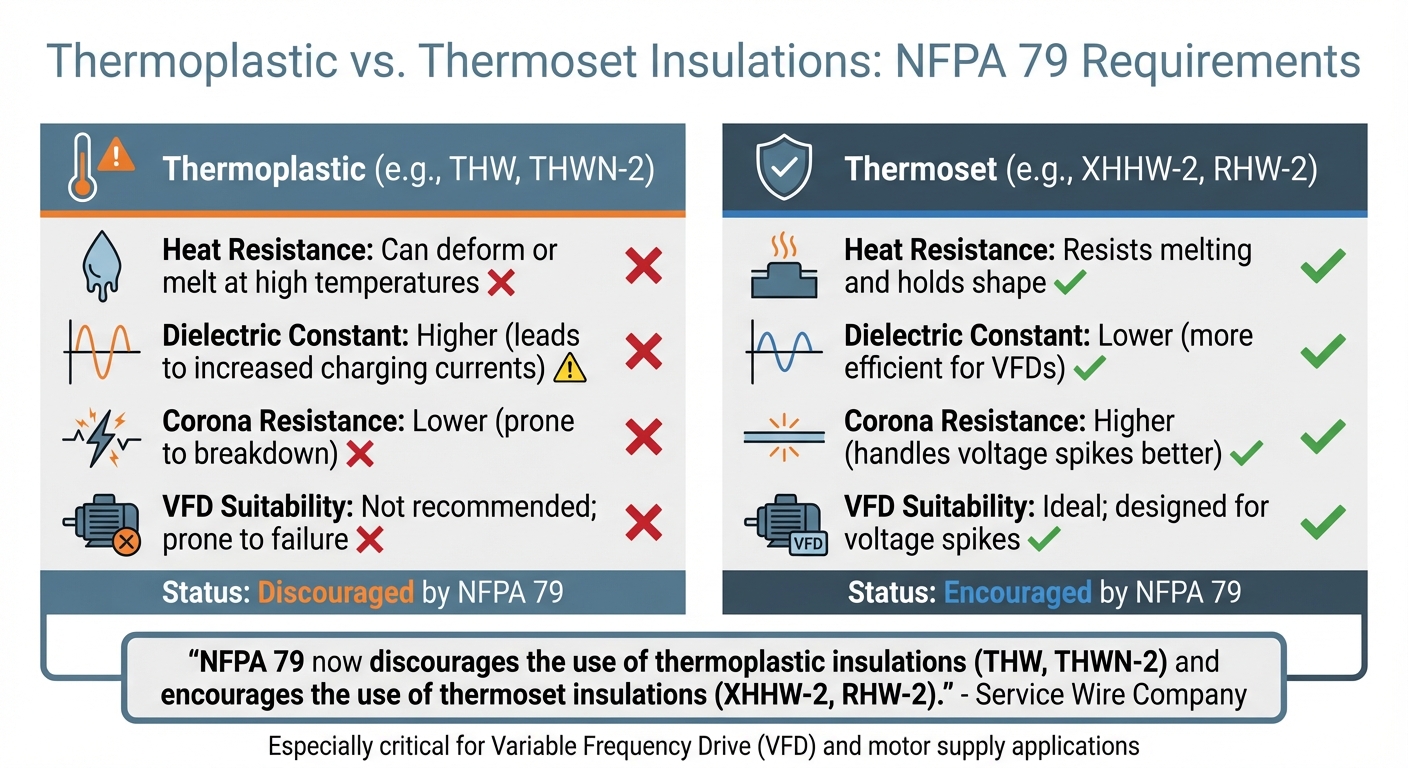
Thermoplastic vs. Thermoset Insulations
The decision between thermoplastic and thermoset insulations can significantly impact equipment reliability. Thermoplastic insulations, such as THW and THWN-2, are commonly used for general internal wiring but have certain limitations. Thermoset insulations, like XHHW-2 and RHW-2, are better suited for demanding applications.
"NFPA 79 now discourages the use of thermoplastic insulations (THW, THWN-2) and encourages the use of thermoset insulations (XHHW-2, RHW-2)." - Service Wire Company
| Property | Thermoplastic (e.g., THW, THWN-2) | Thermoset (e.g., XHHW-2, RHW-2) |
|---|---|---|
| Heat Resistance | Can deform or melt at high temperatures | Resists melting and holds shape |
| Dielectric Constant | Higher (leads to increased charging currents) | Lower (more efficient for VFDs) |
| Corona Resistance | Lower (prone to breakdown) | Higher (handles voltage spikes better) |
| VFD Suitability | Not recommended; prone to failure | Ideal; designed for voltage spikes |
Thermoset insulations have become the preferred choice for VFD applications due to their ability to handle voltage spikes and avoid the hot spots that can cause thermoplastic materials to fail. This shift aligns with NFPA 79's focus on enhancing equipment safety and reliability.
Surge Protection and Grounding Requirements
Proper wiring and insulation directly tie into surge protection and grounding requirements. According to NFPA 79 Section 7.8.1 (2024 Edition), machinery with safety circuits must have surge protection installed unless already shielded from lightning or switching surges. All surge protective devices (SPDs) must be UL 1449 listed to meet NFPA 79 and NEC standards.
"Industrial Machinery with safety circuits not effectively protected from the effects of overvoltages due to lightning or switching surges shall have surge protection installed." - NFPA 79: 2024 Section 7.8.1
Installing SPDs can dramatically improve system reliability. For example, a packaging facility reported a 70% drop in control board failures within a year of adding surge protection. This is especially critical for safety interlock systems, which protect workers from live electrical parts.
Grounding is another critical requirement under NFPA 79. Conductors for equipment grounding must follow NEC Table 250.122, and all exposed conductive parts must be properly grounded. A resistance of less than 0.1 ohm during continuity tests is a common benchmark for effective grounding. Grounding conductors must be green or green-yellow for easy identification, and all terminations should meet torque specifications and use strain relief for long-term reliability.
For VFD systems, specialized cables with multiple grounding conductors and shield terminations ensure a low-impedance path for stray currents. Additionally, disconnect switches must be clearly labeled as "Machine Supply Circuit" to avoid confusion during maintenance or lockout/tagout procedures.
Recent Updates to NFPA 79
Changes in Recent Editions
The NFPA 79 standard has seen several updates in its recent editions, introducing changes that directly impact the design, labeling, and protection of industrial equipment. One of the most notable changes in the 2018 edition was the increase in the nominal voltage limit from 600 volts to 1,000 volts. This adjustment aligns with the National Electrical Code and broadens the range of equipment covered under the standard. Additionally, stricter requirements were introduced for cables used in VFD (Variable Frequency Drive) and servo systems, mandating the use of listed flexible motor supply cables marked as RHH, RHW, RHW-2, XHH, XHHW, or XHHW-2.
The 2024 edition brought further updates aimed at improving safety and clarity. Machine disconnects must now be permanently labeled "Machine Supply Circuit" to avoid confusion during lockout/tagout procedures. This change was driven by multiple OSHA citations in 2022 related to improper or missing disconnect labels. Surge Protective Devices (SPDs) are also now required for sensitive circuits, ensuring protection for PLCs and sensors from voltage spikes. Another key revision involves multi-panel machines, which must now display a unified Short-Circuit Current Rating (SCCR) for the entire system instead of individual ratings for each panel. This ensures no component is under-specified for fault conditions.
For the first time, NFPA 79 has introduced cybersecurity guidelines. These guidelines recommend securing networked controls with firewalls and access permissions, a response to a 2021 ransomware attack that halted operations at a U.S. food processing plant for several days. Additionally, DC wires that remain energized even after the main disconnect is opened must now be marked with orange and blue stripes for clear identification.
These updates are particularly important for ensuring the safety, reliability, and efficiency of industrial equipment, especially in systems that rely on VFD and servo technologies.
Impact on VFD and Servo Systems
The 2018 edition of NFPA 79 introduced specific requirements for conductors used in VFD and servo systems. It mandates that conductors supplied by power conversion equipment must be listed flexible motor supply cables marked as RHH, RHW, RHW-2, XHH, XHHW, or XHHW-2. This change was made because thermoplastic insulations, such as THHN and THWN-2, have shown poor performance in VFD applications. These materials are prone to issues like standing voltage waves and high capacitance, which can lead to cable melting and dielectric breakdown. In moist environments, thermoplastic insulation can even produce nitric acid, further increasing the risk of failure.
"Electrical conductors and equipment supplied by power conversion equipment as part of adjustable speed drive systems and servo drive systems shall be listed flexible motor supply cable marked RHH, RHW, RHW-2, XHH, XHHW, or XHHW-2." – NFPA 79 2018 Edition, Article 4.4.2.8
Thermoset insulations, like XLPE (Cross-Linked Polyethylene), have become the preferred choice for these systems. Unlike thermoplastics, thermoset materials can withstand voltage spikes, hot spots, and corona discharge without deforming or melting. This shift helps ensure that VFD and servo systems operate reliably and efficiently throughout their lifecycle, reducing both downtime and maintenance costs. To stay compliant and avoid issues during inspections, manufacturers and integrators are encouraged to update their specifications to include thermoset-insulated cables for all new VFD installations .
How to Achieve NFPA 79 Compliance
Building Compliance into Equipment Design
Incorporating NFPA 79 requirements during the design phase is a smart way to ensure compliance while keeping costs in check. Start by defining the compliance boundary: the National Electrical Code (NEC) typically governs supply conductors up to the machine disconnect, while NFPA 79 focuses on the electrical equipment and wiring inside the machine from that point onward.
During the design process, follow standardized wiring practices. For control circuits, use 18 AWG stranded copper wire with 600 V-rated insulation, and stick to standard color codes: white or gray for grounded conductors and green (or green-yellow) for grounding. To avoid overheating, limit wireway fill capacity to 40% for signal and control wires and 20% for power wires.
If you're working with multi-panel machines, the 2024 edition brings some extra challenges. The system must have a unified Short-Circuit Current Rating (SCCR), determined by the lowest-rated component in the setup. Conduct a short-circuit study early in the design phase to ensure compatibility with the available fault current at the installation site . Also, test equipment grounding to confirm a resistance of less than 0.1 ohm.
The 2024 update also introduces cybersecurity requirements for networked machine control systems. To safeguard safety-critical processes, implement measures like firewalls, user authentication, and permission controls. Additionally, all disconnects must be permanently labeled "Machine Supply Circuit" to prevent lockout/tagout mistakes. For emergency stop circuits, design them as Category 0 or Category 1 per ISO 13850 standards, typically using monitored safety relays.
Designing a compliant system is just the first step. Choosing the right components is equally important.
Sourcing Compliant Components
The components you select play a huge role in maintaining compliance. Every electrical part must align with companion standards referenced in NFPA 79, such as UL 508A for industrial control panels or UL 489 for molded-case circuit breakers. To simplify compliance checks, maintain a detailed component schedule listing the manufacturer, model, and electrical ratings.
Verifying the Short-Circuit Current Rating of components is essential. Each part must be rated to handle the system's available fault current. For multi-panel setups, ensure all components meet the unified SCCR for the entire system. Disconnecting means should include a visible blade or position indicator and be lockable in the "OFF" position. For DC wiring that remains energized after the main disconnect is opened, use orange wire with blue stripes.
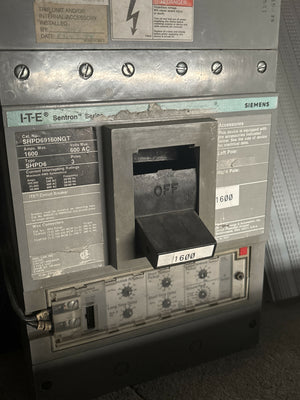
When sourcing parts like breakers, transformers, and control panels, platforms such as Electrical Trader offer both new and used equipment from reputable manufacturers. Always verify that components carry the appropriate UL listing and meet the voltage, amperage, and SCCR requirements of your application.
Third-party labeling from agencies like UL, ETL, or CSA provides independent assurance that components meet NFPA 79 standards . This is especially useful when dealing with international components, as third-party inspections may be required before local inspectors grant approval. To streamline inspections and maintain compliance throughout the equipment's lifecycle, keep thorough documentation. This includes electrical schematics, wire numbers, component schedules, wire lists, and safety circuit validations.
Conclusion
NFPA 79 compliance creates a vital safety framework designed to protect both individuals and machinery. While the National Electrical Code governs building wiring, NFPA 79 zeroes in on machine-specific requirements like control circuits, emergency stops, and protective bonding. These guidelines are essential for reducing electrical hazards at the equipment level and apply to industrial machinery operating at 1,000 volts or less. By addressing risks such as voltage spikes and fault currents, the standard ensures systems can handle operational stresses that might otherwise lead to catastrophic failures.
The benefits of compliance go beyond safety. Real-world examples highlight improvements in control board reliability when Surge Protective Devices are correctly implemented. This reliability stems from thoughtful component choices, such as using thermoset-insulated cables for variable frequency drives (VFDs), coordinating Short-Circuit Current Ratings (SCCR) across systems, and selecting components that align with standards like UL 508A and UL 489.
Planning ahead is key. Engaging with local inspection authorities early on can help you avoid expensive redesigns and failed inspections. As FireCodes.ai puts it:
"Verifying SCCR compatibility is not optional - it is a critical step in preventing catastrophic equipment failure during a fault event".
Achieving compliance involves conducting short-circuit studies, keeping thorough documentation, and ensuring that every component - whether it's a breaker or a transformer - has the appropriate third-party certification. Following these steps not only strengthens system performance but also enhances long-term operational reliability.
The 2024 updates to NFPA 79 bring additional considerations, including cybersecurity measures and unified SCCR labeling, which further protect critical systems. Staying up to date with these changes ensures your equipment remains compliant, inspection-ready, and safeguarded against emerging risks. By integrating NFPA 79 compliance from the outset, you can save time, minimize downtime, and boost overall safety across your facility.
FAQs
Does NFPA 79 or the NEC apply to my wiring?
NFPA 79 focuses specifically on the electrical systems of industrial machinery, while the NEC (National Electrical Code) governs general premises wiring.
Here’s the key difference: If the wiring is part of industrial equipment, NFPA 79 applies. On the other hand, for building wiring and connections, the NEC is the standard to follow.
Each serves a unique role, so it’s crucial to identify whether the wiring in question is tied to machinery or part of a building's electrical system.
What changes in NFPA 79:2024 affect existing machines?
The NFPA 79:2024 updates mandate the installation of Surge Protective Devices (SPDs) in circuits that are sensitive or tied to safety functions. These devices shield equipment from voltage surges, which could otherwise harm control systems or compromise safety interlocks. The goal is to improve both the dependability and safety of the equipment.
How do I determine the correct SCCR for a multi-panel machine?
To figure out the proper Short-Circuit Current Rating (SCCR) for a multi-panel machine, you need to ensure that each panel's SCCR matches or exceeds the available fault current at its supply circuit's disconnecting means. This means you'll need to determine the fault current at the line terminals of each supply circuit. It's important to note that every panel involved in controlling the machine must comply with this standard, no matter how many panels are part of the setup.