




Common NEC Violations in Industrial Settings
Electrical safety in industrial settings is non-negotiable. Yet, violations of the National Electrical Code (NEC) are frequent and dangerous, leading to injuries, fatalities, and operational risks. Here's what you need to know:
- Outdated wiring increases the risk of overheating and fires. Flexible cords and overloaded conduits are common violations.
- Improper grounding and bonding create shock hazards and disrupt fault protection. Misusing conductor sizing tables is a frequent mistake.
- Overloaded panels and insufficient working space around equipment pose fire risks and obstruct emergency access.
- Poor labeling slows maintenance and compromises safety. Missing fault current and circuit identification labels are typical issues.
- Equipment mismatches - like exceeding fault current ratings or using enclosures unsuited for harsh conditions - can lead to severe equipment failure.
Key takeaway: Regular inspections, adherence to NEC standards, and proper equipment selection are critical for safety and compliance. Address these violations proactively to reduce risks and maintain smooth operations.
Outdated or Incorrect Wiring Methods
Wiring Problems in Industrial Facilities
Old and brittle wiring, conductors that are too small for their load, and the improper use of flexible cords as permanent wiring can lead to serious safety issues. These practices violate NEC standards and increase the likelihood of overheating, short circuits, and even fires. A common issue in many industrial facilities is the use of extension cords or flexible cords threaded through walls, ceilings, or mounted on building surfaces - actions that directly conflict with NEC requirements.
Another problem is improperly sealed or secured junction boxes, which allow moisture and debris to infiltrate, compromising the system's integrity. Overfilled conduits are another hazard, as they can trap heat, speeding up insulation failure. Installers often neglect to adjust conductor ampacity for factors like ambient temperature or the number of conductors bundled together. For example, NEC Table 310.16 assumes an ambient temperature of 86°F and limits the number of current-carrying conductors to three. If more than 20 conductors are bundled for over 24 inches, the ampacity must be reduced by 60%. Unfortunately, such adjustments are often overlooked during retrofits, which underscores the importance of adhering to NEC guidelines for safe wiring practices.
NEC Standards for Wiring Methods
NEC Article 310 provides detailed requirements for conductors, including insulation types, ampacity ratings, and usage conditions. Mike Holt, owner of Mike Holt Enterprises, explains:
"Article 310 contains the general requirements for conductors, such as their insulation markings, ampacity ratings, and conditions of use".
For circuits rated at 100A or less, the 60°C ampacity column is usually applied unless the equipment is specifically designed for higher temperatures. For circuits exceeding 100A, the 75°C column is the standard.
NEC Article 314 addresses box and conduit fill limits to prevent physical damage during installation and reduce heat buildup. It also requires that metal raceways, cable armor, and enclosures be metallically joined to create a continuous conductor capable of safely managing fault currents. Additionally, the code prohibits running wiring through ducts that carry dust, loose material, or flammable vapors.
How to Fix Incorrect Wiring
To resolve these issues, it's essential to follow NEC standards closely. Start by conducting accurate load calculations and replacing outdated wiring with conductors rated for the environment's temperature. Ensure conduit and box fill comply with NEC Article 314, and eliminate the use of temporary wiring solutions such as extension cords.
For facilities with nonlinear loads, Mike Holt advises:
"To prevent fire or equipment damage from excessive harmonic neutral current, the designer should consider increasing the size of the neutral conductor or installing a separate neutral for each phase".
Additionally, make sure all junction boxes and cabinets located in damp or wet areas are weatherproof and mounted with at least a 0.25-inch air gap from the wall. These steps not only improve safety but also ensure compliance with NEC standards.
The Most Common Code Violation!!!
Grounding, Bonding, and Overcurrent Protection Violations
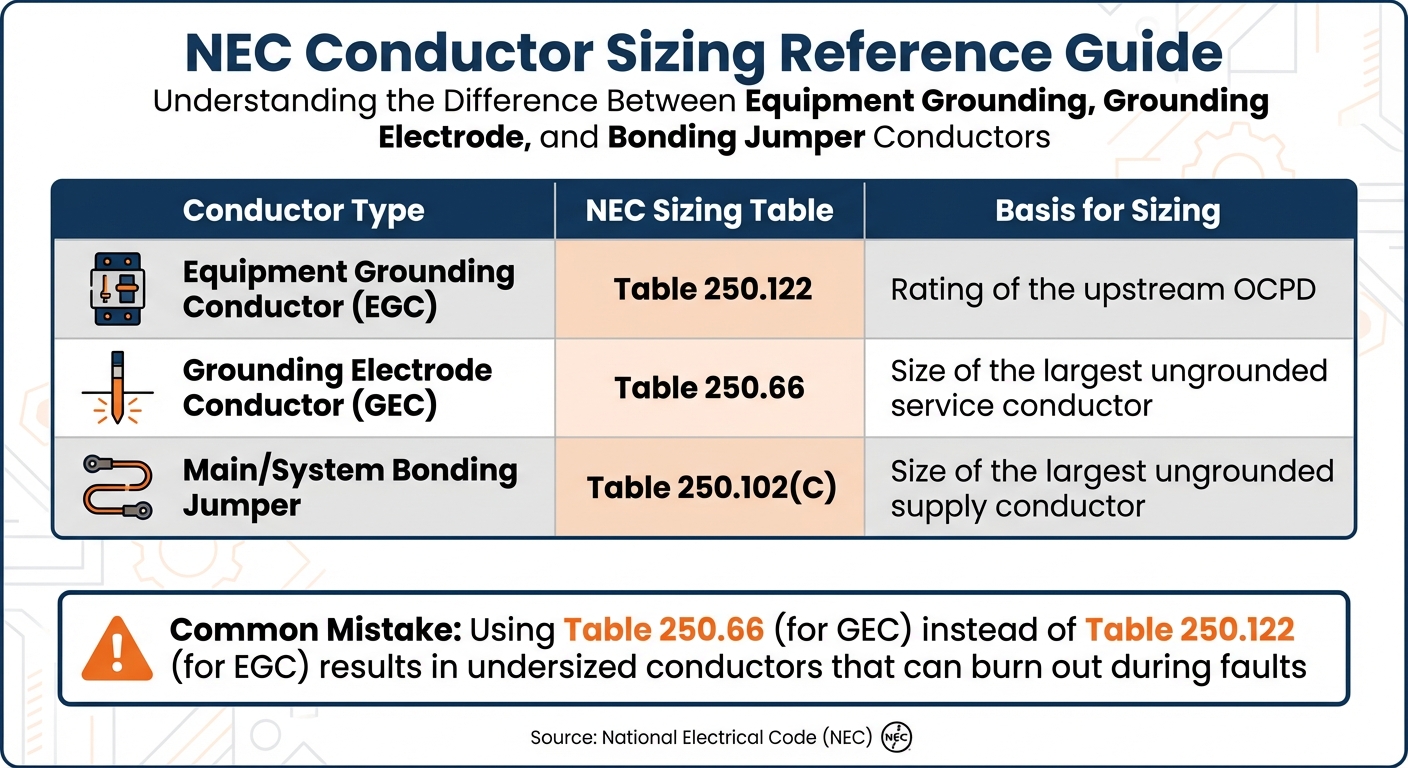
NEC Conductor Sizing Tables: EGC vs GEC vs Bonding Jumper Comparison
Grounding and Bonding Violations
Improper grounding and bonding can lead to serious shock risks. A particularly hazardous violation occurs when the neutral conductor is connected to the equipment grounding conductor downstream from the service equipment. This setup creates parallel paths for neutral current to flow across metal enclosures and raceways, effectively energizing these surfaces. As Mike Holt puts it:
"Load side neutral connections to metal parts or equipment grounding conductors are prohibited to prevent dangerous neutral currents on conductive surfaces".
Another common issue arises when metal conduit is used as the equipment grounding conductor (EGC). If setscrews, locknuts, or threads are not properly secured - often during equipment relocation or repairs - the ground path can become disconnected. Similarly, using improper jumpers in chained grounding conductors is risky. Removing one device can disrupt grounding continuity for all downstream equipment.
Incorrect conductor sizing is another safety concern. Many installers mistakenly reference Table 250.66 (used for Grounding Electrode Conductors) instead of Table 250.122 (used for Equipment Grounding Conductors). This error often results in undersized conductors that can burn out during faults. The NEC mandates that grounding electrodes have a maximum resistance of 25 ohms. However, if a single ground rod exceeds this, a second rod must be installed. For large industrial setups, the International Electrical Testing Association (NETA) recommends a much stricter resistance of 5 ohms or less. Beyond grounding issues, mismatched overcurrent devices add to the risk by delaying protective trips.
Mismatched Overcurrent Devices
Using the wrong circuit breakers or fuses can delay overcurrent protection, increasing the risk of overheating and fire. A common mistake is installing an overcurrent protective device (OCPD) with a higher rating than the ampacity of the conductors it protects. For example, pairing a 30A breaker with 12 AWG wire (rated for 20A) allows dangerous overheating before the breaker trips.
When conductors are upsized to address voltage drop on long cable runs, the equipment grounding conductor must also be increased proportionally, as required by NEC 250.122(B). This critical detail is often overlooked during retrofits, leaving undersized grounding paths that cannot provide the low impedance needed for the OCPD to trip quickly. Derek Vigstol, an electrical safety consultant at E-Hazard, explains:
"OCPDs open faster with more current... This low opposition to current flow and direct path back to the source spikes the current high enough to be within the instantaneous trip range of the OCPD".
| Conductor Type | NEC Sizing Table | Basis for Sizing |
|---|---|---|
| Equipment Grounding Conductor (EGC) | Table 250.122 | Rating of the upstream OCPD |
| Grounding Electrode Conductor (GEC) | Table 250.66 | Size of the largest ungrounded service conductor |
| Main/System Bonding Jumper | Table 250.102(C) | Size of the largest ungrounded supply conductor |
How to Fix Grounding and Overcurrent Protection
To address grounding issues, start by auditing all grounding connections. Use continuity tests on metal raceways and confirm that setscrews and locknuts are properly tightened and free of corrosion. Ensure that the main bonding jumper is installed only at the service disconnect. For wiring devices, always use pigtail jumpers to maintain grounding continuity, even when devices are removed.
Test ground resistance with appropriate equipment instead of assuming compliance with the NEC's 25-ohm requirement. For facilities with sensitive electronics, aim for a resistance of 5 ohms or less. Install multiple ground rods, ensuring they are spaced at least twice the rod length apart (e.g., 16 feet for 8-foot rods).
When it comes to overcurrent protection, verify that OCPD ratings match the ampacity of the conductors they protect. During retrofits, check if grounding conductors were upsized proportionally when power conductors were increased to address voltage drop. Always use Table 250.122 to size equipment grounding conductors based on the OCPD rating, not the conductor size.
Overloaded Panels, Working Space, and Accessibility Violations
Overloaded Panels and Transformers
Upgrading industrial systems often leads to overloaded panels and transformers, posing serious safety hazards. Older panels designed for lower capacities struggle under the demands of modern equipment, leading to frequent breaker trips and overheating. The situation becomes even riskier when too many devices are connected to a single circuit or when the panelboard's rated capacity is exceeded.
A related issue is overfilling junction boxes with excessive conductors, connectors, or splices. According to NEC 314.16, there are strict limits on box fill to prevent dangerous heat buildup that can damage wire insulation. Unlike temporary wiring problems, panel overloads are typically the result of a permanent mismatch between the growing power needs of modern machinery and aging infrastructure. Addressing these overloads also requires maintaining safe working spaces around the equipment.
Working Space and Clearance Violations
Overloaded panels don't just strain circuits - they also contribute to unsafe working conditions. Physical obstructions around electrical equipment are among the most hazardous yet avoidable violations. Mike Holt, Owner of Mike Holt Enterprises, highlights the importance of maintaining clear access:
"For the safe operation and maintenance of equipment, access to and egress from working space must exist around all electrical equipment".
NEC 110.26 mandates clear working spaces around electrical equipment. Specifically, there must be a minimum depth of 3 feet, a width of at least 30 inches (or the width of the equipment, whichever is greater), and a headroom clearance of 6.5 feet. Additionally, equipment doors must open a full 90 degrees. However, many industrial facilities violate these rules by storing materials or routing mechanical piping through these areas.
The "dedicated equipment space" requirement further specifies that the area from the floor to 6 feet above the equipment must remain free of foreign systems. Unfortunately, inspectors often find violations like transformers installed beneath panels, mechanical piping crossing electrical spaces, or construction materials blocking access. As Holt explains:
"It is inherently dangerous to service energized parts. It is unacceptable to be subjected to additional dangers by working around bicycles, boxes, crates, appliances, and other impediments".
How to Fix Panel Overloads and Working Space Issues
To address these issues, start with a pre-installation walk-through involving mechanical and plumbing teams. This ensures that ductwork and piping are routed away from electrical working spaces, preventing violations before they occur. When installing new panels, select enclosures with extra room to accommodate future upgrades like surge modules, submetering, or control boards. This approach also helps meet box fill limits and NEC requirements for industrial retrofits.
Implement a predictive maintenance program to identify overheating components and frequent breaker trips before they lead to failures. Always ensure replacement breakers are compatible with the panelboard's specific rating.
Establish strict "no-storage" zones around all electrical equipment. Clear spaces are essential for workers to move quickly or escape during an arc flash event. For equipment rated at 1,200A or more, ensure that nearby doors (within 25 feet) open outward and are equipped with panic hardware. Holt underscores this point:
"Electricians who suffer burns on their hands in electrical arc flash or arc blast events often can't open doors equipped with knobs that must be turned, and they can't pull a door that opens toward them".
If piping or other systems must run above electrical equipment (outside the dedicated space), install secondary drip pans to prevent moisture from reaching the equipment. Also, remember that walls made of concrete, brick, or tile are considered grounded surfaces, which require 3.5 feet of clearance for 480V systems - slightly more than the 3 feet required for installations with exposed live parts on only one side.
sbb-itb-501186b
Labeling, Documentation, and Identification Problems
Labeling and Documentation Issues
Poor labeling isn't just inconvenient - it can jeopardize safety and slow down critical maintenance work. Labels like "Lights" or "Plugs" are too vague and violate NEC 408.4, making it difficult to quickly identify circuits. Even worse, labels tied to temporary uses, like "Dad's Office", become meaningless as spaces and their purposes change over time.
In harsh industrial environments, hazard markings often fade or fall off, leaving vital safety information unreadable. A common issue is the lack of fault current labels on service equipment, despite NEC 110.24 requiring these labels to include the maximum fault current and the date of calculation. Facilities often neglect to update these labels after system modifications or utility changes, creating potential hazards.
Control panels come with their own set of challenges. Missing Short Circuit Current Rating (SCCR) markings, as mandated by NEC 409.110, can leave maintenance teams unsure if replacement components can handle available fault currents. Additionally, panels powered by multiple sources often lack proper warning signs. This can lead workers to mistakenly believe equipment is de-energized after disconnecting one source, while others remain live.
NEC Standards for Labeling and Identification
To address the risks of poor labeling, the NEC provides clear standards to ensure labels remain legible and durable in tough industrial conditions. For instance, NEC 110.21(B) requires field-applied labels to withstand environmental factors like heat, moisture, or chemical exposure and remain readable for the equipment's entire service life.
Mark C. Ode, Owner of Southwest Electrical Training and Consulting, highlights the importance of proper identification:
"The markings' purpose is to provide more information involving the source's identification so the circuits can be shut down by putting them into an electrically safe work condition or to implement lockout/tagout procedures."
Additionally, NEC 110.22(A) mandates that disconnecting means must clearly indicate their purpose and the circuit source supplying them. This is crucial for safely implementing lockout/tagout procedures under NFPA 70E. For equipment rated at 1,200A or more, NEC 110.16(B) requires permanent labels detailing system voltage, fault current, overcurrent device clearing time, and the date the information was applied.
How to Fix Labeling and Documentation
Improving labeling and documentation to meet NEC standards isn't just about compliance - it's about creating a safer environment. Here are some practical steps to get it right:
-
Use durable materials: Industrial-grade options like self-laminating vinyl wraps or heat-shrink tubing resist peeling and fading far better than standard adhesive labels. Todd Fries, Technical Consultant at HellermannTyton, underscores the importance of this:
"The labeling of equipment in a facility is not only critical, but also tied directly to NEC, OSHA, ANSI, and NFPA regulations and standards."
- Simplify naming conventions: Avoid overly complex identifiers like "DSM-310-TAN-MDP." Instead, use straightforward names like "Main SWBD 312" to make emergency responses faster and more efficient. If you use color-coding for different voltage systems, post a permanent legend at each branch-circuit panelboard, as required by the NEC.
- Keep documentation updated: Maintain electronic copies of riser diagrams, floor plans, and overcurrent protection device settings. Update these documents whenever modifications occur. Arc flash and PPE labels should also be refreshed after system changes or at least every five years. When documenting breaker settings, include leading zeros to prevent misinterpretation of decimal points. Clearly label torque values near equipment terminals to ensure proper connections during servicing.
Accurate and durable labeling is just as important as proper wiring and grounding when it comes to maintaining a safe and efficient industrial electrical system.
Equipment Selection and Replacement in Industrial Retrofits
Industrial Equipment Selection Issues
When it comes to industrial retrofits, choosing the right equipment is just as important as proper wiring and grounding to stay compliant with the NEC. Using the wrong equipment can lead to serious hazards. One common mistake is installing equipment in areas where the available fault current exceeds the equipment's Short-Circuit Current Rating (SCCR). For example, relocating older equipment to a newer facility might expose it to higher fault currents, surpassing its SCCR and violating NEC Sections 409.22 or 670.5.
Another frequent issue is confusing the interrupting rating (IR) of overcurrent devices with the SCCR of equipment. The IR, defined in NEC 110.9, refers to the maximum current a device like a circuit breaker can safely interrupt. On the other hand, the SCCR, outlined in NEC 110.10, is the maximum current the equipment can withstand without severe damage. As Daniel R. Neeser, Senior Field Application Engineer at Eaton's Bussmann Division, points out:
"If inadequate overcurrent protective device IR or equipment SCCR is present, a serious potential safety hazard exists."
Voltage mismatches are another concern. Installing equipment where the circuit's nominal system voltage exceeds the equipment's voltage rating violates NEC 110.4 and creates safety risks. Environmental conditions also play a role - using standard enclosures in corrosive or wet environments instead of enclosures rated for such conditions (per Table 430.91) can cause premature failures and compromise safety.
NEC Standards for Equipment Selection
The NEC provides clear guidelines to prevent these equipment selection errors. Section 110.3(B) mandates that all listed or labeled equipment must be installed and used according to the manufacturer's instructions. Misusing equipment outside its intended application is a violation. Mike Holt, a respected NEC consultant, underscores this point:
"Equipment that is listed, labeled, or identified must be installed per manufacturer's instructions."
For industrial control panels, NEC Article 409 requires specific markings. According to Section 409.110, panels must display information like voltage, full-load current, and SCCR unless they only contain control components without power loads. When determining the SCCR for custom or modified panels, the rating is limited by the component with the lowest SCCR. Steven Owen, President of National Code Seminars, explains:
"The SCCR marked on the panel must be based on the lowest rating of any of the devices within the enclosure."
Section 110.14(C) addresses conductor sizing based on terminal temperature ratings. A common mistake occurs when conductors are sized using the 90°C column of Table 310.16, even though the equipment terminals are rated for only 60°C or 75°C. Additionally, Section 110.21(B) requires that field-applied labels and markings must be durable enough to last the equipment's entire service life, considering the specific environment.
How to Select and Replace Equipment Correctly
Proper equipment selection and replacement involve several key steps, all rooted in NEC standards. Start by calculating the available fault current at the installation point. This value varies - it’s highest near the utility transformer and decreases as system impedance increases further downstream. Any changes to system impedance, like altering conductor length or material, require recalculating the fault current and verifying equipment ratings per NEC 110.24(B).
When modifying industrial control panels, ensure every new component - whether it’s a circuit breaker, motor controller, or relay - has an SCCR that meets or exceeds the available fault current. Even a single component with a lower rating can reduce the panel’s overall SCCR. For supply conductors, size them to handle at least 125% of the full-load current of all resistance heating loads, plus 125% of the highest-rated motor, along with all other connected loads.
Use Table 430.91 to choose enclosures suitable for environmental conditions like dust, water, oil, or corrosive atmospheres. Ensure conductor terminals are rated for the specific material - whether copper or aluminum - and torque connections to the manufacturer’s specifications. Improper torquing can lead to connection failures and NEC violations.
When sourcing replacement components, platforms like Electrical Trader (https://electricaltrader.com) can be a helpful resource for finding both new and used electrical equipment, including breakers, transformers, and control panels. This is particularly beneficial for facilities working within budget constraints. However, always verify that replacement equipment, whether new or used, meets the required SCCR, voltage ratings, and environmental specifications before installation.
If relocating equipment from another facility, calculate the available fault current at the new location to ensure compatibility. The goal is to prevent faults from causing external ignition hazards or extensive equipment damage.
Conclusion
Addressing NEC violations in industrial settings is crucial for ensuring the safety of people, protecting equipment, and maintaining smooth operations. A properly maintained electrical system not only minimizes the risk of severe incidents but also helps keep operations running without interruptions.
The violations discussed - ranging from outdated wiring and improper grounding to overloaded panels and missing labels - can lead to serious consequences. Non-compliance with the NEC can result in accidents, fines, operational shutdowns, and even legal liabilities. Since the NEC is updated every three years to incorporate advancements in safety research and technology, staying up-to-date is not optional - it’s essential. This highlights the importance of reviewing every component within an electrical system to ensure compliance.
Once wiring and grounding issues are addressed, selecting the right replacement equipment becomes equally important. Always confirm that components meet the required Short-Circuit Current Rating (SCCR), voltage specifications, and environmental conditions. For facilities working within tight budgets, platforms like Electrical Trader offer both new and used electrical equipment. However, it’s critical to verify that every item complies with NEC standards before installation.
Regular audits by qualified electricians are your best defense against hidden violations. Comprehensive electrical safety assessments can help identify and resolve issues before they escalate. Make sure workspaces around panels meet NEC 110.26 requirements, confirm that overcurrent devices are properly rated for the equipment, and maintain thorough records of all inspections and repairs. Recent updates, such as Section 110.17, now require that only trained and qualified professionals handle electrical maintenance tasks.
Compliance isn’t just about avoiding penalties - it ensures safer operations, reduces energy costs, extends the lifespan of equipment, and protects against financial and legal risks. The National Electrical Code remains a vital tool for safeguarding both professionals and the public.
FAQs
What are the most common NEC violations in industrial facilities, and how can they be addressed?
Some frequent NEC violations found in industrial environments include outdated or undersized wiring, improper grounding, and overloaded circuits. These problems go beyond just breaking code requirements - they can lead to serious safety hazards like electrical fires or damage to equipment.
The best way to tackle these issues is through regular inspections carried out by qualified professionals. These experts can pinpoint and fix installations that don’t meet standards. Steps like upgrading outdated wiring, enhancing grounding systems, and ensuring electrical loads are properly balanced can help keep your facility compliant and safe.
What safety risks can outdated wiring cause in industrial facilities?
Outdated wiring in industrial facilities isn't just an inconvenience - it can be a serious safety hazard. Over time, the insulation on wiring can deteriorate, becoming brittle or cracking. This exposes the conductors to moisture, chemicals, or physical damage, which significantly increases the risk of short circuits. These short circuits can ignite nearby combustible materials, potentially leading to dangerous electrical fires. On top of that, older wiring systems often struggle to handle the power demands of modern equipment. This can result in overheating, which may damage insulation, melt components, and create even more fire risks.
But the dangers don’t stop there. Faulty or outdated wiring can also pose severe shock risks. Missing, corroded, or improperly sized grounding conductors can allow fault currents to travel through equipment frames, putting workers at risk of exposure to dangerous, even lethal, voltages.
The solution? Upgrading to modern, NEC-compliant wiring systems. This includes using updated conductors, properly rated conduit, and dependable grounding hardware. Platforms like Electrical Trader simplify the process by offering a wide range of breakers, transformers, and wiring accessories. By making these upgrades, you can ensure your facility meets today’s safety standards while protecting both your team and your equipment.
Why is proper labeling crucial for electrical safety and compliance in industrial settings?
Proper labeling plays a crucial role in ensuring electrical safety and meeting regulatory standards in industrial settings. Clear and accurate labels provide essential details about equipment, voltage, current, and potential hazards. This information helps workers identify risks more effectively and prevent accidents. According to OSHA regulations, safety signs and labels are mandatory wherever electrical hazards exist, and failing to comply can result in hefty fines.
Beyond OSHA requirements, standards like the NEC and NFPA 70E specify the need for proper markings to support safe energized work and lockout/tagout procedures. Up-to-date labels allow electricians to quickly identify breakers, confirm fault-current levels, and align protective equipment with potential hazards. This not only minimizes the risk of injuries but also helps prevent downtime and equipment damage. For facilities aiming to improve their labeling systems, Electrical Trader offers a variety of industrial-grade labels and signage solutions that prioritize safety and long-term durability.





