

How to Ensure NEC Compliance in Class I Locations
Working in areas with flammable gases or vapors? NEC Article 501 is your guide to staying safe and compliant.
Here’s what you need to know:
- Class I hazardous locations are areas where flammable gases, vapors, or liquids may create explosive conditions.
- These areas are divided into:
- Division 1: Flammable substances are present during normal operations.
- Division 2: Flammable substances are present only during abnormal conditions (e.g., equipment failures).
-
Key safety measures include:
- Explosion-proof enclosures
- Properly rated equipment for gas groups (A, B, C, D)
- Sealing fittings to prevent gas migration
- Approved wiring methods like Rigid Metal Conduit (RMC) or Metal-Clad Hazardous Location (MC-HL) cables.
- Inspection and maintenance are critical. Equipment must be labeled, regularly checked, and meet NEC standards.
Why it matters: NEC compliance reduces the risk of explosions, protects workers, and helps avoid OSHA penalties. Use certified components and follow proper installation methods to ensure safety.
For more details, including equipment selection and wiring methods, read on.
Hazardous Classified Locations, NEC 2020 - [500.5], (17min:43sec)
sbb-itb-501186b
Understanding Division 1 and Division 2 Classifications
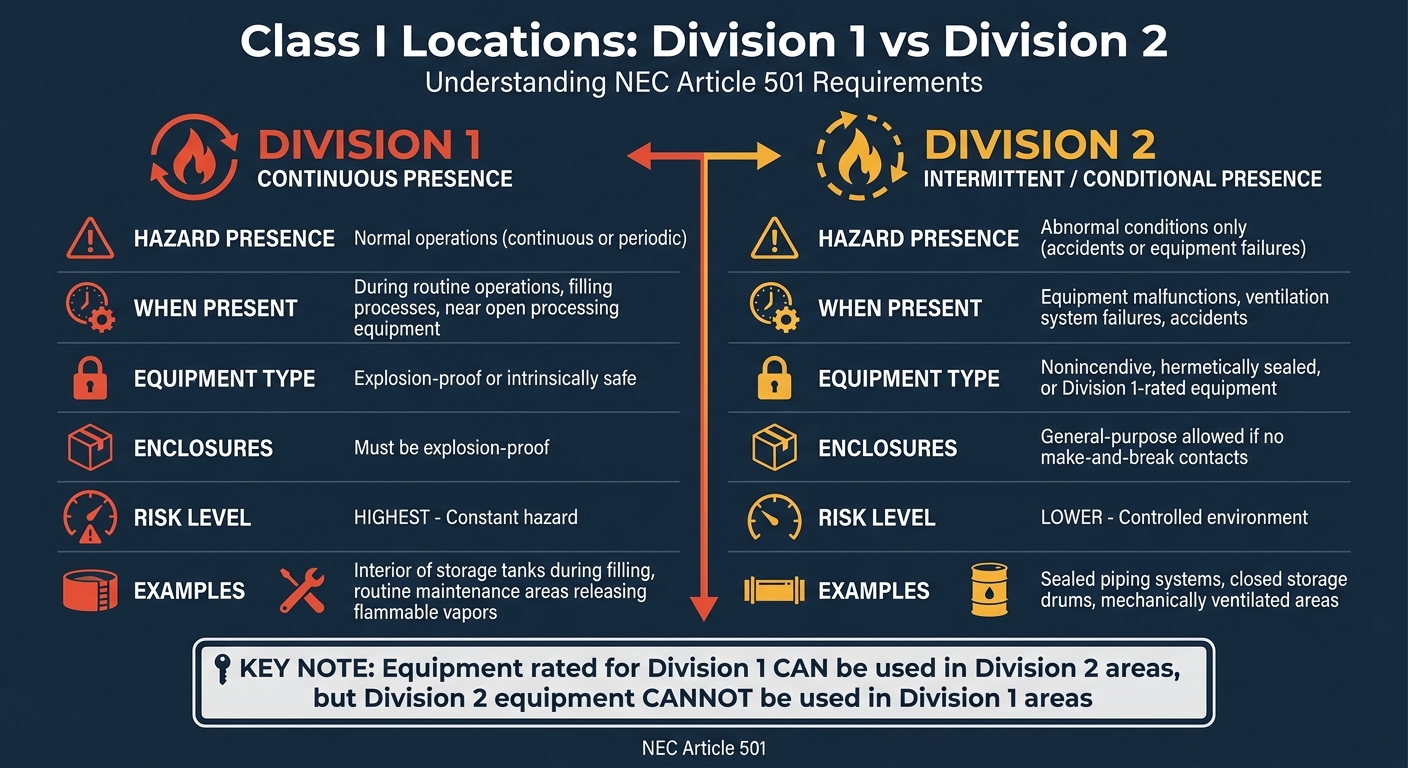
NEC Class I Division 1 vs Division 2 Requirements Comparison Chart
Class I locations are categorized into Division 1 and Division 2, depending on how often and under what conditions flammable gases or vapors are present. These classifications are crucial for determining the right equipment and installation methods.
Division 1
Division 1 refers to areas where flammable concentrations are present during normal operations. This could occur regularly, such as during filling processes or near open processing equipment. Examples include the interior of storage tanks during filling or spaces where routine maintenance activities might release flammable vapors.
Mike Holt, a respected NEC Consultant, explains:
"Division 1 applies to normal conditions. For example, ignitable vapors are usually present or may be present frequently due to routine maintenance... Division 2 applies to abnormal conditions. For example, ignitable vapors are not usually present but abnormal operation can result in their release."
Division 2
Division 2 covers areas where flammable hazards only arise under abnormal conditions, such as equipment malfunctions or accidents. These areas might include locations with sealed piping systems, closed storage drums, or those where mechanical ventilation typically prevents hazardous buildup - unless that ventilation fails.
| Feature | Division 1 | Division 2 |
|---|---|---|
| Hazard Presence | Normal operations (continuous or periodic) | Abnormal conditions (accidents or equipment failures) |
| Equipment Type | Explosion-proof or intrinsically safe | Nonincendive, hermetically sealed, or designed for Division 1 conditions |
| Enclosures | Must be explosion-proof | General-purpose allowed if they lack make-and-break contacts |
| Risk Level | Highest - constant hazard | Lower - controlled environment |
Equipment Considerations
Equipment rated for Division 1 can also be used in Division 2 areas, but the reverse is not true. If equipment is placed near a classification boundary, it’s safer to apply the higher classification or relocate the equipment to avoid potential risks.
These classifications are essential for selecting the right equipment to ensure safe and compliant installations in hazardous environments.
Choosing Equipment for Class I Locations
When working in Class I locations, following the NEC Article 501 guidelines and understanding hazard classifications is essential. Properly rated equipment ensures both safety and compliance with regulations.
Required Equipment Ratings and Certifications
Electrical equipment used in Class I areas must carry an NRTL label, such as one from Underwriters Laboratories (UL), confirming it is approved for hazardous environments.
This label provides critical information, including the Class, Division, Group, and Temperature Code (T1–T6). The Temperature Code indicates the maximum surface temperature of the equipment, ensuring it remains below the auto-ignition temperature of any flammable materials present.
Before selecting equipment, cross-check the flammable material’s Group classification using resources like NFPA 497 or the Safety Data Sheet (SDS). For example, working with acetylene (Group A) or hydrogen (Group B) requires equipment specifically rated for these materials.
NEC Article 501 compliance can be achieved through a variety of methods:
- Explosion-proof enclosures: Contain internal explosions and cool escaping gases.
- Purged and pressurized systems: Types X, Y, or Z systems maintain safe operating conditions.
- Intrinsically safe equipment: Designed to eliminate ignition risks.
In Division 2 areas, general-purpose equipment may be acceptable if it lacks ignition sources, such as make-and-break contacts, under normal operating conditions.
Once you have identified certified equipment, the next step is sourcing it from reliable suppliers.
Where to Find Compliant Electrical Components
To ensure compliance, only purchase equipment from suppliers offering NRTL-listed components. For instance, platforms like Electrical Trader provide a variety of NEC-compliant products, such as breakers, transformers, and power distribution units, specifically designed for hazardous locations. Always verify that the labels on these components meet the required Class, Division, Group, and Temperature Code standards.
For automation needs, modern components like HMIs, PLCs, and VFDs now come with Class I, Division 2 ratings. These options can simplify installations in lower-risk areas by reducing the need for heavy explosion-proof enclosures.
In Division 1 areas, it’s crucial to use approved sealing fittings within 18 inches of enclosure entries to prevent explosive gases from entering. For environments involving hydrogen (Group B), opt for components made from durable materials like 316 stainless steel or 6061 aluminum, as these resist embrittlement.
Wiring Methods for Class I Locations
Once you've chosen equipment that complies with NEC standards, it's crucial to use proper wiring methods to ensure safe installations in hazardous areas. NEC Article 501 outlines specific practices that help prevent gas migration and reduce ignition risks in Class I hazardous locations. The correct selection of conduits and cables creates a containment system that limits explosions and stops flammable gases from spreading between enclosures.
Conduit Systems and Sealing Fittings
Threaded Rigid Metal Conduit (RMC) and threaded steel Intermediate Metal Conduit (IMC) are the primary wiring options approved for Class I, Division 1 locations. To maintain explosionproof integrity and prevent sparking, all conduit connections must be wrench-tight, as required by OSHA Standard 1910.307.
Additionally, NPT tapered conduit connections must have at least five full threads engaged for safety. The Steel Tube Institute explains:
"The threaded connections allow the burning gas to cool as it escapes, so that any explosion would be confined to the inside of the conduit."
This cooling effect is critical for preventing ignition of the surrounding atmosphere during an internal explosion.
Sealing fittings (also known as seal-offs) are another essential component. These must be installed within 18 inches of explosionproof enclosures in Division 1 areas, especially when the enclosure houses equipment that generates arcs, sparks, or high temperatures. The section of conduit between the seal and the enclosure must remain free of unions, couplings, or other fittings - only explosion-proof reducers are allowed. Boundary seals are also necessary where conduit exits a Division 1 area to stop gases from migrating into unclassified zones.
For equipment that requires movement or vibration, use explosion-proof flexible conduits. When bonding, opt for approved bonding jumpers instead of standard locknut-bushing connections to ensure proper electrical continuity.
While conduit systems are the primary choice, certain cable types also meet NEC requirements for hazardous locations.
Approved Cable Types
In addition to conduit systems, specific cables provide compliant wiring alternatives. Mineral-Insulated (MI) cable with gas-tight copper sheathing and Metal-Clad Hazardous Location (MC-HL) cables with continuous gas-tight armor and sheathing are approved for both Division 1 and Division 2 areas. When installed correctly, these cables offer a reliable alternative to traditional conduit systems.
The wiring methods differ slightly between Division 1 and Division 2 areas. Division 1 requires threaded RMC or IMC, while Division 2 allows RMC or IMC with threadless fittings, provided the fittings are listed for hazardous locations. However, Electrical Metallic Tubing (EMT) is prohibited in Class I locations and is only approved for Class II and Class III environments.
When selecting wiring methods, ensure all conduits and fittings are marked for use in Class I locations and are compatible with the specific gas group (A, B, C, or D) in your environment. For installations involving Group B gases, such as hydrogen, stricter equipment standards and tighter specifications are necessary due to lower Maximum Experimental Safe Gap (MESG) requirements.
Inspection, Labeling, and Maintenance Requirements
Once the right equipment is chosen and installed, keeping it in compliance with NEC standards for Class I locations requires regular inspections and careful maintenance.
Inspection Procedures and Record Keeping
To ensure safety, verify that every component is properly listed for its specific Class, Division, and Group of the hazardous location. Pay close attention to temperature markings on equipment like motors and luminaires, making sure they stay below the autoignition temperature of the gases or vapors present. Mike Holt, an NEC Consultant, emphasizes:
"Equipment in Class I locations must not have any exposed surfaces that reach temperatures higher than the autoignition temperature of the gas or vapor present [500.8(B)]."
Check that threaded entries meet the required standard - at least five full threads (or 4.5 for listed equipment) - and that connections are wrench-tight to preserve explosionproof integrity. Any unused openings should be sealed with listed metal close-up plugs, and seals must be inspected to confirm proper installation.
It’s also important to maintain records of equipment listings, certifications, and manufacturer evaluations for review by the Authority Having Jurisdiction (AHJ). These inspection activities tie directly into accurate equipment labeling practices for hazardous areas.
Equipment and Area Labeling
Every piece of equipment used in Class I locations must be listed and approved for the specific hazardous environment by the AHJ. For conduit systems, standard threaded rigid metal conduit (RMC) and intermediate metal conduit (IMC) couplings need to bear the "EC" stamp, showing they meet UL listing standards (UL 6 or UL 1242) for hazardous locations. Always confirm that the required "EC" marking is present on conduit couplings.
Equipment identification follows UL information category AAIZ, which applies to equipment used in Class I, II, and III, Division 1 and Division 2 locations. Both threaded and threadless fittings must be explicitly listed for hazardous environments. Use the NFPA 497 guide, Recommended Practice for the Classification of Flammable Liquids, Gases, or Vapors, to determine the extent of hazardous areas before labeling or installing equipment.
Once labeling is complete, ongoing maintenance becomes essential to ensure compliance.
Maintenance Procedures
Scheduled maintenance is key to preserving the safety ratings of Class I equipment. For instance, inspect sealing fittings to confirm they meet NEC installation standards. Keep enclosures intact to prevent ignition risks, and if any joint is compromised, use an approved bonding jumper to restore integrity.
Facilities must also maintain updated classified area drawings. These should be accessible to personnel responsible for inspecting, maintaining, or operating the equipment. Anytime the facility undergoes changes - like introducing new chemicals or altering equipment density - these drawings should be reviewed and updated. During maintenance, always follow lockout-tagout (LOTO) procedures to avoid accidental ignition. Additionally, ensure maintenance staff receive thorough training on area classification, emergency protocols, and the proper handling of explosion-proof or intrinsically safe equipment.
Conclusion
Why Meeting NEC Standards Matters
Complying with NEC Article 501 ensures that Class I locations are as safe as non-hazardous areas. This is achieved through carefully designed engineering controls. For example, properly assembled conduits can contain explosions and stop gases from spreading. Grounding and bonding systems are also key, as they prevent sparks that might ignite flammable substances.
Beyond keeping people safe, staying compliant helps facilities steer clear of penalties tied to OSHA regulations (29 CFR 1910.307). It also simplifies the selection process for equipment, ensuring everything meets the necessary safety standards.
Where to Find NEC-Compliant Equipment
Once compliance is in place, the next step is finding the right equipment. Each component must carry a permanent NRTL label that specifies the Class, Division, Group, and operating temperature class (T-code) suited to your location.
A great resource for this is Electrical Trader (https://electricaltrader.com). They offer certified components like explosion-proof enclosures, rigid metal conduit (RMC), intermediate metal conduit (IMC), and specialized sealing fittings. These are all critical for meeting NEC Article 501 requirements. Before making a purchase, double-check that the T-code is below the auto-ignition temperature and confirm the Group classification using the SDS.
FAQs
How do I confirm if an area is Class I, Division 1 or Division 2?
To figure out whether an area is Class I, Division 1 or Division 2, you need to assess the likelihood of flammable gases or vapors being present. Division 1 refers to situations where these substances are present during normal operations. On the other hand, Division 2 applies when such substances are only present in unusual or abnormal circumstances. This classification process is outlined in NEC Article 501 and usually requires input from a qualified team along with the authority having jurisdiction (AHJ).
What T-code do I need for the gases or vapors on site?
The NEC Article 501 focuses on safety in hazardous Class I locations where combustible gases or vapors are present. Rather than assigning a single T-code, it outlines requirements based on the hazard classification - either Division 1 or Division 2 - and the markings on approved equipment. For detailed guidance on wiring methods, explosion-proof equipment, and installation standards, refer to NEC Article 501 to ensure all work complies with safety regulations in these environments.
Where are sealing fittings required in Class I locations?
Sealing fittings play a crucial role in maintaining safety at hazardous area boundaries in Class I locations. Their primary purpose is to prevent the transfer of gases or vapors, which could pose ignition risks. To ensure safety, a conduit seal must be installed within 10 feet of a Division 1 boundary. Alternatively, these fittings can be placed on either side of the boundary, provided they effectively stop the movement of gases or vapors, minimizing the risk of ignition beyond the designated hazardous area.