NEMA vs. IP Ratings: Dust Protection Compared
When choosing electrical enclosures, understanding NEMA and IP ratings is crucial for ensuring proper dust protection. Both systems define protection levels, but they differ in scope and application:
- IP Ratings: Focused on protection against solids (like dust) and liquids. The first digit (0-6) measures solid ingress, with IP5x allowing limited dust ingress and IP6x ensuring a completely dust-tight seal.
- NEMA Ratings: Cover dust protection along with other factors like corrosion, ice, and hazardous environments. For example, NEMA 12 resists indoor dust, while NEMA 4X adds outdoor and corrosion resistance.
Quick Comparison
| Rating System | Dust Protection | Additional Features | Best For |
|---|---|---|---|
| IP5x | Limited dust ingress | Focuses only on ingress | Moderate dust environments |
| IP6x | Dust-tight | Focuses only on ingress | High-dust environments |
| NEMA 12 | Resists circulating dust | Adds protection against fibers and lint | Indoor industrial use |
| NEMA 4X | Dust-tight | Adds corrosion resistance | Outdoor or corrosive areas |
For total dust protection, IP6x and NEMA 4/4X are ideal. NEMA ratings are more comprehensive for North American industrial applications, while IP ratings are globally recognized. Always verify certifications to match your specific needs.
IP IEC Enclosures Versus NEMA Enclosures
sbb-itb-501186b
IP Ratings for Dust Protection
The first digit in an IP rating measures protection against solids, ranging from large objects to tiny dust particles. This scale goes from 0 to 6, where 0 offers no protection and 6 ensures a completely dust-tight seal. Understanding these ratings is crucial for determining the right level of protection for various environments.
IP Dust Protection Levels (0-6)
At the lower end of the scale (levels 1 through 4), the focus is on preventing the entry of larger objects like fingers, tools, or wires. However, for dust protection, the critical ratings are 5 and 6.
IP5x (Dust Protected) allows minimal dust ingress, but not enough to compromise safe operation. As defined by the IEC 60529 standard:
Ingress of dust is not entirely prevented, but it must not enter in sufficient quantity to interfere with the safe operation of the equipment.
This level is suitable for indoor industrial environments where dust is present but not excessive.
IP6x (Dust-tight) offers the highest level of dust protection. It guarantees no dust ingress. Products with this rating undergo rigorous tests in a dust chamber filled with fine talcum powder (particles smaller than 75 μm). A vacuum is used to create negative pressure, and the test can last up to 8 hours.
| Level | Effective Against | Description |
|---|---|---|
| 0 | None | No protection against contact or object ingress. |
| 1 | > 50 mm | Large body parts like the back of a hand. |
| 2 | > 12.5 mm | Fingers or objects of similar size. |
| 3 | > 2.5 mm | Tools, thick wires, etc. |
| 4 | > 1 mm | Most wires, slender screws, large insects. |
| 5 | Dust Protected | Limited dust ingress; operation unaffected. |
| 6 | Dust-tight | Complete protection against dust ingress. |
IP6x: Complete Dust Protection
IP6x is critical for environments where even the smallest dust particles can disrupt operations. Richard Miller from Hyperlite's technical team explains:
For operations involving fine powders like flour, sawdust, or agricultural dust, only an IP6X rating provides the necessary assurance of a completely sealed enclosure.
This level of protection is essential in industries such as underground mining, construction, cement production, and grain handling. Fine particulates in these settings can cause serious issues, like short-circuiting electronics or clogging heat sinks, leading to overheating. The National Electrical Code (NEC) warns that dust buildup on LED heat sinks can reduce driver lifespan and increase fire risk.
For dust-sensitive environments, an IP6x rating is non-negotiable. Unlike IP5x, which allows some dust ingress, IP6x ensures zero entry. Miller emphasizes the importance of selecting IP6x-rated equipment for applications like flour mills or cement plants to maintain operational safety and reliability.
When choosing IP6x-rated products, always verify third-party test reports rather than relying solely on marketing claims. Additionally, ensure that every component, including cable glands, plugs, and connectors, meets the same IP6x standard. Even a single weak point can compromise the entire system. Rigorous testing ensures that IP6x-rated enclosures perform reliably in the most challenging, dust-filled environments.
NEMA Ratings for Dust Protection
NEMA ratings, defined by the NEMA 250 standard, use type numbers (like 1, 3, 4, 12) to specify protection levels against various hazards. This system differs from the IP rating system, which uses a two-digit format. While IP ratings focus on dust ingress with numerical precision, NEMA ratings cover dust protection alongside other environmental challenges. Each NEMA type outlines its ability to guard against solid foreign objects, ranging from falling dirt to industrial dust circulating in the air.
NEMA Types with Basic Dust Protection
NEMA 1 provides indoor protection against falling dirt and large objects (over 50 mm). However, it doesn't protect against airborne dust. As Bud Industries points out, NEMA 12 could be seen as an enhanced version of NEMA 1, offering more robust protection by resisting circulating dust, lint, and fibers in indoor industrial environments.
NEMA 3, equipped with gasketed seals, protects against windblown dust. In contrast, NEMA 3R lacks this feature. Bud Industries explains:
NEMA 3R gives mostly the same protection as NEMA 3, but it subtracts the protection against windblown dust.
For environments with fans or high airflow that stir up contaminants, NEMA 3 is a better choice than 3R. Meanwhile, NEMA 3S matches NEMA 3's windblown dust protection but ensures external mechanisms remain operable even when encased in ice.
Advanced Dust-Tight NEMA Types
For environments requiring complete dust exclusion, higher NEMA ratings provide fully sealed enclosures. NEMA 4 and 4X enclosures not only block out dust but also withstand water exposure, including hose-down scenarios. They can handle 65 gallons per minute (GPM) of water from a 1-inch nozzle at 65 PSI. The "X" in NEMA 4X indicates added corrosion resistance, verified through a 600-hour salt spray test.
NEMA 12 and 13 are commonly used in indoor industrial settings. NEMA 12 guards against circulating dust, lint, and fibers, while NEMA 13 adds protection against oil and coolant seepage. Both rely on gasketed construction but aren't completely sealed like NEMA 5, which offers a zero-ingress, dust-tight design. Joe from Viox highlights the difference:
Type 5 is completely dust-tight (zero ingress). Type 12 resists dust but isn't hermetically sealed. In heavy dust environments, choose Type 5 for a completely dust-tight seal.
For extreme conditions, such as submersion, NEMA 6 and 6P enclosures provide complete dust protection (matching IP6x standards) and can endure submersion at depths of 6 feet for up to 24 hours.
To maintain thermal regulation without compromising the seal, dust-tight enclosures often require closed-loop cooling systems.
NEMA vs. IP: Side-by-Side Dust Protection Comparison
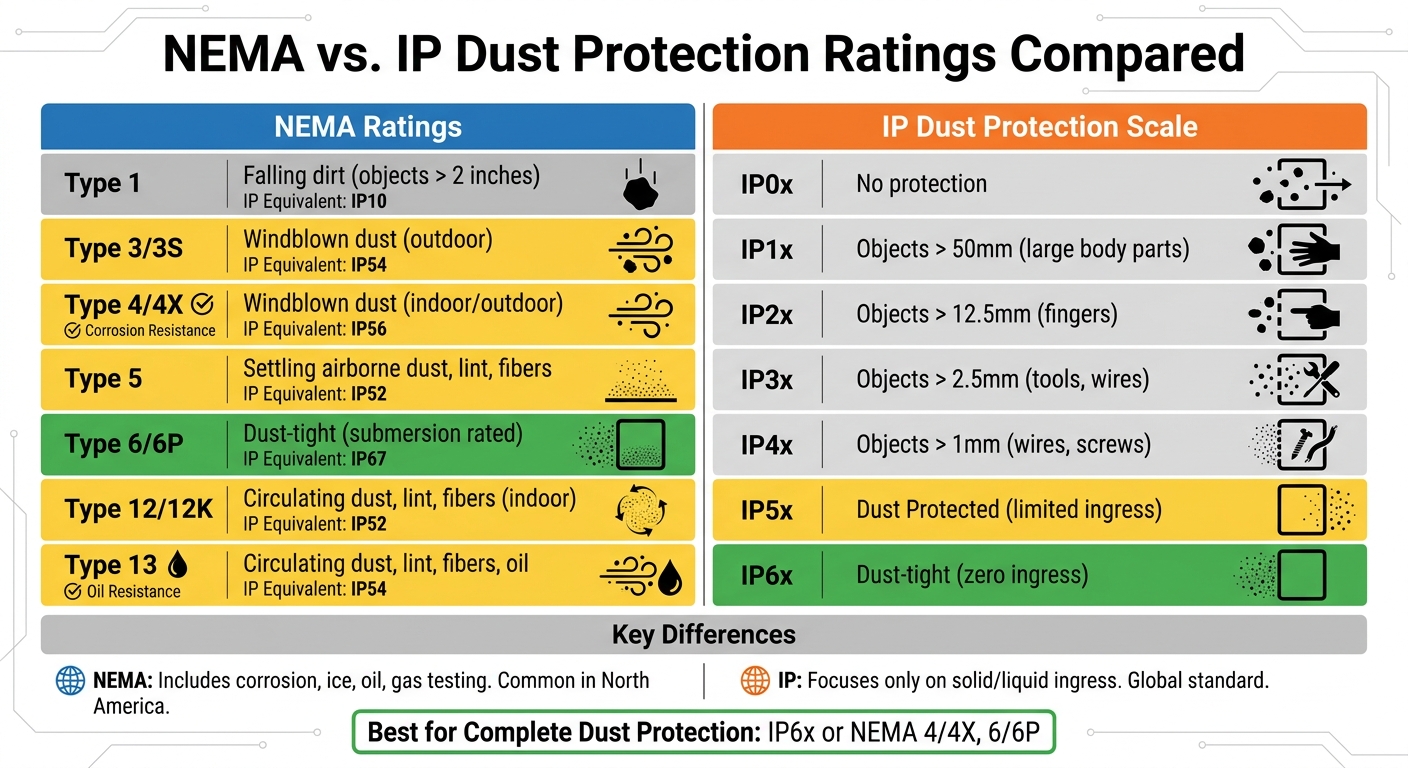
NEMA vs IP Dust Protection Ratings Comparison Chart
NEMA vs. IP Dust Protection Comparison Table
NEMA and IP ratings take different approaches to dust protection. NEMA focuses on specific hazards like incidental contact, falling dirt, and airborne particles like dust and fibers. On the other hand, IP ratings use a numerical system: a rating ending in 5 means "dust-protected" (limited ingress), while a rating ending in 6 indicates "dust-tight" (complete protection).
| NEMA Type | Dust Protection Description | IP Equivalent | IP Dust Protection Level |
|---|---|---|---|
| Type 1 | Protects against incidental contact and falling dirt (objects > 2 inches) | IP10 | 1 |
| Type 3 / 3S | Protects against windblown dust (outdoor use) | IP54 | 5 |
| Type 4 / 4X | Protects against windblown dust (indoor/outdoor use) | IP56 | 5 |
| Type 5 | Protects against settling airborne dust, lint, and fibers | IP52 | 5 |
| Type 6 / 6P | Protects against falling dirt (designed for submersion) | IP67 | 6 |
| Type 12 / 12K | Protects against circulating dust, lint, fibers, and flyings (indoor use) | IP52 | 5 |
| Type 13 | Protects against circulating dust, lint, fibers, and oil | IP54 | 5 |
This table highlights how the two systems measure and classify dust protection, setting the stage for a deeper dive into their key differences.
Main Differences Between NEMA and IP
While IP ratings focus solely on protection from solids and water, NEMA ratings go further by including resistance to factors like corrosion, oil, gases, and ice. Brandon Rogers from Setra Systems explains:
"NEMA requires functionality under icing conditions and testing for environmental hazards such as corrosion and oil, whereas IP standards do not".
This additional testing means NEMA ratings often exceed their IP equivalents. However, the reverse isn't always true. It's worth noting that NEMA numbers don’t follow a straightforward progression - for example, NEMA 12 provides less protection overall than NEMA 4.
To illustrate, Bud Industries’ NBB Series enclosures carry both NEMA 4X and IP66 ratings. The NEMA 4X test involves 240 L/min of water from a 1-inch hose at 3 meters, while IP66 uses 100 L/min at 100 kPa from 1 meter. Additionally, NEMA 4X includes a 600-hour salt spray test for corrosion resistance, which IP66 does not address.
Because testing can be expensive and time-intensive, many manufacturers skip dual certifications for all products. NEMA is more common in North America, especially for industrial settings, while IP ratings are used worldwide and cover a broader range of applications.
How to Choose the Right Rating for Dust Hazards
Best Ratings for Dust-Tight Applications
When selecting a dust protection rating, consider the installation location and the level of hazard involved. For international applications, IP66/IP67 ratings provide a reliable dust-tight seal. In North American industrial environments, NEMA 12 is a preferred choice for indoor settings like factory floors, automation systems, and electronic drives. These enclosures feature gasketed doors to block airborne contaminants effectively. For outdoor or wash-down environments, NEMA 4X is ideal, offering dust-tight protection along with corrosion resistance - especially important in areas exposed to salt water or chemicals. These ratings ensure compliance with both local and international standards.
For facilities with higher risks, such as mining or oil and gas operations, more advanced ratings are necessary. In these environments, NEMA Type 9 enclosures are certified for Class II hazardous locations (Groups E, F, or G), where combustible dust poses a threat. As highlighted by ROLEC UK:
NEMA Types 7, 8 and 9 are used in sectors such as mining, oil/gas, and chemicals.
In extreme conditions, like food processing plants that require high-pressure and high-temperature cleaning, IP69K is recommended. This rating ensures a dust-tight seal and can withstand steam cleaning at temperatures up to 176°F and pressures as high as 1,500 psi. It’s worth noting that there is no direct NEMA equivalent for this level of protection.
Where to Find Equipment with Certified Ratings
Always request certified test documentation from manufacturers instead of relying on generic terms like "waterproof" or "dust-proof". This ensures the enclosure meets the specific NEMA or IP standards required for your application. To save costs, opt for the lowest-rated enclosure that still provides adequate protection. For example, indoor junction boxes typically don’t need the advanced protection of NEMA 4X or IP67.
Marketplaces like Electrical Trader are excellent resources for finding enclosures and electrical equipment certified to NEMA or IP standards. Choosing equipment with the right certification not only simplifies the selection process but also guarantees effective dust protection tailored to your specific needs.
Conclusion: NEMA vs. IP Dust Protection Summary
When deciding between NEMA and IP ratings, it's important to consider the specific environmental risks and compliance requirements of your project. IP ratings focus exclusively on ingress protection, shielding against solid objects and water. For example, an IP6x rating ensures a completely dust-tight enclosure. NEMA ratings, however, go beyond ingress protection, addressing additional factors like corrosion, ice, and exposure to atmospheric gases such as acetylene or gasoline.
For projects in North America, particularly those in hazardous locations with explosive dust or gases, NEMA Types 7, 8, and 9 are crucial, as IP ratings alone do not certify enclosures for these risks without supplementary certifications like ATEX. In less hazardous industrial environments, NEMA 12 is a solid choice for indoor areas with circulating dust, while NEMA 4X provides both dust-tight and corrosion-resistant protection for outdoor settings.
It's wise to avoid over-specifying protection. Choose the lowest-rated enclosure that adequately meets your environmental needs. This approach helps control costs without sacrificing safety. Always ensure the enclosure has certified testing documentation to guarantee compliance.
For certified enclosures and electrical components that meet both NEMA and IP standards, check out Electrical Trader. Review all documentation carefully to select the right rating for your application, ensuring both safety and durability.
FAQs
Is NEMA 12 the same as IP65 or IP66?
NEMA 12 and IP65/IP66 are two distinct systems used to rate the protection levels of enclosures, but they serve slightly different purposes and follow unique testing standards.
- NEMA 12: This rating ensures protection against dust, falling dirt, and dripping non-corrosive liquids. It's often used in indoor environments where such contaminants are a concern.
- IP65: Provides complete protection from dust and can resist low-pressure water jets from any direction, making it suitable for outdoor or industrial settings.
- IP66: Like IP65, it offers full dust protection but can also withstand high-pressure, powerful water jets, offering a higher level of water resistance.
While there are overlapping aspects, particularly in dust protection, these ratings are not directly interchangeable due to differences in how their standards are defined and tested. Each serves a specific need based on the intended application.
Which rating should I choose for fine powder dust like flour or cement?
For handling fine powder dust such as flour or cement, it's best to go with an enclosure rated IP6X or NEMA 12/13. The IP6X rating guarantees complete protection against dust, making it entirely dust-tight. Meanwhile, NEMA 12 and NEMA 13 are crafted specifically for dusty conditions, with NEMA 13 offering extra resistance to oil and non-corrosive substances. These ratings provide the necessary defense against dust and fibers, even in challenging environments.
Do cable glands and connectors need the same dust rating as the enclosure?
When it comes to cable glands and connectors, they don’t always require the same dust protection rating as the enclosure itself. While enclosures are rated for comprehensive protection, the specific rating for glands and connectors can differ based on how they’re used. However, in environments where dust is a major concern, it’s a good practice to ensure that the glands and connectors match or surpass the enclosure’s dust rating. This helps maintain the system’s ability to guard against dust intrusion effectively.