Top 5 Funding Models for Community Energy Systems
Community energy systems empower local communities to manage and produce their own power. However, funding remains a major challenge due to high upfront costs. This article outlines five funding models to finance these projects:
- Grant-Based Funding: Provides upfront financial support through federal programs like DOE grants and Community Project Funding (CPF). Grants are competitive but effective for kickstarting projects.
- Loan-Based Financing: Revolving Loan Funds (RLFs) recycle repayments into new projects, ensuring continuous funding. Examples include Texas LoanSTAR and Montana’s Alternative Energy Loan Program.
- Public-Private Partnerships (PPPs): Combines government oversight with private investment. Projects like the FDA campus microgrid in Maryland highlight its long-term potential.
- Community Investment Models: Leverages local funds, shared solar programs, and revolving funds to empower communities. These models emphasize reinvesting savings for future projects.
- Performance-Based Contracting: Energy Service Companies (ESCOs) install and maintain systems, getting paid from energy savings rather than upfront costs. Ideal for cash-strapped institutions.
Each model offers unique advantages, from reducing upfront costs to ensuring long-term financial sustainability. The right choice depends on project size, available capital, and local regulations.
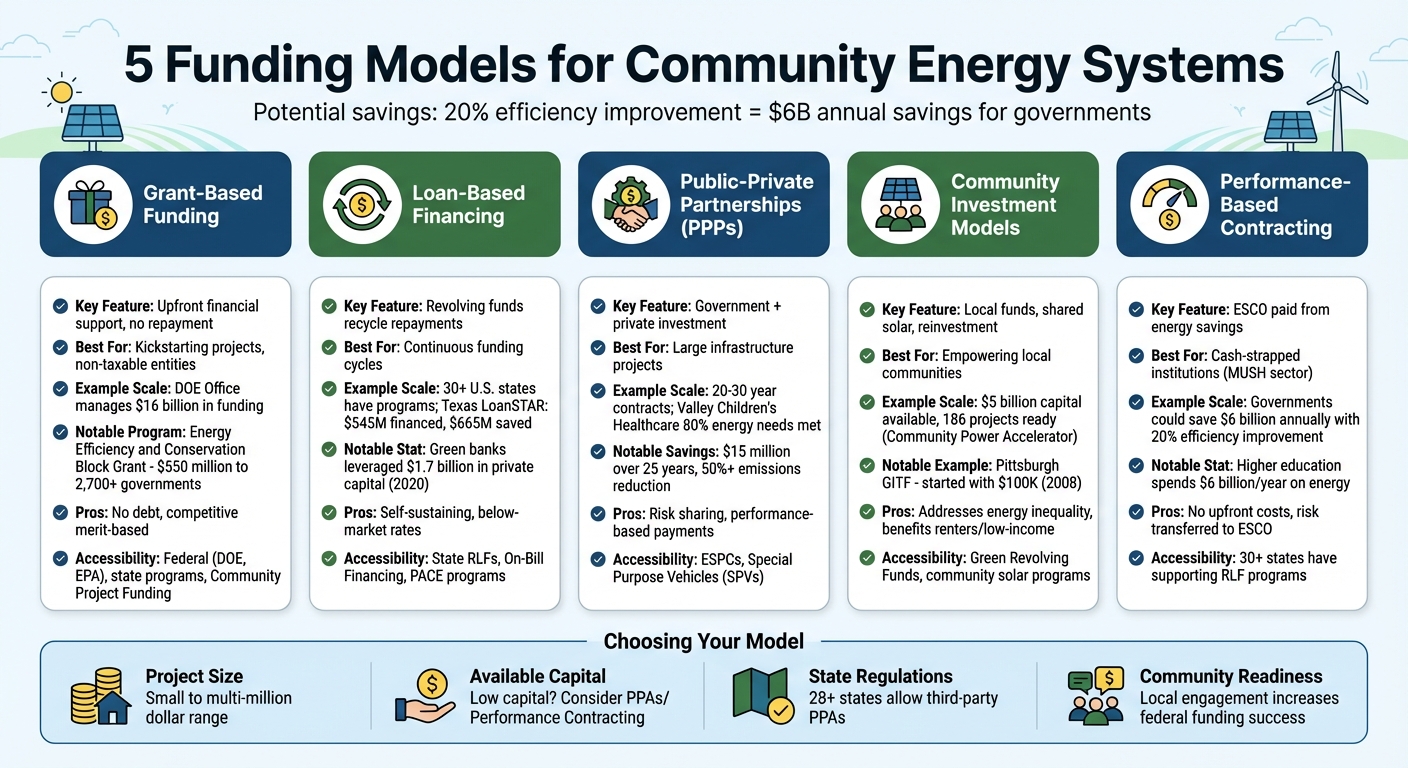
5 Funding Models for Community Energy Systems Comparison
Making Community Energy Work: Financing, Ownership, and Practical Models
1. Grant-Based Funding
Grant-based funding offers upfront financial support, making it a popular choice for kickstarting community energy projects. Federal agencies like the U.S. Department of Energy (DOE) and the Environmental Protection Agency (EPA) are key players in this space. Among them, the DOE's Office of Critical Minerals and Energy Innovation (CMEI) is the largest federal investor in renewable energy technology development. However, these grants are typically aimed at research, development, and demonstration projects rather than direct technology purchases.
Funding Source and Accessibility
Accessing DOE grants involves a multi-step registration process through platforms like Login.gov, SAM, Grants.gov, and FedConnect.net. Grants are awarded based on a competitive merit review, focusing on renewable energy advancements and economic impact. For small businesses, specialized programs like the Small Business Innovation Research (SBIR) and Small Business Technology Transfer (STTR) offer funding for projects with commercial promise.
Another option is Community Project Funding (CPF), formerly known as earmarks. In Fiscal Year 2024, U.S. House Members were allowed to submit up to 15 CPF requests, while Senators faced no such limit. CPF has enabled projects that not only power municipal facilities but also support workforce training for larger solar initiatives.
These funding pathways provide a strong foundation for scaling community energy projects while leveraging federal resources.
Scalability for Community Energy Projects
Scalable grant options, like the Community Power Accelerator, help address the high upfront costs of energy projects. This platform showcases the breadth of available resources, with over $5 billion in capital and 345 megawatts of community solar projects under development. By January 2026, the platform had listed more than 186 projects ready for investment. The best part? Municipalities, schools, nonprofits, and capital providers can join the platform for free.
For larger initiatives, the DOE's Office of State and Community Energy Programs (SCEP) manages $16 billion in funding to strengthen local economies and community infrastructure. For example, the Energy Efficiency and Conservation Block Grant (EECBG) Program alone allocates $550 million to over 2,700 eligible local, state, and Tribal governments. In 2024, Virginia's Nottoway County School District secured $11.5 million through the SCEP Renew America's Schools grant to upgrade five schools, resulting in projected energy savings of 25% to 45%.
Long-Term Financial Sustainability
While grants are excellent for getting projects off the ground, sustaining them over the long term requires additional strategies. Energy costs often rank as the second-largest expense for nonprofits and public schools, consuming up to 30% of a nonprofit's budget. To ensure financial stability, many communities transition to revolving loan funds or attract private investment once grant funding runs its course.
A newer funding mechanism, elective pay (direct pay), offers a unique opportunity for tax-exempt entities. This approach allows organizations to receive cash refunds for clean energy tax credits, providing a reliable, non-competitive funding source. Ian Goldsmith, a Clean Energy Specialist at the World Resources Institute, explains:
"Elective pay is non-competitive and limitless. As long as entities accurately complete the necessary tax forms and submit them to the IRS, they will receive the full amount they are eligible for."
Elective pay can be combined with federal grants, as there are no restrictions on using these funding sources together. The six most common credits under elective pay include those for EV purchases, EV charging infrastructure, wind, solar, geothermal energy, and energy storage. By creating revenue streams through these credits, communities can reinvest and extend the lifespan of their grant-funded projects.
2. Loan-Based Financing
Loan-based financing uses repayments from existing projects to fund new community energy initiatives. Unlike one-time grants, this approach creates a continuous funding cycle, making it a practical choice for communities looking to build lasting energy infrastructure.
Funding Source and Accessibility
Revolving Loan Funds (RLFs) are a cornerstone of loan-based financing for community energy projects. These funds draw capital from various sources, including state bond proceeds, treasury investments, ratepayer contributions, and public-sector grants. As of 2022, more than 30 U.S. states had established revolving loan programs dedicated to energy efficiency and renewable energy.
The Texas LoanSTAR (Saving Taxes and Resources) Program is a standout example. Since its inception in 1989, it has financed over $545 million for 325 retrofit projects in public facilities. These efforts have generated more than $665 million in energy savings as of May 2020.
To improve accessibility in underserved areas, programs like On-Bill Financing and PACE (Property Assessed Clean Energy) simplify repayment by attaching it to utility bills or property tax assessments.
Green banks and energy financing institutions also play a critical role. In 2020, these institutions in the U.S. invested nearly $450 million, successfully leveraging an additional $1.7 billion in private capital. To reduce the risk for lenders, tools like Loan Loss Reserves (LLRs) are used, making it easier to fund projects that might otherwise be considered too risky.
These diverse funding mechanisms help scale energy projects efficiently and effectively.
Scalability for Community Energy Projects
Loan-based models excel at scaling through multideveloper aggregation services. For instance, the NY Green Bank bundles smaller solar investments, enabling small-scale community projects to attract larger capital markets. This aggregation approach ensures that even modest investments can meet the scale needed for broader financial backing.
Montana's Alternative Energy Revolving Loan Program offers another example of scalability. Since its launch in 2001, it has provided low-interest loans to homeowners, small businesses, and nonprofits for renewable energy installations. Interestingly, the program is funded by air quality penalties collected by the Montana Department of Environmental Quality.
Such scalable models are instrumental in supporting long-term energy goals.
Long-Term Financial Sustainability
The sustainability of loan-based financing depends on aligning loan terms with expected energy savings. Revolving energy funds typically offer loan terms of less than 10 years, ensuring that capital returns to the fund quickly. Interest rates are often kept below market levels, either by matching the program sponsor's borrowing rate or by using program funds to lower rates.
A great example of this principle is Pittsburgh's Green Initiatives Trust Fund (GITF). Established in 2008 with an initial $100,000 deposit, the fund is replenished through energy savings compared to a 2003 baseline. These savings are reinvested into the GITF for future projects.
For low- and moderate-income (LMI) communities, programs like Connecticut's EnergizeCT Health and Safety Revolving Fund provide long-term loans of up to $300,000. These loans target multifamily housing projects where at least 60% of the units serve LMI residents, addressing barriers like mold or asbestos that hinder energy efficiency upgrades.
Level of Community Involvement
Community involvement in loan-based financing depends on the structure of the loan program. Internal Green Revolving Funds allow organizations, such as municipalities or universities, to fund their own sustainability projects using internal savings. For example, Hillsboro, Oregon, launched its Sustainability Revolving Fund in 2013 with an initial $51,000 investment. City departments can apply for up to $25,000 to fund projects aimed at reducing municipal energy usage by 60% by 2030.
External RLFs, on the other hand, require more structured community participation. Administrators assess applicants' ability to repay loans and ensure full transparency of financing costs to avoid defaults. Meaningful community engagement during the policymaking process is essential to address local inequalities and ensure the program benefits everyone, rather than exacerbating existing disparities.
3. Public-Private Partnerships (PPPs)
Public-Private Partnerships (PPPs) bring together government backing and private investment to fund energy infrastructure projects for communities. In this setup, private entities typically provide the bulk of the initial funding and often form a Special Purpose Vehicle (SPV). This SPV includes building contractors, maintenance firms, and equity investors - such as pension funds and banks - to develop and manage the project.
Funding Source and Accessibility
PPP projects rely on private investments, guided by public oversight and secured through long-term contracts, often lasting 20 to 30 years. This approach assigns specific risks to the party best equipped to handle them, making it easier to execute complex projects. A prime example is the General Services Administration's (GSA) 55-MW microgrid at the Food and Drug Administration (FDA) campus in White Oak, Maryland. This project, developed under an Energy Savings Performance Contract (ESPC), combined heat and power (CHP) with solar PV and energy efficiency measures to boost resilience and cut costs. This funding model provides a solid foundation for scaling similar projects.
Scalability for Community Energy Projects
One of the standout features of PPPs is their ability to scale, from single-building projects to large municipal utility systems. By bundling quick-return energy efficiency measures with larger initiatives like microgrids, PPPs make these projects more feasible and sustainable. For instance, in November 2024, Valley Children's Healthcare began building a renewable energy microgrid expected to meet 80% of the hospital's energy needs. This project is estimated to save $15 million over 25 years while cutting emissions by more than 50%. This scalability makes PPPs a strong option for long-term energy solutions.
Long-Term Financial Sustainability
Financial sustainability in PPPs is achieved through performance-based payments, where energy savings are used to repay the private investment. A good example is the collaboration between the Triple Bottom Line Foundation (TBL Fund) and the City of Aztec, New Mexico. Together, they evaluated and implemented a utility-scale solar PV and battery storage project, ensuring it was financially viable while stabilizing energy costs for the local community.
Level of Community Involvement
For PPPs to succeed, community involvement is critical. As the end-users of these services, local communities play a central role in meeting both financial and operational goals. Civil Society Organizations (CSOs) often represent community interests in these partnerships, advocating for social benefits and addressing environmental concerns. Many community groups emphasize that local expertise is essential for success. Engaging residents early in the planning stages fosters better outcomes by encouraging innovation and knowledge sharing. For example, platforms like the Community Power Accelerator connect local developers - such as schools, nonprofits, and municipalities - with private capital. This initiative has identified over $5 billion in available funding for community-focused solar projects, making it easier for local organizations to access the resources they need.
sbb-itb-501186b
4. Community Investment Models
Community investment models put the power in the hands of local organizations and residents. These approaches often include initiatives like shared solar programs and revolving loan funds that reinvest repayments into new projects. For instance, the Community Power Accelerator highlights over $5 billion in available capital and 186 community solar projects.
Funding Source and Accessibility
These models draw from a variety of funding sources to help organizations that might not qualify for traditional financing gain access to clean energy. One example is Green Revolving Funds (GRFs), which use internal capital pools. Here’s how it works: energy savings from completed projects go back into the fund, creating resources for future investments. A great example is the University of Vermont, which set aside $13 million in an internal revolving fund for on-campus energy efficiency projects. Each project must cost under $3 million and have a payback period of seven years or less.
Another option is Revolving Loan Funds (RLFs), which provide external financing for communities aiming to adopt clean energy. The Inflation Reduction Act has made this even more accessible by enabling non-taxable organizations to claim clean energy tax credits directly through "elective pay" mechanisms. By tapping into these diverse funding sources, communities can break down financial barriers and launch scalable clean energy initiatives.
Scalability for Community Energy Projects
These models are designed to be self-sustaining. By 2022, more than 30 states in the U.S. had implemented revolving loan programs for renewable energy and energy efficiency projects. This proves the approach works across various community sizes and project types, making it a versatile solution.
Long-Term Financial Sustainability
The key to long-term success lies in reinvesting energy savings. Take the Pittsburgh Green Initiatives Trust Fund, for example. Seeded with $100,000 in 2008, the fund is replenished through savings from aggregated energy purchases. This creates a steady stream of funding for future projects without needing fresh budget allocations. In sectors like healthcare, where energy costs often exceed $5 billion annually and can account for 15% or more of profits, such internal funding strategies are becoming a popular way to manage operating expenses.
Level of Community Involvement
A standout feature of these models is the emphasis on local participation, which makes them effective in addressing energy inequality. They enable groups like renters, low-income households, and organizations without suitable rooftops to benefit from clean energy initiatives. Platforms designed for community involvement simplify the process with expert-crafted checklists that streamline investor due diligence. To ensure equity, decision-makers should include "ability to pay" analysis frameworks when designing debt-based financing. This helps protect low- and moderate-income households from the risk of default.
5. Performance-Based Contracting
Performance-based contracting offers a practical way for communities to implement energy projects without bearing upfront costs. Under this model, an Energy Service Company (ESCO) takes charge of designing, installing, and maintaining energy systems. The ESCO gets paid directly from the energy savings the project generates, meaning organizations don’t need to allocate funds upfront. This is a game-changer for cash-strapped institutions like municipalities, schools, hospitals, and universities.
Funding Source and Accessibility
This model has gained significant traction within the MUSH sector (municipalities, universities, schools, and hospitals). One key advantage is that performance-based contracting treats energy upgrades as a service rather than a capital expense, keeping it off the organization’s balance sheet. This allows projects to move forward without requiring immediate capital investment. For healthcare facilities, where energy expenses can account for over 15% of total profits, this approach is particularly appealing. By removing financial hurdles, this model enables projects to fund themselves over time.
Long-Term Financial Sustainability
The payment structure is simple: the ESCO is compensated only if the energy systems deliver measurable savings. If the systems underperform, the ESCO doesn’t get paid. This results-driven approach has massive potential - governments could save an estimated $6 billion annually with just a 20% improvement in energy efficiency. Similarly, higher education institutions, which collectively spend about $6 billion each year on energy, have been early adopters of this model. To further encourage these projects, more than 30 states have established revolving loan programs to support performance-based contracting.
Scalability for Community Energy Projects
One of the standout features of performance-based contracting is its scalability. Since payments to the ESCO are tied to the verified performance of the energy systems, the financial risks don’t depend on the creditworthiness of individual community members. This structure also shifts technical and maintenance responsibilities to the ESCO, eliminating many of the barriers associated with traditional financing. As a result, this model makes it easier to roll out clean energy projects in communities, paving the way for broader adoption and impact.
Selecting the Right Funding Model for Your Project
Choosing the best funding model for your project depends on several factors, including the size of the project, the amount of capital you have available, and any regulatory requirements you must meet. Let’s break these down.
Project size is a key factor. For example, Community Project Funding (CPF) often supports initiatives that range from hundreds of thousands to several million dollars. A smaller-scale project like Juneau, Alaska’s "Alaska Heat Smart" campaign received $420,000 in CPF to install air-source heat pumps for low-income households.
Your available upfront capital also narrows your options. Some funding models, like Green Banks and On-bill loan programs, require significant financial contributions from the project sponsor. On the other hand, models like Power Purchase Agreements (PPAs) and Performance Contracting shift most of the initial costs away from the sponsor. If your organization has limited funds, third-party ownership models can be a lifeline. For instance, the D.C. Department of General Services partnered with Sol Systems to manage 10.9 megawatts of distributed solar assets through a PPA, effectively transferring the financial responsibility to private developers.
State and local regulations are another critical consideration. Some funding models, such as PPAs and Commercial Property Assessed Clean Energy (C-PACE), require enabling legislation to proceed. As of mid-2025, at least 28 states, plus Washington, D.C., and Puerto Rico, allow third-party PPAs for solar PV projects. Before committing to a funding model, it’s essential to confirm whether your state has the necessary laws in place.
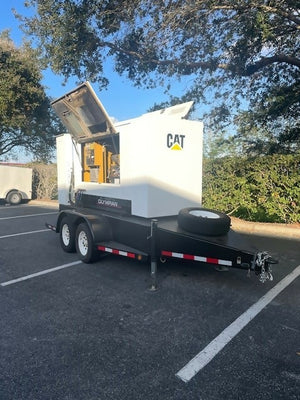
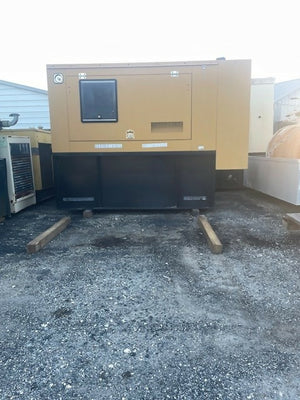
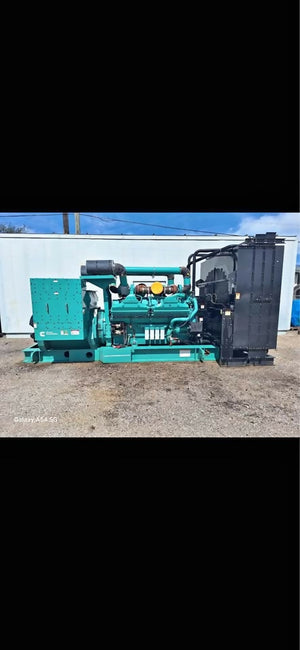
Equipment costs also play a role in shaping your funding strategy. Finding cost-effective equipment can reduce your capital needs, potentially allowing you to use simpler funding models like community investments instead of external debt. Platforms like Electrical Trader can help communities source affordable new and used electrical components, such as transformers and power generation tools, to stay within budget. A great example of this is the Minwind I-IX project in Minnesota. Thirty-three local farmers pooled their resources to negotiate better equipment prices for nine wind farms, ultimately lowering costs for their $16.5 million project.
Lastly, community readiness is vital for success. Projects backed by active local organizations and clear community priorities are more likely to secure federal discretionary funding. Take Houston’s Sunnyside Landfill Solar Project, for instance. It received $750,000 in CPF to support partnerships aimed at training a STEM-focused workforce for a site featuring 50 MW of utility-scale solar and 2 MW of community solar. Engaging with members of Congress and local stakeholders early in the process can align your project with both political and community priorities, significantly boosting your chances of success.
Conclusion
Funding community energy systems becomes much simpler when the available options are clearly understood. Grant-based funding, for example, removes upfront costs and is especially helpful for low-to-moderate income households and non-taxable entities like schools, which can’t directly claim tax credits. Loan-based financing, such as Revolving Loan Funds, creates a self-sustaining cycle of capital. These programs have a proven track record of generating notable energy savings while replenishing funding for future projects. Other models, like public-private partnerships and community investments, reduce upfront costs by pooling resources and leveraging collective purchasing power.
Community investment initiatives, such as Solarize campaigns, often result in 10% to 20% savings on installation costs by utilizing bulk purchasing. Programs like Peninsula SunShares have shown how effectively these savings can be achieved. Another option, performance-based contracting, shifts financial risk to the provider, as payments are tied directly to the energy savings they deliver.
Each funding model has its own set of benefits, and the choice largely depends on the specifics of your project. For non-taxable entities, grants or third-party ownership models are often the best way to indirectly take advantage of tax incentives. Organizations with limited upfront capital might find Power Purchase Agreements (PPAs) or performance contracts more suitable. On the other hand, those looking to cut equipment costs could explore platforms like Electrical Trader for affordable components.
The potential for savings is enormous. For instance, improving energy performance by just 20% in state and local government buildings across the U.S. could save $6 billion annually. These savings could be reinvested into additional community projects. With strong state support and a variety of funding options available, community energy systems have never been more within reach.
FAQs
What are the pros and cons of using grants to fund community energy projects?
Grants are a go-to funding choice for community energy projects because they offer non-repayable funding, allowing local groups to maintain full ownership and decision-making power. They’re particularly useful for getting early-stage projects off the ground by lowering financial risks and encouraging the use of renewable energy technologies. Plus, grants often come with perks like technical assistance or a boost in credibility, which can help attract more funding or gain community backing. Projects that deliver strong social or environmental benefits - like solar initiatives for low-income families - can often secure grants even if they’re not yet profitable.
That said, grants come with their own set of challenges. The competition for funding is intense, and applying can be a lengthy and demanding process, with strict eligibility rules and long approval periods. On top of that, grants typically don’t cover all the costs of a project, so additional funding sources - like loans or private investments - are usually necessary. Relying solely on grants can create delays and uncertainty, which is why they work best when paired with other financing options.
How do public-private partnerships help scale community energy systems?
Public-private partnerships (PPPs) play a key role in expanding community energy systems by bringing together the strengths of both government and private companies. Governments offer regulatory guidance and oversight, while private entities provide funding, specialized knowledge, and fresh ideas. This teamwork not only eases the financial strain on public budgets but also attracts more substantial investments for energy projects.
One of the standout benefits of PPPs is how they handle risk. Private companies typically take on construction and operational risks, leaving regulatory responsibilities to government partners. This balanced distribution of risk makes these projects more attractive to investors and allows for the development of larger, more ambitious energy systems. By encouraging innovation and ensuring stable, long-term revenue, PPPs help transform small-scale community energy projects into extensive networks, speeding up the shift to clean and affordable energy across the United States.
What should you consider when selecting a funding model for a community energy project?
When selecting a funding model for a community energy project, there are a few critical factors to keep in mind. Start with the scale and cost of the project. Larger systems often require long-term funding solutions like loans or public-private partnerships. On the other hand, smaller projects might be well-suited for grants, on-bill financing, or leasing arrangements.
Next, think about the community's financial capacity. For communities with limited borrowing power, grant programs or equity investors might be the best route. Communities with strong credit histories, however, could explore options like low-interest loans or green financing programs.
It’s also essential to align the funding model with local policies and incentives. Communities aiming for ownership and control might prefer public funding mechanisms. Meanwhile, private funding options can be ideal for taking advantage of tax credits or renewable energy incentives that support the project.
Lastly, don’t overlook the importance of reliable equipment suppliers. Platforms like Electrical Trader can streamline the process of acquiring critical components such as transformers and breakers. This not only helps reduce costs but also ensures the project remains financially sustainable.
By considering these elements - project size, financial resources, local policies, and equipment procurement - communities can identify a funding model that balances affordability, efficiency, and long-term success.