

Renewable Energy Integration Challenges and Solutions
Renewable energy is transforming the power grid, but it comes with challenges. The shift to solar, wind, and other renewables requires modernizing outdated infrastructure, addressing grid instability, and managing fluctuating energy outputs. Here's a quick breakdown of the key issues and solutions:
- Grid Challenges: Traditional grids struggle with variable energy inputs, leading to delays in connecting renewable projects and risks of outages. For example, the U.S. grid faces an average 3-year wait for new connections.
- Technical Solutions: Upgrades like grid-forming inverters, energy storage systems (e.g., lithium-ion batteries, pumped hydropower), and bi-directional flow management are essential.
- Policy and Funding: High upfront costs and fossil fuel subsidies hinder renewable adoption. Creative financing models like Power Purchase Agreements (PPAs) and federal tax credits help bridge the gap.
- Community Involvement: Local participation in planning boosts trust and economic benefits, such as job creation and revenue from community-owned projects.
- Energy Equity: Policies must ensure fair access to clean energy, especially for underserved communities.
Renewable integration is not just about technology - it’s a mix of technical fixes, policy reforms, and community collaboration. The goal? A stable, reliable, and fair energy future.
Renewable Energy Integration: Key Challenges and Solutions by the Numbers
Renewable Integration Into Power Systems Challenges and Solutions
Technical Infrastructure and Grid Compatibility Issues
Our electrical grids were originally designed to accommodate traditional synchronous generators, like those powered by coal, gas, and nuclear energy. These generators stabilize frequency and voltage through their rotating masses. However, modern renewable energy sources, such as solar and wind, rely on inverters to connect to the grid, which introduces greater fluctuations in frequency and voltage. The International Energy Agency explains this distinction:
VRE generators do not have a direct, electro-mechanical coupling to the grid, which makes them different to traditional, synchronous generators.
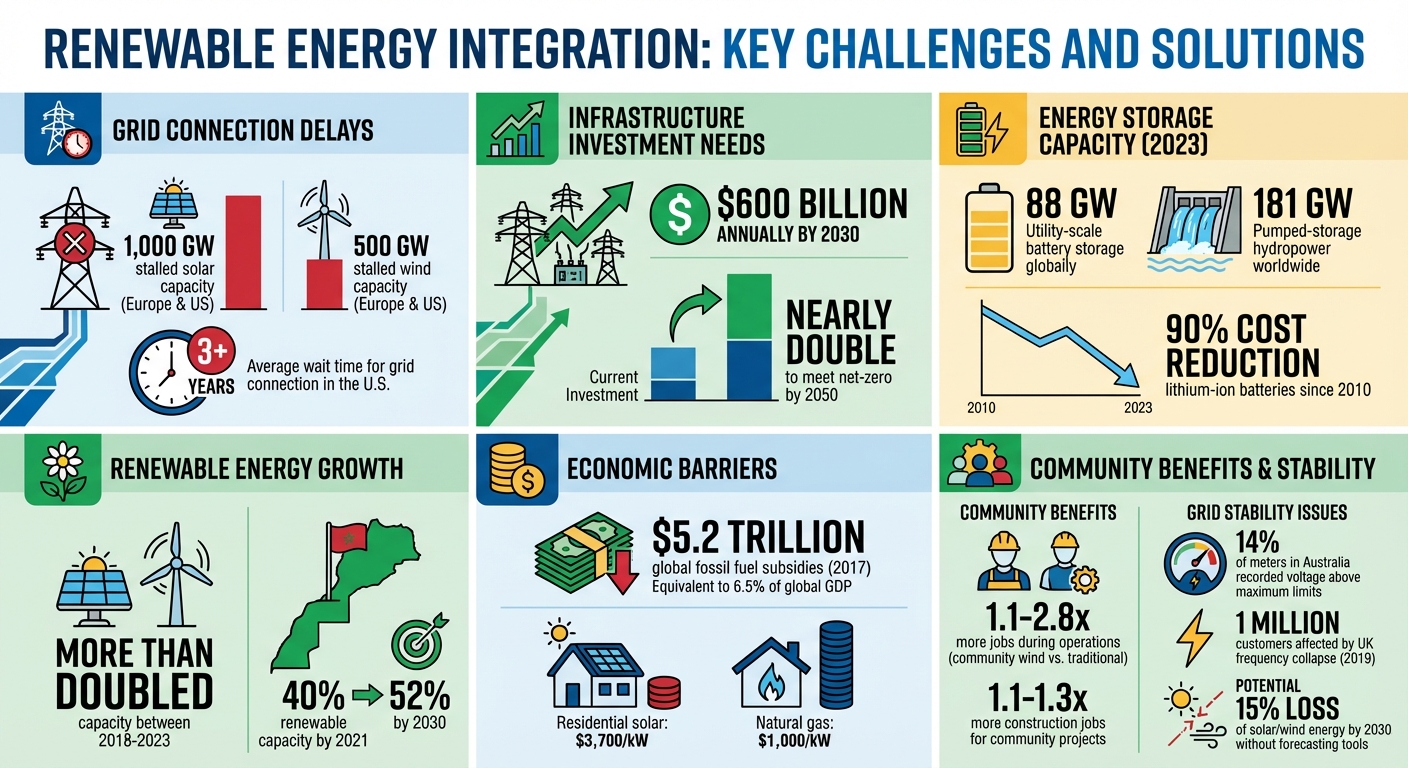
Currently, nearly 1,000 GW of solar capacity and 500 GW of wind capacity are stalled, awaiting grid connection in Europe and the United States. In the U.S., the average wait time for grid connection has now surpassed three years. A stark example of this challenge occurred in May 2022, when Amsterdam’s grid hit its maximum capacity. Operators were forced to reject new connection requests and even limit renewable energy output to avoid overloading the network.
Connecting Variable Renewable Energy Sources
The weather-dependent nature of solar and wind energy creates rapid and unpredictable fluctuations in power generation - something traditional grids weren’t designed to handle. For example, unexpected changes in cloud cover or a sudden drop in wind speed can force generators to ramp up quickly to maintain the balance between supply and demand. These fluctuations happen more frequently and at a faster pace than grid operators initially anticipated.
This variability, combined with the retirement of traditional thermal plants, reduces system inertia. A clear example is the 2019 incident in the UK, where simultaneous outages caused a 40-minute frequency collapse, impacting one million customers. Similarly, in Australia, the widespread adoption of rooftop solar has led to severe voltage swings. An investigation of 12,000 meters found that 14% recorded voltage readings above the maximum limits, causing issues like damaged appliances and flickering lights.
Addressing these challenges requires substantial upgrades to grid infrastructure to better manage these rapid changes.
Modernizing Transmission and Distribution Systems
Distribution systems face a unique hurdle: they were originally designed for one-way power flow - from centralized plants to consumers. Today, they must handle bi-directional flows due to the rise of distributed energy sources like rooftop solar. This shift can lead to local voltage instability and equipment overloads. To meet the goal of net-zero emissions by 2050, global investment in grid infrastructure and transmission lines needs to nearly double, reaching around $600 billion annually by 2030.
One potential solution lies in long-distance transmission. In December 2020, the State Grid Corporation of China launched a 986-mile ultra-high-voltage (UHV) line between Qinghai and Henan provinces. This was the first UHV line specifically designed to transmit 100% renewable energy from remote resource areas to central population centers. Additional measures, such as installing tap changers, switching capacitors, and line regulators, help manage bi-directional power flows and stabilize voltage swings. Companies like Electrical Trader play a key role by supplying essential equipment like transformers, breakers, and power distribution tools to support these modernization efforts.
Intermittency and Energy Storage Options
The unpredictable nature of solar and wind energy poses a real challenge for grid stability. When renewable energy production drops unexpectedly, grid operators need reliable methods to fill the gap. Energy storage has stepped up as a key player, balancing fluctuating energy production with consistent demand. As the U.S. Department of Energy aptly puts it:
Storage acts as an insurance policy for sunshine.
Let’s dive into the various storage technologies and strategies that help address these challenges.
Battery Storage Technologies
Lithium-ion batteries are the go-to solution for short-term storage, typically lasting under eight hours. Since 2010, their costs have dropped by an impressive 90%, making them a feasible option for large-scale energy needs. The industry is increasingly favoring Lithium Iron Phosphate (LFP) batteries, which are cheaper and longer-lasting compared to the older types used in electronics. As battery capacity increases, costs decline even further.
A standout example is the AES Lawai Solar Project in Kauai, Hawaii. This project pairs a solar system with a 100-megawatt-hour battery setup, ensuring power availability even after sunset. It turns solar energy, which is inherently variable, into a steady and reliable resource. Globally, utility-scale and smaller, localized batteries now account for about 88 GW of storage capacity as of 2023.
Different storage needs call for different technologies. Pumped-storage hydropower leads the pack with 181 GW of installed capacity worldwide. This method uses water and elevation changes to store energy with efficiencies between 75% and 85%. For medium-duration storage (4 to 16 hours), options like vanadium redox flow batteries and compressed air energy storage (CAES) are gaining traction. China currently operates three advanced CAES projects, achieving efficiencies between 60% and 80% by utilizing heat generated during compression.
Long-duration storage, which spans days or even seasons, is much trickier. Green hydrogen is emerging as a chemical storage option, though its current round-trip efficiency is only 41%. The need for storage grows significantly as renewable energy becomes a larger part of the grid. Systems with less than 40% renewable energy typically rely on short-term storage, but grids with 90% renewable energy require large-scale, long-duration solutions.
Beyond batteries, mechanical options like flywheels offer quick bursts of power for stabilizing grid frequency. For instance, the Beacon Power flywheel plant in New York provides 20 MW of electricity within minutes, helping balance sudden fluctuations. Communities aiming to adopt such technologies can simplify the process by sourcing equipment like transformers and power distribution tools from platforms such as Electrical Trader.
Now, let’s explore how combining renewable sources can further stabilize energy supply.
Hybrid Renewable Systems
Pairing multiple renewable sources can create a more reliable and consistent energy output. For example, wind energy often peaks when the sun isn’t shining, making solar and wind an effective duo. The National Renewable Energy Laboratory describes this approach well:
Demand for electricity during all hours of the year can be met through a portfolio approach that aggregates variable generation with dispatchable resources.
Hybrid systems use energy storage to shift power from times of surplus - like midday solar production - to high-demand periods, such as evenings. This process transforms intermittent energy sources into reliable ones. For shorter disruptions, small-scale batteries help smooth out peaks, ensuring grid stability.
Community-based microgrids take this a step further by integrating renewables with backup generators and storage. These systems provide continuous power during outages, keeping essential services like emergency facilities running during extreme weather or grid failures. Between 2018 and 2023, global solar and wind capacity more than doubled, showcasing the rapid adoption of these hybrid systems.
To complement these efforts, advanced forecasting tools are improving grid management.
Forecasting and Grid Management Tools
Accurate forecasting tools are indispensable for predicting short-term changes in solar and wind energy output. Integrating weather-based forecasts into grid operations helps balance supply and demand more effectively, especially during the early stages of renewable energy adoption.
Real-time optimization systems enhance flexibility by coordinating storage, dispatchable resources, and demand response strategies to address renewable energy uncertainties. Distributed Energy Resource Management Systems (DERMS) further strengthen local grids, accommodating increased electrification and variable energy sources. These tools are reshaping power systems, making them more adaptable to renewable energy demands.
The International Energy Agency highlights the importance of these advancements:
Integrating high shares of VRE requires rethinking the traditional way in which power systems are operated, planned, and financed.
Technologies like Automatic Generation Control (AGC) and Energy Management Systems (EMS) maintain grid frequency and respond to disturbances in systems with high renewable penetration. Research shows that reliable power systems can handle variable energy levels ranging from 30% to 100%, provided they use effective forecasting and management tools. Delaying these measures could risk losing up to 15% of solar and wind energy by 2030.
Demand response also plays a key role, acting as a kind of virtual storage. For instance, pre-cooling buildings before peak hours aligns energy use with periods of high renewable production, reducing the need for physical storage. Companies are already leveraging grid data to optimize electric vehicle charging and meet sustainability goals, showcasing the practical benefits of these tools at the consumer level.
Economic and Funding Barriers to Renewable Integration
The high upfront costs of renewable energy systems pose a major challenge to their widespread adoption. Adding to this difficulty, fossil fuel subsidies remain significant. In 2017, global subsidies for fossil fuels were estimated at $5.2 trillion - equivalent to about 6.5% of the global GDP - making it harder for renewable energy projects to compete over the long term. Demetrios Papathanasiou, the World Bank's Global Director of Energy and Extractives, highlights the unique challenges faced by developing nations:
"Poorer countries are stuck in a vicious cycle where they pay more for electricity; cannot afford the high upfront cost of clean energy; and are locked into fossil fuel projects. In essence, they are paying a triple penalty for the energy transition."
Overcoming these financial barriers requires creative and accessible funding strategies to level the playing field for renewables.
High Initial Capital Costs
Installing renewable energy systems often comes with hefty price tags. For instance, residential solar systems typically cost around $3,700 per kilowatt (kW), while large-scale solar installations average about $2,000 per kW. Wind power systems are slightly less expensive, ranging between $1,200 and $1,700 per kW. In contrast, new natural gas plants cost roughly $1,000 per kW. In Poland, for example, the average household faces an installation cost of approximately $15,500 for solar panels.
These costs extend beyond the systems themselves. Developers often face "deep connection charges", which include funding not just local grid connections but also broader grid reinforcements. Additionally, renewable energy projects are sometimes viewed as high-risk investments by financial institutions. Concerns over intermittency and shifting regulations can lead to higher interest rates or stricter collateral requirements. Platforms like Electrical Trader aim to alleviate some of these costs by helping communities source electrical components and distribution equipment more efficiently. However, without affordable financing, even modernized grids struggle to fully capitalize on renewable energy's potential.
Alternative Financing Models
In response to these financial hurdles, communities are turning to innovative funding approaches. Power Purchase Agreements (PPAs), for example, allow organizations to outsource the capital investment and management of renewable assets to third-party providers, paying only for the energy generated. Another option, Commercial Property-Assessed Clean Energy (CPACE), enables property owners to finance renewable energy projects through an assessment added to their property tax bill. A notable example of CPACE in action occurred in April 2020, when Greenworks Lending financed a microgrid and rooftop solar installation for a mixed-use building in Hartford, Connecticut. This marked the first time a microgrid project was funded through this mechanism.
Morocco offers a compelling example of how sustained investment can drive progress. Since the early 2000s, the state-owned Moroccan Agency for Sustainable Energy (MASEN) has utilized concessional financing to expand solar power. Under the leadership of Minister Leila Benali, Morocco achieved 40% installed renewable capacity by 2021 and is now aiming for 52% by 2030, with around $1 billion in private sector investment currently underway. As Minister Benali aptly noted:
"The energy transition is not a luxury; it is a necessity"
In the United States, Federal Solar Tax Credits further ease the financial burden for businesses and manufacturers, reducing the net capital required for renewable installations. These innovative funding mechanisms are making renewable energy more accessible, addressing the steep upfront costs that have long been a barrier for many communities.
sbb-itb-501186b
Community Involvement in Renewable Energy Projects
Getting the community involved early in renewable energy projects can turn what might feel like an outside imposition into something the locals trust and embrace. When residents are included in the planning and decision-making process, developers can identify allies, address concerns upfront, and avoid sinking money into projects that might later face pushback. Even more importantly, involving the community fosters a sense of shared ownership over the renewable energy infrastructure.
The economic upside of community participation is hard to ignore. For instance, jobs created during the construction phase are 1.1 to 1.3 times greater for community wind projects than for traditional wind power projects. During the operational phase, this figure jumps to anywhere from 1.1 to 2.8 times higher. These projects often rely on local labor and resources, keeping the financial benefits within the community rather than funneling them to far-off corporate headquarters. The U.S. Department of Energy highlights this dynamic:
Community wind projects garner high levels of support from people living in nearby communities. Increased local acceptance and public support may result from the involvement of local residents as investors or shareholders in these developments.
With such economic benefits in place, the next logical step is ensuring the community understands the project and feels included - this is where education and planning play a crucial role.
Public Education Campaigns
Education campaigns are the cornerstone of building community support. They give developers a chance to explain their projects clearly before misinformation can take root. Sharing accurate, straightforward information about potential impacts - like sound levels, setbacks, and visual changes - helps local officials and residents know what to expect. Starting these efforts early in the project’s development creates a strong foundation for trust and transparency.
Effective education reaches people through multiple channels. Public meetings, workshops, facility tours, and regular updates via websites or press releases ensure that everyone stays informed. For example, organizing tours of existing renewable energy facilities lets community members see the technology up close and understand how it works in practice. This hands-on exposure often addresses concerns more effectively than any presentation or flyer ever could.
Equally important is how developers respond to questions and concerns. The Department of Energy stresses that timely, respectful, and accurate replies are key to building trust. An open line of communication not only prevents misinformation but also helps developers identify community advocates. These supporters can later speak at public hearings and provide valuable testimony during the permitting process.
Community Planning Processes
Beyond the economic benefits, involving the community in planning ensures projects align with local values and priorities. When residents have a say in decisions about siting and size, they feel a sense of control over the project. This local input also helps ensure compliance with regulations on setbacks, sound levels, and aesthetics, addressing one of the most common complaints - that the project feels imposed by outsiders.
It’s crucial to design the planning process to include underrepresented groups. Tribal communities and economically disadvantaged areas often face unique challenges, such as navigating complex regulations or interconnection procedures. The Department of Energy's Distributed Energy Resource Interconnection Roadmap highlights the need for policies that ensure equitable participation. Offering services like independent dispute resolution, engineering support, and legal assistance can empower these communities to engage meaningfully in renewable energy projects.
Community-owned renewable energy projects also provide long-term financial stability. By selling power to local utilities at fixed rates through power purchase agreements, these projects shield residents from fluctuating energy costs while generating revenue for the community. Wind energy projects, which typically require 10 to 80 acres per megawatt (MW) of installed capacity, can be carefully planned to minimize disruption and maximize local benefits. For communities sourcing electrical components and equipment, platforms like Electrical Trader can help cut costs and simplify procurement, making locally managed projects even more viable.
Policy and Regulatory Frameworks for Renewable Integration
Beyond technical and economic challenges, policy frameworks now play a critical role in driving renewable energy integration. The speed at which renewables are incorporated into power grids often hinges on these regulations. Traditional policies, designed for consistent-output power plants, fall short when it comes to the variable nature of solar and wind energy. Between 2018 and 2023, solar and wind capacity more than doubled, exposing a growing disconnect between outdated regulations and the needs of modern renewable systems. While technical upgrades are essential, they alone cannot address the complexities of renewable integration - policies must evolve to meet these new demands.
The International Energy Agency highlights a key issue in today’s energy markets:
Increasingly, power system planning exercises are incorporating assessments of flexibility requirements and integrating across power market segments and economic sectors. Such integrated approaches can help to uncover effective solutions, but policy makers may need to intervene to encourage these kinds of approaches in an unbundled system.
In unbundled markets, where generation, transmission, and distribution are managed by separate entities, seamless coordination doesn’t happen automatically. Policies must actively encourage collaboration among these players. This lack of coordination underscores the need for standardized regulations to simplify the process of renewable integration.
Consistent Renewable Energy Policies
Uniform policies across states and regions can significantly reduce barriers for developers and investors. When every jurisdiction operates under its own unique rules, project costs rise, and timelines stretch unnecessarily. Streamlining interconnection procedures, permitting requirements, and grid access standards can help renewable projects move forward without excessive regulatory delays.
As renewable energy becomes a larger part of the grid, policies must evolve to address new challenges. Early on, minor adjustments and basic forecasting may be sufficient. However, as variable renewable energy sources begin to meet most or all demand during certain periods - often referred to as Phase 4 and beyond - more comprehensive regulatory changes are needed to maintain grid stability. For instance, many current policies restrict battery storage systems and distributed energy resources from participating in power markets. Updating these rules to allow these technologies to compete and earn compensation for their services could unlock much-needed grid flexibility.
Federal and state policies also need to align to create a smoother path for renewable energy projects. For example, federal initiatives like the Inflation Reduction Act and the One Big Beautiful Bill Act of 2025 offer bonus tax credits for projects in “energy communities” and low-income areas, making renewables more financially viable in underserved regions. At the state level, Renewable Portfolio Standards require utilities to source a specific percentage of their energy from renewables. When federal and state policies work in tandem, developers face fewer obstacles, enabling faster project completion.
Energy Access and Equity Standards
Accelerating renewable energy adoption is important, but ensuring fair access is equally critical. Without equitable policies, underserved communities risk being left behind in the transition to clean energy. Policymakers are increasingly focusing on “energy equity and justice” to address this issue.
Some states now require renewable energy developers to sign community benefit agreements as part of the permitting process. These agreements often include commitments to local hiring, apprenticeship programs, and investments in community infrastructure, ensuring that renewable projects bring direct economic benefits to the areas they serve.
Additionally, community-level projects can lower costs by sourcing affordable electrical components from platforms like Electrical Trader, which provides access to both new and used breakers, transformers, and power generation tools. Paired with supportive policies offering technical assistance and conflict resolution services, these resources empower economically disadvantaged communities to actively participate in the clean energy transition.
The regulatory landscape is evolving to address more than just technical challenges - it’s also about fairness. By creating policies that ensure equitable access to clean energy and offering practical support for underserved areas, the renewable transition can move forward without leaving anyone behind.
Conclusion
Bringing renewable energy into community grids isn't just a matter of upgrading technology - it demands collaboration across technical innovation, policy reform, and active community participation. The challenges go beyond outdated infrastructure, touching on issues like grid congestion and the fluctuating nature of renewable energy output. Recent data underscores growing delays in connecting renewable projects and increasing grid congestion.
For professionals in the electrical and industrial sectors, the way forward involves adopting tools like grid-forming inverters, leveraging AI-based forecasting, and using standardized procurement processes to improve grid reliability and manage costs. Industrial consumers can also engage in flexibility markets, such as demand response programs and congestion management services, to not only support grid stability but also create additional revenue streams.
While technology plays a critical role, progress hinges on supportive policies. Coordinated regulatory frameworks can simplify permitting, ensure fair access to renewable energy, and channel community investments into local job creation and better infrastructure.
In this collaborative effort, platforms like Electrical Trader can make a difference by offering access to essential components - like breakers, transformers, and power generation equipment - at affordable prices. By aligning technological solutions, policy initiatives, and accessible resources, renewable energy integration can become both scalable and inclusive.
The transition to clean energy is already underway. The next step is accelerating its adoption while ensuring its benefits are shared equitably.
FAQs
What are the key technical challenges of adding renewable energy to U.S. power grids?
Integrating renewable energy sources like wind and solar into the U.S. power grid comes with its share of technical hurdles, mainly because these sources depend on weather conditions and don’t generate a steady output. This variability complicates the balancing act of matching electricity supply with demand. Unlike traditional coal or gas plants, renewables also lack the inherent grid-stabilizing properties needed to maintain consistent frequency and voltage levels, pushing for innovative solutions.
Here are some of the main challenges:
- Unpredictable output: Since weather conditions drive wind and solar energy production, forecasting their output accurately is tough. This requires advanced modeling tools and constant real-time adjustments.
- Grid stability issues: Traditional power plants provide inertia, which helps stabilize grid frequency. Renewables don’t offer this, increasing the risk of frequency fluctuations.
- Infrastructure gaps: Wind and solar farms are often located far from cities, meaning transmission lines and distribution networks need significant upgrades to handle the energy flow.
- Storage and flexibility needs: To manage times of low energy production, solutions like battery storage systems and demand-response programs are critical for storing surplus energy and ensuring a steady supply.
Grid modernization is another key piece of the puzzle. Up-to-date equipment like transformers, breakers, and power electronics is essential to handle the bidirectional power flows and the growing capacity demands of renewable energy systems. Platforms such as Electrical Trader offer a variety of these components, supporting utilities and contractors in adapting to these new challenges.
By investing in cutting-edge technology and infrastructure improvements, the U.S. can create a more reliable, resilient grid capable of supporting the growing adoption of renewable energy.
How does community involvement improve the success of renewable energy projects?
Community participation plays a crucial role in the success of renewable energy projects. It builds local support, minimizes resistance, and ensures that solutions address actual needs. By involving residents early - through public meetings, surveys, or collaborative planning - developers can identify the best locations, tackle fairness concerns, and design systems that align with local energy requirements. This approach not only makes the permitting and interconnection process smoother but also enhances community acceptance and brings benefits like job creation.
When communities rally around a shared renewable energy goal, they can combine resources, negotiate power-purchase agreements, and simplify project implementation. Sourcing key components like transformers, breakers, and inverters locally from reliable suppliers such as Electrical Trader helps meet technical standards while also supporting nearby businesses.
Continued community involvement strengthens long-term reliability. Engaged residents are more likely to report problems, contribute to maintenance efforts, and adopt energy practices that balance usage with generation. By making communities active partners in these projects, renewable energy initiatives become more durable, cost-efficient, and inclusive.
What are the best ways to finance renewable energy systems and address their high upfront costs?
Financing renewable energy systems doesn’t have to be a hurdle, thanks to a variety of available options. One popular choice is the solar tax credit, a federal incentive that lets homeowners and businesses deduct a portion of their installation costs directly from their taxes. This can make a significant dent in the overall expense.
For those looking to avoid upfront costs altogether, solar leases and power purchase agreements (PPAs) offer a practical solution. These arrangements allow third-party ownership of the system, giving you access to renewable energy without the need for a hefty initial investment.
State and local governments also play a big role in making renewable energy more accessible. Many offer grants, low-interest loans, or rebate programs designed to encourage adoption. On the business side, renewable energy certificates (RECs) provide an opportunity to earn extra revenue by selling the environmental benefits of clean energy generation.
By taking advantage of these options, the financial barriers to renewable energy can be significantly reduced, making these systems a more realistic choice for many.