Top 7 Fire-Rated Cables for Backup Power Systems
When it comes to backup power systems, fire-rated cables are essential for keeping critical systems operational during emergencies. These cables ensure circuit integrity even under extreme conditions, such as fire exposure, making them vital for emergency lighting, fire pumps, smoke control fans, and more. Here's what you need to know:
- Fire-rated cables maintain power flow during direct flame exposure, unlike flame-retardant cables that only slow fire spread.
- They must pass UL 2196 tests, enduring 2 hours at 1,800°F and a high-pressure water test.
- Compliance with NEC Articles 700, 760, and 728 and NFPA 72 standards is mandatory for proper installation.
Key Features to Look For:
- Fire Rating: A 2-hour UL 2196 certification is the industry standard.
- Construction Type: Options include mineral-insulated (MI) for high-heat zones and polymeric cables for flexibility in corridors and risers.
- Smoke and Toxicity: Choose Low Smoke Zero Halogen (LSZH) jackets for safer evacuation routes.
- Voltage Class: Match the cable to your circuit's voltage needs (e.g., 600V for primary power, 300V for fire alarms).
- Installation Environment: Select cables rated for wet areas, outdoor use, or specific conduit setups (CI or CIC).
Top Picks:
- Prysmian FP Series: Durable, fire-resistant cables for various voltage needs.
- nVent PYROTENAX: Mineral-insulated cables for extreme heat and zero smoke.
- System 1850: Copper-sheathed cables requiring no conduit.
- CI/CIC Cables: Ceramifiable silicone insulation for free-air or conduit setups.
- Helukabel: Halogen-free cables for industrial and generator connections.
- Windy City Wire: Efficient feeder cables with reduced pulling friction.
- Belden and Similar: Fire-rated cables for life-safety and alarm circuits.
Quick Comparison
| Cable | Fire Rating | Material Type | Voltage | Best Use Case |
|---|---|---|---|---|
| Prysmian FP Series | 2-Hour (UL 2196) | Mica/LSZH Polymeric | 300-600V | Fire pumps, power & control |
| nVent PYROTENAX | 2-Hour (UL 2196) | Mineral-Insulated | 600V | High-heat zones, plant rooms |
| System 1850 | 2-Hour (UL 2196) | Copper Sheath | 600V | Fire pumps, emergency feeders |
| CI/CIC (DuraLife II) | 2-Hour (UL 2196) | Ceramifiable Silicone | 300V | Alarm systems, hospitals |
| Helukabel | IEC 60331 | Halogen-Free Polymeric | 600-1000V | Generators, smoke extraction |
| Windy City Wire | 2-Hour (UL 2196) | CI/CIC LSZH | 300-600V | Emergency feeders, risers |
| Belden | 30-120 Min | Polymeric | 300V | Fire alarms, vertical risers |
Choosing the right fire-rated cable depends on your system's fire endurance, voltage, and installation needs. Always follow UL and NEC guidelines for compliance and safety.
Key Features to Look for in Fire-Rated Cables
Choosing the right fire-rated cable is a critical decision - getting it wrong can compromise essential backup circuits. To ensure dependable performance during a fire, focus on these key criteria.
Fire rating duration is a fundamental consideration. A 2-hour fire rating is the industry standard, and cables must meet certification requirements under UL 2196. Additionally, compliance with NEC Articles 700 and 701 is required for backup power systems. Always verify that the cable you’re considering aligns with these standards before making a purchase.
Construction type plays a significant role in determining where a cable is most effective. Mineral-insulated (MI) cables - made with magnesium oxide (MgO) and a seamless copper sheath - are highly suited for high-risk areas like fire pump rooms and plant rooms. Magnesium oxide, with its melting point of 2,800°C, ensures these cables maintain circuit integrity even under extreme heat. On the other hand, polymeric fire-rated cables (featuring mica tape barriers and thermoset insulation like XLPE or silicone) are more flexible and easier to terminate, making them ideal for corridors, risers, and general life-safety systems.
Smoke and toxicity performance is another critical factor, especially in buildings with occupants. For cables running through public escape routes or occupied spaces, opt for those with Low Smoke Zero Halogen (LSZH) jackets. Unlike standard PVC jackets, which can emit corrosive gases and impair visibility during a fire, LSZH materials reduce risks to both visibility and occupant safety during evacuations.
Voltage class and installation environment are equally important. Primary backup power circuits, such as those connecting UPS systems to fire panels, typically require 600V-rated cables, while power-limited fire alarm circuits often use 300V-rated cables. Beyond voltage ratings, check the environmental suitability of the cable. For instance, choose wet-rated cables for damp areas, sunlight-resistant ones for outdoor use, and confirm whether the cable has a CI or CIC designation depending on whether it will be installed in free air or within conduit (EMT/IMC).
The table below outlines how different cable construction types align with specific environmental and performance needs:
| Construction Type | Best Environment | Key Advantage |
|---|---|---|
| Mineral-Insulated (MI) | Plant rooms, fire pump feeders, high-heat zones | No polymers; minimal smoke; maintains integrity under extreme heat |
| Polymeric (Mica-Taped, LSZH) | Corridors, shafts, alarm risers | Flexible; supports standard terminations; low smoke |
| CI (Circuit Integrity) | Free-air installations per NEC | 2-hour rated without the need for conduit |
| CIC (Cable in Conduit) | Industrial runs requiring mechanical protection | 2-hour rated when installed in EMT or IMC |
1. Prysmian FP Series Fire-Resistant Power Cables
The Prysmian FP Series is a trusted range of fire-resistant cables designed specifically for backup power systems. This lineup includes FP200 Gold, FP PLUS, FP400, and FP600, each crafted to meet distinct voltage requirements and installation needs. What sets these cables apart is their circuit integrity, achieved through Prysmian's proprietary Insudite insulation. This hard-skinned, damage-resistant material not only handles the stresses of installation but also performs reliably when exposed directly to fire. Unlike softer silicone-based alternatives, Insudite offers added durability and resilience.
Each model in the series is tailored for specific voltage applications. The FP200 Gold and FP PLUS are rated at 300/500V, making them suitable for power-limited fire alarm and control circuits. On the other hand, the FP400 and FP600 are rated at 600/1,000V, making them ideal for primary backup power feeders.
The FP Series also complies with BS 6387 Categories C, W, and Z, ensuring circuit integrity under three challenging conditions: exposure to fire alone (C), fire combined with water spray (W), and fire with mechanical shock (Z).
You can find Prysmian FP Series cables and other fire-rated components for your backup power needs at Electrical Trader.
2. nVent PYROTENAX Mineral-Insulated Fire-Rated Cables
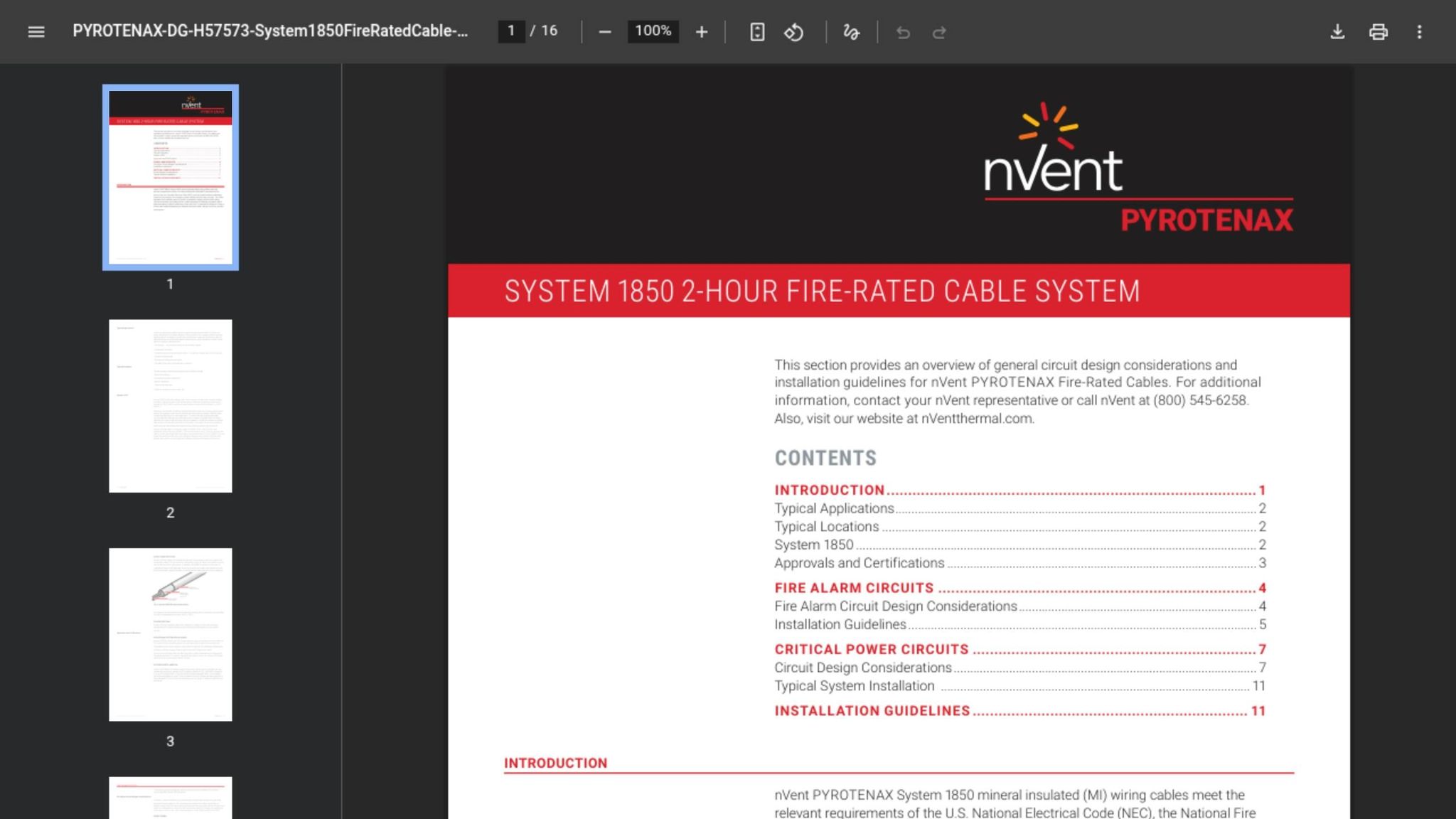
When it comes to fire protection, nVent PYROTENAX mineral-insulated (MI) cables stand out as a dependable solution. These cables are built with a fully inorganic construction, combining magnesium oxide (MgO) insulation and an outer sheath made of either copper or Alloy 825. This design ensures they won’t burn, emit smoke, or contribute fuel during a fire.
"This inorganic and inherently fire-resistant construction means zero smoke, zero flames, and zero fuel contribution." - nVent PYROTENAX
nVent offers two distinct systems designed for backup power applications. The System 1850, featuring a copper sheath and solid copper conductors, is rated to endure temperatures up to 1,850°F (1,010°C) for two hours. Meanwhile, the System 2200, built with an Alloy 825 sheath and nickel conductors, can handle rapid temperature increases up to 2,200°F (1,200°C). It also passes the UL 1709 hydrocarbon fire test, which replicates a fire scenario where temperatures reach 2,000°F (1,093°C) in just five minutes. Both systems are UL 2196 listed and meet the requirements of NEC Articles 695 (Fire Pumps) and 700 (Emergency Systems).
| Feature | System 1850 | System 2200 |
|---|---|---|
| Max Temperature | 1,850°F (1,010°C) | 2,200°F (1,200°C) |
| Sheath Material | Copper | Alloy 825 |
| Conductor Material | Solid Copper | Nickel |
| Voltage Rating | 600V | 600V |
| Fire Rating | 2-Hour (UL 2196) | 2-Hour (UL 2196 / UL 1709) |
This breakdown highlights how each system is tailored to meet specific performance needs. Beyond their impressive technical ratings, nVent PYROTENAX cables simplify installation - a major advantage. Unlike many other fire-resistive cables, these don’t require additional conduit or fireproofing, which is especially useful in retrofit projects. Their high free-air rating also allows them to carry more power in tighter spaces, making them ideal for routing backup generator feeders in older buildings.
"Because of their superior free air rating, MI cables can conduct more power through a smaller area, saving expensive space in new construction and retrofitting of older buildings." - nVent PYROTENAX
These cables have been trusted in major installations, including Dubai International Airport, Roy Thomson Hall in Toronto, and the United States Capitol - locations where maintaining circuit integrity during a fire is absolutely crucial.
3. System 1850 Fire-Rated Copper-Sheathed Power Cables
System 1850 stands out as a durable solution for backup power systems. Made entirely from inorganic materials - solid copper conductors, magnesium oxide (MgO) powder insulation, and a continuous copper sheath - it is designed to maintain circuit functionality even under extreme conditions.
The continuous copper sheath acts as a built-in conduit, eliminating the need for additional conduit protection during installation. This "all-in-one" design is particularly advantageous when retrofitting older structures or working in tight spaces, as it simplifies the process and reduces installation challenges.
Copper's melting point is 1,983°F (1,083°C), while magnesium oxide insulation stays stable up to an impressive 5,072°F (2,800°C). This allows the cable to maintain current flow at temperatures exceeding 1,832°F (1,000°C). It carries a 2-hour fire rating and complies fully with NEC, the Canadian Electrical Code (CEC), and BS EN 60702-1 standards.
| Feature | Specification |
|---|---|
| Voltage Rating | 600V |
| Fire Resistance | 2 Hours |
| Insulation | Magnesium Oxide (Mineral Powder) |
| Sheath Material | Continuous Copper |
| Conductor Material | Solid Copper |
| Conduit Requirement | None - self-protected |
| Standards | NEC, CEC, BS EN 60702-1 |
Because it contains no plastics or organic materials, the cable produces no smoke or toxic emissions during a fire. This makes it ideal for enclosed spaces like tunnels, subways, and high-rise stairwells, where controlling smoke buildup is crucial for safety. Typical uses include powering emergency systems such as fire pumps, elevators, smoke extraction fans, and pressurization systems.
Terminations can be either field-installed or pre-factory terminated. Factory-terminated, pre-measured cable sets help reduce on-site errors, while the cable’s compact size and flexibility allow for discreet installation in architecturally sensitive areas. Up next, we’ll take a closer look at CI cables designed for maintaining circuit integrity.
4. CI/CIC Fire-Resistive Power Cables for Circuit Integrity
When it comes to fire-rated cables, CI and CIC options are designed to ensure circuit integrity in critical situations.
CI (Circuit Integrity) cables are certified for free-air installation without requiring a conduit, all while maintaining a 2-hour fire rating. On the other hand, CIC (Circuit Integrity in Conduit) cables achieve the same 2-hour fire rating but must be installed within specific conduit systems, such as EMT or IMC. Many modern cables are designed to support both configurations, offering flexibility for installation either in open air or within a conduit. This dual rating ensures reliable performance across various setups.
The key to their performance lies in their ceramifiable silicone rubber insulation. Under extreme heat, this material transforms into a ceramic-like crust, which acts as a barrier to maintain electrical insulation and reduce the risk of short circuits. Additionally, these cables feature oxygen-free high-conductivity (OFHC) conductors and a low-smoke, zero-halogen (LSZH) jacket, which helps minimize toxic gas emissions in enclosed spaces.
Typically rated for 300V, both CI and CIC cables must meet UL 2196 standards. Two standout products in this category are the Radix DuraLife® CI/CIC and the Southwire Circuit Defender™, both of which comply with UL 2196 and the requirements of NEC Articles 700, 760, and 517.
| Feature | Radix DuraLife® CI/CIC | Southwire Circuit Defender™ |
|---|---|---|
| Fire Rating | 2-Hour (UL 2196) | 2-Hour (UL 2196) |
| Voltage Class | 300V | 300V |
| Insulation | Ceramifiable Silicone Rubber / LSZH FRPE Jacket | Mica Tape / Silicone Rubber / PVC Jacket |
| Installation | Free-air or EMT/IMC conduit | UL FHIT System #44 |
| NEC Articles | 760, 700, 517 | 760, 700, 517 |
It’s important to note that the 2-hour fire rating applies to the entire system, not just the cable. For CIC installations, it’s essential to use the specified conduit, compression couplings, and splice enclosures (e.g., UL FHIT System 28D) to maintain certification. Furthermore, splicing must be done with approved components, such as 3M butt-type crimp terminals and certified silicone or fiberglass tapes. Using unapproved parts can void the fire-resistance certification.
sbb-itb-501186b
5. Helukabel Fire-Resistant Power and Control Cables

Helukabel employs a halogen-free design that incorporates aluminum hydroxide. This material releases water vapor through an endothermic reaction when exposed to fire. The process cools the cable's surface and displaces oxygen, all without emitting the toxic acids often associated with materials like PVC or PTFE. Two standout products demonstrate this approach in backup power applications:
HELUPOWER® THERMFLEX® 145 and TRAYCONTROL® 500 are tailored for specific needs. The THERMFLEX® 145 is ideal for generator connections, motors, and transformers in tight spaces, such as wind power plants or compact switch cabinets. It features tinned, finely stranded Class 5 copper conductors with a cross-linked polyolefin jacket, supports a nominal voltage of 600/1000V AC, and handles short-circuit conductor temperatures up to +250°C. On the other hand, the TRAYCONTROL® 500 is designed for industrial cable tray installations and is certified under UL 1277 (TC-ER), UL 2277 (WTTC), and CSA FT4 standards.
Helukabel also provides a circuit integrity classification: FE(EI)180/E30. The FE(EI)180 rating guarantees insulation integrity for over 180 minutes of direct flame exposure, preventing short circuits. Meanwhile, the E30 designation ensures the entire system - including mountings and connected equipment - remains operational for at least 30 minutes. This E30 rating is crucial for backup power systems, as it reflects performance during emergencies.
| Feature | HELUPOWER® THERMFLEX® 145 | TRAYCONTROL® 500 |
|---|---|---|
| Voltage Rating | 600/1000V AC | 600V (UL TC) / 1000V (WTTC) |
| Fire Standards | IEC 60332-3-22, IEC 60754, IEC 61034 | UL 1277, UL 2277, CSA FT4 |
| Jacket Material | Cross-linked polyolefin (halogen-free) | Special PVC (oil-resistant) |
| Temperature Range | -67°F to +293°F (fixed) | -13°F to +221°F (fixed) |
| Primary Use | Generator connections, motors, transformers | Industrial trays, plant machinery |
This table underscores the versatility of Helukabel’s products, addressing both compact generator setups and industrial tray systems.
One practical example of Helukabel's fire-resistant cables in action comes from SMS Siemag AG. They installed these cables to ensure that three stationary fire monitors remained functional across a large factory during a fire event. For installations in the U.S., always confirm that the chosen Helukabel series complies with UL or CSA certifications.
6. Fire-Resistive Feeder Cables by Windy City Wire
Windy City Wire's feeder cables are engineered to keep critical backup power systems operational under extreme conditions. These cables boast a certified 2-hour fire-resistive performance, meeting ANSI/UL 2196 (FHIT System 28B) and UL 1424 standards. They are suitable for plenum, riser, and general-purpose applications. This certification ensures essential systems - like generator start signals, fire pump controllers, elevator recall circuits, and smoke control systems - can withstand temperatures as high as 1,850°F (1,000°C) for two hours.
The cables also prioritize installation efficiency. With SmartWire Glide® lubrication, pulling friction is reduced by up to 70% compared to standard cables. This feature minimizes installation tension, shortens labor time, and lowers the risk of damaging the cable jacket.
Important: The 2-hour fire-resistive rating is valid only when installed according to FHIT System 28B instructions using approved supports and components.
| Feature | Specification |
|---|---|
| Fire Rating | 2-Hour Fire-Resistive |
| Compliance | ANSI/UL 2196 (FHIT System 28B), UL 1424 |
| Voltage Class | 300V |
| Temperature Rating | 90°C |
| Available Gauges | 14 AWG, 16 AWG, 18 AWG |
| Jacket Types | PVC (Plenum / FPLP), LSZH (Riser / General Purpose) |
| Shielding Options | Shielded (Aluminum/Aramid) or Non-Shielded |
| Conductor Material | Bare Copper (Solid standard) |
The riser and general-purpose versions feature an LSZH (Low Smoke Zero Halogen) jacket, which reduces toxic fume emissions during a fire - an essential safety advantage for occupied spaces. For environments prone to electrical interference, such as those near generators or elevators, the shielded version uses an aluminum/aramid composite to effectively limit EMI/RFI.
Windy City Wire offers these cables in standard lengths of 1,000 ft and 5,000 ft. They are packaged in the patented RackPack® carton, designed to simplify installation and cut down on handling time.
7. Fire-Resistive Cables for Life-Safety and Alarm Circuits (Belden and Similar)
In backup power systems, maintaining circuit integrity for life-safety and alarm circuits during a fire is absolutely critical. Specialized fire-rated cables - manufactured by companies like Belden, Syston Cable Technology, and Best Wire & Cable - are designed to ensure that emergency systems continue to function under fire conditions.
These cables go beyond standard CI (circuit integrity) cables by offering reliability specifically tailored for fire alarm and life-safety applications. They achieve this through advanced insulation technologies that can maintain functionality for up to 2 hours, meeting UL 2196 standards. For example, the Belden 5122UL features polypropylene or polyolefin insulation with a PVC jacket, making it suitable for riser and notification circuits. However, it doesn’t guarantee multi-hour survivability in an active fire. On the other hand, products like the DuraLife II series use ceramifiable silicone rubber insulation. This material transforms into a ceramic shell under intense heat, preserving circuit integrity for the full 2-hour UL 2196 requirement.
The choice of cable depends largely on the installation environment. For vertical runs between floors, riser-rated cables (FPLR), such as the Belden 5122UL, meet UL 1666 flame spread standards. In air-handling spaces, plenum-rated cables (FPLP), like the Belden 83752 with FEP insulation, are required. These cables comply with NFPA 262 for low smoke and flame spread. The Belden 83752 is particularly versatile, operating in temperatures ranging from –94°F to +392°F (–70°C to +200°C), making it ideal for high-heat conditions.
For specific environments like hospitals, high-rise buildings, or transit systems governed by NFPA 130 or NFPA 502, CI/CIC dual-rated cables are often mandatory. The "CIC" rating ensures the cable is suitable for installation inside conduit systems - such as EMT, IMC, or phenolic conduits - allowing engineers greater flexibility without compromising compliance. All cables in this category must adhere to NEC Article 760 (Fire Alarm Systems) and meet NFPA 72 survivability requirements.
Here’s a quick comparison of key fire-rated cables and their ideal applications:
| Cable | Rating/Standard | Voltage | Best Use Case |
|---|---|---|---|
| Belden 5122UL | FPLR (UL 1666) | 300V | Riser-rated fire alarm and control circuits |
| Belden 83752 | FPLP (NFPA 262) | 300V | Plenum spaces and high-heat environments |
| DuraLife II | CI/CIC (UL 2196) | 300V | 2-hour survivability for life-safety and alarm circuits |
| Syston 6667 | CL3R / FPLR | 300V | Addressable fire alarm and burglar alarm systems |
One important note: CL3 cables can handle surges up to 300 watts, while CL2 cables are limited to 150 watts. While a CL3 cable can replace a CL2 cable if needed, the reverse substitution is not allowed under code.
Comparison Table
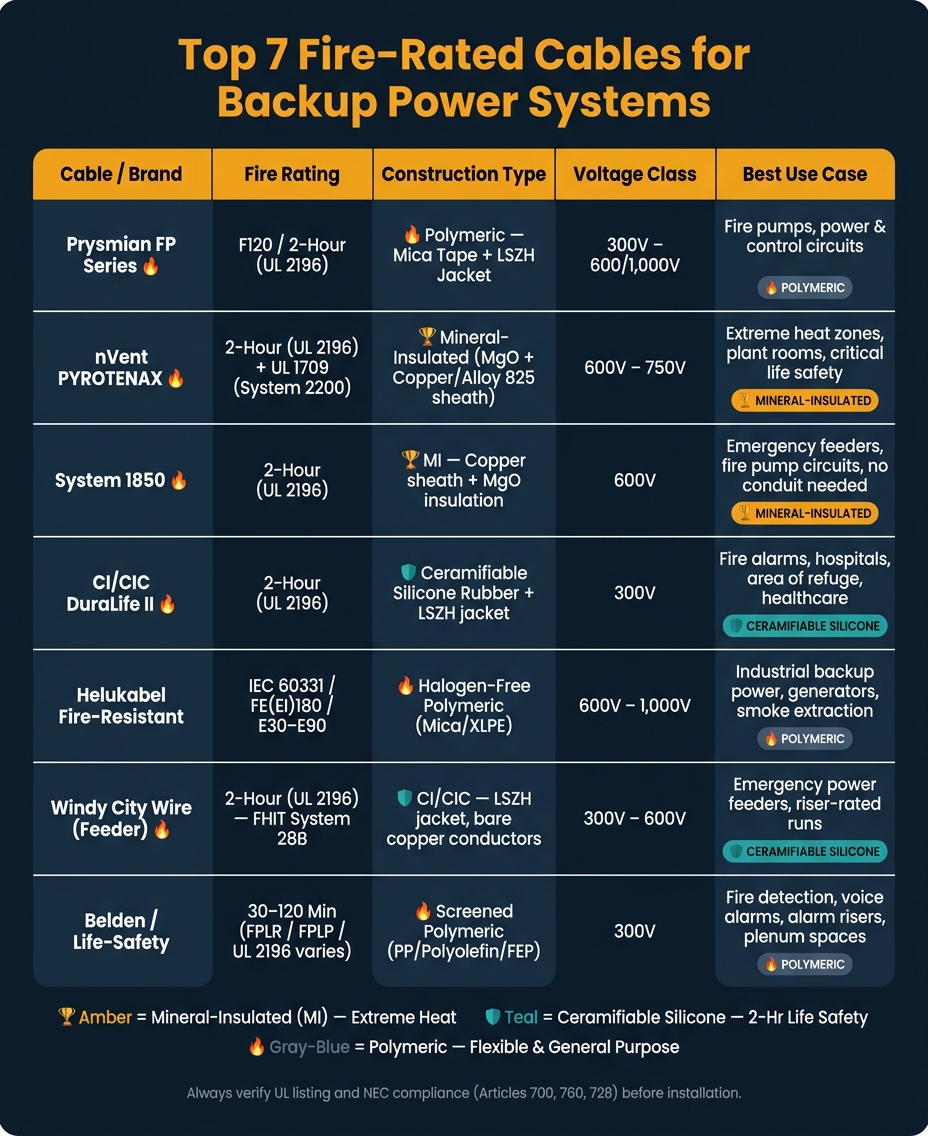
Top 7 Fire-Rated Cables for Backup Power Systems: Side-by-Side Comparison
Select a cable by matching its fire endurance, voltage class, and installation environment.
| Cable | Fire Rating | Construction Type | Voltage Class | Primary Application |
|---|---|---|---|---|
| Prysmian FP Series | F120 / PH120 | Polymeric (Mica/LSZH) | 600/1,000V | Power & control, fire pumps |
| nVent PYROTENAX | BS 6387 CWZ (950°C) | Mineral-Insulated (MI) | 750V (heavy duty) | Critical life safety, hot zones, plant rooms |
| System 1850 | 2-hour (UL 2196) | MI (copper sheath) | 600V | Emergency feeders, fire pump circuits |
| CI/CIC (DuraLife II) | 2-hour (UL 2196) | Ceramifiable silicone | 300V | Fire alarm, healthcare, area of refuge |
| Helukabel Fire-Resistant | IEC 60331 / BS 6387 (E30–E90) | Polymeric (Mica/XLPE) | 600/1,000V | Industrial backup power, smoke extraction |
| Windy City Wire (Feeder) | 2-hour (UL 2196) | CI/CIC (LSZH) | 300V–600V | Emergency power feeders, riser-rated runs |
| Belden / Life-Safety | Standard 30–120 min | Screened polymeric | 300V | Fire detection, voice alarms, alarm risers |
The table above outlines the key distinctions between various fire-rated cables. Mineral-insulated (MI) cables, like nVent PYROTENAX and System 1850, are designed to handle extreme heat, withstanding temperatures over 1,000°C. These cables are ideal for critical applications such as fire pump feeders and plant rooms. On the other hand, polymeric cables (e.g., Prysmian FP, Helukabel, Belden) provide greater flexibility and are easier to install, making them suitable for corridors, risers, and control panels. However, proper installation is essential to maintain the integrity of the mica barrier under high temperatures.
For life-safety and alarm circuits in settings like hospitals or high-rise buildings, ceramifiable silicone cables such as DuraLife II and Windy City Wire feeders deliver the required 2-hour UL 2196 rating. These cables are particularly effective for critical systems that must remain operational during emergencies.
When installations are exposed to sprinkler systems or debris impact, CWZ-rated cables like nVent PYROTENAX are the preferred choice. These cables have passed rigorous tests, including exposure to 950°C fire, water spray, and mechanical shock, ensuring reliability in the harshest conditions. Each cable type offers unique strengths, so selecting the right one depends on the specific demands of your application.
Conclusion
Selecting the right fire-rated cable for a backup power system is a crucial decision that directly impacts life safety. The cables mentioned here serve different needs: mineral-insulated options like nVent PYROTENAX and System 1850 are designed for extreme heat, while ceramifiable silicone cables like DuraLife II are better suited for environments such as hospitals or high-rise alarm systems.
After reviewing the cable specifications, it’s essential to ensure your installation aligns with the required standards. The chosen cable must match your system's rating, voltage, and environmental conditions, whether it faces high heat, moisture, or physical impact. For most U.S. emergency power setups, a cable rated for at least two hours under UL 2196 is typically the minimum requirement. Additionally, the NEC provides specific guidance: refer to Article 700 for emergency systems, Article 760 for fire alarms, and Article 728 for fire-resistive cable systems.
Adherence to fire safety standards is non-negotiable. For example, NFPA 72 mandates two-hour fire-rated cables for certain pathway survivability levels. Similarly, IBC Section 909 requires continuous raceways for smoke control wiring. Always follow the manufacturer’s UL listing instructions, including the use of specified conduits, compression couplings, and lubricants. Any deviation from these guidelines can void the fire rating, putting safety at risk.
FAQs
Do I need UL 2196 or just flame-retardant cable?
If you need cables that remain functional during a fire, you’ll want UL 2196-certified cable. Unlike flame-retardant cables, which only slow down flame spread and reduce smoke, UL 2196 cables are designed to keep working even in extreme fire conditions. These cables are crucial for critical systems like emergency alarms or backup power, especially since NFPA 72 requires pathway survivability. To comply, the cables must pass the rigorous two-hour fire and hose stream test.
When should I choose MI vs CI/CIC cable?
When dealing with extreme heat or critical life-safety circuits, mineral-insulated (MI) cable is the go-to choice. This type of cable can handle high temperatures without needing extra protection, making it incredibly durable. However, it comes with higher costs and requires more effort to install.
For general construction projects, circuit integrity (CI/CIC) cables are a more practical and cost-effective option. CI cables work well for non-conduit risers, while CIC cables are designed for use with conduits. These cables are easier to install, making them a solid choice for most commercial or residential applications.
Will conduit or splices void the 2-hour rating?
Whether conduit or splices affect a 2-hour fire-resistance rating depends entirely on the UL Electrical Circuit Integrity System (FHIT) certification for the cable being used. Under UL 2196 standards, specific components - such as conduit types, couplings, and enclosure boxes - must be approved and installed correctly to maintain the rating.
Using hardware or materials not listed in the certification can void the rating. To avoid this, always refer to the manufacturer's installation manual for guidance. Additionally, it's crucial to consult your local Authority Having Jurisdiction (AHJ) to ensure compliance with all regulations before beginning any work.