RCD Installation Standards Explained
In the U.S., the short answer is this: use a listed GFCI or GFCI breaker, put it where the NEC requires it, wire it exactly right, and test it before sign-off. If you miss any one of those steps, you can end up with failed inspections, nuisance trips, or a device that does not protect people at all.
Here’s the core idea in plain English: RCD is the global term, but in the United States, GFCI is the term that matters for personnel protection. And there’s a big number gap too: U.S. Class A GFCIs trip at about 4 to 6 mA, while many IEC RCD setups use 30 mA. So I would not assume an imported RCD meets U.S. rules just because the function sounds similar.
If you only remember a few points, make them these:
- RCD and GFCI are not interchangeable in U.S. code work
- UL listing matters as much as device type
- NEC 210.8 tells you where GFCI protection is required
- GFCI protection does not replace overcurrent protection
- Neutral and ground errors are a top cause of nuisance tripping
- The TEST button checks device function, but not full trip current or trip time
- Local AHJ rules may change what your job needs
A few jobsite facts stand out:
- Every bathroom receptacle in a dwelling needs GFCI protection
- NEC 210.8 covers many 125 V to 250 V receptacles rated 50 A or less
- U.S. personnel protection targets 4–6 mA, not 30 mA
- For commercial and industrial sites, NFPA 70B 2023 calls for documented maintenance programs
When I strip the article down, it comes down to four checks: where the device is required, what listing it carries, how it is wired, and how it is tested. That gives you the fast path to code-ready installation and fewer callbacks.
NEC 2023 GFCI requirements: making your next installation safer | Eaton PSEC

sbb-itb-501186b
The Main U.S. Standards That Drive RCD Installation
In the U.S., three documents shape most ground-fault protection decisions: NFPA 70 (the National Electrical Code), UL 943, and IEC reference standards that help explain the bigger picture.
NEC Rules: Where Ground-Fault Protection Is Required
The NEC does not call for GFCI protection everywhere. It requires GFCI protection in specific places where shock risk is higher, such as near water, outdoors, in unfinished areas, and on rooftops. NEC Article 210.8 applies to 125–250 V receptacles rated 50 A or less, and it tells you where installation is mandatory, not just a good idea.
Recent NEC editions added more places to that list. For dwelling units under Section 210.8(A), GFCI protection is required in bathrooms, kitchens, laundry areas, garages, unfinished basements, crawl spaces at or below grade, outdoor areas, and spots near sinks, bathtubs, and shower stalls. Every bathroom receptacle in a home needs GFCI protection. There is no sink-distance exception.
For non-dwelling occupancies under Section 210.8(B), the NEC adds places like buffet serving areas and aquariums or bait wells when receptacles are within 6 ft of the vessel edge. It also covers rooftop receptacles serving HVAC equipment, commercial kitchen outlets, indoor damp or wet locations, locker rooms with showers, and garage service bays.
One thing trips people up all the time: the NEC is a model code. Local jurisdictions can add to it or change how GFCI rules apply. So before design sign-off, check the adopted NEC edition and any local amendments with the AHJ. Once you know where protection is required, the next move is picking the right device and trip function for the circuit.
UL 943 Class A GFCIs: What They Do and What They Don't Cover
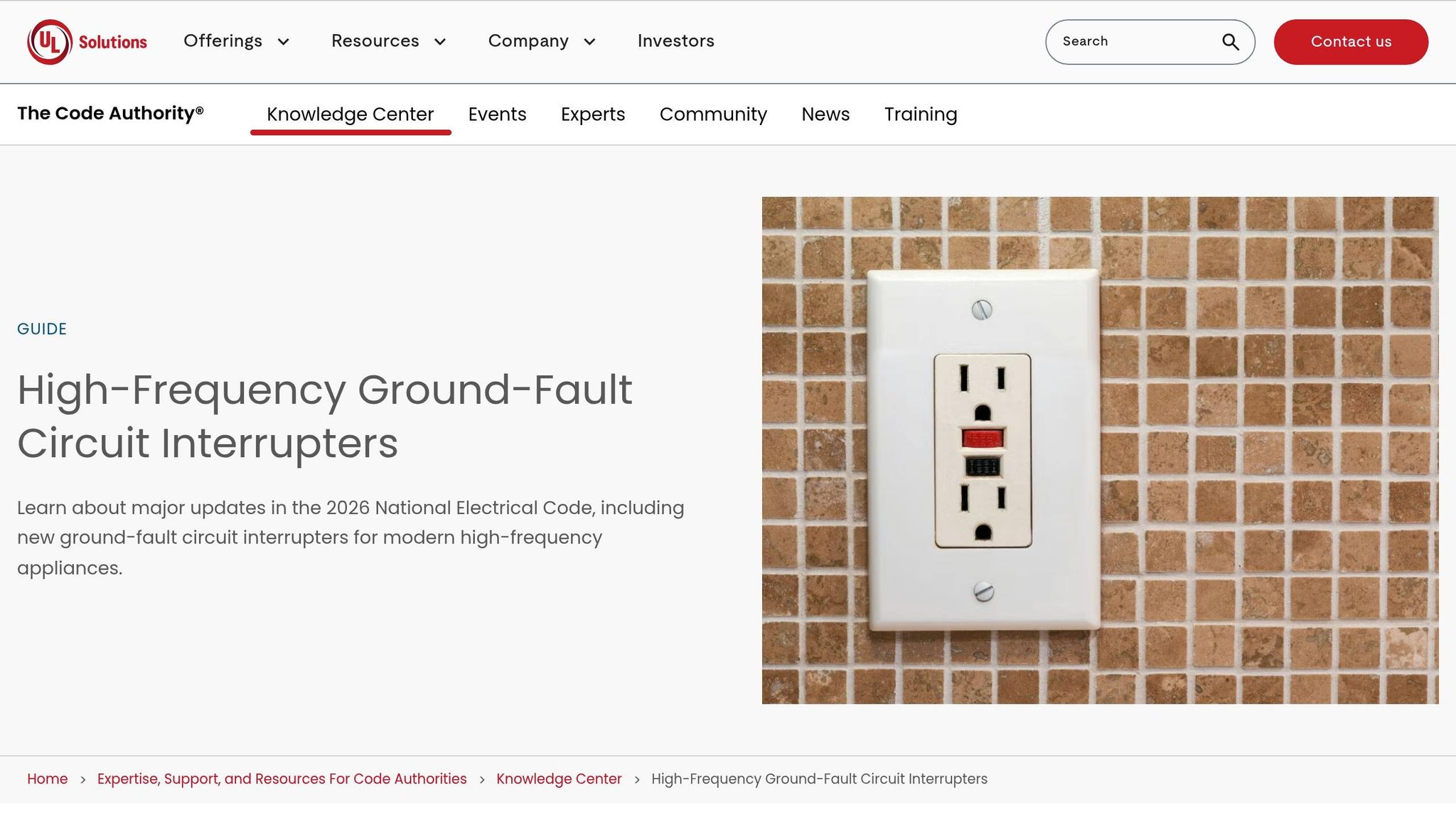
UL 943 sets the U.S. performance standard for GFCI devices. UL 943 Class A GFCIs are meant for personnel protection, and the device’s listing and intended use decide whether it can be used in a U.S. installation.
A Class A GFCI works by sensing leakage current. It does not operate like thermal or magnetic overcurrent protection. That means it won't clear overloads or short circuits. You still need a UL 489-listed breaker or a fuse for that job. Put simply, GFCI protection handles leakage current, while overcurrent protection handles fault current and overloads. That split is what drives device choice and coordination.
Where IEC Standards Provide Useful Background
IEC 60364-4-41 lays out the idea of additional protection, using RCDs with a 30 mA trip threshold as an added layer of shock protection beyond basic insulation and earthing. IEC 60364-6 deals with installation testing and verification, including RCD trip-time checks. That background can be helpful, especially if you work across markets, but it does not replace NEC and UL rules in the U.S.
For U.S. projects, the rule of thumb is simple: follow the NEC, use listed equipment, and install it per the manufacturer’s instructions. IEC material can help inform design decisions, but NEC and UL are the standards that govern the work.
Choosing the Right Device and Planning Circuit Coordination
Matching Device Type to the Load and Application
Once you know where protection is needed, the next step is picking the right device for the load, trip setting, and panel layout. Load type usually makes the first cut. IEC-type labels are a good guide, but in the U.S., the final word still comes from the product listing and the manufacturer's instructions.
Type AC detects only sinusoidal AC, so it fits simple resistive loads. Type A detects both AC and pulsating DC, which makes it the go-to option for most household and light commercial loads, including PCs, LED drivers, and specialty appliances. For most modern loads, Type A is the standard pick. Type B is required for EV charging, PV inverters, and VFDs.
Device function matters too. RCCB gives you leakage protection only, so it has to be paired with an MCB. RCBO rolls both jobs into one device, which makes sense for dedicated circuits. The device's rated current should match the upstream protective device.
After that, you match the residual-current threshold to what you're trying to protect.
Trip Ratings for Personnel, Equipment, and Fire Protection
Rated residual current (IΔn) is one of the main selection points. In a coordinated setup, 30 mA is used on branch circuits that serve people directly, like socket outlets, bathrooms, kitchens, and other higher-risk areas. 100 mA fits places where the risk of direct contact is lower or where circuits have more natural leakage current. 300 mA is used for fire protection and is usually placed at main distribution points in larger installations, not on branch circuits that people use directly.
Pick the wrong sensitivity and things get messy fast. Set it too low, and nuisance tripping goes up. Set it too high, and the protection starts to lose its point.
Coordination and Selectivity Across Panels and Subpanels
In a system with more than one level of distribution - a main panel feeding subpanels, then branch circuits - the goal is selective tripping. Put simply, the device closest to the fault should trip first. If upstream and downstream devices all have the same sensitivity, one small branch fault can knock out a much bigger part of the system.
A common setup is a 300 mA device at the main incomer and 30 mA devices on downstream branch circuits. If a fault shows up on a branch, the 30 mA device trips first and isolates that one circuit. That keeps a local problem from shutting down upstream equipment.
Here’s how device function and sensitivity line up with common uses.
| Device | Leakage Protection | Overcurrent Protection | Typical Sensitivity | Common Application |
|---|---|---|---|---|
| MCB | No | Yes | N/A | Basic wiring and appliance protection |
| RCCB | Yes | No | 30 mA / 100 mA / 300 mA | Used with an MCB; adds personnel or fire protection |
| RCBO | Yes | Yes | 30 mA | Single-device solution for dedicated circuits |
For the last step, match the pole count to the supply system: 2-pole for single-phase and 4-pole for three-phase, so all phases and the neutral disconnect at the same time.
Installation, Wiring, Testing, and Troubleshooting Rules
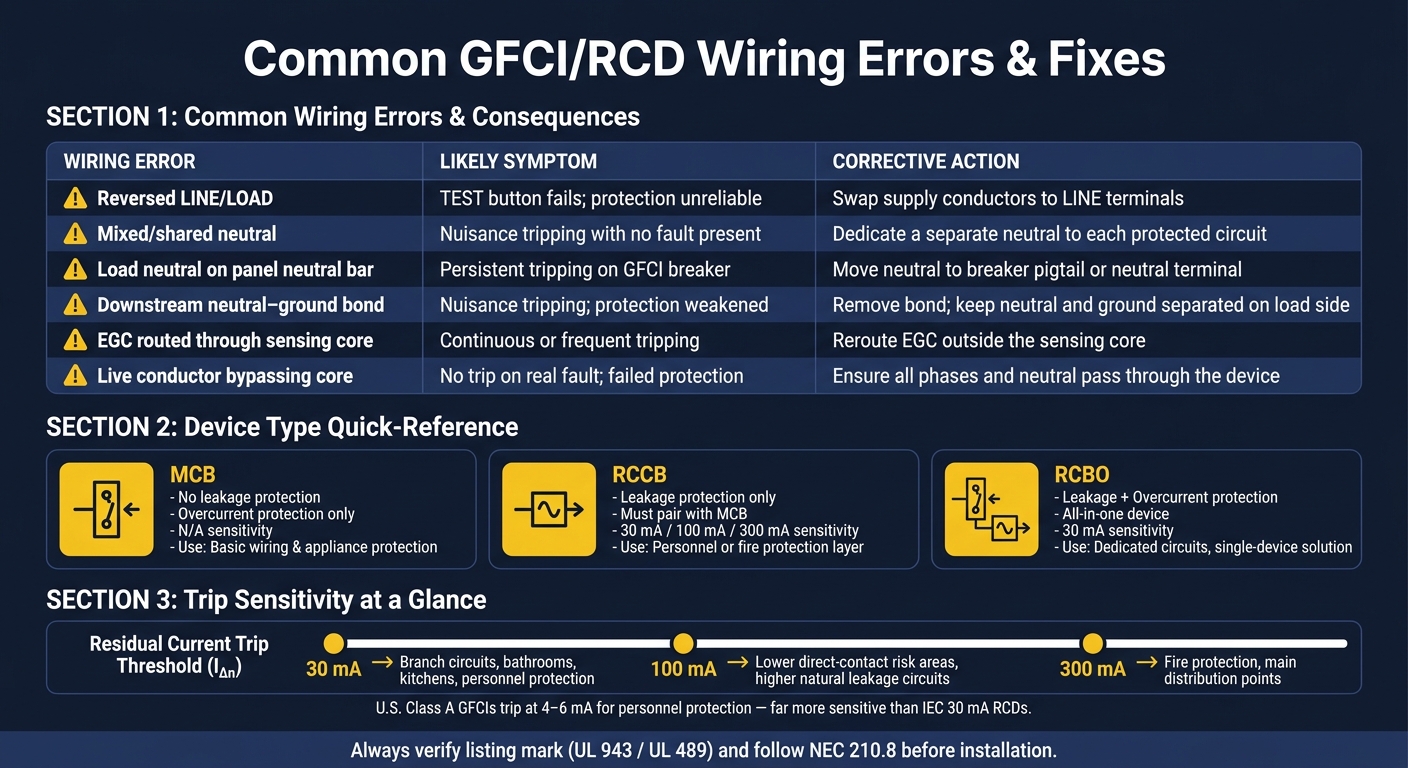
GFCI vs RCD: U.S. Wiring Errors, Device Types & Trip Ratings Explained
Wiring Rules You Must Follow
After you pick the right device, wiring is what makes the protection do its job. Conductor routing matters too. It’s part of installing a listed device the way its instructions and the NEC require.
Every live conductor - each phase and the neutral - has to pass through the RCD sensing core. The device checks the current going out against the current coming back. If even one live conductor skips the core, that mismatch can stop the device from tripping the way it should.
The equipment grounding conductor (EGC) must stay outside the sensing core.
Neutral and ground must stay separate on the load side. If there’s a neutral-ground bond downstream, the device can trip when it shouldn’t, and protection is reduced.
On GFCI breakers, connect the branch neutral to the breaker terminal or pigtail - not to the panel neutral bar.
Once the circuit is wired the right way, the next step is to check that it works.
Testing, Verification, and Maintenance After Installation
Start with a visual check before you energize the circuit. Make sure all required conductors pass through the device, and confirm that the EGC is bonded as required but not routed through the core.
After energizing, press TEST and make sure the device trips and resets. For receptacles, use a plug-in tester to check polarity, grounding, and downstream protection.
The TEST button only checks the device’s internal operation. It does not confirm actual trip current and trip time, so instrument testing is still needed for that.
For service and feeder devices, check neutral-to-ground isolation before energizing.
If any additions or alterations are made later, inspect neutral and ground routing again. Unintended bonds or shared neutrals can slip in during follow-up work.
For commercial and industrial facilities, NFPA 70B 2023 now requires documented maintenance programs.
Common Wiring Errors and What They Cause
Most GFCI and RCD trouble in the field comes from a small set of wiring mistakes. One of the most common is reversed LINE/LOAD connections. If the supply lands on the LOAD terminals instead of the LINE terminals, the device’s internal test circuit may not have supply power. That usually means the TEST button won’t work, and protection may not work the way you expect.
Shared neutral problems are also common. If two circuits share one neutral and only one circuit has GFCI protection, return current from the unprotected circuit can travel on the protected circuit’s neutral. The device sees an imbalance and trips even though there’s no fault. Each GFCI-protected circuit needs its own neutral.
| Wiring Error | Likely Symptom | Corrective Action |
|---|---|---|
| Reversed LINE/LOAD | TEST button fails; protection unreliable | Swap supply conductors to LINE terminals |
| Mixed/shared neutral | Nuisance tripping with no fault present | Dedicate a separate neutral to each protected circuit |
| Load neutral on panel neutral bar | Persistent tripping on GFCI breaker | Move neutral to breaker's pigtail or neutral terminal |
| Downstream neutral–ground bond | Nuisance tripping; protection weakened | Remove bond; keep neutral and ground separated on the load side |
| EGC routed through sensing core | Continuous or frequent tripping | Reroute the EGC outside the sensing core |
| Live conductor bypassing core | No trip on a real fault; failed protection | Ensure all phases and the neutral pass through the device |
Fix these issues before energizing the circuit or putting it back into service.
Sourcing Compliant Devices and Key Takeaways
What to Check Before Buying RCD, GFCI, or RCBO Equipment
Once the circuit is designed and wired the right way, buying the device becomes the last compliance step. This is where small mistakes can turn into big problems.
Start with the listing mark. In the U.S., buy only devices listed by an NRTL, most often UL, and make sure the listing matches the job the device is supposed to do. Use UL 943 Class A for personnel protection and UL 489 for breaker-integrated ground-fault protection. UL Solutions classifies GFCIs under product categories KCXS and DKUY, and you can confirm both in the Product iQ database before you place the order.
Next, compare the device ratings to the circuit itself. UL 943 devices are meant for AC circuits at 120 V, 208Y/120 V, and 120/240 V at 60 Hz, so the circuit’s voltage, phase, and frequency all need to line up. Pole count matters too. For example, a 208Y/120 V three-phase panel may need a 3-pole GFCI breaker for a three-phase load.
Here’s a quick check table before you buy:
| Check | What to Verify |
|---|---|
| Listing | UL mark, category code (UL 943, UL 489), NRTL acceptance |
| Voltage | Matches system voltage to ground (120 V, 240 V, 208Y/120 V) |
| Current rating | Matches conductor size and load per NEC Articles 210 and 240 |
| Interrupting rating | Meets or exceeds available fault current at the panel |
| Pole count | Correct for single-phase or three-phase circuit configuration |
| Protection class | Class A personnel protection, equipment protection, or fire/feeder protection |
| Panel compatibility | Listed for use with the specific panel brand and model |
| Enclosure rating | NEMA type matches indoor, damp, or wet location requirements |
If you’re dealing with VFDs or inverter-driven loads, slow down and check one more thing. A standard Class A device may not fit the leakage profile. In some cases, you may need an HF-marked device instead.
Using Electrical Trader to Source Protection and Distribution Equipment
For new or used equipment, the next step is making sure the listing and panel match are correct before you buy. Electrical Trader gives buyers one place to source new and used breakers, transformers, and distribution equipment.
Used gear needs extra care. The listing mark should be legible, and the device should match both the panel and the available fault current. It also helps to check the listing against the NEC articles tied to your job. For ground-fault protection, Articles 210, 215, 230, and 240 are the main ones to review.
Conclusion: The Main Rules to Keep in Mind
In the U.S., choose listed devices, match them to the circuit, and wire them exactly as labeled. Verify neutral, grounding, and coordination details before energizing, then test after installation.
FAQs
Can I use an imported RCD in the U.S.?
No. In the U.S., you should only use an imported RCD or GFCI if it’s certified by a Nationally Recognized Testing Laboratory (NRTL), such as UL or ETL.
If that certification mark isn’t there, the device can violate building codes, fail inspection, and cause safety, insurance, or legal problems. Always check for the proper U.S. certification marks.
Why does my GFCI keep tripping?
A GFCI trips when it senses a ground fault. That means electricity is leaving the path it’s supposed to follow.
A few things can set that off:
- Moisture
- Damaged insulation
- Small electrical fluctuations
- High-frequency noise from certain appliances
You should test it once a month with the built-in Test button. If the outlet doesn’t trip during the test, or if it trips again and again, contact a licensed electrician to check the circuit and your home’s grounding system.
Does a GFCI replace a breaker or fuse?
No. A GFCI only takes the place of a standard breaker or fuse if it’s a GFCI circuit breaker.
A standard breaker protects a circuit from overloads and short circuits. A GFCI breaker does that too, but it also trips when it detects a ground fault.
If you’re using a standalone GFCI, like a receptacle, you still need a standard breaker or fuse to handle overcurrent protection.