

RCD Working Principle Explained
Residual Current Devices (RCDs) are safety devices that protect people from electric shocks and reduce the risk of electrical fires. They work by detecting and reacting to current imbalances between live and neutral wires, which indicate leakage to the ground. If leakage exceeds safe limits (e.g., 30 mA), the RCD disconnects power within milliseconds. Here's a quick breakdown:
- Purpose: Protect against electric shocks and fire risks.
- How It Works: Monitors current flow; trips when imbalance is detected.
- Response Time: Typically 25–40 milliseconds.
- Types: Single-phase (residential) and three-phase (industrial).
- Sensitivity Levels: 5–30 mA for personal protection; higher for industrial use.
- Maintenance: Test fixed RCDs every 3 months; portable ones before use.
RCDs are critical for modern electrical safety, offering fast response times and high reliability (97%). Proper installation and regular testing ensure they function effectively.
Residual Current Devices (RCD) - How they work
How RCDs Work: The Basic Principle
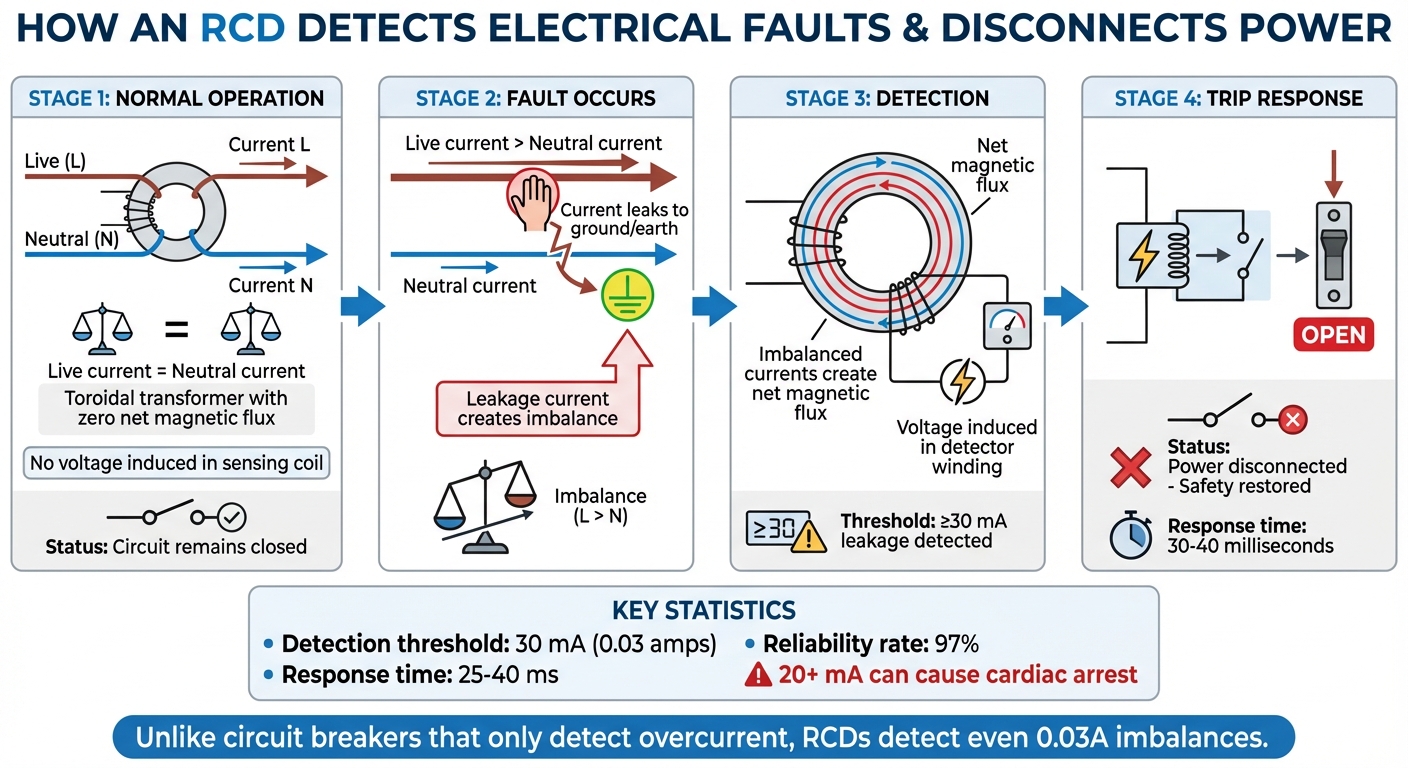
How RCD Detects Faults and Trips Circuit in Milliseconds
RCDs, or Residual Current Devices, operate by monitoring the flow of electrical current. Specifically, they compare the current leaving through the live wire to the current returning through the neutral wire. In a properly functioning circuit, these two currents are equal. This balance is what allows the device to quickly react to any faults.
Kirchhoff's Current Law and Detecting Imbalances
The foundation of RCD operation is Kirchhoff's Current Law (KCL), which states that the total current entering and leaving a circuit must equal zero. In other words, the current through the live conductor should match the current returning through the neutral conductor. Electrical expert Jignesh Parmar explains:
"The operation of an earth leakage circuit breaker... is based on the fact that the algebraic sum of the currents in any healthy single phase, three phase and three phase and neutral system is zero".
To detect imbalances, RCDs use a toroidal transformer. This component ensures that equal but opposite currents cancel each other out, resulting in zero net magnetic flux. However, when a fault occurs - like someone accidentally touching a live wire or when insulation breaks down - some current leaks to the ground instead of returning through the neutral wire. This leakage creates an imbalance, with the live current exceeding the neutral current.
If the leakage surpasses the 30 mA threshold, the imbalance generates a magnetic flux that induces a voltage in a sensing coil. This voltage activates a relay, cutting off power in just 30–40 milliseconds. As LED Controls Ltd puts it:
"The genius of the RCD is that it doesn't need to know where the fault is, only that current is escaping somewhere it shouldn't".
Unlike traditional circuit breakers, which only respond to overcurrent situations where live and neutral currents remain balanced, RCDs are designed to detect even small discrepancies - down to 0.03 amps. This sensitivity makes them highly effective at protecting against electric shocks, ensuring safety through precise fault detection.
Internal Components of an RCD
Once an imbalance in current is detected, the internal components of a Residual Current Device (RCD) spring into action to ensure a quick response. These components work together to identify faults and disconnect power in as little as 30–40 milliseconds, reducing the risk of electrical shock.
Toroidal Transformer and Sensing Coils
At the core of every RCD lies a toroidal transformer - a doughnut-shaped magnetic core - through which both live and neutral wires pass as primary windings. Under normal conditions, the currents in these wires are balanced, resulting in zero net magnetic flux. However, when a fault occurs, such as a leakage of current to the ground, this balance is disrupted, generating a residual magnetic flux.
This is where the sensing coil comes into play. Wound around the toroidal core, it detects changes in flux and induces a voltage. This voltage activates the tripping mechanism, which then isolates the faulty circuit.
Relay and Solenoid Mechanism
RCDs use either an electromechanical or electronic design to trigger the disconnection.
- Electromechanical RCDs rely on a permanent magnet to hold a spring-loaded tripping arm. When a fault occurs, a demagnetizing coil releases the arm, breaking the circuit. These devices operate independently of external power, making them especially reliable during a loss of neutral.
- Electronic RCDs, on the other hand, amplify the fault signal using a relay. While this allows for a more compact design - suitable for sockets and portable devices - it does require mains power to function.
Despite their differences, both designs share the same objective: disconnecting power swiftly to prevent harm. For instance, a 30 mA RCD subjected to a fault current of 150 mA (five times its rated capacity) must trip in under 40 milliseconds. This rapid response is critical for ensuring safety.
RCD Behavior During Normal and Fault Conditions
Normal Operation: Balanced Currents
An RCD functions by carefully monitoring the balance of currents between the live and neutral wires. During normal operation, the current flowing out through the live wire is equal to the current returning via the neutral wire. This balance ensures that the opposing magnetic fields in the toroidal core cancel each other out, resulting in zero net magnetic flux. With no flux, the detector winding remains inactive - no voltage is induced, no current flows to the relay, and the circuit stays closed. This allows electricity to flow uninterrupted to your appliances and devices. However, the moment this balance is disrupted, the RCD springs into action to address the fault.
Fault Condition: Detecting and Responding to Leakage Current
When a fault occurs, such as a person accidentally touching a live wire or insulation failure causing current to leak to the earth, the balance between live and neutral currents is disrupted. This imbalance generates a net magnetic flux in the toroidal transformer, which then induces voltage in the detector winding. The induced voltage activates the relay, cutting off the power supply to prevent harm.
The speed of the RCD's response depends on the severity of the leakage current. According to BS EN 61008 standards, an RCD must trip within specific timeframes based on the level of leakage current:
| Fault Current Level | Maximum Break Time |
|---|---|
| 1× Rated Current (30 mA) | 300 ms |
| 2× Rated Current (60 mA) | 150 ms |
| 5× Rated Current (150 mA) | 40 ms |
As LED Controls explains, "The RCD doesn't need to know where the fault is, only that current is escaping somewhere it shouldn't". Its sole job is to detect the imbalance and disconnect the power before the leakage poses a risk. By acting swiftly, the RCD ensures safety in both domestic and industrial environments.
sbb-itb-501186b
Types and Configurations of RCDs
Single-Phase vs. Three-Phase RCDs
Single-phase RCDs are designed to monitor the balance between one live wire and one neutral wire. They’re commonly used in residential settings, providing protection for circuits, bathrooms, and individual outlets through consumer units.
On the other hand, three-phase RCDs monitor the combined sum of currents across three phases (and sometimes a neutral wire). These are essential for commercial and industrial setups, where they safeguard circuits powering heavy machinery and variable speed drives. In these environments, three-phase RCDs are often paired with overcurrent protection in distribution boards to address both leakage and overload conditions. However, it’s important to note that RCDs only detect leakage currents flowing to earth - they don’t respond to overloads or phase-to-phase faults. This makes their sensitivity ratings and response times especially critical, as outlined below.
Trip Current Ratings and Response Times
The way RCDs are designed directly impacts how quickly and effectively they detect faults. The table below highlights the sensitivity levels, rated currents, and typical applications for different RCD configurations:
| RCD Sensitivity | Rated Current | Application |
|---|---|---|
| High Sensitivity | 5–30 mA | Residential / Life safety |
| Medium Sensitivity | 100–1,000 mA | Commercial / Fire protection |
| Low Sensitivity | 3–30 A | Industrial machinery |
Why does this matter? Alternating currents at 60 Hz that exceed 20 mA can cause cardiac arrest in just a fraction of a second. That’s why standard RCDs are designed to trip within 25–40 milliseconds, preventing dangerous conditions like ventricular fibrillation. In systems with multiple RCDs installed in series, selective (S-type) RCDs are used upstream. These devices introduce a slight time delay, ensuring downstream RCDs trip first, which helps avoid cutting power to an entire building due to a localized fault.
Modern electrical systems, particularly those with advanced electronics, may produce DC leakage currents. For precise detection in such cases, Type A or Type B RCDs are essential.
To maintain reliability, fixed RCDs should be tested every three months using their built-in test button. Portable RCDs, however, should be tested before each use. Fixed RCDs are highly dependable, with a reliability rate of about 97%, making regular testing a small but crucial step in ensuring safety.
Where to Buy RCDs and Related Components
Finding RCDs on Electrical Trader

Once you understand how RCDs work and their safety benefits, choosing the right one becomes a critical step. It’s essential to check for proper certification, brand reliability, and compliance with safety standards. Using uncertified RCDs can result in devices that fail to trip correctly, putting safety at risk. That’s why it’s wise to stick with suppliers offering certified products from reputable brands like Schneider, Eaton, ABB, Legrand, Hager, and FuseBox. Prioritizing quality ensures you’re investing in equipment that does its job - protecting lives and property.
Electrical Trader serves as a one-stop marketplace for both new and pre-owned RCDs and other circuit protection equipment. Whether you’re upgrading a consumer unit or working on a new installation, they offer a variety of RCDs, including:
- Type A: Perfect for modern domestic electronics.
- Type B: Ideal for EV chargers and solar PV systems.
- Type F: Designed for frequency-controlled equipment.
Choosing the right RCD type for your system’s specific load is essential to maintain fault detection accuracy.
Make sure the components you buy meet current standards, such as BS EN 61008 for RCCBs or BS EN 61009 for RCBOs. In residential applications, devices with a 30 mA sensitivity rating are the norm for personal protection, as this level effectively reduces the risk of severe electric shock. If you’re planning a high-integrity system to minimize nuisance tripping, consider using individual RCBOs or split-load consumer unit components.
For pricing, portable RCDs typically cost around $15, while replacing a fixed RCD, including installation, can range from $60 to $180. If you’re on a tight budget or need older components, certified used parts can be a safe and cost-effective solution.
Conclusion
Knowing how RCDs operate isn't just about understanding technical details - it’s about safeguarding lives. These devices detect earth leakage currents that standard circuit breakers completely overlook, acting quickly to stop shocks from turning deadly. Their internal components work together seamlessly to achieve this rapid disconnection.
The 30 mA sensitivity threshold isn’t arbitrary - it’s based on the sharp rise in electric shock risks above this level. RCDs are designed to protect you from electrocution, not just your electrical systems. As electrical professional Jignesh Parmar aptly states:
"We can assume that the ELCB [RCD] is the brain for the shock protection, and the grounding as the backbone".
Fixed RCDs boast a reliability rate of about 97%, but this can improve significantly with routine maintenance. Regular testing is critical: test fixed devices every three months and portable ones before each use.
For homes updated since July 2008, these protections are typically standard. If your consumer unit doesn’t have a test button, it’s time to upgrade - make sure to enlist a registered electrician for the job.
FAQs
How often should you test an RCD to ensure it’s working correctly?
To keep your RCD working as it should, make it a habit to test it twice a year. Regular testing ensures the device will trip when needed, offering essential protection against electric shocks and potential fire risks.
For an easy way to remember, try aligning your tests with daylight saving time changes - every six months. A simple reminder can go a long way in keeping your home safe.
What is the difference between single-phase and three-phase RCDs?
Single-phase and three-phase residual current devices (RCDs) are designed for different electrical systems and applications.
Single-phase RCDs are commonly found in residential homes or small commercial setups. These systems typically have one live wire and one neutral wire. The RCD monitors this single-phase power supply to detect any leakage currents and provides protection by cutting off the power if needed.
Three-phase RCDs are more suited for larger commercial or industrial environments where three-phase power systems are standard. These devices monitor all three live wires, and the neutral wire if present, to ensure safety across the entire system. They are especially useful for equipment or systems that demand higher power loads.
While both types of RCDs are designed to detect leakage currents and disconnect power to prevent potential hazards, the choice between them depends entirely on the electrical system in use.
Why is a 30 mA RCD sensitivity level preferred for personal protection?
A 30 mA sensitivity is often selected for personal safety because it offers an effective middle ground between protection and practicality. This level is low enough to guard against harmful electrical currents that could lead to ventricular fibrillation, a life-threatening heart condition. At the same time, it’s high enough to minimize the risk of frequent, unnecessary device trips.
This sensitivity level provides dependable protection in everyday situations, such as shielding against electric shocks from faulty appliances or accidental contact with live wires. It’s a widely accepted safety standard in both residential and commercial electrical systems throughout the United States.