Ultimate Guide to RCD Testing Tools
Residual Current Device (RCD) testing tools are critical for ensuring electrical safety. These tools simulate faults to measure trip time and current, verifying that RCDs disconnect power quickly to prevent shocks and fires. Here's what you need to know:
-
Types of RCD Testers:
- Basic Handheld: Compact, affordable, good for residential use.
- Multifunction: Combines RCD testing with other diagnostics, ideal for professionals.
- Advanced: High-precision tools for complex systems, often with data storage and connectivity.
- Portable Plug-In: Simple, quick checks for outlets.
-
Key Features to Look For:
- Compatibility with RCD types (AC, A, F, B).
- Auto-sequence testing for efficiency.
- Data storage and connectivity for reporting.
- Durability (e.g., IP54-rated) for fieldwork.
-
Price Ranges:
- Residential: $200–$400.
- Commercial: $600–$1,200.
- Industrial: $1,200–$2,500+.
-
Top Models:
- Kewtech KT500: Affordable and reliable for basic needs.
- Megger RCDT330: Advanced features for diagnostics.
- Fluke 1664 FC: Includes cloud integration for reporting.
- Megger MFT-X1: Best for industrial and solar applications.
RCD testers protect lives and infrastructure by ensuring compliance with safety standards like BS 7671. Choose a tool based on your specific needs, whether for residential, commercial, or industrial work.
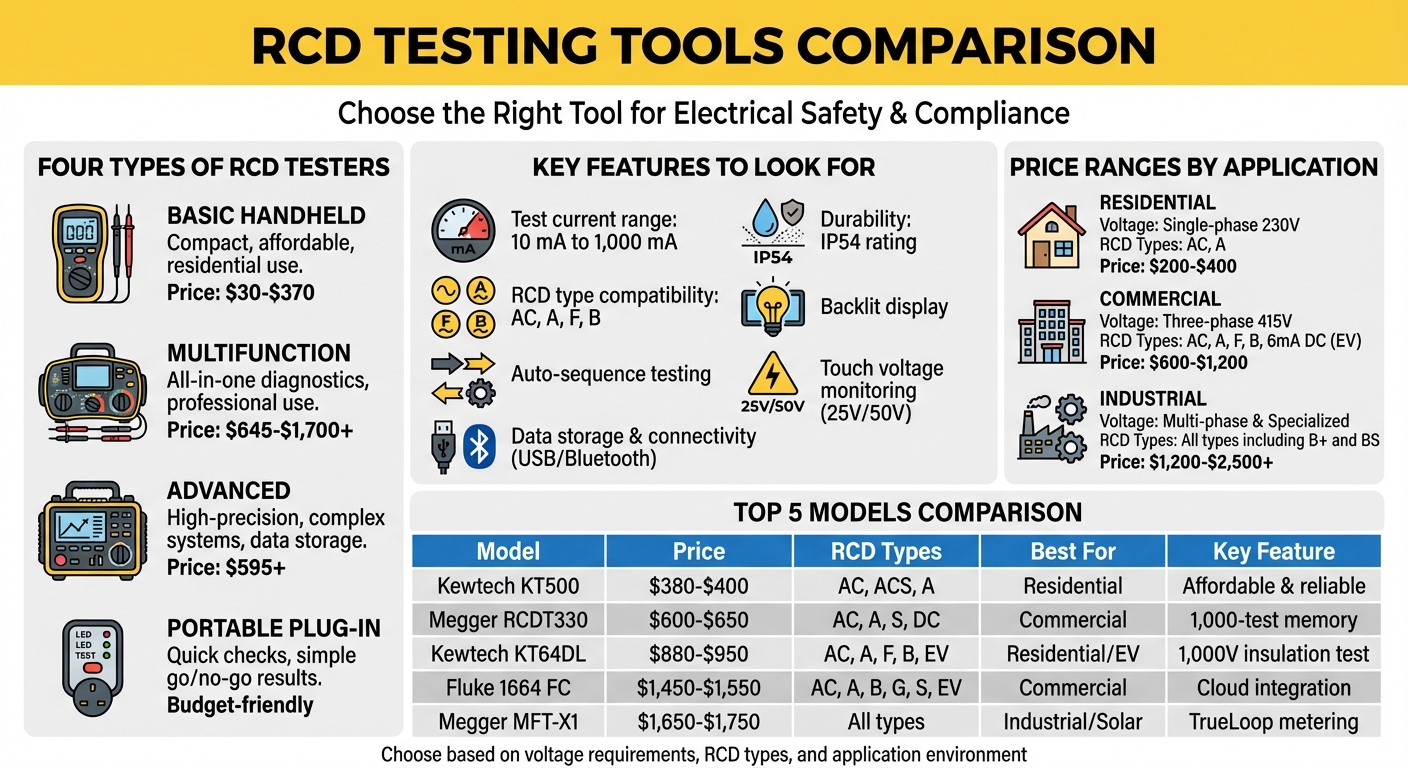
RCD Testing Tools Comparison Guide: Types, Features, and Price Ranges
How to Test RCDs
sbb-itb-501186b
Types of RCD Testing Tools
RCD testing tools come in four main types, each tailored to different testing scenarios and user needs. Knowing these categories can help you choose the right tool for your electrical work. Let’s dive into what sets these tools apart.
Basic Handheld RCD Testers
These are compact, portable devices designed for everyday RCD maintenance. They measure trip times at various test currents - like 50%, 100%, and 500% of the rated current - and are commonly used with Type AC and Type A RCDs in residential setups. Powered by batteries, they’re lightweight, easy to use, and budget-friendly, with prices ranging from about $30 to $370. For instance, the Kewtech KT500 is a popular choice in this category.
Multifunction Installation Testers
Multifunction testers (MFTs) combine RCD testing with other electrical diagnostics, such as insulation resistance, continuity, loop impedance, and earth resistance measurements. This all-in-one design simplifies the process of certifying new installations or performing comprehensive system audits. Entry-level models start around $645, while advanced versions - offering features like EVSE (Electric Vehicle Supply Equipment) testing and three-phase support - can go beyond $1,700. These tools are a go-to for professional electricians handling residential and commercial projects, especially when compliance documentation is required.
Advanced RCD Testers
For more intricate electrical systems, advanced RCD testers provide precise, high-level analysis. They accommodate a wider range of RCD types, including Type B and Type F, and often feature ramp testing, which gradually increases current to identify the exact tripping threshold. A good example is the Megger RCDT330, priced around $595, which can store up to 1,000 test results. Many of these testers come with Bluetooth or USB connectivity for digital reporting and are housed in durable, IP54-rated enclosures to withstand dust and moisture.
Portable Plug-In RCD Testers
These plug-in devices are perfect for quick checks, offering a hands-free way to test wiring polarity and RCD functionality by plugging directly into standard outlets. While they don’t provide detailed trip time data or advanced features, they’re ideal for simple go/no-go results. Their speed and ease of use make them a great option for routine outlet checks in homes or offices.
Key Features of RCD Testers
When choosing an RCD tester, it's essential to look for a tool that offers versatile testing capabilities, automated features, and a sturdy design. These elements ensure the tester is suitable for a range of applications, from residential to industrial environments.
Test Current Range and RCD Type Compatibility
A good RCD tester should handle rated currents ranging from 10 mA to 1,000 mA, covering everything from sensitive residential circuits to industrial-grade selective breakers. But current range alone isn’t enough - you also need to consider RCD type compatibility. For instance:
- Type AC testers: These detect standard alternating currents but may fall short for modern systems.
- Type A testers: These can handle pulsating DC currents and are now the minimum requirement for socket outlets under the 18th Edition Wiring Regulations.
- Type B testers: Essential for advanced setups like EV charging stations, solar systems, or three-phase equipment, as they detect smooth DC faults that other testers might miss.
Your tester should also support multipliers like 1/2I, 1I, and 5I at both 0° and 180°, in line with BS 7671 standards. Advanced testers often include ramp testing, which gradually increases current to help identify the exact trip threshold - perfect for diagnosing nuisance tripping issues.
Auto-Sequence Testing and Display Options
Auto-sequence testing is a game-changer, especially for solo electricians or those handling multiple circuits. This feature cycles through all required tests automatically, saving time and reducing errors.
A backlit display is another must-have for working in dimly lit areas like basements or electrical closets. For example, models such as the Megger RCDT320 and RCDT330 include backlit screens, while some basic models do not. Additionally, many testers now measure touch voltage with selectable 25 V or 50 V inhibits, offering an extra layer of safety by preventing dangerous voltages on exposed metal surfaces.
Data Storage, Connectivity, and Durability Ratings
After completing tests, reliable data management and durability become critical. High-end testers with internal memory eliminate the need for manual record-keeping, which is especially helpful if you conduct 10–20 tests or more per week. Features like USB and Bluetooth connectivity allow seamless data transfer to PC software or cloud platforms. For example, the Fluke 1664FC integrates with Fluke Connect and Fluke Cloud, making professional reporting much more efficient.
Durability is equally important for fieldwork. Look for testers with an IP54 weatherproof rating and rubber-armored casings to protect against dust, moisture, and impacts. Certain models, like those in the Megger RCDT series, even include protective display covers that fold down to shield the screen when not in use.
| Feature | Basic Professional (Megger RCDT310) | Advanced Professional (Megger RCDT330) |
|---|---|---|
| Data Storage | None | 1,000 test locations |
| Connectivity | None | USB Interface |
| Durability | IP54 & Rubber Casing | IP54 & Rubber Casing |
| Reporting | Manual logging required | Downloadable to PC software |
How to Choose the Right RCD Testing Tool
Matching Tools to RCD Types (AC, A, F, B)
The first step in choosing the right RCD testing tool is understanding the types of RCDs you'll be working with. Type AC testers are designed for older circuits that deal with sinusoidal waves, such as those powering resistive loads like heaters or ovens. Meanwhile, Type A testers can detect pulsating DC currents (up to 6 mA), making them the minimum standard for socket outlets under the 18th Edition Wiring Regulations. If you're handling modern domestic loads like LED drivers, induction hobs, or washing machines, you'll need at least a Type A tester.
For more specialized applications, Type F testers are built to manage high-frequency currents up to 1 kHz. On the other hand, Type B testers are indispensable for EV charging stations, solar PV systems, and three-phase equipment where smooth DC faults might occur. According to Megger, it's crucial to test an RCD based on its intended function rather than just its type. For instance, if a Type A RCD is protecting a purely sinusoidal AC circuit, you should use the Type AC setting. If you're unsure about the circuit type, it's a good idea to test it using both Type AC and Type A settings.
Another important consideration is the "blinding" effect. This occurs when DC components saturate the magnetic core in standard Type AC RCDs, which can impair their operation or reduce their sensitivity. Advanced RCD testers are equipped to verify proper functionality even in the presence of DC leakage. Always factor in how your specific application environment might influence your choice of testing tool.
Considerations for Application and Environment
The environment where you'll be using the tester plays a big role in your decision. For residential installations (single-phase, 230V), a basic handheld RCD tester is usually sufficient. These models typically cost between $200 and $400.
In commercial environments, you'll need a tester that can handle 415V three-phase systems. These tools often come with features like phase rotation testing, three-phase loop testing, and specialized RCD tests for EV charging equipment (6 mA DC). Multifunction testers for these settings generally fall in the $600 to $1,200 range.
For industrial settings, where systems are more complex, advanced diagnostic tools are essential. These testers often include capabilities like harmonics analysis, power consumption monitoring, and specialized testing for medical installations. High-end models in this category can cost anywhere from $1,200 to over $2,500.
If you'll be working in outdoor or harsh environments, consider testers with an IP54 rating for added durability. For industrial work involving three-phase systems, ensure your tester is marked as "3-phase safe" to avoid damage from accidental cross-phase connections. Contractors entering the EV market should also confirm that their tester supports 6 mA DC RCD testing, a feature typically found in commercial and industrial-grade multifunction testers.
| Setting | Voltage Focus | RCD Types | Price Range |
|---|---|---|---|
| Residential | Single-phase (230V) | AC, A | $200–$400 |
| Commercial | Three-phase (415V) | AC, A, F, B, 6 mA DC (EV) | $600–$1,200 |
| Industrial | Multi-phase & Specialized | All types + B+ and BS | $1,200–$2,500+ |
Comparison of Leading RCD Testing Tools
Comparison Table of Popular Models
When comparing RCD testers, key differences emerge in their supported types, features, and pricing. For instance, the Kewtech KT500 is an affordable, entry-level option priced between $380 and $400. It's ideal for basic residential pass/fail testing, offering straightforward functionality.
The Megger RCDT330, priced at $600–$650, offers advanced features like a large memory capacity and connectivity options. It supports AC, A, S, DC, and programmable RCDs, making it a great choice for diagnosing nuisance tripping and managing documentation across multiple job sites.
Moving up the scale, the Kewtech KT64DL, priced around $880–$950, combines RCD testing with additional capabilities like 1,000V insulation testing and no-trip loop impedance checks. It supports AC, A, F, B, and EV-specific RCDs, making it particularly useful for residential use and electric vehicle charging station installations.
At the higher end, the Fluke 1664 FC, priced between $1,450 and $1,550, includes features like Fluke Connect cloud integration and an Auto-Test sequence that runs five installation tests consecutively. This feature is especially helpful in reducing manual errors during diagnostics. Finally, the Megger MFT-X1, priced at $1,650–$1,750, offers advanced features like TrueLoop metering, EVSE support, and upgradeable firmware. It supports all RCD types, including those for solar PV installations, making it a top choice for industrial and solar specialists.
| Model | RCD Types Supported | Key Features | Price Range (USD) | Best For |
|---|---|---|---|---|
| Kewtech KT500 | AC, ACS, A | Hands-free operation, results recall | $380–$400 | Residential pass/fail testing |
| Megger RCDT330 | AC, A, S, DC, Programmable | 1,000-test memory, USB download, ramp test | $600–$650 | Commercial diagnostics |
| Kewtech KT64DL | AC, A, F, B, EV | 1,000V insulation test, no-trip loop impedance | $880–$950 | Residential/EV installers |
| Fluke 1664 FC | AC, A, B, G, S, EV | Fluke Connect, Auto-Test, insulation PreTest | $1,450–$1,550 | Commercial with data logging |
| Megger MFT-X1 | All types (inc. B, EV, PV) | TrueLoop metering, EVSE support, upgradeable firmware | $1,650–$1,750 | Industrial/Solar specialists |
The Megger MFT series stands out for its TrueLoop measurement and Confidence Meter, which provide stable readings even in noisy industrial environments. On the other hand, the Fluke 1664 FC shines with its Auto-Test feature, which automates multiple tests to save time on-site. For contractors, the Kewtech KT series is favored for its user-friendly rotary dials, simplifying operation and improving efficiency.
These tools highlight how modern testing procedures can benefit from advanced features tailored to specific needs.
RCD Testing Procedures with Modern Tools
Start by conducting a visual inspection to check for any signs of damage, wear, or loose connections. This step helps catch obvious issues before moving on to the actual testing process. Once the physical condition is confirmed, proceed with the testing sequence.
Modern RCD testing typically follows a structured process. First, the 1/2 x I (no-trip) test ensures the RCD stays closed under normal conditions. Next, the 1 x I (trip) test checks if the RCD disconnects within 300ms, as required by BS 7671 standards. For RCDs with a rating of 30mA or less, a 5 x I test is performed to confirm disconnection within 40ms. These tests are carried out at both 0° and 180° of the AC cycle to ensure comprehensive results.
After completing the standard trip tests, ramp testing is used to gradually increase the leakage current until the RCD trips. This helps pinpoint the exact tripping threshold and can be especially useful for diagnosing nuisance tripping. As a general guideline:
The maximum current leakage under standard operations shouldn't be any more than a third of a device's tripping current rating.
Modern tools, such as the Megger RCDT320 and Socket & See RCD PRO, simplify these tests by automating the sequence. The operator only needs to reset the RCD after each trip, while the tester automatically stores the results. This automation ensures efficient testing while maintaining safety and compliance. Peter Wade from Megger underscores an essential best practice:
No matter what type of RCD you're using, if you're using it to do the job of a Type AC device, you should test it as if it were a Type AC device. In other words, test the RCD for the purpose for which it was fitted, not according to its type.
Some advanced testers also feature touch voltage monitoring, which measures the voltage on the earth connection before the test begins. If the voltage exceeds safe levels (commonly 25V or 50V), the test is automatically inhibited, reducing the risk of electric shock. These added safety features further improve the reliability and security of modern testing methods. Lastly, always confirm that your tester has a valid calibration certificate to ensure accuracy and meet legal requirements.
Conclusion
Choosing the right RCD testing tool comes down to matching the tool's features to your specific needs. For domestic work on single-phase 230V systems, basic testers designed for Type AC and Type A RCDs are sufficient. However, commercial electricians working on three-phase 415V installations require tools that support Type F RCDs and include phase rotation checks. For industrial applications, such as EV charging, medical installations, or complex power distribution, advanced testers capable of handling Type B and 6mA DC testing are essential.
Effective RCD testers combine key functions with practical features. Tools that offer trip time tests at various power levels, ramp testing, and auto-sequence testing provide greater versatility, as previously discussed. For electricians handling high-volume testing, such as Electrical Installation Condition Reports (EICRs), models with downloadable data storage are a game changer, reducing manual errors and making certification more efficient. As highlighted by Test-Meter.co.uk:
Investing in a tester that doesn’t meet your required specifications can limit the scope of your work and reduce your earning potential.
Looking ahead, it’s worth considering where your work might take you. If you plan to explore the EV charging market, investing in a tester with 6mA DC testing capability now can save you from upgrading later, as many entry-level models lack this feature. For added efficiency and safety, tools with remote test probes featuring buttons on the shaft or hands-free operation modes are invaluable, especially when working at heights or in tight consumer units.
Investing in high-quality equipment not only ensures compliance with BS 7671 standards but also plays a critical role in protecting lives and infrastructure. For a wide range of RCD testing tools, from basic models to advanced multifunction instruments, check out Electrical Trader. Their selection is tailored to meet the needs of domestic, commercial, and industrial electricians alike.
FAQs
What should I look for when choosing an RCD tester for my application?
When choosing an RCD tester, the first step is to ensure it’s compatible with the specific types of RCDs you’ll be working with. The most common types are Type AC, Type A, and Type B, each designed to handle different waveforms like sinusoidal AC, pulsed DC, or full-wave DC. Look for a tester that includes separate modes for these types, especially if you’re dealing with modern setups like EV chargers or advanced electronic lighting systems.
Key features to look for include trip-time testing (e.g., 1/2 I, 1 I, 5 I), selective breaker testing, and a broad range of residual current testing capabilities (from 10 mA to 1,000 mA). For those who need to test both RCDs and protective loops, a combined RCD/loop tester is a smart choice. These models often include non-trip loop measurements and phase-to-earth testing, making them versatile tools. Don’t forget to consider practical aspects like portability, weather resistance, built-in safety features, and whether the tester supports 3-phase systems.
If you’re purchasing in the U.S., make sure the tester meets the latest wiring standards and can be calibrated for accuracy. Electrical Trader offers a variety of RCD testers, ranging from simple models to advanced multifunction units, allowing you to easily compare features and prices in USD.
What are the benefits of using auto-sequence testing for RCD testing?
Auto-sequence testing simplifies the RCD testing process by automating a series of pre-set current-level and trip-time tests. With this feature, there's no need for manual adjustments between tests, which cuts down testing time significantly.
Beyond just saving time, auto-sequence testing improves both accuracy and consistency. By reducing the chances of human error, it delivers more dependable and repeatable results - making it an invaluable tool for professionals managing frequent or large-scale RCD testing projects.
Why is it important to use the right RCD tester for your specific RCD type?
Using the right RCD tester is crucial for applying the correct test currents and waveforms specific to the RCD type you're working with - whether it's AC, A, or B. This approach ensures precise testing, confirms the RCD's trip characteristics, and reduces the risk of false readings or missed faults.
Choosing a tester that matches the RCD type also helps you meet safety standards and keeps your electrical systems running dependably.