

High-Temp Ratings: What Electricians Need to Know
High-temperature ratings are critical for the safety, reliability, and longevity of electrical systems. Here's what you need to know:
- Temperature Ratings Matter: Every electrical component has a maximum operating temperature. Exceeding it can lead to insulation damage, reduced lifespan, and safety risks. For instance, a 10°C rise above the design limit can halve a cable’s lifespan.
- Ampacity Depends on Weakest Link: A circuit’s current-carrying capacity is limited by the lowest-rated component, like a breaker or terminal. Even if a wire is rated for 90°C, it must match the termination rating (e.g., 75°C).
- Insulation Types Vary: Common materials like PVC handle lower temperatures (60°C–75°C), while XLPE or specialty materials like silicone and Teflon can withstand higher ranges (90°C–550°C).
- Derating is Key: Adjust ampacity for factors like ambient temperature, conduit packing, and altitude. For example, tightly packed wires in conduits can experience a 20°C rise.
- Testing and Standards Ensure Safety: UL, IEC, and NEMA standards dictate how components are tested for heat tolerance, including long-term aging and resistance tests.
Proper understanding of temperature ratings helps electricians choose the right materials, avoid failures, and ensure compliance with safety codes.
What High-Temperature Ratings Mean for Electrical Components
Definition of High-Temperature Ratings
A temperature rating indicates the highest continuous temperature a component can handle during its service life without compromising its performance or structure. Essentially, it measures the heat tolerance of the component. While "high-temperature" often refers to ratings of 125°C (257°F) or more, it can also include components rated as low as 90°C (194°F), depending on the specific application.
These ratings are crucial because most insulation materials are made from polymers, which degrade when exposed to heat. Over time, heat causes these materials to become brittle and lose flexibility. Once their elongation drops to 50% of the original range, the insulation reaches the end of its useful life. At that point, even minor bending can lead to cracks in the insulation, increasing the risk of electrical shorts or fire hazards.
This distinction between a component's absolute limits and its practical operating range is key to understanding its performance.
Maximum Ratings vs. Recommended Operating Ranges
The maximum rating of a component represents its absolute thermal limit, but the actual safe operating range is often dictated by the equipment terminations it connects to. The maximum operating temperature is the highest temperature a component can sustain continuously over its lifetime. However, the recommended operating range is determined by the weakest link in the system - whether it's the lugs, circuit breakers, or receptacles where the wire terminates.
For example, if a high-rated conductor is connected to a termination with a lower temperature rating, the circuit must be sized based on the lower ampacity. A 90°C THHN wire connected to a 75°C breaker must follow the 75°C ampacity rating. This ensures the system operates safely within the termination's limits. As Underwriters Laboratories explains:
"A 75°C or 90°C temperature marking on a terminal... does not in itself indicate that a 75°C or 90°C insulated wire can be used unless the equipment in which the terminals are installed is marked for 75°C or 90°C."
If a conductor has a 75°C (167°F) termination at one end and a 60°C (140°F) termination at the other, the circuit must be sized using the 60°C ampacity column, regardless of the wire's insulation rating. This method prioritizes protecting the terminations from overheating, which could otherwise lead to premature equipment failure or frequent tripping of overcurrent devices.
Wire Ampacity, Breakers, and Receptacle Temperature Ratings
Temperature Ratings for Common Electrical Components
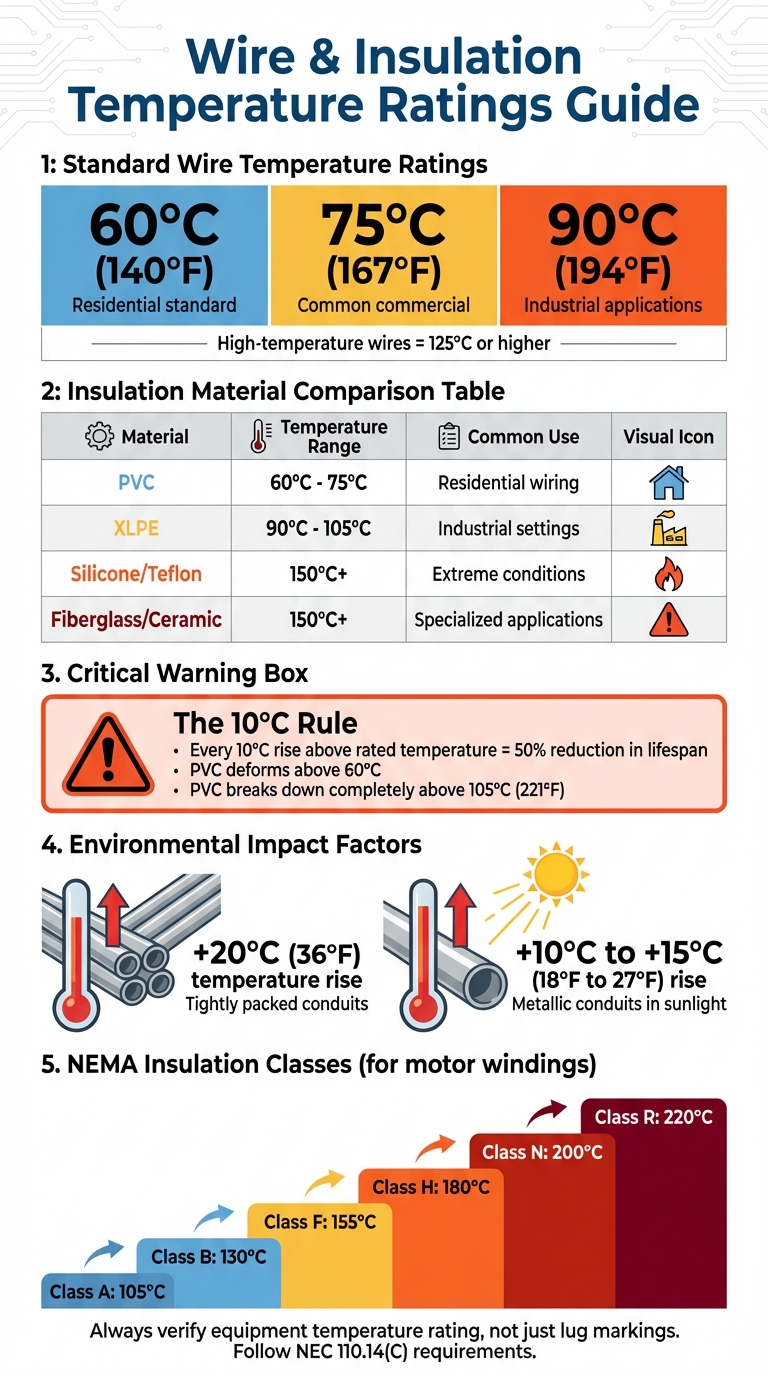
Electrical Wire Temperature Ratings and Insulation Material Comparison Chart
Wires, Cable Ties, and Insulation
Electrical wires are typically rated for temperatures of 60°C (140°F), 75°C (167°F), or 90°C (194°F). When it comes to high-temperature wires, they are generally defined as those rated at 125°C or higher, though some may consider wires rated as low as 90°C in this category. The insulation material plays a major role in determining these limits. For example, PVC is commonly used in residential wiring and is typically rated between 60°C and 75°C, while XLPE (cross-linked polyethylene), often found in industrial settings, can handle temperatures ranging from 90°C to 105°C.
It’s important to note that insulation life decreases significantly with every 10°C rise above its rated temperature. PVC insulation, for instance, begins to deform at temperatures above 60°C and completely breaks down when exposed to temperatures exceeding 105°C (221°F).
Environmental factors can also have a big impact on wiring performance. For instance, wires tightly packed in conduits can experience temperatures up to 20°C (36°F) above the surrounding ambient temperature. Similarly, metallic conduits exposed to direct sunlight can cause internal temperatures to rise by an additional 10°C to 15°C (18°F to 27°F) compared to the outside air. In extreme conditions where temperatures exceed 150°C, specialized materials such as Silicone, Teflon (PFA/FEP), Fiberglass, or Ceramic are required for safe operation.
When it comes to cable ties, their selection should be based on the maximum temperature of the environment where they’ll be installed, rather than the conductor’s rating. According to NEMA, cable ties are not tested or rated as conductor or cable insulation under current product standards.
Resistors, Capacitors, and Semiconductors
Electronic components like resistors, capacitors, and semiconductors face unique challenges when exposed to high temperatures. Unlike wiring, these components don’t just degrade - they can fail entirely if their temperature ratings are exceeded. The Arrhenius relationship explains that for every 10°C increase in temperature, the expected lifespan of these components is cut in half.
Managing heat is critical for these components. Heat is generated due to circuit resistance and the flow of current, and without proper dissipation, temperatures can rise uncontrollably, leading to failure. As Jimmy Walker from EIS, Electrical Specialties Group of Motion Industries, aptly states:
"The number-one enemy of designing and manufacturing any electrical/electronic product is heat".
For applications such as motor windings, NEMA insulation classes provide a clear framework for understanding temperature limits. These classes include:
- Class A: Rated for up to 105°C
- Class B: Rated for up to 130°C
- Class F: Rated for up to 155°C
- Class H: Rated for up to 180°C
Specialty classes like Class N and Class R extend these limits further, with ratings of 200°C and 220°C, respectively. Over time, exposure to high temperatures can cause insulation materials to age, becoming brittle and prone to cracking. Proper thermal management is essential to maintain the longevity and reliability of these components.
Standards and Testing Methods for Temperature Ratings
UL, IEC, and NEMA Standards
For electricians, standardized tests and certifications play a crucial role in ensuring safe and reliable component selection. Several key standards define how high-temperature ratings are determined and certified for electrical components. For instance, UL 758 sets requirements for Appliance Wiring Material, covering aspects like gauge, insulation material, and ratings.
When it comes to high-temperature fluoropolymer-insulated wires, UL 83A serves as the primary standard. Unlike Appliance Wiring Material (AWM) products, these wires are "UL Listed" and must meet stringent construction and performance testing requirements, including long-term aging evaluations. To ensure flame-retardant and low-smoke properties, manufacturers rely on UL 1685 and UL 2556, with compliant products often marked as "ST1" or "-LS". For low-smoke, halogen-free cables, certifications are guided by UL 2885 and IEC 61034-2.
The National Electrical Manufacturers Association (NEMA) also provides standards for high-temperature applications, including a High Ambient Temperature Test Procedure for wiring devices designed for elevated-temperature environments. Additionally, standards like ISO/IEC 11801 and ANSI/TIA 568.2-D are used to assess the performance of data and communication cables. Manufacturers incorporate these standards into their testing processes to replicate long-term operating conditions.
How Temperature Ratings Are Tested
Manufacturers subject electrical components to rigorous testing to confirm they can withstand continuous thermal stress. Long-term aging and insulation resistance tests are performed to ensure materials do not degrade prematurely under sustained heat exposure.
For high-voltage applications, more demanding dielectric tests are required. Environmental evaluations, such as acid gas and cold bend tests, further validate a component's resilience. For example, acid gas testing under UL 2556 ensures that cable compounds produce less than 14% acid gas by weight. The cold bend test (also part of UL 2556) determines the minimum temperature at which wires can be safely manipulated without cracking.
Standardized testing also provides a predictive framework for component lifespan. A general rule of thumb is that for every 10°C increase in operating temperature above the rated limit, the lifespan of a polymer insulator is typically cut in half.
When verifying certifications, electricians should look for the UL Mark on product packaging or reels. While the "UL" symbol printed directly on the wire itself can provide some indication, it is not definitive proof of certification. For AWM wires, electricians should consult the UL Product iQ database to confirm the specific "Style", as these products are recognized components rather than fully listed items.
sbb-itb-501186b
Risks of Exceeding Temperature Ratings and Derating
What Happens When Temperature Ratings Are Exceeded
Pushing electrical components beyond their temperature limits isn't just risky - it can shorten system life and create dangerous conditions. For instance, when a wire operates at 110°C, its lifespan can plummet from 40 years to just 10 years. Overheating can also cause circuit breakers to trip, even when the load is within the rated limits. This often happens when a conductor designed for 90°C insulation is connected to a termination rated for 75°C. The extra heat at the connection point can trigger unnecessary trips, disrupting operations. Worse yet, uncontrolled overheating is a leading cause of electrical fires. Ignoring these temperature ratings can also result in failed NEC Article 310.15 compliance, which often leads to inspection rejections.
"Reduced conductor sizes result in the system having less ability to dissipate heat and therefore increase the operating temperature of the equipment terminations."
Polymers, which typically have 300%–700% flexibility, can lose their functionality when their flexibility drops below 50%. At that point, even slight bending can cause cracking. Environmental factors add another layer of complexity. For example, at altitudes above 3,300 feet (1,000 meters), the thinner air reduces cooling efficiency by about 1% for every 330 feet (100 meters) of elevation, which makes additional derating necessary.
These risks highlight why proper derating practices are so critical.
How to Use Derating Guidelines
Derating is the key to preventing these issues. It adjusts conductor capacity to match real-world conditions that aren't accounted for in standard ampacity tables. The Master Formula for adjusted ampacity involves multiplying the base ampacity by correction factors for temperature, altitude, grouping, and installation method. For example, at an ambient temperature of 122°F (50°C), a PVC-insulated (70°C) cable must be derated to 71% of its capacity, while XLPE-insulated (90°C) cables require a derating to 82%.
To avoid failures, always ensure that all equipment matches its rated specifications. One key step: check the equipment’s temperature rating, not just the lug marking. Manufacturers sometimes use 90°C-rated lugs (marked AL9CU) on equipment that is only rated for 75°C. Underwriters Laboratories explains:
"A 75°C or 90°C temperature marking on a terminal... does not in itself indicate that a 75°C or 90°C insulated wire can be used unless the equipment in which the terminals are installed is marked for 75°C or 90°C."
- Underwriters Laboratories
When applying derating, follow the "worst-case" rule: use the lowest derating factor across the entire cable run. For non-linear loads such as LED drivers or variable frequency drives (VFDs), count the neutral conductor as current-carrying in grouping calculations. This is due to third harmonic heat losses. For circuits rated at 100A or less, stick to the 60°C ampacity column unless the equipment is specifically marked for 75°C.
| Number of Conductors | Adjustment Factor | Ampacity Loss |
|---|---|---|
| 1–3 | 1.00 | 0% |
| 4–6 | 0.80 | 20% |
| 7–9 | 0.70 | 30% |
| 10–20 | 0.50 | 50% |
Using 90°C-rated conductors can help since they start with a higher base ampacity. This reduces the need for upsizing, provided the adjusted ampacity stays within termination ratings.
Finding High-Temperature Components on Electrical Trader
How to Search the Electrical Trader Marketplace
When searching for high-temperature components on Electrical Trader, a strategic approach can save time and ensure you find exactly what you need. Start by focusing on specific heat-resistant insulation materials like Silicone, PTFE (Teflon), Mica Glass, or Aramid paper. These materials are well-known for their ability to perform in high-temperature environments. For wires and cables, try entering specific UL Style numbers into the search bar. For instance, UL 758 is used for Appliance Wiring Material, while UL 83A applies to Fluoropolymer Insulated Wire. These identifiers help confirm compliance with temperature and voltage standards.
To refine your results, set filters to a minimum temperature of 125°C, keeping in mind that many industrial applications demand ratings of 150°C or higher. You can also search by trade names like TGGT for applications up to 250°C, MG for 450°C environments, or SRML for 150°C-rated components. For transformers, use insulation thermal classes such as Class H (180°C), Class N (200°C), or Class R (220°C) to narrow down your options.
"The use of wire and cable products outside their designed temperature range can result in premature and often expensive failures in service."
Additionally, filtering by conductor type is key. For example, tinned copper works well for temperatures up to 180°C, while nickel-plated copper is suited for environments reaching 450°C. By applying these targeted search methods, you can efficiently locate components that meet your high-temperature requirements.
High-Temperature Products Available
Once you've applied the appropriate filters, you’ll find a comprehensive selection of high-temperature products on Electrical Trader. The marketplace organizes wire and cable options by temperature ratings, typically ranging from 125°C to 550°C. Examples include:
- SRML and SF-2 lead wires (150°C–200°C), ideal for motors and lighting.
- TGGT appliance wire (250°C), commonly used in ovens.
- MG/MGT extreme-temp wire (450°C–550°C), designed for industrial applications.
For transformers, the platform offers dry-type units categorized by insulation class and cooling type. Class H transformers (180°C) often use silicone or epoxy resin, while Class R models (220°C) feature Aramid paper insulation. Some transformers even provide enhanced performance; for example, units with an 80°C temperature rise using 220°C insulation can handle up to 47% continuous overload capacity. Additionally, current transformers with Class B insulation (rated up to 135°C) are available for monitoring and protection purposes.
To further refine your search, explore categories like "Appliance Wiring Material (AWM)", "Lead Wire", "Control Cable," and "Dry-Type Transformers". Electrical Trader also offers value-added services such as cut-and-strip, custom dyeing, or braiding, which can enhance the functionality of your selected products. By prioritizing the right insulation and conductor ratings, you ensure safer, more reliable, and code-compliant installations.
Conclusion
High-temperature ratings play a crucial role in protecting lives, equipment, and maintaining professional standards. According to NEC 110.14(C), conductors must be sized based on the lowest temperature rating within the circuit. For instance, even if you’re using 90°C-rated THHN wire, the ampacity must align with the 75°C rating when connecting to a 75°C breaker.
The implications of overlooking these ratings are significant. Every 10°C rise above the rated operating temperature can cut a cable's lifespan in half. This leads to insulation becoming brittle, cracking, and eventually failing. Beyond the risk of failures, exceeding temperature limits introduces safety hazards and drives up repair costs.
In environments with high ambient temperatures, derating from the 90°C ampacity column can help you use smaller conductors while still adhering to the 75°C termination safety requirements.
It’s essential to verify the temperature rating of the entire piece of equipment - not just the individual lugs. A 90°C marking on a terminal doesn’t automatically mean you can use the full ampacity unless the entire device is rated for 90°C. For equipment rated at 100A or less, the 60°C column should be used. For equipment rated above 100A, refer to the 75°C column. Following these guidelines ensures installations remain safe and compliant with code standards.
FAQs
How can I choose the right temperature rating for electrical components?
To choose the right temperature rating for electrical components, you need to factor in the maximum continuous operating temperature the materials and insulation can withstand without deteriorating over time. This rating plays a key role in ensuring both the safety and durability of the component.
Don’t overlook the ambient temperature of the environment or the heat produced by the electrical current itself. Higher temperatures can take a toll on insulation, dramatically reducing its lifespan. For perspective, an increase of just 10°F in operating temperature can cut insulation life in half.
Always consult the manufacturer's datasheet or specifications to verify the component's temperature rating. Ensure it aligns with the environmental and operational conditions to maintain performance, safety, and compliance with electrical standards.
What happens if electricians ignore temperature rating guidelines in electrical systems?
Ignoring temperature rating guidelines in electrical systems can have serious repercussions. For starters, it can lead to overheating, which not only raises the chances of equipment failure but also poses a significant fire hazard. On top of that, disregarding these guidelines may result in violations of electrical codes, which could mean failed inspections, expensive repairs, or even legal consequences.
By sticking to the recommended temperature ratings, electricians can ensure safer and more dependable installations. Plus, it helps to prolong the life of electrical components, saving time and money in the long run. Following these guidelines isn't just about compliance - it's about preventing avoidable risks and costs.
What’s the best way to apply derating guidelines for safe and compliant installations?
To use derating guidelines properly, start by evaluating the specific conditions of your installation. Factors like high ambient temperatures, elevation, or bundled conductors can lower a conductor's ampacity, making adjustments necessary to maintain safety and compliance.
Next, consult the National Electrical Code (NEC) tables, such as NEC Table 310.15(B)(16), to determine the conductor's base ampacity. From there, apply correction factors for conditions like elevated temperatures (e.g., 104°F) or altitude changes. It's also crucial to ensure that the insulation's temperature rating matches the equipment's limits to prevent overheating or potential hazards.
By addressing environmental conditions, referencing NEC standards, and confirming proper conductor sizing, electricians can create installations that are safe, dependable, and meet code requirements.