

Circuit Breaker Sizing: Key Factors to Know
When it comes to circuit breaker sizing, getting it right is all about safety and efficiency. A properly sized breaker protects your home's wiring from overheating, reducing the risk of electrical fires and system failures. Missteps like oversizing or mismatching breakers with wire gauge can lead to dangerous conditions, frequent tripping, or even property damage.
Here’s a quick breakdown of what you need to know:
- Calculate the Electrical Load: Use the formula Watts ÷ Volts = Amps to determine the current load. For continuous loads (operating for 3+ hours), apply the 125% rule to add a safety margin.
- Match Breaker Size to Wire Gauge: Ensure the breaker rating aligns with the wire's capacity (e.g., 14 AWG wire pairs with a 15-amp breaker).
- Avoid Common Mistakes: Don’t oversize breakers to stop trips, mix brands, or assume empty slots mean available capacity.
- Professional Installation Matters: Licensed electricians ensure compliance with the National Electrical Code (NEC) and prevent costly errors.
For example, a 4,500-watt water heater on a 240V circuit requires a 30-amp breaker when factoring in continuous usage. Similarly, using a 20-amp breaker with 14 AWG wire (rated for 15 amps) would be unsafe and violate code standards.
Key Takeaway: The breaker protects the wire, not the appliance. Proper sizing ensures safe, efficient operation and reduces electrical faults by up to 40%. Always consult a professional for installations.
How to Calculate Size of Circuit Breaker | Sizing of Circuit Breaker
Why Circuit Breaker Sizing Matters
Choosing the wrong circuit breaker size can lead to serious issues. If a breaker is too large, it might not trip when the wiring exceeds its capacity, which could cause the insulation to overheat and potentially start a fire.
On the flip side, a breaker that's too small can trip frequently during normal use, especially when several appliances are running at once. These constant trips not only disrupt daily activities but also put thermal stress on the breaker, which can damage sensitive electronics over time. This is why following proper sizing standards is so important.
Overloaded circuits are a major safety concern, often leading to electrical fires that can result in property damage ranging from $50,000 to over $100,000. Installations that comply with National Electrical Code sizing guidelines, however, experience up to 40% fewer electrical faults. Warning signs like melted terminals, discolored insulation, or scorch marks on the panel are clear indicators that the wiring has been exposed to unsafe levels of heat.
Certain types of circuits, like those used for EV chargers, HVAC systems, or workshop equipment, run continuously for three hours or more. These "continuous loads" present unique challenges. Even if the current stays within the breaker's rating, prolonged use can lead to heat buildup, causing unexpected tripping or, worse, failure to trip when needed. To address this, the 125% rule is applied, offering a critical safety margin to handle sustained thermal stress effectively.
Key Factors in Circuit Breaker Sizing
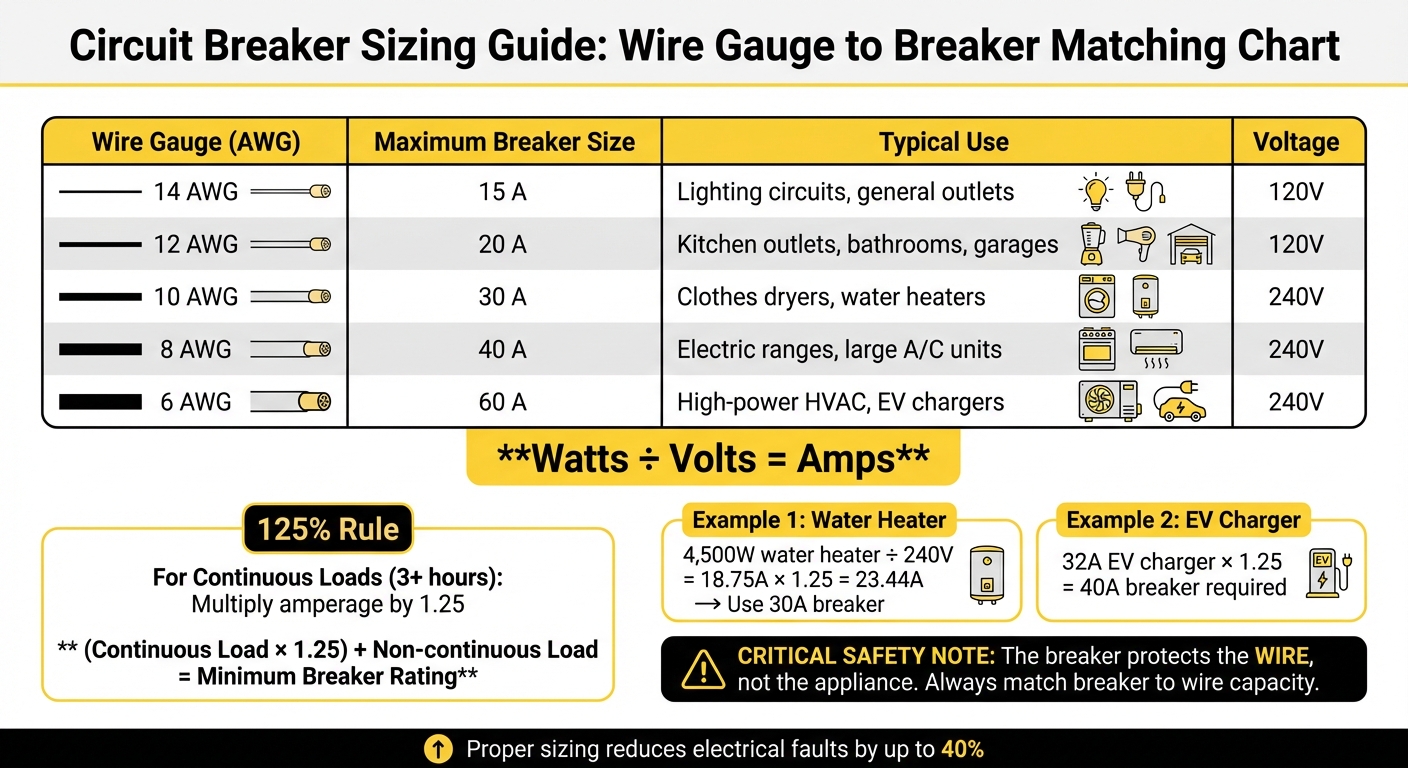
Circuit Breaker Sizing Guide: Wire Gauge to Breaker Matching Chart
Choosing the right circuit breaker size boils down to three main considerations: calculating the actual electrical load, factoring in safety margins, and ensuring compatibility with the wire gauge. Each step is critical for maintaining safety and efficiency.
Calculating Electrical Load Requirements
To determine the electrical load, use the formula: Watts ÷ Volts = Amps.
For instance, a 4,500-watt water heater on a 240-volt circuit draws 18.75 amps (4,500 ÷ 240). Likewise, a 1,800-watt microwave on a 120-volt circuit draws 15 amps. It's also important to classify loads as either continuous or non-continuous. Continuous loads - like water heaters, EV chargers, and HVAC systems - run for three hours or more, while non-continuous loads, such as microwaves or hair dryers, operate in shorter bursts. Once the load is calculated, adjustments for continuous usage come next.
Applying the 125% Rule
After determining the load, you need to account for sustained operation by applying a safety margin. According to the National Electrical Code, continuous loads require the amperage to be multiplied by 1.25 to ensure the breaker isn't operating at full capacity for long periods. This precaution helps prevent overheating and extends the lifespan of the breaker.
"Breakers are not meant to sit at 100% of their rating all day long. With long run times, ambient temperature changes and accumulated thermal stress, the device has a harder life - so the code wants a bit of headroom." - Engineer Tsai
For example, a 32-amp Level 2 EV charger, when multiplied by 1.25, needs at least a 40-amp breaker. Similarly, for the 4,500-watt water heater, multiplying 18.75 amps by 1.25 yields 23.44 amps. Since breakers come in standard sizes, you would round up to a 30-amp breaker. For circuits with mixed loads, use this formula:
(Continuous Load × 1.25) + Non-continuous Load = Minimum Breaker Rating.
Matching Breaker Size to Wire Gauge
The breaker must always match the wire's capacity because its primary role is to protect the wiring from overheating - not the appliances. For instance, using a 20-amp breaker with 14-gauge wire (rated for 15 amps) can lead to dangerous overheating.
Here are common wire and breaker pairings:
- 14-gauge wire: 15-amp breaker
- 12-gauge wire: 20-amp breaker
- 10-gauge wire: 30-amp breaker
- 8-gauge wire: 40-amp breaker
For larger loads, such as electric ranges or high-power HVAC systems, 6-gauge wire can handle up to 60 amps. If you're installing a new appliance that requires more power, the entire wire run must be upgraded to meet the new amperage needs.
| Wire Gauge (AWG) | Maximum Breaker Size | Typical Use |
|---|---|---|
| 14 AWG | 15 A | Lighting circuits, general outlets |
| 12 AWG | 20 A | Kitchen outlets, bathrooms, garages |
| 10 AWG | 30 A | Clothes dryers, water heaters |
| 8 AWG | 40 A | Electric ranges, large A/C units |
| 6 AWG | 60 A | High-power HVAC, EV chargers |
Finally, always adhere to the lowest temperature rating of any circuit component, usually 75°C for residential terminals. This step helps you avoid code violations and ensures a safe installation.
Common Sizing Mistakes and How to Avoid Them
Getting sizing right is essential for safe electrical work, but knowing what not to do is just as important. Let’s look at a few common mistakes and how to steer clear of them.
Mistake 1: Thinking empty slots mean extra capacity.
An empty breaker slot doesn’t automatically mean your panel can handle more circuits. Your system’s capacity is determined by the main breaker rating - whether it’s 100, 150, or 200 amps - not the number of open spaces. Overloading a panel that’s already at its limit can lead to serious hazards.
"That empty breaker slot is not an invitation - it's a potential trap. Ten minutes of calculation can save you from a lifetime of regret." – Joe, Electrical Professional, VIOX Electric
Mistake 2: Oversizing breakers to stop trips.
Swapping a 20-amp breaker for a 30-amp one might seem like a quick fix, but it’s a dangerous move. Wires rated for 20 amps, like 12 AWG, can overheat before a 30-amp breaker trips, increasing the risk of fire. Instead of upsizing the breaker, figure out what’s causing the overload. Systems sized according to NEC standards have been shown to experience up to 40% fewer electrical faults.
Mistake 3: Misusing wire ampacity ratings.
Wire insulation ratings can be misleading if you’re not careful. For instance, a wire with a 90°C insulation rating might seem adequate, but if the breaker or outlet terminals are rated for 75°C, you’ve created a weak point in the system.
Mistake 4: Mixing breaker brands.
Using a breaker that doesn’t match your panel’s brand isn’t just a bad idea - it’s a code violation. For example, installing a Square D breaker in a Siemens panel can void the UL listing and lead to dangerous failures. Stick with breakers from the same manufacturer to keep your system safe and compliant.
If your panel is already operating at 80% capacity or higher, it’s time to consider upgrading the service panel instead of squeezing in more circuits. These steps can help ensure your electrical system stays safe and up to code.
sbb-itb-501186b
Standard Breaker Sizes for Residential Use
Building on the earlier discussion of load calculations and safety standards, understanding standard breaker sizes is key to efficient residential circuit design.
In most residential panels, 15-amp breakers dominate, accounting for about 35–40% of all breakers. 20-amp breakers are the next most common, making up roughly 25–30%. Together, these two sizes manage around 60–70% of a home's electrical distribution.
Larger breakers serve specialized purposes. 30-amp breakers, used for appliances like dryers and water heaters, typically represent 10–15% of a panel. 40-amp and 50-amp breakers are less frequent, comprising about 5–8% and 3–5% of the panel, respectively. These larger breakers are essential for high-demand appliances such as electric ranges and EV chargers. Homes built between 2020 and 2025 often include more 20-amp circuits to handle increased device usage, along with dedicated 40-amp or 50-amp circuits for Level 2 EV chargers.
"The breaker size must match the wire gauge in the circuit." - Joe, Electrical Professional, Viox Electric
When replacing or adding a breaker, always confirm the wire gauge. For example, 14 AWG is used with 15-amp circuits, 12 AWG with 20-amp circuits, 10 AWG with 30-amp circuits, and 8 AWG with 40-amp circuits. For appliances running continuously for more than three hours - like water heaters or EV chargers - the breaker should be rated at 125% of the appliance's amperage. These guidelines align with the 125% safety factor and proper wire gauge selection to ensure safe and efficient operation. Keeping a record of breaker sizes can also simplify future troubleshooting.
Breaker Size Comparison Table
| Breaker Size | Wire Gauge | Typical Residential Applications | Voltage |
|---|---|---|---|
| 15 Amp | 14 AWG | General lighting, bedroom outlets, living room outlets | 120V |
| 20 Amp | 12 AWG | Kitchen counters (GFCI), bathrooms, laundry, garage | 120V |
| 30 Amp | 10 AWG | Electric clothes dryers, water heaters, small AC units | 240V |
| 40 Amp | 8 AWG | Electric ranges, cooktops, large central AC units | 240V |
| 50 Amp | 6 AWG | Electric ranges, RV hookups, EV chargers | 240V |
| 60 Amp | 4 AWG | Hot tubs, high-speed EV chargers, large heat pumps | 240V |
This framework provides a clear guide for safe, code-compliant installations and assists in making informed decisions for professional electrical setups.
Professional Installation and Safety Compliance
When it comes to electrical systems, professional installation is essential to ensure everything aligns with NEC standards. Licensed electricians are trained in the intricacies of the National Electrical Code (NEC), particularly Article 240 (overcurrent protection) and Article 220 (load calculations), making sure every component meets legal safety requirements. One key concept they understand - and many homeowners overlook - is that the breaker is there to protect the wire, not the appliance. For example, using a 20-amp breaker with 14 AWG wire (which is rated for just 15 amps) is a serious mistake. This can allow the wire to carry 18 amps continuously, causing dangerous overheating without tripping the breaker.
Professionals also ensure that terminal temperature ratings (usually 60°C or 75°C) are verified and that all components are compatible with each other. This attention to detail prevents mismatches that could void UL certifications and create fire risks. In fact, installations done by licensed electricians using proper sizing practices have been shown to reduce electrical faults by as much as 40%.
Hiring a professional doesn’t just ensure compliance - it can save you from costly errors. DIY electrical work often results in failed inspections, expensive fixes, and even denied insurance claims. For context, upgrading a standard residential electrical panel typically costs between $2,500 and $4,500, while subpanel installations range from $800 to $2,000. If you ever notice warning signs like melted insulation, burn marks, rust, or a burnt smell coming from your panel, it’s crucial to call a licensed electrician immediately.
"Following code protects your property and can save you from fines or insurance headaches." - Magnify Electric
Conclusion
The guidelines outlined above are essential for ensuring safe and code-compliant electrical installations. Properly sizing circuit breakers is not just about meeting regulations - it’s about protecting your home and loved ones from potential hazards like electrical fires or system failures. For instance, pairing a 20-amp breaker with 14-gauge wire (which is designed to handle only 15 amps) can lead to overheating without the breaker tripping, creating a dangerous situation.
The 125% rule and 80% application limit are critical for continuous loads such as HVAC systems, water heaters, and EV chargers. These safety margins help prevent overheating, equipment damage, and even fires. Skipping these precautions can lead to serious consequences.
Common errors, like "sizing up" a breaker to avoid nuisance tripping, overlooking terminal temperature ratings, or assuming that empty panel slots equate to available capacity, can compromise safety and lead to system failures.
Hiring a licensed electrician ensures that your system adheres to NEC Article 240 and Article 220 standards, passes inspections, and operates safely for years to come. Following these practices keeps your electrical system efficient and secure. If you're ever unsure, consulting a licensed professional is always the safest choice.
FAQs
Why is it crucial to match a circuit breaker size with the wire gauge?
Matching the circuit breaker size to the wire gauge is crucial for maintaining safety and meeting code requirements. When the breaker is correctly sized, it will trip before the wire overheats or surpasses its current-carrying limit. This helps minimize the risk of electrical fires and potential damage to your system.
It also ensures adherence to the National Electrical Code (NEC), which establishes guidelines to prevent electrical hazards. Using the wrong breaker size can result in overheating, equipment malfunctions, or even severe safety issues in your home.
What does the 125% rule mean for sizing circuit breakers?
The 125% rule is a standard guideline for safely sizing circuit breakers. It involves sizing the breaker at 125% of the continuous load, which means multiplying the continuous load current by 1.25. This ensures the breaker can manage the load without frequent trips while still providing adequate circuit protection.
For instance, if the continuous load is 20 amps, the breaker should be sized to handle 25 amps (20 × 1.25). This method ensures both safety and adherence to electrical regulations.
What mistakes should I avoid when choosing a circuit breaker size?
When picking a circuit breaker, a few common missteps can lead to big problems. Using the wrong amp rating, pairing it with an incompatible wire size, or overlooking safety codes are frequent errors. For instance, if the breaker is too small, it will trip often, disrupting your system. On the flip side, an oversized breaker won’t adequately protect the wiring, which could lead to overheating and even fire hazards.
One key rule to follow is the 125% rule for continuous loads - those operating for 3 hours or more. This means sizing the breaker at 1.25× the calculated load to ensure it can handle the demand safely.
Another critical factor is matching the breaker to the right wire gauge. For example:
- A 15-amp breaker requires 14 AWG wire.
- A 20-amp breaker pairs with 12 AWG wire.
It’s important to remember that the breaker’s job is to protect the wiring, not the appliances. Choosing the correct size keeps the circuit functioning safely and efficiently. To avoid costly or dangerous mistakes, always follow NEC guidelines and consider adjustments for ambient temperature.