Checklist for Choosing Reliable Cable Brands
Choosing the right cable brand is critical for safety, performance, and compliance. A poor choice can lead to system failures, safety hazards, or costly replacements. Here’s a quick guide to help you make an informed decision:
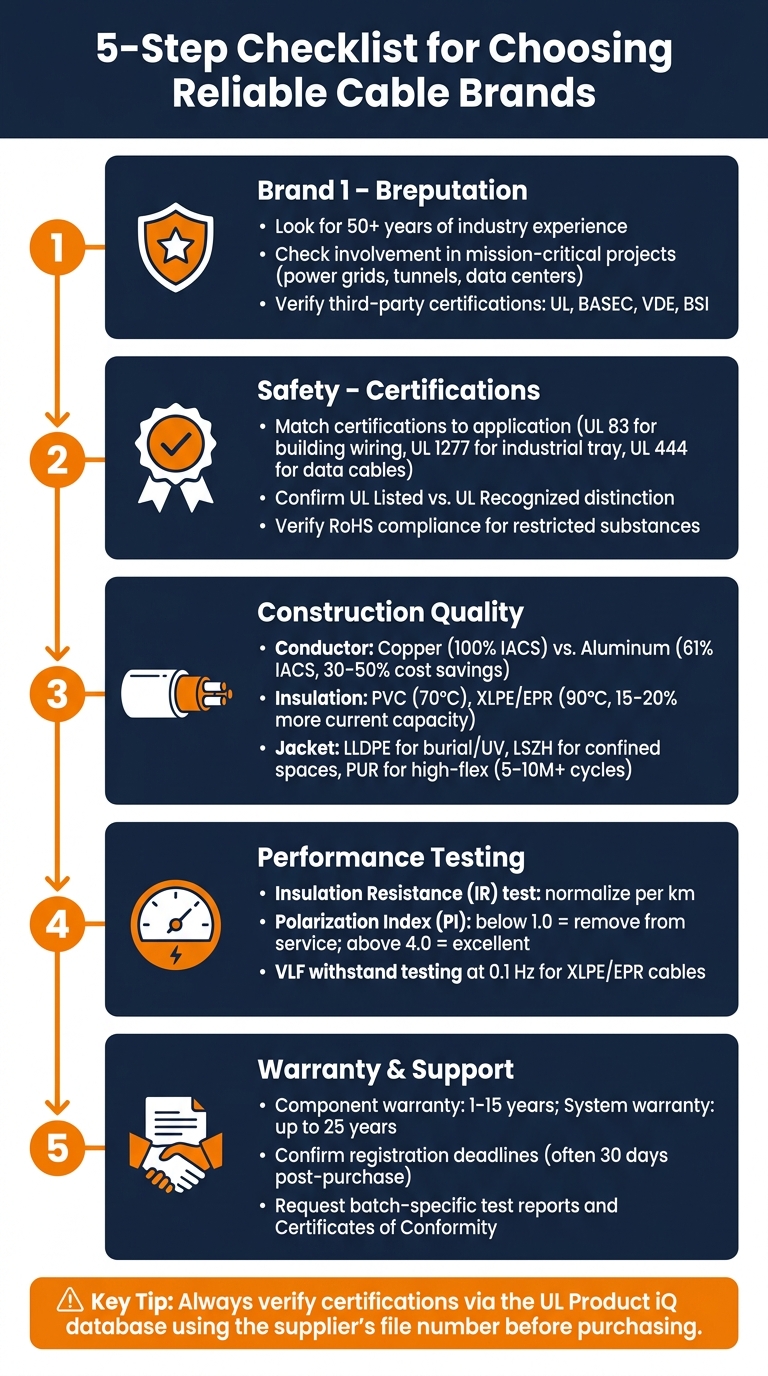
- Brand Reputation: Look for established brands with a strong history and involvement in high-stakes projects. Check for third-party certifications (e.g., UL, BASEC) and industry awards.
- Safety Standards: Verify certifications like UL, CSA, or RoHS. Match certifications to your application (e.g., UL 83 for building wiring, UL 1277 for industrial tray cables).
- Construction Quality: Choose the right conductor (copper or aluminum), insulation (PVC, XLPE, or LSZH), and shielding based on your project’s environment.
- Performance Testing: Conduct insulation resistance (IR) and polarization index (PI) tests to ensure durability and electrical integrity.
- Support & Warranty: Opt for brands offering detailed documentation, responsive support, and strong warranty terms.
Key Tip: Always confirm the cable’s certifications and materials align with your specific needs to avoid costly mistakes. For complex projects, consult with technical support or request test reports.
Keep reading for a detailed breakdown of each step.
5-Step Checklist for Choosing Reliable Cable Brands
1. Checking Brand Reputation and Market Presence
1.1 Research Brand History
A brand's history often speaks volumes about its reliability. Companies with decades - or even over a century - of experience have weathered industry challenges and proven their ability to deliver quality. For instance, AmerCable has been in operation since 1899, and SKB-Group has been around since 1891. Surviving and thriving for over 130 years in such a demanding field reflects their commitment to excellence and their ability to meet high standards.
Another key factor is a brand's involvement in mission-critical infrastructure. Projects like power grids, airports, tunnels, or data centers demand exceptional performance under pressure. Take Studer Cables, for example - they’ve contributed to high-profile projects like the Gotthard rail tunnel and the Marina Bay Sands Resort. These achievements demonstrate their ability to deliver in the most demanding environments.
Ownership structure is also worth examining. Brands that are part of larger global groups often benefit from stronger R&D investment and stricter quality controls. For example, Carol Brand operates under the Prysmian Group, one of the largest cable manufacturers worldwide. This kind of backing can ensure consistent supply and robust technical support, which are critical when reliability is non-negotiable.
Once you’ve reviewed a brand’s history and project portfolio, it’s essential to dig deeper by checking third-party certifications to confirm their reliability.
1.2 Look for Industry Recognition
Third-party certifications offer a clear way to separate marketing claims from actual performance. Certifications from organizations like BASEC, BSI, VDE, or UL carry significant weight because these agencies conduct rigorous audits and ongoing product testing. Their marks ensure that products meet high standards consistently.
Industry awards are another indicator of a brand’s standing. For example, Southwire earned the EC&M 2026 Product of the Year award in the Wire & Cable category for their Re3™ SIMpull XHHW-2®/RW90 cable with a Color ID jacket. This innovation was designed to assist color-blind electricians, showcasing both creativity and practical problem-solving. Consistent recognition from professional organizations signals that a brand is not only meeting industry needs but also pushing boundaries to address real-world challenges.
"The [BASEC] mark is recognised globally and represents quality and impartiality which gives our customers confidence that our products have been independently verified to be fit for purpose." - Sanjay Gadhave, Senior Leader in Cable Design and Global Market Strategy, KEI Industries
Sustainability ratings are becoming increasingly important too. Brands like Eland Cables, for instance, have been awarded an EcoVadis Gold Medal (reaffirmed in 2024), placing them among the top performers globally for ethical and environmental practices. Strong ESG performance often correlates with operational stability, making these brands reliable long-term partners. Responsible supply chain management is more than just a trend - it’s a sign of a company that prioritizes consistency and accountability.
Choosing High-Quality Cables | How to spot a quality cable in 3 seconds
2. Verifying Safety Ratings and Certifications
After confirming a brand’s reputation, the next step is ensuring their cables meet the necessary safety standards - not just on paper, but in real-world applications. This involves understanding key certifications and aligning them with your specific project requirements.
2.1 Key Certifications to Look For
In the U.S., UL (Underwriters Laboratories) is the gold standard for cable safety certifications. UL Listed applies to finished, ready-to-install products, while UL Recognized refers to internal components, like Appliance Wiring Material (AWM), intended for use inside larger products. Choosing the wrong designation can lead to costly mistakes.
Another important certification is ETL (Intertek), which holds the same regulatory weight as UL. Both are recognized as Nationally Recognized Testing Laboratories (NRTLs) by OSHA and adhere to identical safety standards, such as UL 1581. Similarly, CSA (Canadian Standards Association) certifications are widely accepted in the U.S. and often align with UL benchmarks.
For projects concerned with material safety, RoHS compliance ensures the cable is free of restricted substances like lead or mercury. However, it’s worth noting that RoHS addresses material composition, not electrical performance.
"The mark on the cable jacket represents far more than passing a one-time test... it means the manufacturing facility agreed to periodic inspections to verify continued compliance." - Elyza Castillo, Distributor Wire & Cable
To confirm the authenticity of UL-certified cables, check the UL file number in the UL Product iQ database. Genuine products often include holographic labels to deter counterfeiting.
2.2 Matching Certifications to Applications
Once you understand the certifications, it's essential to match them to your cable’s intended use. Below is a guide to common applications, relevant UL standards, and key markings to check on the cable jacket:
| Application | Key UL Standard | Important Markings |
|---|---|---|
| Building & Residential Wiring | UL 83 (THHN/THWN-2) | Voltage rating, AWG size, "W" for wet locations |
| Industrial Tray Cable | UL 1277 | TC, TC-ER, SUN RES, DIR BUR |
| Communications & Data | UL 444 | CMP (Plenum), CMR (Riser), CM (General) |
| Power-Limited Circuits | UL 13 | CL2, CL3, PLTC |
| Solar/Renewable Energy | UL 4703 | UV resistance, sunlight-resistant markings |
| Appliance/Internal Wiring | UL 758 | AWM style numbers (e.g., 1007, 1015) |
For air-handling spaces, cables must have a CMP (Plenum) rating rather than CMR. While CMR-rated cables are designed for vertical runs between floors, they cannot replace plenum-rated cables in HVAC spaces. For high flame resistance, look for the VW-1 marking, which signifies the cable passed a vertical flame test. However, in industrial tray applications, VW-1 alone may not suffice - IEEE 1202 (UL 1685) provides a more rigorous standard by testing bundled cables for 20 minutes at 70,000 BTU/hour.
In industrial settings, the TC-ER (Exposed Run) designation is particularly important for tray cables. While standard TC cables must be installed within trays or conduits, TC-ER cables are rated for crush and impact resistance, allowing them to run unprotected for up to 6 feet between the tray and equipment. Using standard TC cables where TC-ER is required can result in code violations and safety risks.
3. Evaluating Construction Quality and Materials
Once safety standards are confirmed, it's time to dig deeper into the construction quality of the cables. This step ensures they’ll hold up under stress and deliver reliable performance over time. Surprisingly, two cables with the same UL certification can vary widely in durability and operational efficiency.
3.1 Conductor and Insulation Materials
Copper is still the top choice for conductors in most applications. It achieves nearly 100% IACS (International Annealed Copper Standard) conductivity, offers excellent tensile strength, and resists corrosion at connection points. On the other hand, aluminum, with 61% IACS conductivity, requires a larger cross-section - 1.6 times that of copper - but can cut material and freight costs by 30–50% for large-scale projects. This makes aluminum an appealing option when cost and weight are critical factors.
When it comes to insulation, the decision between PVC, XLPE, and EPR is crucial. Standard PVC handles continuous operation at 70°C, while XLPE and EPR can sustain higher temperatures of up to 90°C. Additionally, XLPE can withstand short-circuit temperatures as high as 250°C. Cables with XLPE insulation also carry about 15–20% more current than their PVC counterparts of the same conductor size. For installations in confined spaces or areas with high occupancy, LSZH (Low Smoke Zero Halogen) materials are a safer choice, as PVC releases toxic hydrogen chloride gas and dense smoke during a fire.
"Selecting a cable rated for the wrong environment is one of the most common causes of premature cable failure." - Yangzhou Yaguang Cable Co., Ltd
For medium-voltage (MV) cables, it’s worth asking if the manufacturer uses a triple-extrusion process. This process applies the conductor screen, insulation, and insulation screen simultaneously, reducing interfacial contamination that can lead to partial discharge. High-quality MV cables should have less than 5–10 picocoulombs of partial discharge at 1.5 times their rated voltage.
3.2 Shielding and Jacket Ratings
A cable’s shielding and jacket materials play a big role in its durability, especially in harsh environments.
Shielding isn’t just for signal cables. In systems operating above 1 kV, proper shielding - such as copper tape or concentric neutral - helps distribute the electric field evenly and prevents insulation wear over time. Copper tape shields with a 25% overlap are the standard for industrial tray applications, ensuring consistent protection. For signal and instrumentation cables, aluminum foil provides full coverage at a lightweight, while braided wire shielding works best in dynamic environments or areas with high electromagnetic interference (EMI).
The jacket material is equally important. LLDPE (Linear Low Density Polyethylene) jackets are ideal for direct burial or installations exposed to sunlight, thanks to their moisture and UV resistance. PVC jackets are better suited for tray-rated and hazardous locations (Class I and II, Division 2). For extremely cold environments, like outdoor runs in northern climates or refrigerated warehouses, check for a –40°F cold impact rating, often marked as LTGG on the jacket. Without this rating, the cable could crack during installation or movement in freezing temperatures, potentially leading to hidden failure points.
| Jacket Material | Best Use Case | Key Rating |
|---|---|---|
| LLDPE | Direct burial, sunlight-exposed runs | Sunlight resistant, moisture resistant |
| PVC | Industrial trays, hazardous locations | UL Tray Rated, Class I/II Div. 2 |
| LSZH | Tunnels, public buildings, confined spaces | Low smoke, zero halogen |
| HDPE | Underground burial, high-moisture environments | Maximum moisture resistance |
Choosing the right materials for conductors, insulation, shielding, and jackets ensures cables perform as expected while meeting safety and reliability standards. These decisions directly impact the cable's lifespan and operational efficiency.
sbb-itb-501186b
4. Checking Performance Consistency Under Use
Materials and certifications tell only part of the story - what really matters is how well cables perform under continuous load.
4.1 Signal Integrity and Current Handling
One of the best ways to assess the electrical health of a cable is through Insulation Resistance (IR) testing. This involves using a megohmmeter to measure the insulation's resistance. If the readings are low, it’s often a sign of issues like moisture intrusion, thermal wear, or physical damage. Keep in mind, IR values decrease as cable length increases, so always normalize readings to a per-kilometer value for accurate comparisons.
To further evaluate insulation quality, use the Polarization Index (PI), which compares IR readings taken at 10 minutes and 1 minute. A PI below 1.0 is a serious warning - the cable should be removed from use immediately. On the other hand, a PI above 4.0 suggests the insulation is either new or exceptionally clean. For modern cables like XLPE and EPR, VLF (Very Low Frequency) withstand testing at 0.1 Hz is the go-to method for checking dielectric strength. Traditional DC Hipot tests aren’t recommended for these materials, as they can cause "space-charge" damage.
"Unlike a motor that vibrates or a transformer that overheats, a cable with degrading insulation gives you no warning until it faults." - InsulationTesting.com
When it comes to current-handling capacity, consult the NEC ampacity tables (Table 310.16 or 310.60(C)), adjusting for factors like installation conditions (ducts vs. open air) and the number of conductors in a raceway. For cables connected to Variable Frequency Drives (VFDs), annual PI testing is highly recommended. The high-frequency switching transients from VFDs can put unique stress on insulation that routine checks might miss.
Once electrical integrity is confirmed, it’s time to evaluate the cable’s mechanical strength and flexibility.
4.2 Durability and Flexibility
Mechanical durability and flexibility play a huge role in how well a cable performs over time, especially in demanding environments.
Conductor stranding class is a critical factor here. Stranding types like Class K or M (also known as Class 5 or 6) use finer, more numerous strands, which significantly boost flex life compared to standard Class B stranding. For example, a 24 AWG conductor with 42/40 stranding can last up to five times longer in high-flex situations than one with 7/32 stranding. This makes finer stranding a game-changer for applications like robotic arms or drag chains, potentially extending cable life from months to years.
The cable jacket material is equally important. Polyurethane (PUR) jackets are engineered to endure 5–10+ million flex cycles and are highly resistant to oil and abrasion, making them ideal for high-motion applications. TPE (Thermoplastic Elastomer) jackets excel in extreme cold or in food and beverage settings, withstanding temperatures as low as –40°F. In contrast, standard PVC jackets become brittle below 23°F, limiting them to stationary or light-duty use. While PUR jackets can cost 1.8–2.5× more than PVC, the long-term savings are substantial. As one manufacturer explained:
"A $500 PVC cable that fails and must be re-pulled after 2 years costs $500 + $1,200 labor + $3,000 downtime = $4,700. A $2,000 silicone cable that lasts 10+ years costs $2,000 total." - Shanghai Unicorn Cable
For high-flex applications, the minimum bend radius should be 4–5× the cable’s outer diameter, while stationary cables should have a bend radius of at least 10×. If a cable is pushed to operate near its minimum bend radius, expect its flex life to drop by 30–40% due to the added mechanical strain.
5. Warranty, Support, and Documentation
Once you've confirmed the cable's performance, it's just as important to ensure the brand offers strong warranty terms, reliable support, and accessible documentation. These factors are key to ensuring long-term reliability.
5.1 Warranty Terms and Conditions
Warranty terms can vary widely. A component warranty typically spans 1 to 15 years, covering defects in materials. On the other hand, a system warranty may go up to 25 years, but it often requires certified installation and the use of approved components. For instance, Optical Cable Corporation (OCC) offers a 25-year "Channel/Link Limited Warranty" for installations registered and performed by certified professionals. In contrast, Panduit's warranty is limited to 1 year from the invoice date (or 18 months from the shipment date, whichever comes first).
Some warranties require registration within a specific timeframe - often 30 days after purchase - to activate extended coverage. Failing to meet this deadline can void the warranty. This is common with certain UPS and cable line manufacturers. Additionally, check if the warranty is transferable, especially if ownership of the installation site changes. Some brands may require written notice before the transfer date.
"Replacement without charge shall be the customer's sole and exclusive remedy regardless of the basis – whether in contract, tort, express or implied warranty, negligence, or strict liability." - Optical Cable Corporation
Another critical factor is determining who pays for return shipping in case of a defect. Some manufacturers place this responsibility on the buyer unless the defect is clearly proven. It's also important to review the terms of the remedy - whether it involves repair, replacement, or credit.
Beyond warranty coverage, having access to thorough documentation and responsive support is equally important.
5.2 Product Documentation and Support Availability
Detailed documentation is a hallmark of a dependable brand. Before making a purchase, confirm that the manufacturer provides easy access to datasheets, installation guides, and UL compliance documents. A lack of readily available resources on the brand's website could be a warning sign.
Support services also play a crucial role. Distributor Wire & Cable (DWC), for example, offers a "fastQuote Portal" that responds to quote requests in under six minutes and provides 24/7 emergency support through a monitored email channel for urgent project needs. Similarly, Houston Wire & Cable Co. boasts a 99.99% order accuracy rate across over 30,000 products and provides round-the-clock, year-round service. These examples set a helpful benchmark for what to expect.
A smart way to evaluate a brand's technical expertise is by testing their support team. Call with a specific question - like asking which cable rating is suitable for a VFD installation in a conduit with multiple conductors. Their response time and accuracy can reveal a lot about their knowledge and commitment.
"Calling your Account Manager directly is the fastest way to get things moving [when a shipment arrives damaged]." - Distributor Wire & Cable (DWC)
For high-stakes installations, request batch-specific test reports, such as Fluke performance tests or third-party lab certifications. Brands that can provide Certificates of Conformity or RoHS compliance data on demand tend to be more dependable than those that cannot.
6. Matching Cable Choices to Specific Applications
Once warranty and support are squared away, the final step in selecting the right cable is ensuring it aligns with the specific application. This involves considering documented safety standards, construction quality, and support requirements alongside the technical specifications needed for the job.
6.1 Power and Industrial Cables
For power and industrial needs, start by selecting the correct voltage class. Low-voltage cables (under 1 kV) are suitable for motor circuits and lighting, while medium-voltage cables (1 kV–33 kV) are designed for larger feeders and substations. Using the wrong voltage class can lead to serious safety issues.
Insulation also matters. Use XLPE-insulated cables in high-temperature or underground environments, while PVC-insulated cables work best in dry, indoor settings. For extreme heat, such as in furnace rooms or chemical plants, silicone or PTFE insulation is a better choice. In high-impact or direct burial scenarios, Steel Wire Armored (SWA) cables are ideal, and LSZH cables are essential in fire-sensitive areas since standard PVC emits hydrochloric acid gas when it burns. Industrial power cables are generally designed to last 30–50 years.
"Every 10°C rise above rated temperature reduces insulation lifespan by approximately 50%." - Alibaba.com Seller Blog
While power and industrial cables focus on temperature and mechanical durability, data and networking cables require precision in signal integrity and shielding.
6.2 Data and Networking Cables
For data and networking setups, shielding, jacket type, and cable layout are key factors to consider. In environments with electrical noise, unshielded cables are not an option. Foil shields are effective for high-frequency noise rejection, while braid shields are better for flexibility and low-frequency protection. In most industrial settings, a combination of foil and braid shielding offers the best performance.
"Shielding isn't just a technical preference - it's a decision that directly affects system performance, especially in electrically noisy environments like factories, data centers, and water treatment plants." - Distributor Wire & Cable
The jacket type depends on the installation environment. Plenum-rated (CMP) cables are required for air-handling spaces according to NFPA 70 (NEC), while LSZH jackets are necessary in data centers and hospitals to minimize toxic gas emissions during fires. For robotics or drag-chain applications, TPE-jacketed cables provide the flexibility to endure constant movement without cracking. Always check the minimum bend radius - typically 6 to 12 times the cable's outer diameter - to avoid damaging the insulation.
Conclusion: Final Checklist for Choosing Reliable Cable Brands
Here's a practical checklist to wrap up everything we've covered. Picking the right cable brand isn't just about price - it's about ensuring quality, reliability, and compliance. Take the time to confirm certifications like UL or CSA, and always request batch-specific test reports to avoid unexpected project setbacks.
"The cheapest quotation is often not the lowest landed cost. Delays, inconsistent quality, rejected batches, or nonstandard packaging can make a low offer expensive very quickly." - ECI Wires
Use this table as your go-to guide before making any cable purchase:
| Checklist Category | What to Verify |
|---|---|
| Compliance | Active certifications (UL/IEC/CSA), RoHS compliance, NEC designations |
| Technical Specs | Voltage rating, ampacity, conductor material, insulation type, shielding |
| Quality Control | Batch test reports, dielectric strength (min. 6.5kV AC for 5 min.), insulation resistance |
| Environmental Fit | UV resistance, temperature range, moisture protection, direct burial ratings |
| Supplier Reliability | ISO 9001 certification, material traceability, written lead times, engineering support |
These steps are designed to ensure that every cable you purchase aligns with high safety and performance standards.
For added assurance, verify UL-certified products through the UL Product iQ database using the supplier's file number. If you're considering a new product line, request a sample cut to test for fit and termination before placing a larger order.
Each category in this checklist is grounded in established industry standards. When sourcing components, platforms like Electrical Trader can be a valuable resource. They offer a wide range of verified electrical products, including cables, circuit breakers, and transformers, with inventory from over 130 top manufacturers such as ABB and Allen-Bradley. With in-stock items and reliable options, they simplify finding dependable components for your projects.
FAQs
How can I verify a cable’s UL certification is real?
To verify a cable's UL certification, start by locating the official UL Mark. This mark should appear on the reel, box, flange, or the smallest container - not just on the cable jacket's surface printing. For some product categories, also look for a holographic UL label.
Next, use the file number provided on the packaging to search the UL Product iQ database. If the file number doesn't return a match or the UL Mark is missing, the cable is not certified.
Which UL rating do I need for my specific installation?
When selecting a UL-rated cable, it's crucial to align the cable's specifications with your environment. Pay attention to factors like voltage, temperature exposure, and flame retardancy.
For example, check if the cable is suitable for dry or wet locations. If your installation involves plenum or riser spaces, opt for flame-retardant cables such as CMP or CMR. These types are specifically designed to meet safety standards in such areas.
To confirm that your chosen cable meets all necessary requirements, refer to resources like the UL Wire and Cable Marking Guide or the UL Product IQ database. These tools provide detailed information to ensure your cable is up to code.
What construction features matter most for harsh environments?
For tough conditions, it's crucial to choose sturdy materials for cable jackets and insulation that can handle exposure to chemicals, heat, and physical wear. Options such as cross-linked polyethylene (XLPE) or EPR are excellent for resisting heat and moisture. Meanwhile, polyurethane (PUR) or fluoropolymers like FEP and PFA are better suited for environments with high abrasion or chemical exposure. For applications involving frequent movement or vibration, go with finely stranded conductors to improve flexibility and longevity. Adding braided or foil shielding is also a smart move to minimize electromagnetic interference.