Comparing Power Cable Brands: 2026 Innovations
In 2026, the power cable industry is transforming to support modern energy needs like AI-driven data centers, offshore wind farms, and grid upgrades. This article compares four key players - Prysmian Group, Nexans, Southwire, and Power Innovations International - focusing on their latest advancements, strengths, and challenges.
Key Highlights:
- Prysmian Group: Automated splicing technology cuts splicing time to under an hour and integrates low-carbon aluminum for eco-friendly solutions.
- Nexans: Focuses on recycled materials and high-capacity cables, with expanded U.S. production through acquisitions.
- Southwire: Offers AI-powered monitoring, fire-rated cables, and rejuvenation services for aging systems.
- Power Innovations International (Pii): Specializes in mobile chargers and microgrid-compatible systems for flexible power delivery.
Quick Comparison:
| Brand | Focus Areas | Strengths | Challenges |
|---|---|---|---|
| Prysmian Group | Automated splicing, HVDC systems | Faster splicing, low failure rates | Limited capacity until 2027 |
| Nexans | Recycled materials, HVDC subsea | Sustainability, expanded U.S. presence | Higher costs for smaller projects |
| Southwire | AI monitoring, fire-rated cables | Strong U.S. logistics, grid modernization | Revenue decline in 2025 |
| Power Innovations Intl | Mobile chargers, microgrids | Flexible, grid-independent solutions | Niche market focus |
Each brand addresses specific market needs, from high-voltage systems to renewable energy and EV infrastructure. Choosing the right partner depends on your project's technical and supply chain priorities.
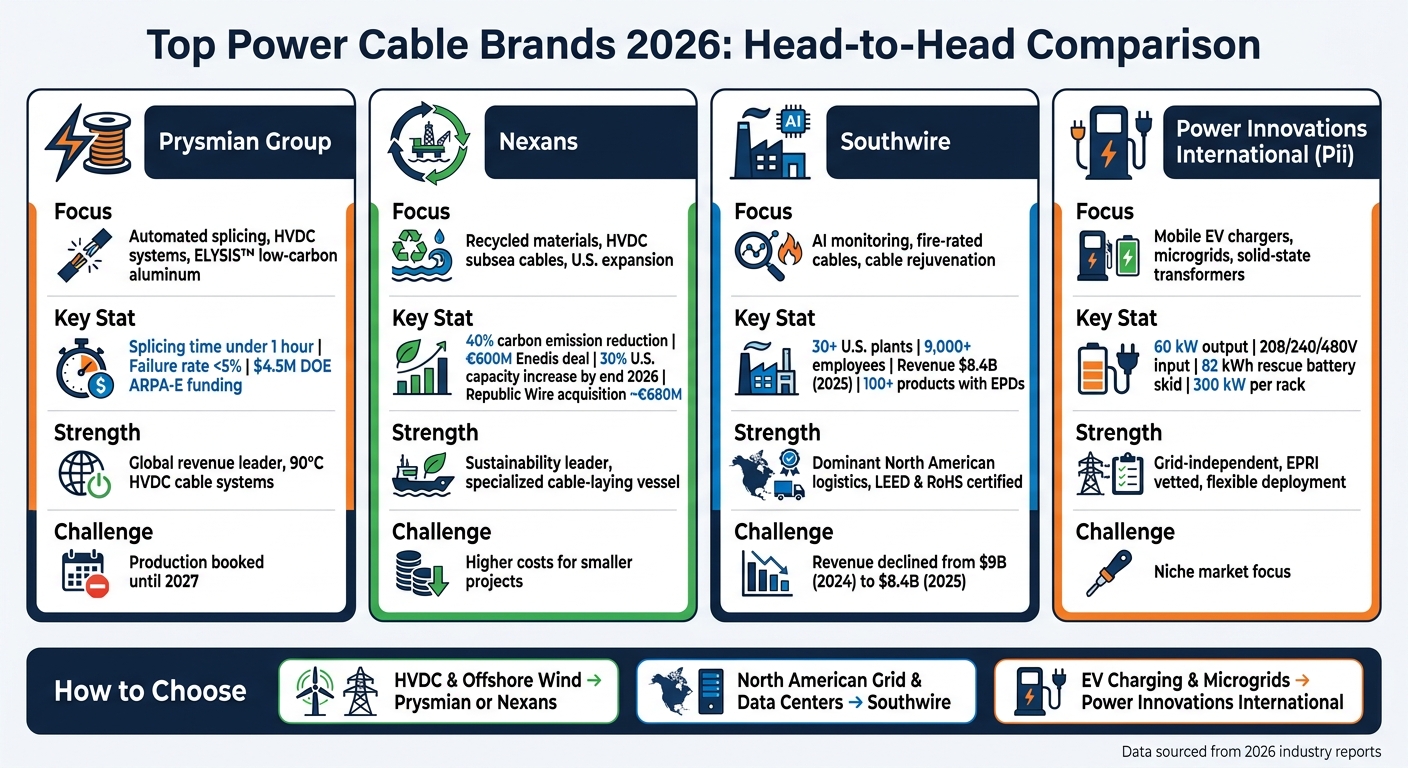
Top Power Cable Brands 2026: Head-to-Head Comparison
Top 5 Electric Cable Companies in the World 2026 | Best Power & Electrical Cable Brands
1. Prysmian Group
By 2026, Prysmian Group is set to make waves with two major breakthroughs: an automated splicing machine for underground power cables and 525 kV HVDC cable systems capable of operating continuously at 90°C, a significant leap from the current standard of 70°C. These innovations are tailored to meet the demands of U.S. utilities, particularly in modernizing the grid and integrating offshore wind energy.
For over a century, manual cable splicing has remained largely unchanged, requiring workers to perform the task in confined, hazardous manhole environments. Prysmian's automated splicing machine transforms this process, completing splices in under an hour with a failure rate of less than 5%. This breakthrough, developed in collaboration with Con Edison and Exelon and supported by $4.5 million in funding from the U.S. Department of Energy's ARPA-E GOPHURRS program, aims to improve both grid reliability and worker safety.
"For over 100 years, the manual splicing process has remained the same, and this new technology marks a warranted change that will not only improve splice consistency but also remove workers from extremely hazardous environments." - Jared Weitzel, R&D Director, and Arthur Perconti, PD Product Development Engineer Senior Manager, Prysmian North America
On the materials front, Prysmian is teaming up with Rio Tinto to use ELYSIS™ aluminum, a low-carbon aluminum made without direct greenhouse gas emissions. This material will be incorporated into Prysmian's cable conductors, aligning with the growing demand for environmentally responsible solutions in U.S. infrastructure projects.
Looking ahead, Prysmian plans to integrate AI-driven diagnostics into future versions of the splicing system. This would enable real-time monitoring of splice integrity, potentially giving the company an edge in large-scale utility applications. The technology is currently transitioning from lab validation to commercial deployment in the U.S. market.
Next, we’ll explore Nexans’ contributions to the industry for a broader perspective on these advancements.
2. Nexans
In 2026, Nexans made strides in sustainability by incorporating recycled polyethylene and low-carbon aluminum into its 20 kV underground cables, slashing carbon emissions by up to 40%. These advancements fit seamlessly into the broader movement toward modernizing power grids and integrating renewable energy. Alongside these eco-friendly innovations, Nexans has also enhanced its installation technologies and expanded its production capabilities.
A key highlight is Nexans' Reinforced Direct Burial (EDR) technology. This advanced sheath design allows cables to be buried directly in tough terrains, cutting both installation and maintenance costs. On top of that, Nexans has scaled up production of 400 mm² aluminum cross-sections, ensuring they can handle the increased power loads demanded by renewable energy facilities and EV charging networks.
To further solidify its environmental efforts, Nexans provides PEP Ecopassport® declarations. These third-party-verified Life Cycle Assessments (LCAs) give utility and infrastructure buyers transparent insights into a product's carbon footprint. By 2025, 70% of Nexans cables sold in North America were covered by these declarations.
In February 2026, Nexans signed a €600 million (~$645 million) framework agreement with Enedis to upgrade France's medium-voltage network through 2032. This deal will double Nexans' annual delivery volumes.
"This contract illustrates Nexans' ability to combine economic performance, security of supply and environmental requirements... By doubling the volumes delivered, we will make a concrete contribution to the modernization of the network and the acceleration of the energy transition." - Marco Spinelli, Managing Director of PWR Grid Central Europe, Nexans
Nexans also bolstered its market presence in April 2026 by acquiring Republic Wire, Inc., a Cincinnati-based manufacturer, for approximately €680 million (~$730 million). This purchase includes a state-of-the-art 350,000-square-foot automated facility and is expected to increase U.S. production capacity by 30% by the end of 2026. The move is aimed at high-growth areas like data centers and residential construction.
"The United States represents the single largest growth opportunity in low- and medium-voltage cable, within a premium business segment where quality and reliability drive sales." - Julien Hueber, Chief Executive Officer, Nexans
This acquisition underscores Nexans' commitment to addressing the growing demand for low-carbon cables in the U.S. market.
3. Southwire Company
Southwire, a long-established U.S. manufacturer founded in 1950, has built a strong reputation through decades of expertise. As a family-owned company with a vertically integrated structure, Southwire operates over 30 manufacturing plants across the United States and employs more than 9,000 people worldwide. Unlike the European-based brands mentioned earlier, Southwire’s operations are deeply rooted in the U.S., shaping its approach to power delivery innovations.
One of Southwire’s standout advancements is its move toward intelligent power solutions. A key partnership with VoltServer focuses on fault-managed power, a shift from traditional passive systems to active, real-time power monitoring. In March 2026, Southwire further strengthened its position by investing in Verdigris Technologies, aiming to integrate AI-driven electrical intelligence into power systems designed for AI-scale data centers.
To address the growing demands of hyperscale and colocation facilities, Southwire launched QWIK Whip™ cables - UL-listed power whips designed for low minimum order quantities. This product is part of the SPEED™ Services program, which ensures fast delivery for critical data center and utility projects.
In renewable energy, Southwire introduced the RenewaFLEX™ Power Cable and MV-105, tailored for Battery Energy Storage Systems (BESS) and wind or solar installations. Meanwhile, the Circuit Defender™ cable, with its 2-hour fire rating, supports essential infrastructure by ensuring uptime during emergencies. Additionally, Southwire now offers over 100 products with independently verified Environmental Product Declarations (EPDs) across more than 55 categories, helping large-scale builders assess embodied carbon impacts.
Southwire also stands out with its cable rejuvenation service, made possible through its acquisition of Novinium. This service allows utilities to extend the life of aging underground cables without full replacements, providing a cost-effective solution that aligns with the U.S. push for grid modernization. In recognition of its contributions, Southwire was named a Product of the Year Category Winner by Electrical Construction & Maintenance (EC&M) in May 2026.
"Southwire invests in continuous innovation and recently announced the expansion of our Cofer Technology Center, enabling the advancement of research and development initiatives." - Southwire
With a focus on domestic innovation and grid modernization, Southwire continues to play a key role in shaping the future of U.S. energy infrastructure.
sbb-itb-501186b
4. Power Innovations International
Power Innovations International (Pii) takes a different path compared to traditional high-volume manufacturers. Their focus is on intelligent power management systems that seamlessly integrate with cables and charging systems. This makes them a notable contributor to the U.S. power systems landscape in 2026. Pii's systems are designed to provide reliable, high-performance power solutions in areas where the traditional grid infrastructure falls short, improving grid adaptability and addressing gaps in existing systems.
As a subsidiary of LITEON, a global manufacturing leader, Pii leverages international production capabilities alongside U.S.-based engineering expertise. A prime example of this synergy is their EVFC060 charger. This charger delivers a consistent 60 kW output and can handle 208 V, 240 V, or 480 V inputs without losing power capacity. This eliminates the need for costly infrastructure upgrades, making it an ideal solution for electrifying school bus fleets or supporting utility programs that require quick rollouts without waiting for new grid connections.
"Our outdoor mobile charger offers field-configurable Vac input power, which enables accepting the most common distribution voltages. Our charger plugs into standard outlets, delivering DC quick charging without extensive grid upgrades." - Power Innovations International
Pii also offers the Tower of Power, a solid-state transformer system that supports up to 300 kW per rack. Designed for modern microgrids and nanogrids, it works seamlessly with battery storage and solar arrays. For emergency situations, their Rescue Charging system features an 82 kWh battery skid that fits into a standard 3/4-ton pickup, enabling Level 3 fast charging even in areas without grid access. Moreover, Pii's outdoor mobile chargers have earned a spot on the Electric Power Research Institute (EPRI) Vetted Product List, reflecting their compliance with rigorous utility and government standards.
"Being recognized by EPRI adds another layer of trust to our chargers and supports our growing presence in utility programs across the country." - Power Innovations International
Pros and Cons by Brand
Here's a breakdown of how key brands in the cable industry are addressing the evolving demands of the 2026 market, highlighting their innovations, strengths, and challenges.
| Brand | Innovation Focus | Strengths | Limitations |
|---|---|---|---|
| Prysmian Group | Automated splicing; E3X efficiency tech; ELYSIS™ low-carbon aluminum | Cuts splicing time to under 1 hour; failure rate below 5%; global revenue leader; expertise in HVDC submarine cables | High demand causing lead times to extend until 2027; automated splicing still undergoing field validation |
| Nexans | HVDC subsea technology; Nexans Electra cable-laying vessel | Strong focus on sustainability; specialized fleet minimizes offshore project risks | Targeted specialization may drive up costs for smaller-scale projects |
| Southwire Company | Automation & digital monitoring; North American logistics network | Leading position in the North American market; LEED and RoHS-certified manufacturing | Revenue dropped from $9 billion (2024) to $8.4 billion (2025), indicating market challenges |
Prysmian's automated splicing technology is a standout, reducing splicing times to under an hour and maintaining a failure rate below 5%. However, its production capacity is fully booked until 2027, which could complicate projects with tight deadlines. Nexans brings a strong focus on HVDC subsea systems and sustainability, supported by its specialized cable-laying vessel, though this focus might make smaller projects costlier. Southwire's strengths lie in its North American logistics and certified manufacturing, making it a reliable choice for domestic needs, despite recent revenue pressures.
These insights reflect a larger trend in 2026: balancing advanced technology with supply chain readiness to meet infrastructure demands in the U.S.
"The 2026 cable market is no longer about finding the biggest name; it's about finding the manufacturer with the available capacity to meet your timeline." - Juyang Zheng, Chairman, Anpu Cable Group
Conclusion
In 2026, no single power cable brand can meet every project's needs. The right choice depends on your specific technical requirements and supply chain priorities. As we've seen, balancing cutting-edge technology with production capacity is crucial in today’s market.
For HVDC systems and offshore wind projects, focus on manufacturers that support continuous operation at 90°C (194°F) - a notable improvement over the traditional 70°C (158°F) limit. Prysmian, with its integration of low-carbon aluminum, continues to lead in high-temperature HVDC solutions.
In North America’s medium-voltage distribution, Southwire stands out as a dependable choice. Meanwhile, Nexans delivers strong solutions for large-scale offshore projects, emphasizing environmentally conscious practices.
The modernization of the grid and the growth of EV charging infrastructure go hand in hand, as both require cables capable of handling high-voltage setups and frequent thermal cycling. To future-proof EV charging networks, it’s critical to specify NACS-compatible hardware from the beginning. This ensures compliance with evolving standards and avoids expensive retrofits down the road.
Finally, when sourcing compatible components - whether it’s transformers, switchgear, or circuit breakers to pair with high-voltage cable runs - Electrical Trader remains a go-to marketplace for both new and reconditioned equipment.
FAQs
Which brand fits my project best - HVDC, grid upgrades, data centers, or EV charging?
When choosing the best power cable brand, it all comes down to your project’s specific needs.
- For HVDC (High Voltage Direct Current): Brands like Dow, NKT, and Hitachi Energy stand out with advanced solutions tailored for long-distance power transmission and improving grid reliability.
- For data centers and EV charging stations: LS Cable & System specializes in high-capacity, dependable cables designed to handle the demands of these applications.
Make sure to evaluate your project’s voltage requirements, capacity, and environmental conditions to select the most suitable option.
How do lead times and capacity constraints in 2026 affect cable selection and schedules?
In 2026, long lead times - sometimes stretching as far as four years for large transformers - and capacity issues in the supply chain can push project timelines back significantly. These hurdles highlight the importance of careful planning to ensure cables and other essential equipment arrive when needed. To minimize disruptions, focusing on proper scheduling and early procurement becomes absolutely critical.
What sustainability proof should I ask for (EPDs, LCAs, recycled content, low-carbon aluminum)?
To gauge sustainability effectively in 2026, start by requesting Environmental Product Declarations (EPDs). These provide verified data on a product’s life cycle impacts, offering a clear picture of its environmental footprint.
Additionally, ask for Life Cycle Assessments (LCAs) to gain a broader understanding of environmental impacts across a product's entire life span. It's also important to look into materials with recycled content, such as steel or aluminum, which help reduce resource consumption. Lastly, prioritize products made with low-carbon aluminum, which is produced using renewable energy sources, as this significantly lowers emissions during manufacturing.
These steps can guide you toward more environmentally responsible choices in sourcing and production.