Key Players in Power Equipment Alliances
Strategic partnerships are reshaping the power distribution industry, addressing critical challenges like aging infrastructure, renewable energy integration, and supply chain delays. With the global power equipment market projected to grow from $840 billion in 2026 to $1.23 trillion by 2031, these alliances are driving grid modernization and reliability improvements. Here's a quick breakdown:
- Grid Modernization: Companies like Siemens, Schneider Electric, and Microsoft are leveraging AI and digital platforms to boost grid capacity by up to 20% without requiring new transformers.
- Renewable Energy Integration: Solutions targeting solar and wind energy challenges, such as SF₆-free switchgear, are gaining traction.
- Supply Chain Stability: Investments in domestic manufacturing by firms like AEP and Quanta Services address lead times for key components, such as transformers.
Key collaborations include:
- Siemens & Schneider Electric: Focused on digital grid solutions and SF₆-free technology.
- ABB & GE: Combining ABB's digital platforms with GE's hardware to improve reliability.
- Eaton & Hubbell: Expanding manufacturing and adopting advanced connection technologies.
- Tech Partnerships: Microsoft and Google are integrating AI and cloud solutions into grid systems, enabling smarter operations.
These alliances are transforming the energy landscape, balancing investment needs with operational efficiency to meet growing demand.
1. Siemens and Schneider Electric
Partnership Focus
Schneider Electric and Siemens are recognized as the global leaders in energy grid digitalization, holding the first and second positions, respectively. Both companies share a common goal: transforming power distribution through digital solutions and decarbonization. Schneider Electric's EcoStruxure platform plays a key role in this effort, offering tools like Advanced Distribution Management Systems (ADMS), Distributed Energy Resource Management Systems (DERMS), and cybersecurity solutions. Siemens complements this strategy by integrating power quality equipment with its broader electrical and automation systems, utilizing platforms such as Electrification X and Gridscale X.
One shared priority for both companies is the shift to SF₆-free switchgear. In April 2025, Schneider Electric entered a long-term agreement with E.ON to supply SF₆-free medium-voltage switchgear (GM-AirSeT and RM-AirSeT) across Europe, aligning with the EU F-Gas Regulation set to take effect on January 1, 2026. Siemens, on the other hand, offers its blue GIS technology as an alternative SF₆-free solution. These advancements are supported by significant financial investments from both companies.
Investment Scale
Siemens' financial performance in fiscal 2025 highlights its capacity for large-scale projects, with €78.9 billion in revenue and €10.4 billion in net income. This financial strength allows Siemens to pursue ambitious infrastructure projects under its "ONE Tech Company" approach, which unites its Smart Infrastructure and Digital Industries portfolios. Notably, Siemens has collaborated with Samsung C&T on major infrastructure projects in countries like Saudi Arabia, Thailand, and Canada. These investments are directly tied to efforts to modernize power distribution systems.
Reliability Benefits
With their financial resources, Siemens and Schneider Electric are driving innovations that significantly enhance grid performance. Digital grid edge solutions have the potential to increase the capacity of existing utility infrastructure by up to 20%, cutting down the need for extensive lead times typically required for physical upgrades like transformers. Cloud-based DERMS solutions further streamline operations, reducing execution times by over 60% and speeding up the integration of distributed resources such as rooftop solar panels and electric vehicles. Additionally, AI tools for load forecasting and restoration time predictions improve both operational efficiency and customer satisfaction.
Competitive Advantages
In June 2025, ABI Research ranked Schneider Electric and Siemens as the top two companies in energy grid digitalization technologies, citing their market leadership and advanced innovations. Their collaborations with tech giants like Microsoft and Itron have enabled utilities to adopt "Grid to Prosumer" solutions, which simplify the management of distributed energy resources. These systems not only increase grid capacity by 20% but also reduce DERMS deployment times by 60%, solidifying their position as industry leaders. With U.S. grid capacity expected to nearly double by 2050, these advancements address critical challenges in modernizing energy infrastructure.
sbb-itb-501186b
2. ABB and General Electric
Partnership Focus
In 2018, ABB made a bold move by acquiring GE Industrial Solutions (GEIS) for $2.6 billion, forming a strategic partnership that significantly boosted its presence in North America. This deal not only gave ABB long-term rights to the GE brand but also allowed it to incorporate GEIS into its Electrification division. By doing so, ABB tapped into GE's well-established distribution networks and long-standing customer relationships. The partnership also created a unique supply arrangement: ABB supplies its full product portfolio to GE, while GE continues sourcing from the former GEIS business.
One of the standout outcomes of this collaboration was the rollout of the ABB Ability digital platform across GE's vast installed base. This platform introduced advanced services like predictive maintenance, cloud-based analytics, and real-time optimization. Additionally, in April 2021, Hitachi ABB Power Grids and GE expanded their cooperation through a cross-licensing agreement. This agreement focused on sharing SF₆-free technology, using a fluoronitrile gas mixture to meet evolving environmental standards. By standardizing environmental compliance solutions, this partnership combines GE's deep-rooted customer relationships with ABB's cutting-edge digital platforms, driving the industry's transition toward integrated grid solutions.
Investment Scale
ABB didn't just stop at the acquisition - it invested heavily to maximize the partnership's potential. Beyond the $2.6 billion purchase, ABB allocated $480 million for integration efforts between 2018 and 2022. The company also poured around $100 million into expanding four North American facilities, including $39.9 million for the Mebane, North Carolina plant, and $36 million for the Senatobia, Mississippi facility. On top of that, ABB committed $400 million over five years to modernize GEIS's product lines with digital and IoT technologies. These investments aimed to achieve approximately $200 million in annual cost synergies by the fifth year.
Reliability Benefits
This partnership has significantly improved system reliability by introducing standardized solutions and enhanced digital connectivity. The SF₆-free cross-licensing agreement, for instance, enables utilities to adopt uniform auxiliary equipment and standardized services across various manufacturers, simplifying maintenance and optimizing network operations. Heiner Markhoff, CEO of GE's Grid Solutions, highlighted the importance of this innovation:
"Our g3 SF6-free products have been commercially available since 2015 and feature the same compactness and performance as traditional SF6 equipment".
By integrating ABB's digital solutions with GE's hardware, the partnership has shifted maintenance practices from reactive to predictive. This proactive approach not only improves reliability but also strengthens ABB’s market position.
Competitive Advantages
The collaboration has dramatically expanded ABB's market share in the U.S. distribution sector, jumping from about 20% to 40%. Globally, it solidified ABB's position as the second-largest player in electrification. This increased reach has translated into significant wins, such as a $26 million project with the City of Houston Water Works, a $14 million contract with Rexel, and a $10 million deal with Tyson Foods. Tarak Mehta, President of ABB's Electrification Products division, emphasized the importance of this partnership:
"Together we will strengthen ABB's #2 position in electrification globally and expand our access to the attractive North American market".
3. Eaton and Hubbell Incorporated
Partnership Focus
Eaton and Hubbell Incorporated aren't directly partnered but are pursuing similar goals in the power distribution sector through acquisitions and manufacturing growth. In August 2025, Hubbell announced its $825 million acquisition of DMC Power from Golden Gate Capital. Under the leadership of Chairman and CEO Gerben Bakker, this move integrates DMC Power's swage connection technology into Hubbell's Utility Solutions portfolio, targeting substation and transmission markets. The acquisition is expected to generate around $130 million in revenue and $60 million in EBITDA by 2026.
At the same time, Eaton has been forming alliances with key industry players and expanding its manufacturing capabilities in North America. In 2024, Eaton reported $24.9 billion in sales, while Hubbell recorded $5.6 billion in revenue. These figures highlight their significant presence in the utility solutions market, with both companies adopting different strategies to strengthen their positions.
Investment Scale
Both Eaton and Hubbell are making substantial investments to solidify their market standing. Since 2023, Eaton has invested over $1 billion in North American manufacturing, allocating $500 million to electrification and digitalization initiatives. In October 2025, Eaton completed a $100 million expansion of its Nacogdoches, Texas facility, adding 200,000 square feet to the plant. This expansion doubled its production capacity for voltage regulators and three-phase transformers, with the first shipment delivered to Oncor, Texas's largest energy delivery company.
Meanwhile, Hubbell's $825 million investment in DMC Power underscores its commitment to advancing high-voltage connection technology. This acquisition is set to close by the end of 2025 and will enhance Hubbell's capabilities in substation and transmission infrastructure.
Reliability Benefits
These investments directly address pressing issues like supply shortages and infrastructure reliability. Eaton's expanded production capacity for voltage regulators and transformers helps utilities manage supply constraints while modernizing the grid. To improve service efficiency, Eaton also opened its largest regional distribution center in Chicago and expanded facilities in Dallas, focusing on healthcare, data centers, and industrial clients.
Hubbell, through its acquisition of DMC Power, gains access to swage connection technology that enables faster and more reliable infrastructure development for substations and data center interconnections. These advancements enhance both companies' ability to meet market demands.
Competitive Advantages
Eaton and Hubbell are leveraging the industry's shift from standalone products to integrated system solutions. Eaton's manufacturing expansions position it to meet growing domestic demand for utility products while strengthening supply chain resilience through onshoring. On the other hand, Hubbell's acquisition accelerates the adoption of its proprietary swage technology, setting it apart in the competitive substation and transmission markets. Together, their combined investments of over $1.8 billion prepare them to support the increasing need for grid modernization and electrification across the U.S..
4. Partnerships with Hyperscalers (Google and Microsoft)
Partnership Focus
Power equipment companies are teaming up with tech leaders like Google and Microsoft to implement Grid Edge Intelligence - AI systems designed to process real-time grid data. These collaborations aim to modernize grid systems by incorporating advanced, data-driven technologies.
In March 2025, Schneider Electric and Itron expanded their partnership with Microsoft to introduce a Grid Edge Intelligence solution for North America. This system combines Itron's DI-enabled meters with Schneider's EcoStruxure ADMS, all hosted on Microsoft's AI-powered SaaS platform. The rollout is expected by the end of 2025. Similarly, Eaton joined forces with Microsoft in June 2022 to implement its EnergyAware UPS technology in Microsoft’s data centers. This innovation transforms uninterruptible power systems into distributed energy resources, offering rapid frequency response services to the grid. These collaborations are underpinned by significant financial investments aimed at modernizing grid infrastructure.
Investment Scale
The scale of investment in these partnerships is massive. American Electric Power (AEP) announced a $72 billion capital plan for 2026–2030, with around 80% of its 28 GW incremental load growth driven by hyperscalers like Google, Microsoft (via AWS), and Meta. In November 2025, AEP also partnered with Quanta Services to boost domestic manufacturing of extra-high-voltage transformers and circuit breakers tailored for the hyperscale market.
Google has been equally proactive, setting up a $25 million fund to support energy efficiency and workforce development at its West Memphis data center. In June 2025, Google and CTC Global Corporation collaborated to scale advanced conductor deployment. Amanda Peterson Corio, Google's Global Head of Data Center Energy, issued a Request for Information (RFI) to identify transmission projects where Google could provide funding and technical expertise. These investments not only create new business opportunities but also strengthen grid reliability.
Reliability Benefits
These partnerships are tackling infrastructure challenges by combining physical upgrades with digital advancements. The Grid Edge Intelligence solution from Schneider Electric, Itron, and Microsoft can boost grid capacity by up to 20% without requiring new transformers - a crucial benefit given current transformer lead times of one to two years. The system also includes transformer-to-meter mapping and enhanced VVO, which help reduce equipment wear and improve reliability.
"Working with Itron and Schneider Electric, we are enabling utilities to manage, interpret, and act on data-powered insights from the edge to the cloud."
– Darryl Willis, Corporate Vice President, Energy & Resources Industry, Microsoft
Eaton’s grid-interactive UPS technology further supports the integration of variable renewable energy sources while delivering sustainability benefits. In addition, NextEra Energy’s collaboration with Google Cloud, announced in late 2024, utilizes Google’s TimesFM 2.5 forecasting model and WeatherNext 2 for improved system optimization and predictive maintenance across its energy infrastructure.
Competitive Advantages
These partnerships are reshaping the energy industry by combining energy expertise with cutting-edge technology. Hyperscaler collaborations offer direct access to vast data center loads while enabling new business models. For example, in September 2025, Schneider Electric and Microsoft launched the Accelerating Resilient Infrastructure Initiative, which provides $7.5 billion in financing for microgrids and distributed energy resources. This Energy-as-a-Service (EaaS) model shifts high upfront costs into manageable recurring payments, making advanced infrastructure more accessible.
AEP has also adapted its contracting approach by signing full take-or-pay agreements earlier in the development process. This strategy eliminates speculative loads and ensures cost recovery even if power usage varies. Combined with AI-driven predictive operations that address equipment failures and supply chain delays, these innovations position power equipment companies to meet the projected doubling of U.S. data center electricity demand to 409 TWh by 2030.
Advantages and Disadvantages
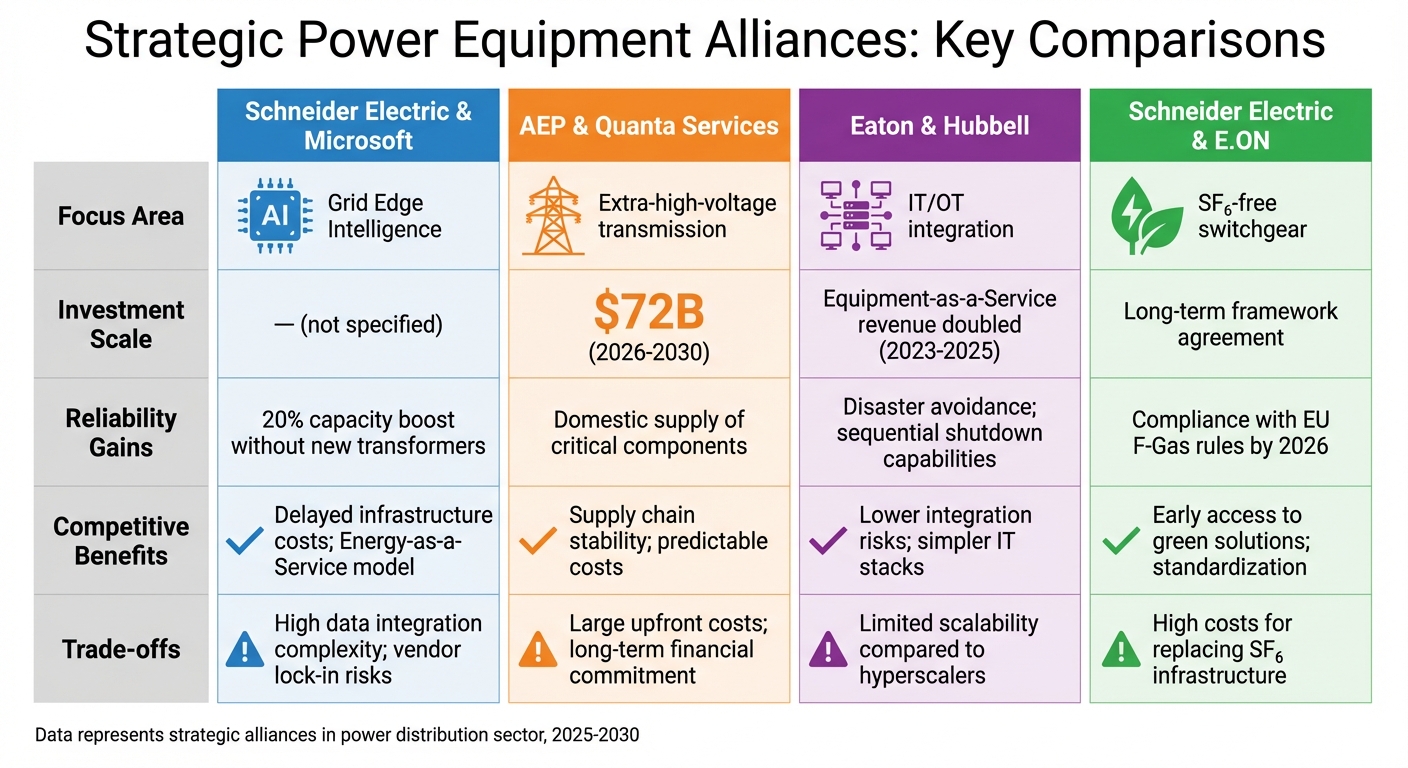
Strategic Power Equipment Alliances: Investment Scale and Reliability Benefits Comparison
This section dives into the benefits and challenges associated with various strategic alliances in the power distribution sector, building on earlier examples.
For instance, digitalization partnerships, like the collaboration between Schneider Electric and Microsoft, have shown impressive results - boosting grid capacity by 20% without requiring new transformers. This approach delays expensive physical upgrades, saving significant costs. On the flip side, integrating these digital ecosystems can be tricky, especially when dealing with multiple vendors. Plus, there's always the risk of becoming overly reliant on a single vendor.
Infrastructure-heavy alliances - such as AEP's ambitious $72 billion plan with Quanta Services - focus on securing domestic supplies of critical components like transformers and breakers. This strategy strengthens supply chain reliability and makes costs more predictable. However, the steep upfront investment can be a hurdle, particularly for smaller utilities that may struggle to allocate such resources.
When it comes to IT integration partnerships, companies like Eaton and Hubbell have adopted solutions that lower operational risks through advanced management tools and disaster avoidance software. These partnerships make system integration easier and speed up implementation, which is especially appealing in enterprise environments. Yet, they don’t scale as effectively as hyperscaler solutions - Microsoft alone plans to add 1.2 gigawatts of backup capacity in 2024, highlighting the difference in scale.
Sustainability alliances are also gaining traction. Schneider Electric’s agreement with E.ON to develop SF₆-free switchgear not only aligns with EU regulations effective January 1, 2026, but also provides early access to environmentally friendly technology. That said, transitioning away from SF₆ infrastructure comes with substantial costs, considering SF₆’s staggering global warming potential of 24,300.
Here’s a quick comparison of these alliances, highlighting their focus, investments, benefits, and trade-offs:
| Alliance | Focus Area | Investment Scale | Reliability Gains | Competitive Benefits | Trade-offs |
|---|---|---|---|---|---|
| Schneider Electric & Microsoft | Grid Edge Intelligence | - | 20% capacity boost without new transformers | Delayed infrastructure costs; Energy-as-a-Service model | High data integration complexity; vendor lock-in risks |
| AEP & Quanta Services | Extra-high-voltage transmission | $72B (2026–2030) | Domestic supply of critical components | Supply chain stability; predictable costs | Large upfront costs; long-term financial commitment |
| Eaton & Hubbell | IT/OT integration | Equipment-as-a-Service revenue doubled (2023–2025) | Disaster avoidance; sequential shutdown capabilities | Lower integration risks; simpler IT stacks | Limited scalability compared to hyperscalers |
| Schneider Electric & E.ON | SF₆-free switchgear | Long-term framework agreement | Compliance with EU F-Gas rules by 2026 | Early access to green solutions; standardization | High costs for replacing SF₆ infrastructure |
These alliances reflect the complex decisions companies face when balancing investment, reliability, and long-term competitiveness in the power distribution industry. Each approach comes with its own set of trade-offs, influencing how businesses structure their strategies.
Conclusion
Strategic alliances are playing a major role in reshaping grid modernization. Partnerships with hyperscalers like Microsoft and Google Cloud are speeding up the integration of AI and digital technologies into grid management. For instance, the collaboration between Itron, Schneider Electric, and Microsoft has introduced the Grid Edge Intelligence solution, which can increase grid capacity by 20% without requiring additional transformers. Similarly, NextEra Energy and Google Cloud are working on large-scale data center campuses and utilizing advanced AI tools like TimesFM 2.5 to improve grid forecasting. These hyperscalers are not just consuming energy - they are actively contributing to grid management and capacity planning. As John Ketchum, CEO of NextEra Energy, put it:
"Our partnership with Google exemplifies this very singular moment when energy and technology are becoming inextricably intertwined".
This digital transformation is also enabling a variety of renewable energy strategies. For example, GE Vernova and Xcel Energy are collaborating on multi-gigawatt wind projects and upgrading grid technologies. Meanwhile, Eaton and Siemens Energy are focused on modular systems designed to reduce CO₂ emissions by about 50%, using hydrogen-ready turbines. The partnership between NextEra and Google has already resulted in 3.5 GW of clean energy capacity being operational or contracted, including a recent 600 MW addition to Oklahoma’s grid. These efforts, paired with hyperscaler and AI-driven advancements, are creating a more integrated approach to modernizing the grid.
As the grid continues to evolve, non-wires solutions are expected to gain traction, especially as utilities face 2–4 year lead times for critical components like transformers. AI-driven tools for maintenance, real-time grid optimization, and integrated resource management are likely to become standard practices. With data center demand projected to hit 176 GW by 2035 - a fivefold increase from 2024 levels - these partnerships are shifting from being competitive advantages to essential components of grid operations.
The future of power distribution will be shaped by alliances that focus on early production planning, embedded AI hardware, and outcome-based collaboration. For businesses navigating this rapidly changing landscape, platforms like Electrical Trader offer a wide range of power distribution equipment - from breakers to transformers - helping to support grid optimization and modernization driven by these strategic advancements.
FAQs
How do these alliances cut transformer wait times?
Alliances like these help cut down transformer wait times by bolstering supply chain reliability, boosting manufacturing output, and encouraging teamwork on key infrastructure projects. This strategy tackles supply challenges and speeds up delivery, ensuring essential equipment reaches its destination more quickly.
What does 'Grid Edge Intelligence' actually do?
'Grid Edge Intelligence' focuses on advanced data analysis and control at the edge of the power grid - where distributed energy resources (DERs) like solar panels, batteries, and electric vehicles are connected. By leveraging AI and big data, it boosts grid reliability and efficiency. This technology optimizes operations, facilitates the integration of renewable energy, and enhances real-time visibility and control. The result is a more adaptable and efficient energy system.
Is switching to SF₆-free switchgear worth the cost?
Switching to SF₆-free switchgear is often a smart investment because of its major environmental benefits, improved safety, and increasing regulatory backing. Although upfront costs may be higher, the long-term benefits - like aligning with sustainability goals and meeting stricter regulations - frequently justify the expense.